Lecture 7-8
 Studied by 0 people
 Call with Kai
 Learn
Learn Practice Test
 Spaced Repetition
 Match
Match Flashcards
 Knowt Play
1/9

There's no tags or description
Looks like no tags are added yet.
Name | Mastery | Learn | Test | Matching | Spaced | Call with Kai |
|---|
No study sessions yet.
10 Terms
Why are faces considered “special” stimuli in the human brain?
Faces are processed holistically, engage specialized neural systems (e.g., FFA), and rely on a distributed network of face-selective regions rather than general object-processing mechanisms.
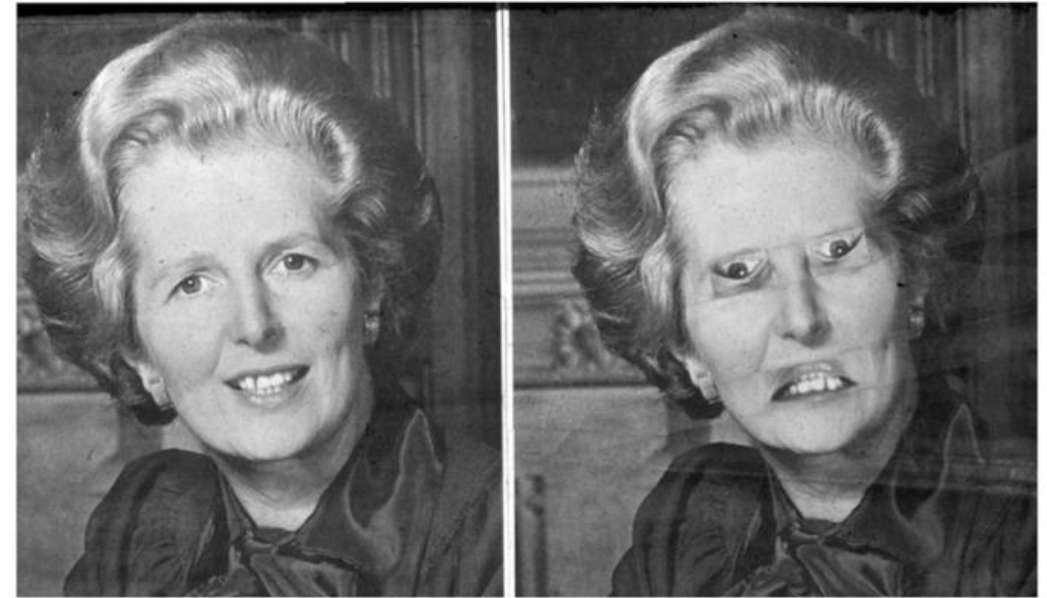
What evidence suggests face processing relies on specialized neural systems?
Prosopagnosia, inversion effects (e.g., Thatcher effect), fMRI localization of the FFA, cortical stimulation, and distributed face-selective neurons.
What role does the fusiform face area (FFA) play in face perception?
It plays a causal role in processing facial structure and identity and is part of a broader distributed face-processing network.
How does Harada et al. (2020) extend findings from the “other-race effect” literature (e.g., Hughes & Eberhardt, 2019)?
While other-race effect studies focus on perceptual tuning for identity, Harada et al. show that culture also modulates emotional salience and amygdala responses to in-group faces.
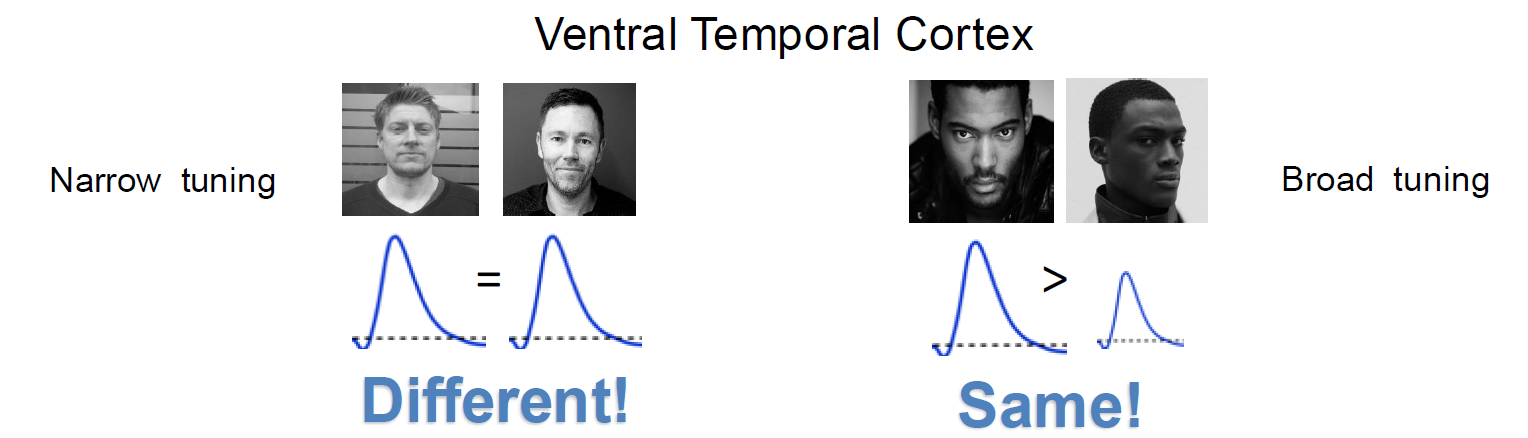
What is the key shared principle between the other-race effect and the cultural in-group effect?
In-group members are processed as individuals with greater sensitivity, while out-group members are processed more categorically.
Why is the face vs. shape comparison a limitation in Harada et al. (2020)?
Because the amygdala responds to faces in general, making it difficult to conclude that observed effects are specific to emotional expression rather than face perceptio
Why should the whole-brain findings be interpreted cautiously?
They rely on reverse inference in encoding-based fMRI analyses, which can overinterpret the psychological meaning of activation patterns.
Why was the collectivism correlation considered weak or unreliable in the lecture?
Small sample sizes and low statistical power make brain–behavior correlations unstable and potentially misleading.
According to the lecture, what does Harada et al. (2020) show about the relationship between culture and biology?
Neural responses to emotional faces are shaped by cultural experience and are not purely hard-wired or genetically determined.
What broader societal implication do the lecture slides emphasize?
Cultural biases influence early neural processing, which may contribute to intergroup misunderstanding, stereotyping, and social bias.
 Note
Note  Flashcards (48)