game theory
 Studied by 1 person
 Call Kai
 Learn
Learn Practice Test
 Spaced Repetition
 Match
Match Flashcards
 Knowt Play
1/16

There's no tags or description
Looks like no tags are added yet.
Name | Mastery | Learn | Test | Matching | Spaced | Call with Kai |
|---|
No analytics yet
Send a link to your students to track their progress
17 Terms
game theory
the science of making good decisions involving strategic interaction
strategic interaction
when your best choice may depend on what others choose, and their best choice may depend on what you choose
underlying idea comes from the interdependence principle → our decisions are intertwined with those of others
relate to both competition and collaboration
examples of strategic interaction
games → boxing, football, basketball, chess
business → your decision about whether to enter a market depends on how other businesses in the market may respond
politics → payoff from voting on a bill depends on whether others vote for it too
friends & family → you will go to a party only if your friends also go
steps for making strategic decisions
consider all possible outcomes
think about the “what ifs” separately
play your best response
put yourself in other player’s shoes
best responses
your best response is the choice that gives you the highest payoff given what the other player is doing
to find best responses:
fix the other player’s choice
compare your possible payoffs
choose the option with the highest payoff
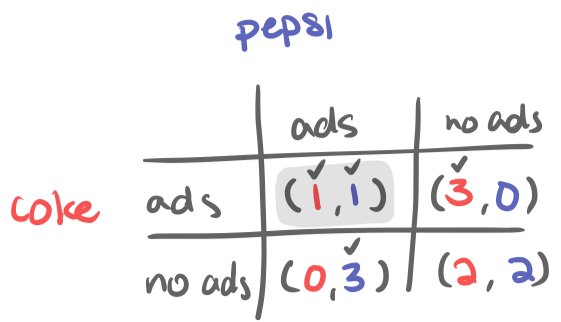
Nash equilibrium
each player makes their best response based on the other player’s choice
no one can do better by changing their choice alone
each makes their best choice given the choice of others
socially optimal decision
they are jointly better off if they cooperate
why would one of them defect?
they believe the other has a strong incentive to defect
if one defects and the other doesn’t, one group gets nothing
thus the best response is usually to defect
temptation to defect undermines cooperation, sometimes agreements are not credible
ie. prisoner’s dilemma
dominant strategy
a choice that gives you a higher payoff than any other option, no matter what the other player does
dominated strategy
always gives a lower payoff than some other option, no matter what the other player does
dominant strategy equilibrium
when each player is choosing a dominant strategy
both coke-pepsi and prisoner’s dilemma have the same game structure
each firm has an incentive to defeat, even though both would be better off cooperating
coordination games
players benefit from matching choices
difficult because there may be multiple equilibria
failure to coordinate can lead to an inferior outcome
ex. choosing a company’s business hours
anti-coordination games
players benefit from making different choices
can also have multiple equilibria
ex. choosing different routes to avoid traffic
solutions to coordination issues
communication → works when incentives are aligned
focal points, culture, and norms → ex. shaking hands vs bowing depends on ^, they can help select a particular equilibrium
laws and regulations → choosing which side of the road to drive on
sequential games
you observe a rival’s action before choosing yours
vs simultaneous games: you choose without seeing the other player’s choice
order matters → may create first-mover or second-mover advantages
first mover advantage
gaining strategically by committing early
airline scheduling example → if WestJet chooses to be aggressive, Air Canada is forced to respond less aggressively
moving late or early depends on commitment vs flexibility
second mover advantage
adapting to the first mover’s choice
examples:
pricing: undercut after observing prices
product positioning: fill underserved niches
cake-cutting: they cut, you pick
game trees
shows how a game plays out overtime
the first move forming the trunk, each subsequent choice branching out, final leaves show all possible outcomes
how to solve game trees:
look forward → anticipate consequences of choices
reason backward → begin at final decision and work to the start
backwards induction reveals optimal choices today
 Note
Note  Flashcards (94)