ECO 202 Module 5: Externalities, Environmental Policy, and Public Goods
 Studied by 0 people
 Call Kai
 Learn
Learn Practice Test
 Spaced Repetition
 Match
Match Flashcards
 Knowt Play
1/28

There's no tags or description
Looks like no tags are added yet.
Name | Mastery | Learn | Test | Matching | Spaced | Call with Kai |
|---|
No study sessions yet.
29 Terms
externality
a benefit or cost that affects someone who is not directly involved in the production or consumption of a good or service
cause a difference between a private cost and a social cost and interfere with economic efficiency
cause a difference between a private benefit from consumption and a social benefit
ex) pollution, negative externality, people not involved in production or consumption face negative consequences
ex) medical research, positive externality, people not directly involved in producing medical research can benefit from it
private cost (of production)
the cost borne by the producer of a good or service
social cost (of production)
the total cost of producing a good or service, including both the private cost and any external cost
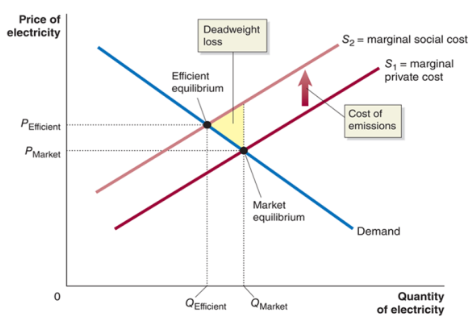
negative externalities raise the social cost
when there is a negative externality in producing or consuming a good or service, too much of the good or service will be produced at market equilibrium
marginal social cost is effectively ignored, and energy is produced at market equilibrium, resulting in deadweight loss
private benefit (of consumption)
the benefit received by the consumer of a good or services
social benefit (of consumption)
the total benefit from consuming a good or service, including both the private benefit and any external benefit
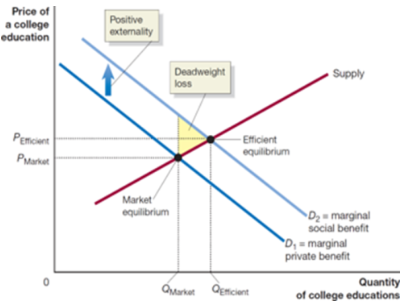
positive externalities increase the social benefit
when there is a positive externality in producing or consuming a good or service, too little will be produced at market equilibrium
market failure
a situation in which the market fails to produce the efficient level of output
overproduction with negative externalities and underproduction with positive externalities
there will be deadweight loss
the larger the externality, the great is likely to be the size of the deadweigh loss — the extent of the market failure
what causes externalities?
incomplete property rights or from the difficulty of enforcing property rights in certain situations
ex) free use water will be polluted because there is no incentive to enforce clean use
property rights
the rights individuals or businesses have to the exclusive use of their property, including the right to buy or sell it
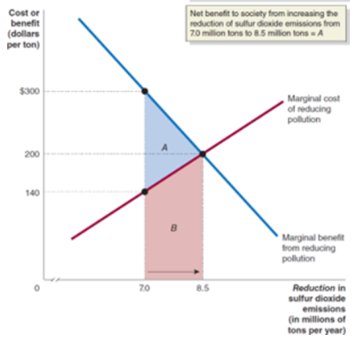
benefits of reducing pollution
increasing reduction from 7 to 8.5 results in total benefits equal to the sum of areas A and B
the total cost is equal to area B
the total benefits are greater than the total costs by area A
transaction costs
costs in time and other resources that parties incur in the process of agreeing to and carrying out an exchange of goods and services
when many people are involved, transaction costs are often higher than net benefits from reducing an externality
Coase Theorem
private parties can solve the externality problem through private bargaining provided:
property rights are assigned and enforcable, and
transaction costs are low, and
parties have full information about the costs and benefits involved
all parties are willing to accept a reasonable agreement
it DOES NOT matter to whom preperty rights were assigned
government politcies to deal with externalities
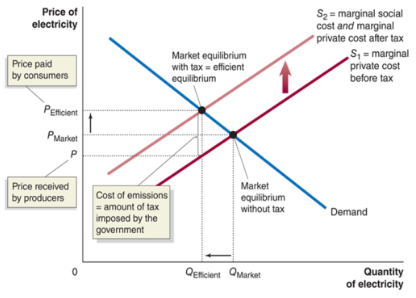
externalities cause inefficiency by moving the level of production away from the efficient level. taxes also cause inefficiency by moving the level of production away from the efficient level.
a tax of just the right size could cause these two effects to cancel out, returning us to an efficient level of production
ex) utilities do not bear the cost of pollution, so they produce too much. if the government imposes a tax equal to the cost of the pollution, the utiliites will internalize the externality, the supply curve will shift right, and the market equilibirum quantity falls to the economically efficient level
taxes and externalities
taxes work to solve negative externalities because negative externalities caused too much to be produced while taxes reduced the amount of output
when there is a positive externality, too little will be produced, so taxes won;t work
subsidies
amounts paid to producers of consumers to encourage the production of consumption of a good
may solve the problem of positive externalities
consumers will internalize the externality, demand curve shifts right, and equilibrium price and output increase
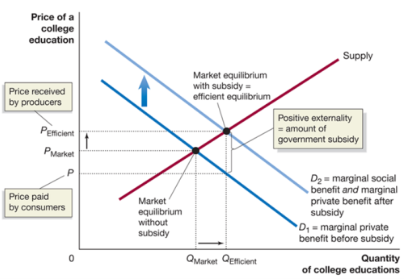
Pigovian taxes and subsidies
taxes and subsidies used to solve the externality problem
increase efficiency while bringing in tax revenue. allows for inefficiency-causing taxes in other markets to be reduced (a double dividend of taxation)
command-and-control approach
policy involving the government imposing quantitative limits on the amount of pollution firms are allowed to emit or requiring firms to install specific pollution control devices
ex) requiring car manufacturers to equip cars with catalytic converters
BUT, what if firms have very different costs of reducing pollution? it may not be efficient for them to reduce pollution by the same amount
cap-and-trade system
the government establishes an allowable amount of emissions
emissions allowances are distributed
firms can trade emissions allowances
firms with high costs of reducing pollution will buy allowances from firms with low costs of reducing polluiton, ensuring that pollution is reduced at the lowest possible cost
the market is used to achieve efficient pollution reduction (market-based approach)
effective but needs political backing to be successful
criticism: gives firms “licenses to pollute,: but pollution allows for cheap production BUT resources are scare and trade offs exist
carbon tax
market-based policy to reduce carbon dioxide emissions
the marginal social cost of CO2 emissions is estimated at $49/metric ton
the tax would replace other regulations and rely on market to respond to an increase in the price of products that result in CO2 emissions
would push people to less-polluting alternatives, but would disadvantage US firms if not adopted globally
rivalry
situatino that occurs when one person’s consumption of a unit of a good means no one else can comsume it
ex) I eat a Big Mac, no one else can eat it
excludability
the situation in which anyone who does not pay for a good cannot consume it
ex) if you don’t pay for a Big Mac, McDonald’s can exclude you from consuming it
four categories of goods
1) private good
2) public good
3) quasi-public good
4) common resource
private good
good that is both rival and excludable
ex) food, clothing, haircuts, etc.
markets tend ot be good at providing efficient levels of private goods because the person making decisions about how much to purchase tends to be the only one benefiting from the good, so only their preferences matter
public good
good that is both nonrival and nonexcludable
ex) national defense
leads to free riding, or benefitting from a good without paying for it
quasi-public good
good that is excludable but not rival
ex) Netflix and toll roads, one person’s use doesn’t interfere with anothers
profit-maximization tends to lead too many people to be excluded from quasi-public goods
common resource
goods that are rival but not excludable
ex) forest land, if one person cuts down a tree, no one else can use that tree
people have little incentive to conserve common resources, leading them to be overconsumed
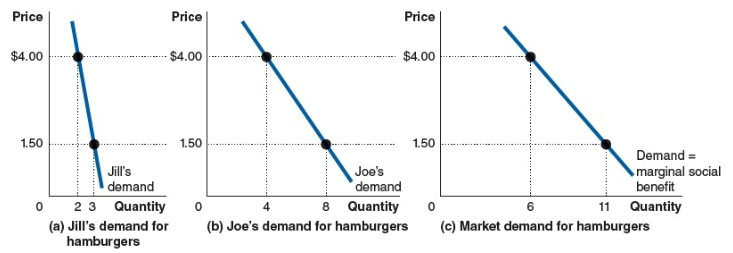
demand curve for private goods
determined by adding horizontally the quantity of the good demanded at each price by each consumer
a) Jill demands 2 hamburgers when the price is $4
b) Joe demands 4 hamburgers when the price is $4
a quantity of 2+4=6 hamburgers at a price of $4
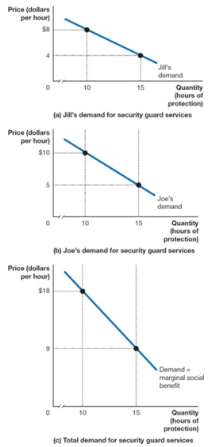
demand curve for a public good
determined by adding up the price at which each consumer is willing to purchase each quantity of the good. add individual demand curves vertically
a) Jill is willing to pay $8 per hour for a security guard to provide 10 hours of protection
b) Joe is willing to pay $10 for that level of protection
c) the prive of $18 per hour and the quantity of 10 hours will be a point on the demand curve for security guard services
optimal quantity of a public good
found where the demand and supply curves intersect
but finding the demand curve can be difficult because consumers may not have incentives to reveal their willingness to pay for public goods
tragedy of the commons
tendency for a common resourse to be overused
people cannot be excluded from the resource, but their consumption is rival, depleting the resource for other people
 Note
Note  Flashcards (20)