Agri 41. PlantPath
 Studied by 0 people
 Call Kai
 Learn
Learn Practice Test
 Spaced Repetition
 Match
Match Flashcards
 Knowt Play
1/36

There's no tags or description
Looks like no tags are added yet.
Name | Mastery | Learn | Test | Matching | Spaced | Call with Kai |
|---|
No analytics yet
Send a link to your students to track their progress
37 Terms
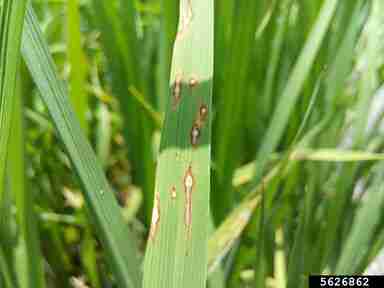
Pyricularia oryzae
Rice blast
Symptoms:
• Elliptical lesions resembling a spindle shape, which tapers towards each end.
• Center of the spot is whitish to gray with brown to reddish brown margin.
Description :conidia are hyaline to pale olive, bicelled (two-septate), with pyriform to obclavate shape.
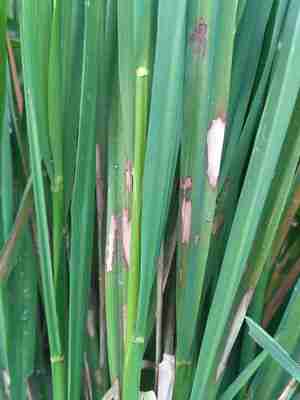
Rhizoctania solani
Rice Shealth blight
Symptoms:
• initial oval to ellipsoidal greenish gray lesions on leaf sheath.
• older lesions coalesce with grayish white centers with tan to dark brown irregular borders.
Descriptions:
• hyphae are solely produced; septate, dark brown, branched at right angles.
• plate culture below shows the sclerotial bodies that are brown and irregularly shaped.
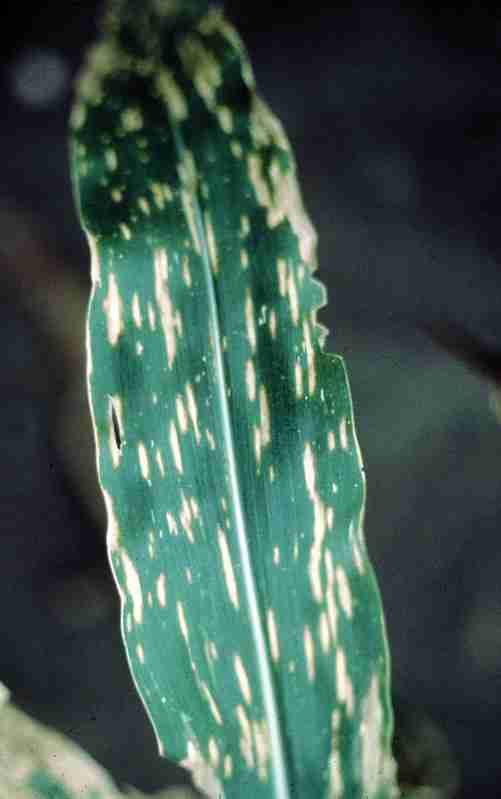
Bipolaris maydis
Corn Leaf Spot
Symptoms:
• begin as small diamond-shaped lesions.
• develops into elongated or rectangular brown spots.
Descriptions: conidia are curved, fusiform, pale to golden brown, distoseptate,
multiseptate, lunate with round ends, smooth, and with distinct basal scar.
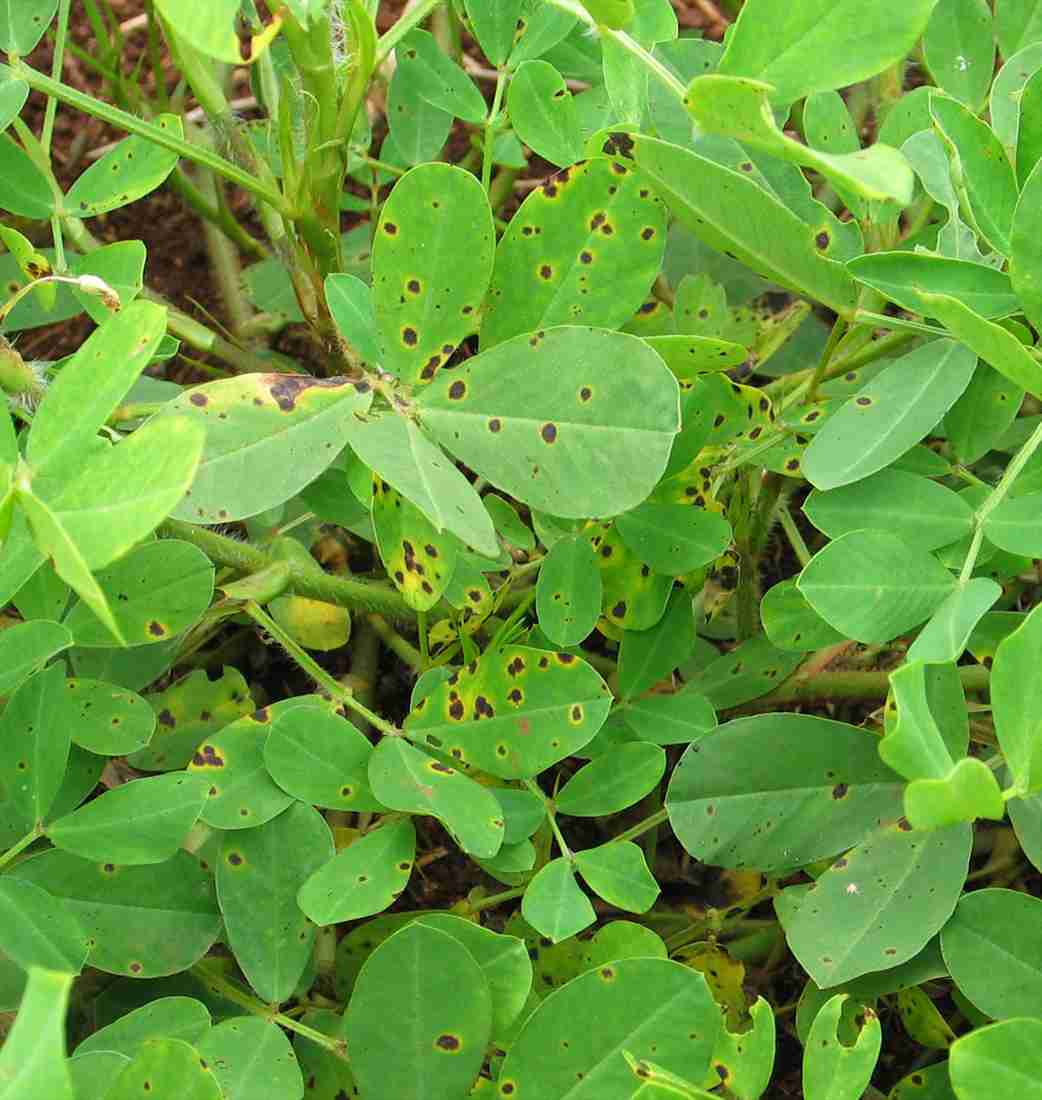
Cercospora arachidicola
Peanut Leaf spot
Symptoms:
• dark brown to black spots on leaves.
• usually with yellow halo.
Descriptions:
• conidiophores are in fascicle (in group) and brown and septated.
• conidia are elongated, smooth, multiseptated, and hyaline.
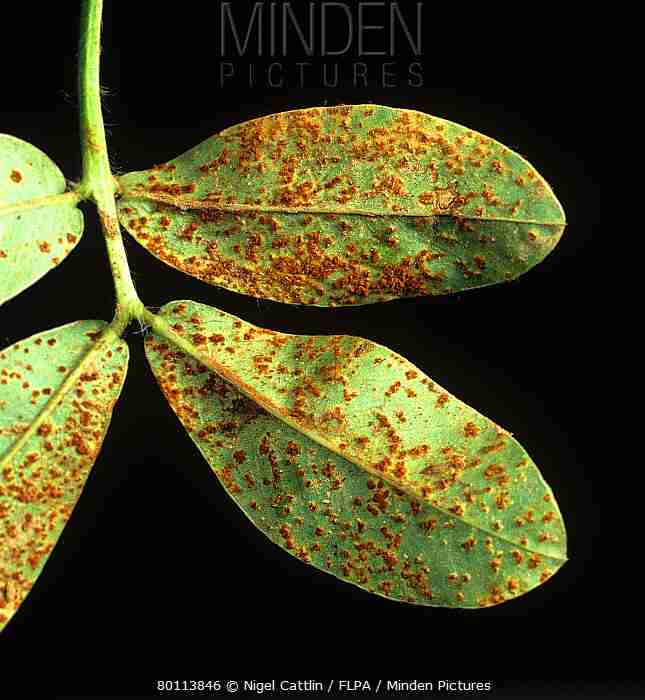
Puccinia arachinidis
Peanut Rust
Symptoms:
• pin-head size, brick-red pustules on underside of the leaf.
Descriptions:
• uredospores are subglobose, ellipsoidal or obovoid, aseptate (no cross walls), smooth, and cinnamon brown.
Fusarium oxysporum f. sp. cubense
Panama Wilt of Banana
Symptoms:
• Yellowing of the older leaves.
• Pseudostem has brick red to brown streaks.
• Wilting of leaves at the petiole base.
Descriptions:
• microconidia are ellipsoidal, oval or kidney-shaped.
• have either a single septum or none.
Puccinia polysora
Corn Rust
Symptoms:
• round, cinnamon brown pustules on underside of the leaf.
Descriptions:
• uredospores are subglobose, rough-walled, yellow to orange, and aseptate (no cross walls).
Colletotrichum gloeosporiodes
Mango anthracnose
Symptoms:
• circular brown spots on leaves, collapsed spots, sometimes resulting to shot-hole.
• black rot on fruit skin or surface.
Descriptions:
• conidia are one-celled, ovoid to oblong, smooth, and slightly curved.
• conidia are hyaline (photo below shows conidia stained with cotton blue).
Lasodiplodia theobromae
Stem End Rot of Mango
Symptoms:
• dark brown to black rot develop from the stem end of the fruit.
Descriptions:
• conidia are bicelled, dark brown to black, obovoid, smooth.
Cercospora abelmoschi
Okra leaf mold
Symptoms:
• black moldy growths appear on the lower leaf surface.
• reddish discoloration is observed on the upper leaf surface.
Descriptions:
• conidiophores are in fascicle (in group), brown, and septated.
• conidia are multiseptate, smooth, and elongate.
Alternaria porri
Purple Blotch of Onion
Symptoms:
• starts with water-soaked lesions with white center on the leaves.
• progress as brown lesions with purple margin.
Descriptions:
• conidia are multiseptate, obclavate, catenate, with short to long beak, and smooth.
Phythium spp.
Damping-Off of Seedlings
Symptoms:
• water-soaked rot of root and stem.
• above soil plant parts topple down or wilt.
Descriptions:
• sporangia are globose, hyaline, smooth, and unicellular.
Peronosclerospora philippinensis
Corn Downy Mildew
Symptoms:
• white to yellow chlorotic streaks or stripes along leaf veins.
• white growth of structures associated with fungi is seen at the underside of the leaf.
• systemic disease.
Descriptions:
• finger-like sporangiophore.
• sporangia are hyaline, ellipsoidal, and unicellular.
Phytophthora colocasiae
Gabi (Taro) Leaf Blight
Symptoms:
• circular, zonate, brown to purplish brown lesions on leaves.
Descriptions:
• sporangia are obovoid, with papillum, unicellular, and smooth.
Albugo sp.
White Rust of Kangkong
Symptoms:
• white or yellow-creamy pustules on stems, flowers, or lower leaf surface.
• affected parts may curl.
Signs:
• catenate (in chain), hyaline, cylindrical, and smooth sporangia.
• sporangia are connected with disjunctor cells.
Ralstonio Solanacearum
BACTERIAL WILT OF SOLANACEOUS CROPS
Symptoms:
• rapid wilting and death of plants.
• lower leaves turn yellow, sometimes on one side of the plant or one side of a branch. This is followed by leaf and stem wilting.
Descriptions:
• gram-negative , rod-shaped, motile with a single polar or peritrichous flagella, 0.5-0.7 x 1.5-2.0 μm in size.
• colonies white or cream colored, irregularly round, fluidal and opaque.
Xanthomonas oryzae pv. oryzae
BACTERIAL BLIGHT OF RICE
Symptoms:
• lesions develop as water-soaked to yellow-orange stripes on leaf blades or leaf tips with wavy margin and progress toward the leaf base.
• old lesions turn yellow to grayish white with black dots
Descriptions:
• gram negative short and straight rods with round ends ((0.4-0.7 x 0.7-1.8μm), motile by a single polar flagella.
• colonies circular, convex and viscid, whitish yellow to straw yellow in color, have smooth surface, an entire margin, glistening, extremely mucoid.
Pectobacterium carotovorum
SOFT ROT OF VEGETABLES
Symptoms:
• water-soaked lesions which rapidly spread and develop into deterioration of the
tuber (or fruit) into a slimy, foul-smelling mass.
Descriptions:
• gram negative, straight rod (0.5-1.0 BACTERIAL BLIGHT OF ANTHURIUMx 1.0-3.0μm), motile by means of peritrichous flagella.
• colonies are whitish and umbonate.
Xanthomonas axonopodis pv. dieffenbachiae
BACTERIAL BLIGHT OF ANTHURIUM
Symptoms:
• yellowed (chlorotic), water-soaked lesions along the leaf margins that grow rapidly to form dead (necrotic) V-shaped lesions.
Descriptions:
• gram negative, aerobic rods with one polar flagellum, and produce yellow xanthomonadin pigment.
Xanthomonas citri
Cintrus canker
Symptoms:
• blister-like lesions on leaves and fruit darken to tan or black and develop a water-soaked margin with a yellow halo surrounding it.
• lesions may appear raised and corky or scabby surrounded by a water- soaked margin.
Descriptions:
• gram-negative, straight, rods (1.5-2.0 x 0.5-0.75 μm), motile by means of a single, polar flagellum.
Candidatus Liberibacter
Huanglongbing / Citrus Greening
Symptoms:
• blotchy mottle leaves
• reduced fruit size • stunted growth
• root decline and dieback • yellow shoot
Descriptions:
● originally grouped with mycoplasma-like organisms (MLOS) but subsequent studies revealed presence of a cell wall of Gram- negative type.
● cannot be isolated in pure culture.
● found in phloem sieve elements of infected plants.
Candidatus Phytoplasma
Rice Orange Leaf
Symptoms:
● Orange-colored leaves which later roll inward and desiccate.
Description:
● pleomorphic shape phytoplasmas in sieve tubes of infected cell.
Candidatus Phytoplasma
Cassava Witches Broom
Symptoms:
• shortening of nodes with dense clumping of
stunted leaves, resembling a witch's broom.
Meloidogyne incognita
Meloidogyne incognita
Symptoms:
• aboveground: stunting and chlorosis.
• belowground: numerous enlarged roots termed as galls or knots.
Descriptions:
• sedentary endoparasitic nematodes (migrate/feed inside the root tissue and establish a fixed feeding site).
• infective juveniles are vermiform while adult females are saccate/globose.
Radopholus similis
Toppling/Blackhead Disease of Banana
Symptoms:
• aboveground: uprooting (toppling) of banana, especially when fruiting or during
strong winds, because of destroyed anchor roots.
• belowground: black, circular lesions on rhizomes or roots.
Descriptions:
• vermiform migratory endoparasitic nematodes (migrate/feed inside the root tissue all throughout their life).
Pratylenchus spp.
CORN ROOT LESION
Symptoms:
• above ground: stunted growth and leaf chlorosis.
• below ground: lesions and necrosis.
Descriptions:
• vermiform migratory endoparasitic nematodes (migrate/feed inside the root tissue all throughout their life).
Tobacco mosaic virus (TMV)
TOBACCO MOSAIC
Symptoms: Mosaic
• intermingled pattern of light green and dark green areas on leaves with distinct boundaries between the yellow light and green
Description:
• rod shape virus particles
Rice tungro bacilliform virus (RTBV) and Rice tungro spherical virus (RTSV)
Rice Tungro
Symptoms:
• stunting and reduced tillering
• yellow-orange leaf discoloration
Descriptions:
• bacilliform shape and spherical shape virus particles
Banana bunchy top virus (BBTV) or Abaca bunchy top virus (ABTV)
ABACA/BANANA BUNCHY TOP
Symptoms: bunchy top
● stiff, narrow, short upright or erect leaves that crowd together at the apex of stems or pseudostems
● dark green streaks on leaf veins
● chlorotic edges on the leaves
Description:
• Spherical shape virus particles
Papaya ringspot virus (PRSV)
Papaya ring spot
Symptoms:
● mosaic on the leaves: intermingled pattern of light green and dark green areas on leaves with distinct boundaries between the yellow light and green.
● ringspot on the fruit: concentric rings or irregular almost circular chlorotic or dark green lines on fruits.
Descriptions:
• Flexuous rod shape virus particles.
Tomato leaf curl Philippines virus (ToLPV)
TOMATO LEAF CURL
Symptoms:
• Upward or downward curling of leaves.
• Stunted growth.
Descriptions:
• Geminivirus with twin-shaped particle (geminate).
Rice grassy stunt virus (RGSV)
Rice Grassy Stunt
Symptoms: Grassy appearance
• narrow, stiff and pale yellow leaves.
• profuse tillering.
Description:
• filamentous shaped virus particles
Citrus tristeza virus (CTV)
Citrus Tristeza
Symptoms:
• die-back.
• stem pitting.
• yellowing of leaves.
Description: flexuous-rod shape virus particles.
Potato spindle tuber viroid (PSTVd)
Potato Spindle TUber
Symptoms:
• severely reduced growth of infected plants.
• tubers are small, elongated, and cracked.
• ‘eyes’ are more pronounced than normal.
Descriptions:
• highly-structured, rod-like native
conformation that is 37±6 nm in length.
Coconut cadang-cadang viroid (CCCvd)
CADANG-CADANG DISEASE OF COCONUT
Symptoms:
• non-necrotic yellow spots on leaves.
• ‘brooming’ symptom caused by limiteddevelopment of the lamina in palms.
• rounding of nuts and reduction in the husk.
Descriptions:
• similar with PSTVd
Loranthus philippinensis
PHANEROGAM
● hosts are cultivated trees particularly mango.
● Loranthus species may also parasitize neem,
avocado, sapota trees, among others.
Characteristics:
• Hemiparasite or partial stem parasite.
• With leaves but lacks true roots.
Cuscuta sp.
PHANEROGAM:
● has a wide-host range which may include tomato, tobacco, legumes, trees, and shrubs.
Characteristics:
• True parasite.
• Yellow to orange leafless vinestrands around the host.
• Stem winds itself around host.
 Note
Note  Flashcards (21)