Subsystem Features Of AE (Australian English) - What features differentiate it from other Englishes
 Studied by 0 people
 Call with Kai
 Learn
Learn Practice Test
 Spaced Repetition
 Match
Match Flashcards
 Knowt Play
1/10

There's no tags or description
Looks like no tags are added yet.
Name | Mastery | Learn | Test | Matching | Spaced | Call with Kai |
|---|
No study sessions yet.
11 Terms
Lexical Features
Borrowings - migrant (ethnolects) and Aboriginal
Swear words and dysphemisms (You’re a rat, you are a nasty bloke)
Slang and creative word formation (for covert prestige - to enhance in-group membership)
Key characteristic
Australian English has a more descriptivist attitude (doesn’t always adhere to strict linguistic norms - is flexible with language)
The variety is ever-changing, mirroring its “laid back” and “relaxed” characteristics, typically associated with Australians
Adam Wording
Australians’ descriptivist approach to language use (take no heed in adhering to rigid linguistic norms, but instead being flexible with language) strongly mirrors the ‘laid-back’ and ‘relaxed’ characteristics typically associated with the Australian identity.
Morphological Changes
Hypocoristic suffixation
Nicknames
Shortenings (use some hand ‘sany’ in the ‘arvo’ - note the ‘o’ being a diminutive)
Blends (Scomo)
Contractions (can’t)
Initialism - DNA
Acronym - ANZAC, ASIO
Hyphenation (abso-bloody-lutely, compounding)
Examples Of Hypocristic Suffixation
Examples of suffixes:
-ie - conveys smallness (mozzie)
-o - conveys toughness (smoko)
-s/z - conveys familiarity
‘Albo’ for Albanese
There are many more - if it looks like a hypocristic suffixation usage, then it probably is
Nicknames - Strongly AE related (use of hypocristic suffixation)
Australian English is famous for using diminutives with endings like -o, -ie/-y:
John → Johnno
Sharon → Shazza
Barbecue → Barbie
Breakfast → brekky
This pattern is very strongly associated with AE and contributes to its identity.
A nickname shows affection, and also suggests that the friends obviously know each other and are comfortable with their real names not being used. Being called with a nickname makes someone feel special, liked by a certain individual, hence attending to their positive face needs.
Why are such morphological changes done
This all reflects Australian identity, reflects being laid-back and playful with language, [linguistic innovation] rebellious towards rigid linguistic standards and norms - a very Aussie thing to do.
Syntactic Features (Pronouns) - Unclear
Pronouns - “youse” (to convey 2nd person plural)
Discourse Features (Unique to AE)
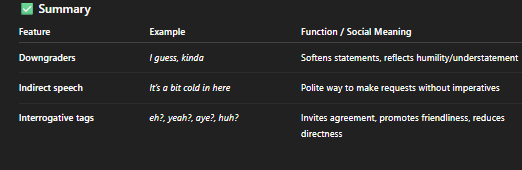
Downgraders e.g ‘I guess’, ‘kinda’ - mirrors value of understatement and humbleness
Indirect Speech (the lack of imperatives) - ‘its a bit cold in there’ (imply to close door)
Interrogative tags - aye?, eh?, huh?, yeah?
Why are the discourse features used
Pertains to the values of Australian society
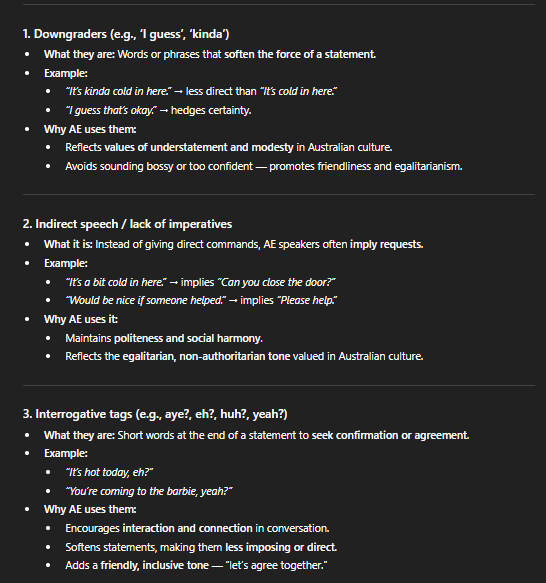
Table outline
 Note
Note  Flashcards (86)