Theme 3E - Market Failure

0.0(0)
studied byStudied by 0 people
0.0(0)
full-widthCall Kai
learnLearn
examPractice Test
spaced repetitionSpaced Repetition
heart puzzleMatch
flashcardsFlashcards
GameKnowt Play
Card Sorting

1/18

flashcard set

Earn XP

Description and Tags

Evaluation

Study Analytics
Name
Mastery
Learn
Test
Matching
Spaced
Call with Kai

No study sessions yet.

19 Terms

1
New cards

Explain how to evaluate policies through effectiveness and appropriateness

Effectiveness of measure 

Appropriateness of measure 

  1. Does the measure correct the market failure?

  • What are the constraints / limitations that limit the effectiveness?

  • How significant are they in the given context?

  • Do the assumptions for the measure to be effective hold in the given context?

  • How will cognitive biases like sunk cost fallacy, loss aversion and salience bias affect the decisions of economic agents 


  1. Does the measure address the root cause or only the symptom of the problem?


  1. How much time is required for the policy to take effect? 

  • How time sensitive is the problem?

  • Can the policy have an impact in the short term when implemented as a quick solution? 

  • Will it be effective in the long term?

(broader criteria) 


Measure must be effective then it can be appropriate 


  1. Includes 1-3 


  1. Extent to which there are unintended consequences: trade-off with / aid other economic goals

  • Does the measure resolve allocative inefficiency but result in unintended consequences that worsen /aid other economic goals?

  • How significant are these in the given context?


  1. Long term sustainability

  • Does the measure require high and/or rising government expenditure over time such that it is difficult to sustain over the long-term?


  1. Cost-efficiency of the policy

  • From society’s point of view, is the measure the least-cost method to solve the problem?


  1. Non-economic considerations

  • Social - Public acceptability towards measures: which measures are perceived to be more equitable to the public?

  • Political - Will the policy be politically unpopular?

2
New cards

State the possible evaluations of taxes


1. Data constraints

  1. PED

  2. Responsiveness of firms

  3. Targeting root cause

  4. Worsens inequity

  5. Adverse effects on consumers and firms

  6. Cost of implementation - production vs pollution tax

  7. Provide government with a source of revenue

3
New cards

Describe data constraints and PED of tax

Data constraints 

The government does not have perfect information and may not be able to accurately estimate the MEC of…If the government over-estimates the MEC, there will be an over-tax. For example, if the government provides a per unit tax which causes the SS=MPC to fall by a larger extent to SS’’ (MPC’’), there would now be an underconsumption of Q*Q’’ units, leading to a welfare loss of Area B. Should the welfare loss from the over-subsidy (Area B) exceed the original welfare loss (Area A), there would be an overall fall in society’s welfare and hence, the measure would not be effective in ensuring efficient allocation of skills upgrading courses.
PED 

  • Production tax: If the demand for the good is price inelastic, the rise in price will cause quantity demanded to fall less than proportionately -> higher tax is required to lower the quantity demanded by enough to reach the socially optimal level 

  • Higher prices may encourage illegal production or smuggling of the good -> preventing the socially optimal level of output to be achieved

4
New cards

Describe responsiveness of firms and target root cause of tax

Responsiveness of firms 

  • Extent of effectiveness depends on response of firms to tax 

  • Hard to estimate given imperfect information and a dynamic environment -> factors that affect producers’ output and pollution reduction decisions change -> affect the impact the pollution tax has on producers’ decisions

Targeting root cause 

  • Pollution tax and tradable permits may be more effective than a production tax in tackling pollution as it targets the root cause of the problem

  • Production tax: reduces the amount of negative externalities indirectly by reducing the quantity of goods produced and consumed -> producers do not have any incentive to develop methods to lower externalities

  • Pollution tax: based on the amount of pollution / emissions generated, firms have the incentive find cleaner production methods or engage in R&D that allows them to reduce the amount of tax it needs to pay

5
New cards

Describe how tax worsens inequity and its adverse effects on consumers and firms

Worsens inequity 

  1. Necessity goods (Eg. Electricity) 

  • Less affordable for the lower-income consumers causing them to be rationed out of the energy market

  • Since electricity is a necessity, it leads to inequity, where there is an unfair distribution of electricity since only the rich who have higher ability to pay for electricity will be able to afford it


Impact: 

  • Low-income: have to sacrifice spending in other areas such as food or education because they are likely to already be spending all their available income (no substitutes) 

  • High-income: have spare disposable income to pay for the increased expenditure on electricity

Adverse effects on consumers and firms

  • Taxes are regressive -> costs passed along the chain to consumers 

  • Essentials take up more of low-income limited disposable income

  • Taxes risk driving companies away to other countries -> costing the economy jobs

6
New cards

Describe cost of implementation of production vs pollution tax and how tax provide government with a source of revenue

Cost of implementation - production tax vs pollution tax

  1. Production tax

  • Easy to implement as it only requires the firms to report their output before the government subsequently administers the tax 


  1. Pollution tax 

  • Cost more to implement and enforce compared to production taxes because the government has to measure the pollution levels that arise from an additional unit of production and may also administer different pollution tax rates based on different types of pollutants

Provide governments with a source of revenue

  • Taxation on goods with price inelastic demand like tobacco and alcohol generates significant tax revenue for the government

  • The tax revenue collected can be used to finance alternative measures related to the externality problem, implementation costs or other social needs

7
New cards

Describe sunk cost fallacy

  • Costs that have already been incurred by economic agents and cannot be recovered

  • Not considered in economic decision-making as they are irrelevant for both present and future economic decisions


  • However, human’s tendency to continue a behaviour or on an endeavour due to previously invested resources (time, money or effort) whether or not the marginal costs outweigh the marginal benefits 


Eg. High COE prices and Additional Registration Fee (ARF) 

  • Raise the fixed costs of owning a car in Singapore

  • Once the car has been purchased, these are sunk costs, and should not impact on a driver’s decision on whether to drive to a location

  • Drivers tend to utilise their cars more often to make the COE price paid ‘worthwhile’ as they take into account the high COE prices paid when making their decisions on car usage

  • Even though controlling car ownership through COE is meant to reduce congestion on the roads, sunk cost fallacy committed by the car owners has led to increased car usage

8
New cards

Describe loss aversion and salience bias

Loss aversion (Prospect theory) 

  • Tendency for people to prefer avoiding a loss over making an equivalent or greater gain

Salience bias 

  • Tendency for people to focus on information that is more prominent and ignore other less prominent but equally relevant pieces of information

  • Causes economic agents to overestimate the likelihood of events that come easily to mind -> skews the weighting of benefits and costs when making decisions


Eg. ERP 

  • To make the cost of using a congested road more salient, monitors on gantries display real-time ERP charges

  • Every time a driver passes under a gantry, they are reminded of the cost of road usage by an audible beep

9
New cards

Describe evaluations of subsidy

  1. Data constraints

  2. Improve equity

  3. Require government finance

10
New cards

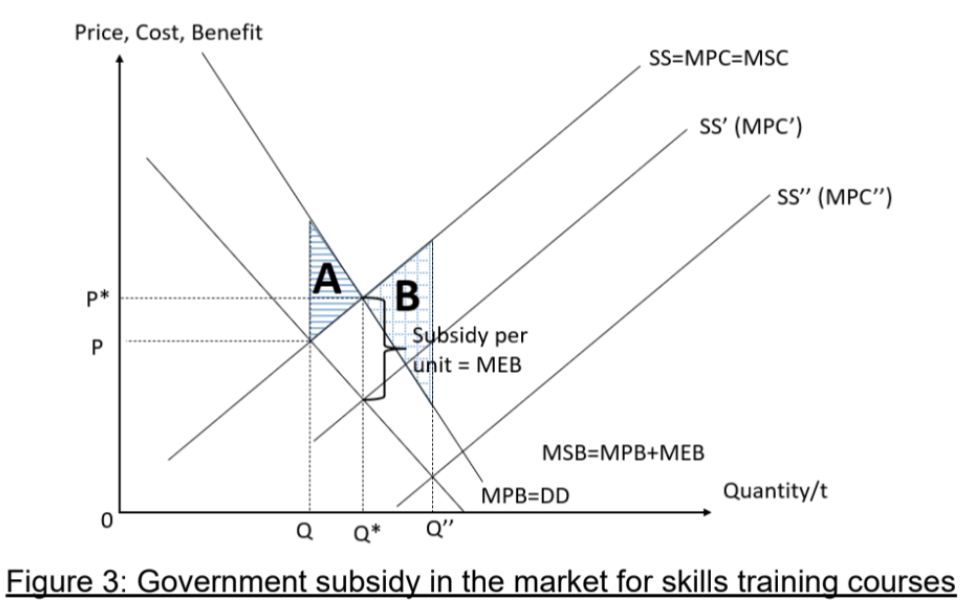
Describe data constraints of subsidy with graph pls

The government does not have perfect information and may not be able to accurately estimate the MEB of attending skills training courses. If the government over-estimates the MEB, there will be an over-subsidy. For example, if the government provides a per unit subsidy which causes the SS=MPC to fall by a larger extent to SS’’ (MPC’’), there would now be an overconsumption of Q*Q’’ units, leading to a welfare loss of Area B. Should the welfare loss from the over-subsidy (Area B) exceed the original welfare loss (Area A), there would be an overall fall in society’s welfare and hence, the measure would not be effective in ensuring efficient allocation of skills upgrading courses.

<p><span>The government does not have perfect information and may not be able to accurately estimate the MEB of attending skills training courses. If the government over-estimates the MEB, there will be an over-subsidy. For example, if the government provides a per unit subsidy which causes the SS=MPC to fall by a <strong>larger extent</strong> to SS’’ (MPC’’), there would now be an <strong>overconsumption </strong>of Q*Q’’ units, leading to a <strong>welfare loss</strong> of Area B. Should the welfare loss from the over-subsidy (Area B) exceed the original welfare loss (Area A), there would be an <strong>overall fall </strong>in society’s welfare and hence, the measure would not be effective in ensuring efficient allocation of skills upgrading courses.</span></p>
11
New cards

Describe how subsidy improve equity and it require government funds to finance

Improve equity

  • Enable more lower- income households to afford the good / service

  • Effect is substantial if the good in question has no close substitutes and is price inelastic in demand

Direct provision, subsidies, grants and vouchers require government funds to finance

  • Direct provision require use to government funds -> opportunity cost incurred -> government may have to raise taxes 

  • If the strain on government expenditure is severe enough leading to a government budget deficit -> measures are not sustainable in the long term

12
New cards

State possible evaluations of direct provision

  1. Data constraints

  2. Result in productive and dynamic inefficiency

  3. minimal data constraints

  4. public good is a necessity

13
New cards

Describe data constraints and productive inefficiency of direct provision

Data constraints 

  • Government faces difficulty in accurately measuring true benefits that consumers enjoy from the public good

  • Government estimate consumers’ preferences and the optimal quantity to be produced -> under or overproducing the good

Result in productive & dynamic inefficiency

  • Governments do not have the incentive to minimise costs -> productive inefficiency -> lack of competition which removes the incentive for producers to innovate to reduce costs or improve quality over time -> dynamic inefficiency


Can be reduced by: 

  1. Providing incentives to civil servants to reward and encourage cost-saving and innovative behaviour 

  1. Joint provision: government can also pay a firm to produce the goods since private producers have more incentive to minimise costs compared to the public sector 

  • Presence of the private sector creates competition for the government enterprise + presence of the public sector can address the problem of underproduction by the private sector

14
New cards

Describe minimal data constraints and public good necessity of direct provision

  1. Minimal data constraints 

  • Even if the government supplies the wrong quantity, society is better off having some quantity of the public good produced by the government as opposed to none at all under the free market-> society’s welfare is likely to increase significantly 

  1. Public good may be a necessity (Eg. National service)

  • It is a non-negotiable good and is crucial for a countries survival no matter how much it costs

15
New cards

State possible evals of public education

  1. Responsiveness of consumers

  2. Target one group of people

  3. Cognitive bias

  4. Target root cause

16
New cards

Describe the evals of public education

Responsiveness of consumers 

  • Consumer behaviours are based on existing mind sets that are hard to change 

  • Consumers may have existing habits or addictions that are hard to break out of 

  • Only effective in long term as it takes time to communicate information and change their behaviour 

Does it target one group of people only? 

Eg. Healthy eating campaign 

  • Appropriate -> Targets young children -> extent of market failure is large as children have a lot of imperfect information -> more allocative efficient outcome 

Cognitive bias 

  • Many campaigns use salience bias that exists in society to provide a greater nudge to getting people to change their diet -> visual information allows consumers to better internalize and make changes to their consumption habits -> more effective 

  • Highlight the potential loss -> consumers more receptive to campaign due to the tendency to avoid losses 

Targets root cause 

  • Outreach and impact tends to be large and addresses the root problem of… and not the symptom 

  • Only viable solution due to non excludability of good 

17
New cards

Describe evals of regulations

Responsiveness 

  • Consumers and producers are forced to comply by law. 

  • Effective as long as there is effective monitoring and enforcement

  • Penalties for breaking the law also need to be sufficiently harsh

Cost of implementation - taxes vs regulation 

  1. Taxes 


  1. Regulations 

  • To be effective, the government must have the resources and capability to ensure compliance by consumers and firms

  • Monitoring costs in large countries will be high as more manpower is needed -> cost of intervention is high 

18
New cards

Describe cost efficiency of policy measures

  1. Pollution tax and tradable permits (more cost effective) 

  • Firms seek to lower pollution in least costly manner to improve its profitability 

  • Encourages the lowering of pollution at a lower overall cost across firms

  1. Regulations 

  • Regulations are government-imposed rules that require all firms to reduce pollution by the same amount, regardless of how costly it is for each firm to do so. 

  • This lack of flexibility means that firms with high pollution reduction costs are forced to spend more than necessary -> leading to a higher overall cost to achieve the same environmental outcome. 

  • In contrast, market-based policies like pollution taxes or tradable permits allow firms to decide how much to reduce based on their individual costs, encouraging the most cost-effective pollution reduction across the economy

19
New cards

Describe eval for responsiveness of consumers public education

  • Eval: Depends on Level of Trust in Government

  • Eg. In UK, level of trust at all-time low due to previous mishaps such as public perception of poor political integrity, poor impact of Brexit and dissatisfaction with public services like NHS (National Health Service)

Explore top flashcards