IGCSE 0610 Biology (2026-2028) - Chapter 1 Classification
 Studied by 0 people
 Call with Kai
 Learn
Learn Practice Test
 Spaced Repetition
 Match
Match Flashcards
 Knowt Play
1/43

Earn XP
Description and Tags
Chapter 1 Classification
Name | Mastery | Learn | Test | Matching | Spaced | Call with Kai |
|---|
No study sessions yet.
44 Terms
7 characteristics of living organisms?
Movement, respiration, sensitivity, growth, reproduction, excretion, and nutrition.
Movement
An action by an organism that causes a change in position or place.
Respiration
Chemical reactions in cells that break down nutrient molecules and release energy for metabolism.
Sensitivity
Ability to detect or sense stimuli in external or internal environment and make appropriate responses.
Growth
Permanent increase in size and dry mass by an increase in cell number or cell size or both.
Excretion
Removal from organisms of the waste products of metabolism, toxic materials and substances in excess of requirements.
Nutrition
Taking in of materials for energy, growth and development.
How are organisms classified?
They are classified into groups by the features they share.
Define species
Group of organisms that can reproduce and produce a fertile offspring.
Define binomial system
An internationally agreed system of naming species in which the scientific name of an organisms is made up of two parts, genus then species.
What are classification systems for?
To reflect evolutionary relationships.
How do scientists identify whether a species is closely related to one another?
By comparing the sequences of bases in the DNA of organisms from two different species. The more similar the base sequences, the more closely related a species is to one another. They have a more recent common ancestor than species with different DNA base sequences.
How can biologists identify that two organisms are closely related?
Two organisms can be identified as closely related if they belong to the same genus or are the same species (not same species name). FYI: Same species = same genus and same species name.
Characteristics of animals
Multicellular.
Cells have a nucleus
No cell walls or chloroplasts.
Feed on organic substances made by other living organisms.
Characteristics of plants
Multicellular.
Cells have nucleus
Cell walls made of cellulose
Have chloroplasts. Feed by photosynthesis. Usually have roots, stems and leaves.
Characteristics of fungi
Usually multicellular, some are unicellular like yeast.
Feed saprophytically or parasitically.
Are usually decomposers.
Cells have nuclei
No chloroplasts
Have cell walls made of chitin.
Reproduce by spores.
Characteristics of Protoctista
Multicellular or unicellular.
May have plant-like cells and animal-like cells.
Some feed by photosynthesis and some feed on organic substances made by other organisms.
Characteristics of Prokaryotes
Usually unicellular.
Cells have no nucleus.
Often have plasmids.
Does not have mitochondria.
Have cell walls that are not made of cellulose
Circular DNA that is free in the cytoplasm.
Describe the structure of a virus
A virus consists of genetic material (DNA or RNA) surrounded by a protein coat called a capsid
Explain why viruses are not considered living things
Viruses are not considered living because they do not show the seven characteristics of living organisms on their own. They can only reproduce inside a host cell and do not carry out metabolism independently.
How do viruses work
They take over a living host cell's machinery and make multiple copies of themselves. They then burst out of the cell and invade other cells, this process is repeated.
Define Vertebrates
Vertebrates are animals that have a backbone (vertebral column)
Describe the 3 main characteristics of fish
Scaly skin
Breathe through gills
Have fins
Describe the 4 main characteristics of amphibians
Smooth, moist, scale-less skin
Live in water when young and on land when adult
Soft eggs laid in water
Larva has gills, adults have lungs
Describe the 2 main characteristics of reptiles
Scaly skin
Lay rubbery shelled eggs
Describe the 6 main characteristics of birds
Have beaks
Forelimbs modified into wings
Vertebrates with feathers
Lay hard-shelled eggs
Endothermic
Heart has 4 chambers
Describe the 8 main characteristics of mammals
Give birth instead of laying eggs
Endothermic
Heart has 4 chambers
Has placenta
Young feed on milk from mammary glands
Vertebrates with hair
Have a diaphragm
Have different types of teeth
Define arthropods
Animals with exoskeleton, several jointed legs but no backbone (invertebrates).
2 characteristics of arthropods
Have exoskeleton
Have several pairs of jointed legs
Give the 4 classes of arthropods
Insects
Crustaceans
Myriapods
Arachnids
Characteristics of insects
Have 3 pairs of jointed legs
Body is divided into head, thorax and abdomen
One or two pairs of wings (one or both may be vestigial)
Breathe through trachea
One pair of antennae
Characteristics of crustaceans
Have more than 4 pairs of jointed legs
Breathe through gills
Have an exoskeleton made of chitin, often hardened with calcium to form a tough shell
2 pairs of antennae
3 body segments (head, thorax, abdomen
Characteristics of arachnids
Have 4 pairs of jointed legs
Body divided into cephalothorax and abdomen
Breathe through book lungs
No antennae
Characteristics of myriapods
Have several jointed legs
Each body segment has a pair of jointed legs
Body consists of many segments
Centipedes and millipedes
One pair of antennae
Elongated body
What is the green colour in plants caused by?
A pigment called chlorophyll
Define photosynthesis
Photosynthesis is the process by which chlorophyll in plants absorbs energy from sunlight and uses it to convert carbon dioxide and water into glucose and oxygen.
Characteristics of ferns
Plants with roots, stems and leaves
Have leaves called fronds
Reproduce by spores
Spores are produced on the underside of the fronds
Do not produce flowers
Characteristics of flowering plants
Plants with roots, stems and leaves
Reproduce sexually by means of flowers and seeds
Seeds produced in ovary, in the flower
2 main groups of flowering plants
Monocotyledonous plants and dicotyledonous plants (monocots and dicots)
Feature of monocots
Have one cotyledon in their seeds
Strap-shaped leaves
Branching root system
Veins in leaves run parallel to one another
Features of dicots
Two cotyledons in their seeds
Tap root system
Leaves are often broader
Have network of branching veins
Formula for magnification
magnification = size of drawing divided by size of actual object OR size of real object = size of drawing x magnification
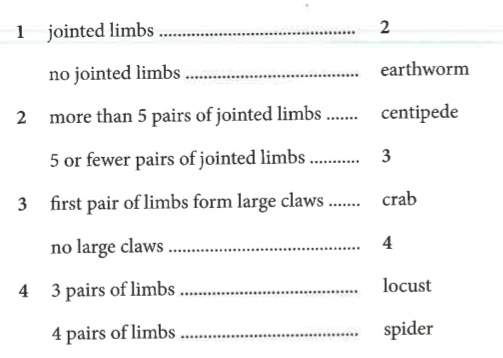
Define dichotomous key
A dichotomous key is a tool used to identify organisms by following a series of paired statements, where each choice leads to the next pair, until you end up with the name of your organism
Give the 5 main vertebrates
Fish, amphibians, reptiles, birds and mammals
 Note
Note  Flashcards (108)