Roman Art Final
 Studied by 0 people
 Call Kai
 Learn
Learn Practice Test
 Spaced Repetition
 Match
Match Flashcards
 Knowt Play
1/81

There's no tags or description
Looks like no tags are added yet.
Name | Mastery | Learn | Test | Matching | Spaced | Call with Kai |
|---|
No analytics yet
Send a link to your students to track their progress
82 Terms
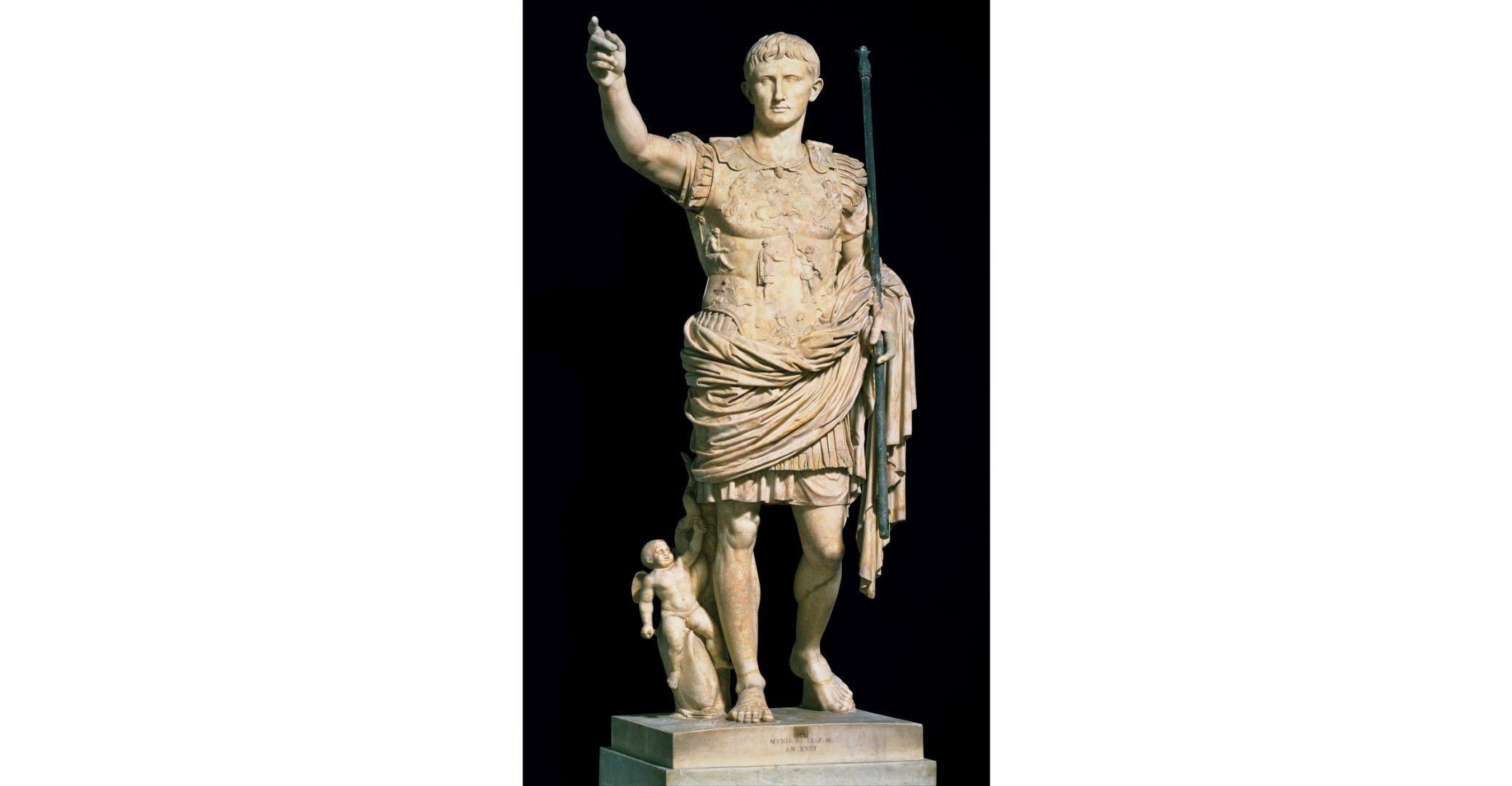
Augustus from Primaporta, Augustan, after 20 BCE, adopted by Julius Caesar to be heir, in their struggle for power, Augustus and Marc Antony divided territory, Marc Antony betrays Augustus’ sister for Cleopatra, Augustus takes over Egypt
Augustus was credited with restoring Rome to the Republican era, he maintained a lot of power while seeming like he didn't
•This portrait of Augustus embodies three major themes in Augustan propaganda after 31 BCE: 1) military victory as the foundation of his power 2) peace achieved through military victory 3) his claim to divine descent, not only as the son of the new god, Julius Caesar, but also as a descendant of Aeneas, son of Venus.
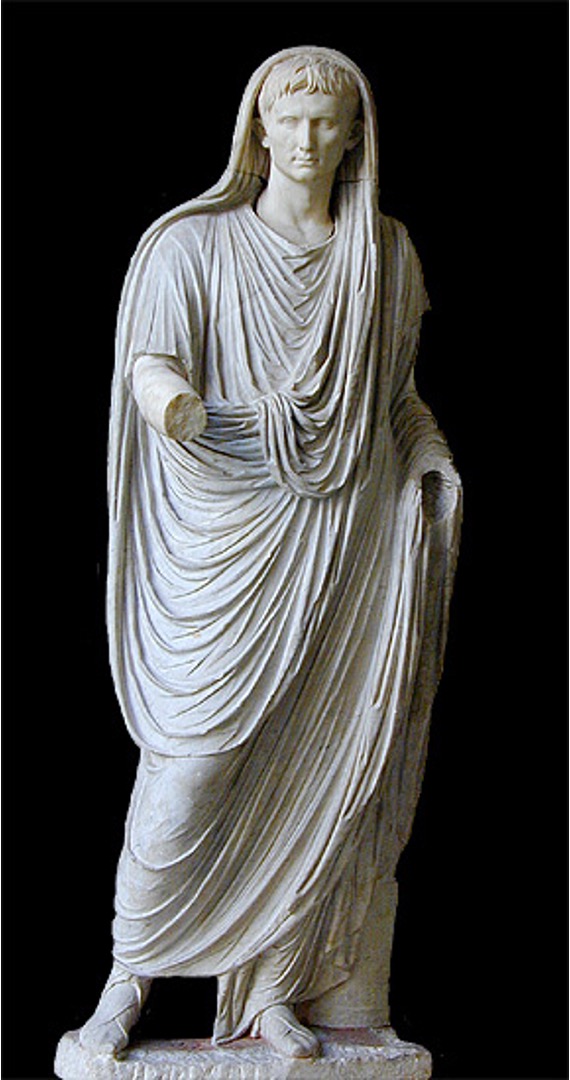
Augustus Sacrificing, Augustan,
early 1st century CE, piety was important to the Augustan period, Augustus built new temples to Apollo and Mars, Augustus was once pontifex maximus, chief priest of rome,
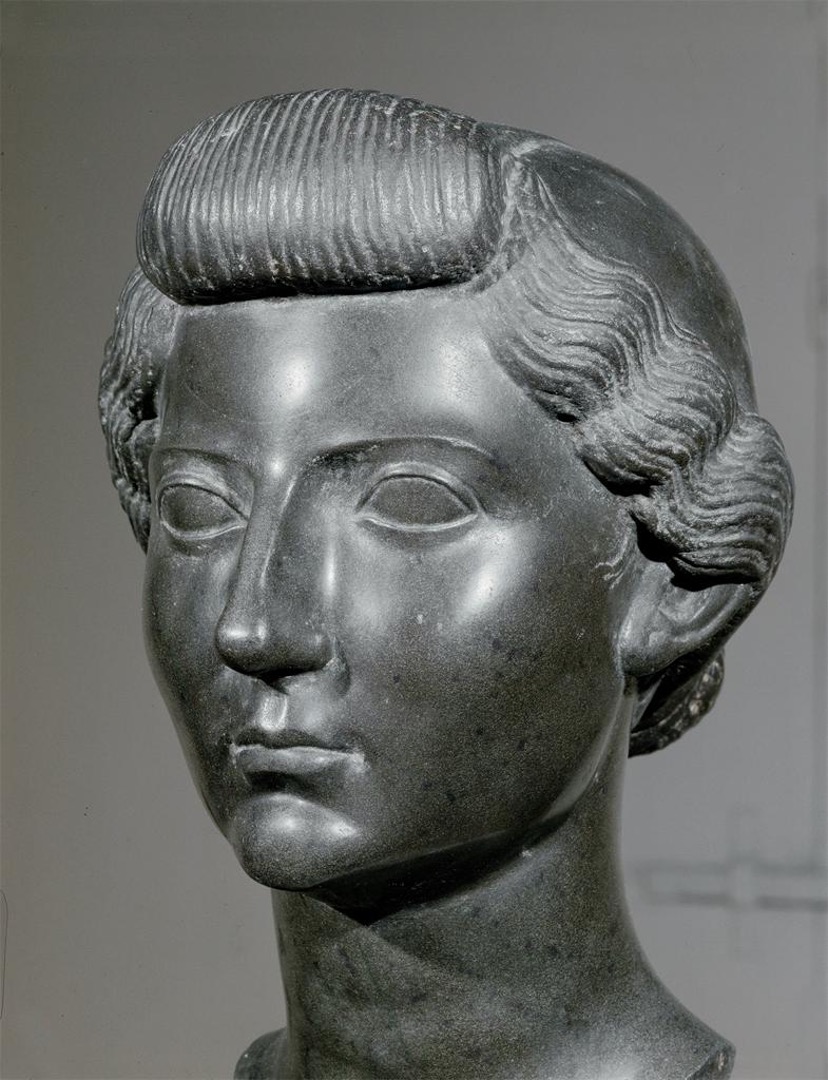
Basanite Portrait of Livia, Augustan,
ca. 30 BCE, Augustus’s wife and confidant of 50 years, shown youthful, nodus, the roll of hair over the forehead, which was quickly replicated by other women of the time, recalls the style of recently conquered Hellenistic Egypt
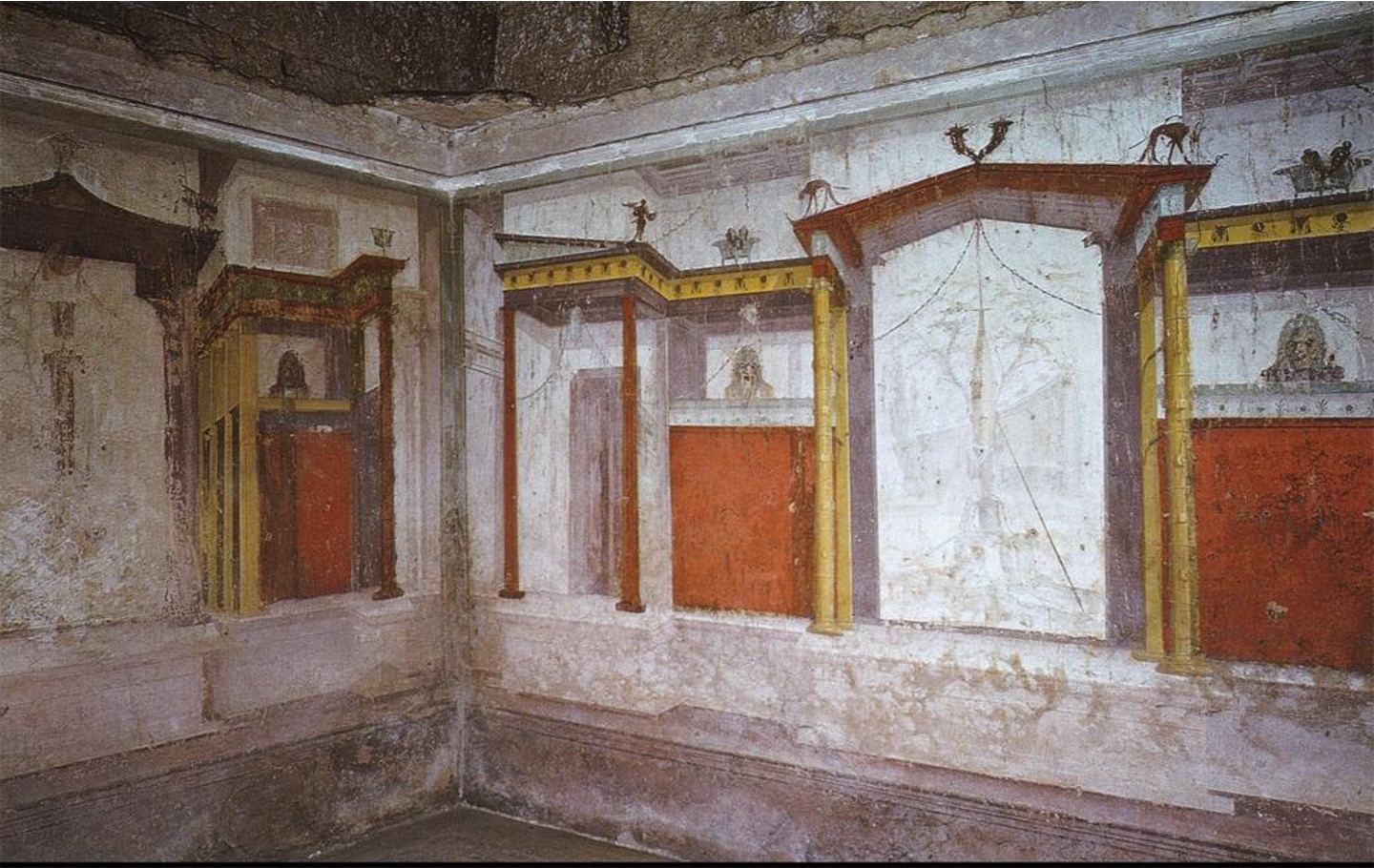
House of Augustus: Room of the Masks (Late Second Style), Augustan, ca. 30 BCE, Augustus, ever careful to never give the appearance to the people of Rome that he considered himself a king or dictator, never built a palace or other large home for himself in Rome. Instead, it appears that he lived in a two adjacent pre-existing Republican homes on the Palatine Hill that were redecorated to contemporary tastes. One of these homes, known as the House of Augustus, connected directly to the podium of the Temple of Apollo, which Augustus built to honor the divinity with whom he felt the closest connection,
late Second style, lacking a lot of landscape, simple blocks of color, theatrical inspiration, betylos in center with inscription to Apollo
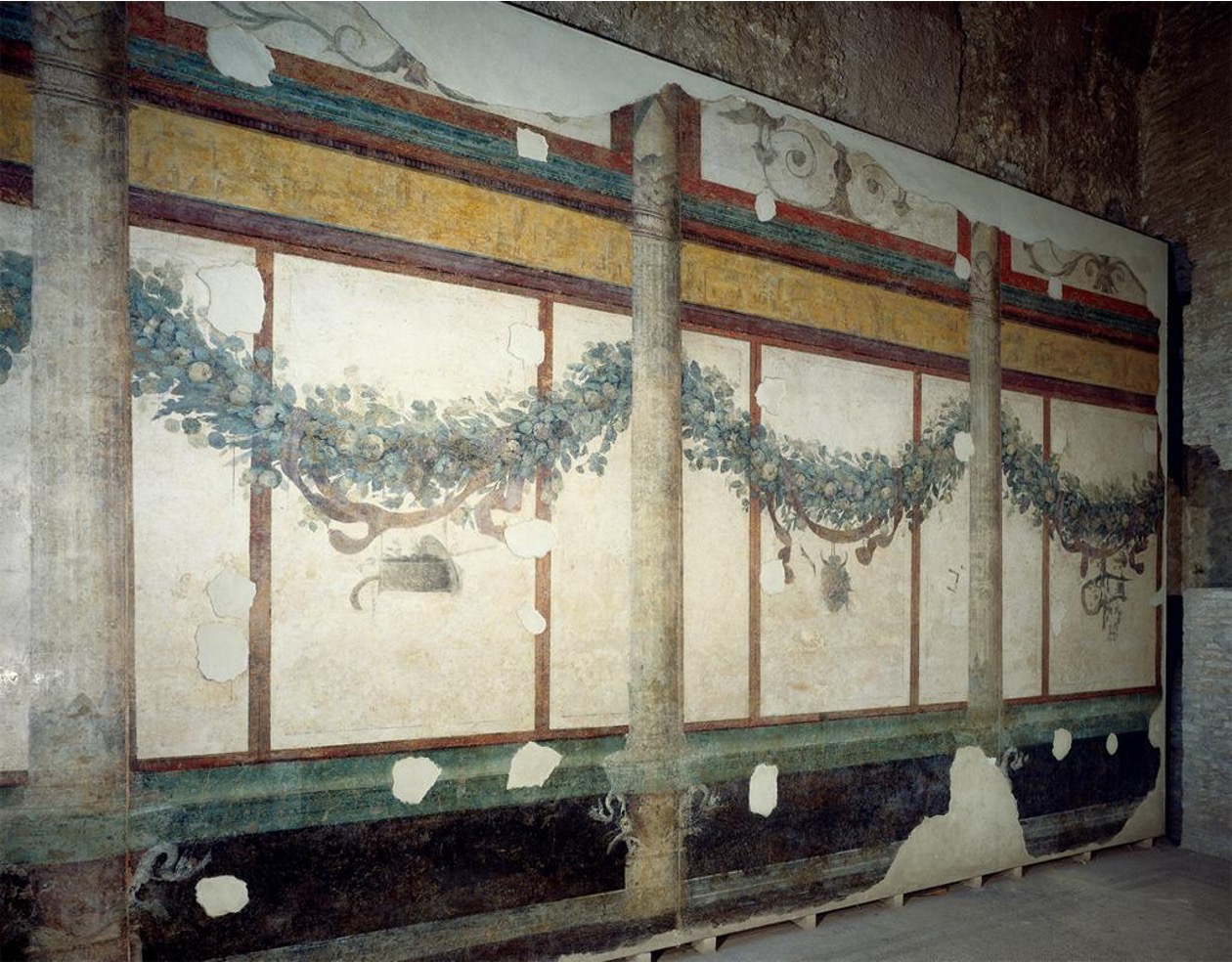
House of Livia: Right-hand Ala (Late Second Style), Augustan, ca. 30-20 BCE, was attributed to Augustus’ wife after the discovery of a lead water pipe stamped with the name “Iulia Aug(usta).”Rich garlands (similar to those seen on the Ara Pacis) of fruit and leave hang between the columns in front of the orthostates and ribbons and implements of agriculture and the cult of Dionysos hang from them. Many different fruits express thanks to the god and at the same time convey the notion of blessings and abundance, key themes in Augustan iconography,•In the yellow frieze is painted, in monochrome, depictions of scenes of Egyptian life along the Nile, executed in a very impressionistic manner of painting with dabs and highlights of white and magenta. Color of background is reminiscent of the color of papyrus. Such “Egyptianizing” elements are frequent in the wall painting of the time, especially in imperial villas, probably making reference to Augustus’ conquest of Egypt, which he used as a means of legitimizing his reign.
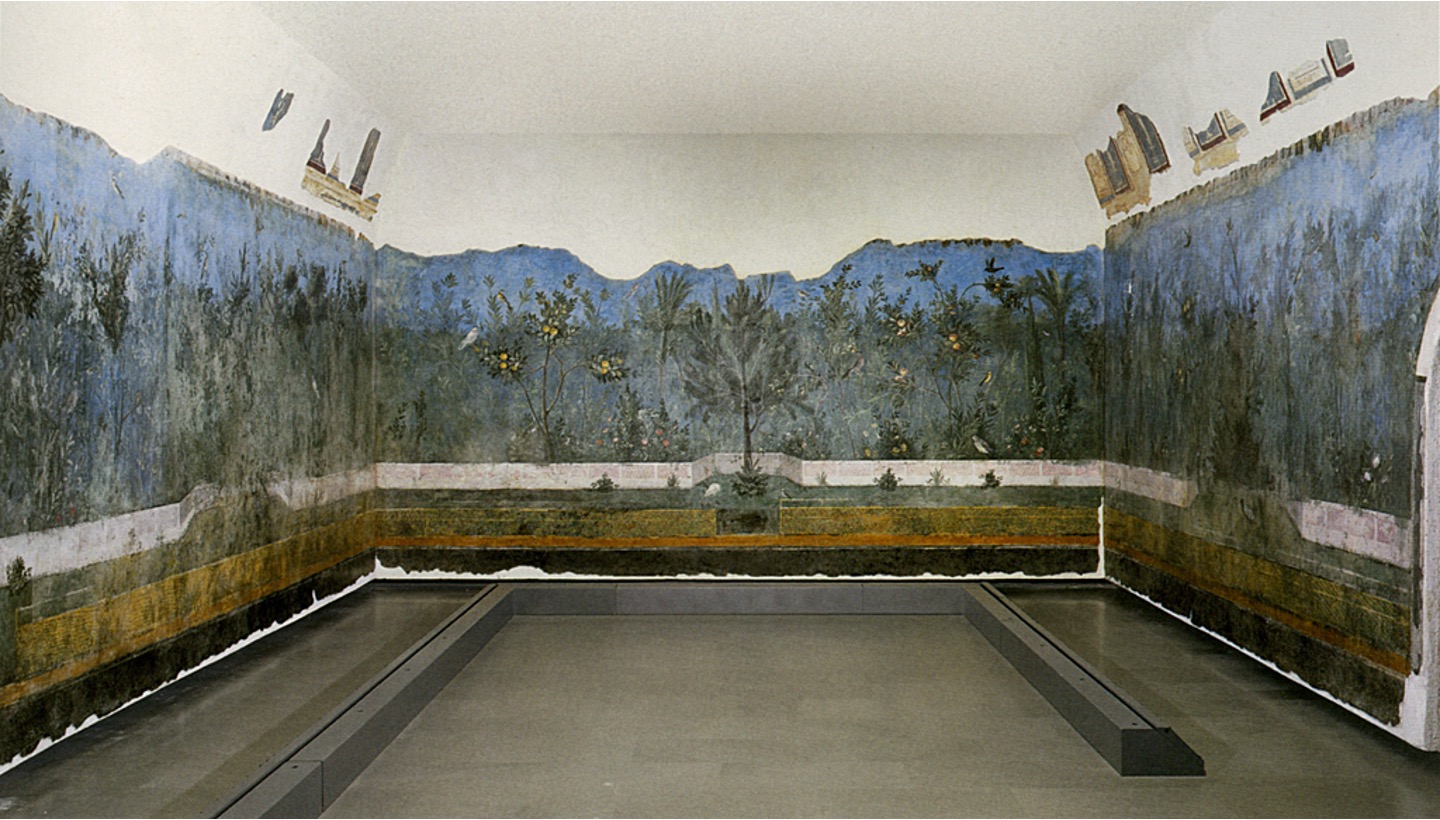
Primaporta: Livia’s Garden Room (Late Second Style), Augustan, ca. 20 BCE, According to Pliny, the home was called Villa ad Gallinas Albas, Garden scenes and landscapes are not unusual in Campanian and Roman wall painting, but they are generally stylized vistas, seen through colonnades with fountains surrounded by formalized plants, stiff settings for Egyptianizing figures with trees and shrubs reduced to architectural elements. The garden pictures in Livia’s room show an entirely different approach- here the room itself becomes a terra or possibly a grotto or pergola from which one can look into a fairy garden, where romantic nature runs wild.
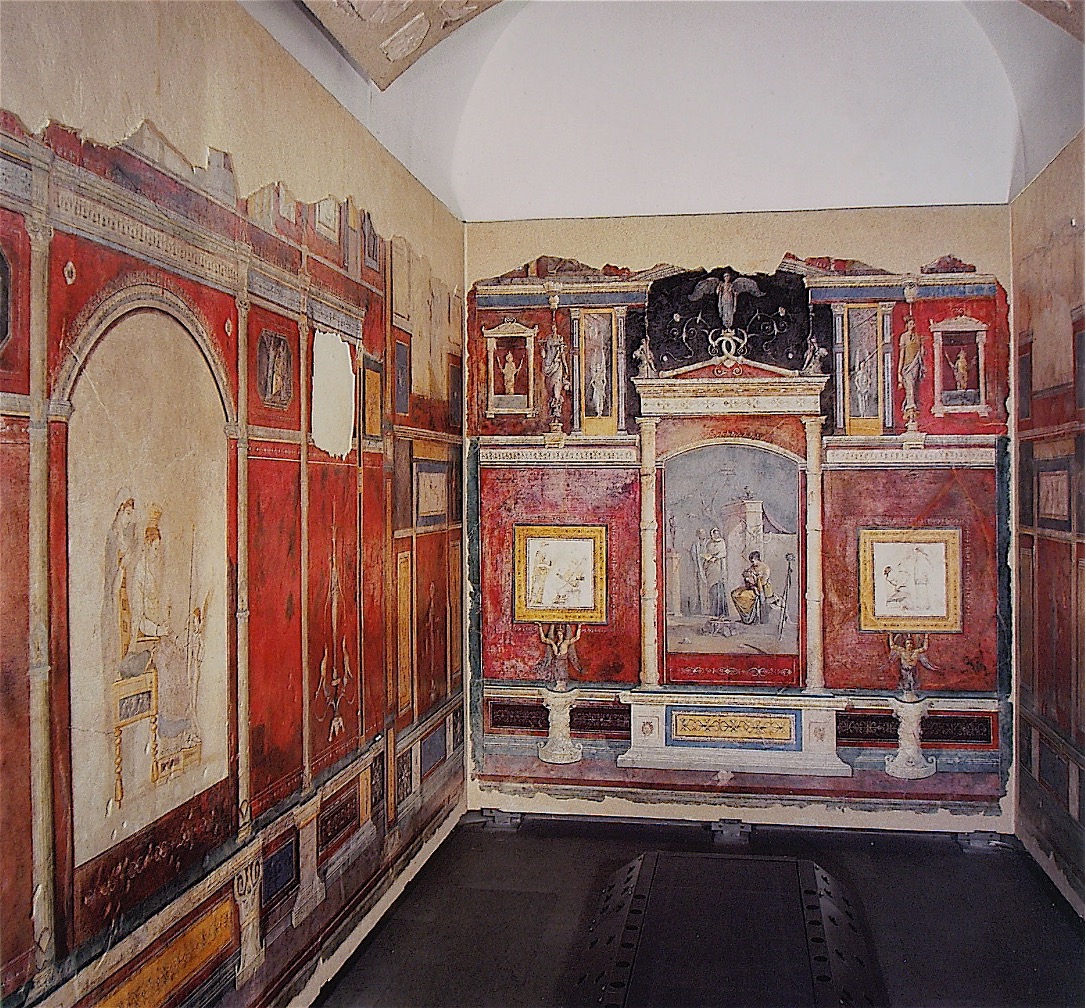
Villa Farnesina: Red Room (Late Second Style), Augustan, ca. 20 BCE, document the transition between Second and Third Style wall-painting. It has been suggestion that this villa was built by Agrippa in 21 BCE to celebrate his marriage to Julia, daughter of the emperor Augustus, Most elaborate decorations are in this room- they are ostensibly architectural, but the perspective has been so underplayed that the projecting pavilions with their pedestals and entablatures seem barely to stand out from the rest of the wall. They serve merely as frames for figure paintings-
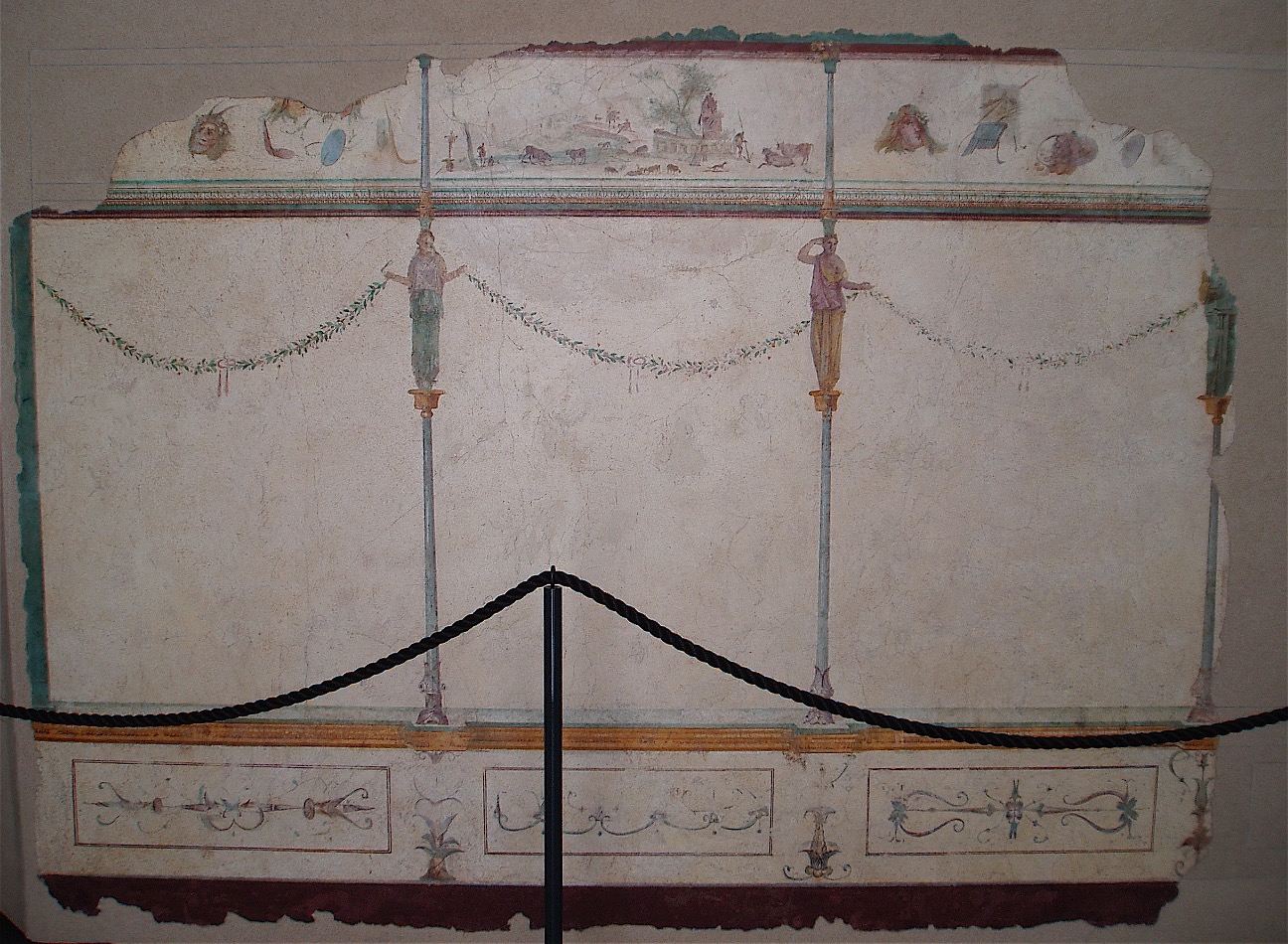
Villa Farnesina: White Corridor (Late Second Style),
Augustan, ca. 20 BCE, chief characteristic of the Third Style is that it rejected illusionism in favor of surface effects and fastidious ornament. The main zone consists of either simple blocks of color (plain or bearing vignettes), arranged paratactically and divided by spindly elements such as columns or candelabra, or else the middle of the wall contains a non-perspectival aedicule that frames and highlights a separate figural painting.•The paintings are distinguished by their quick, sketchy quality, with bold juxtapositions of light and dark to suggest volume. These works are painted with freshness and rapidity that show an immediate link between invention and execution.
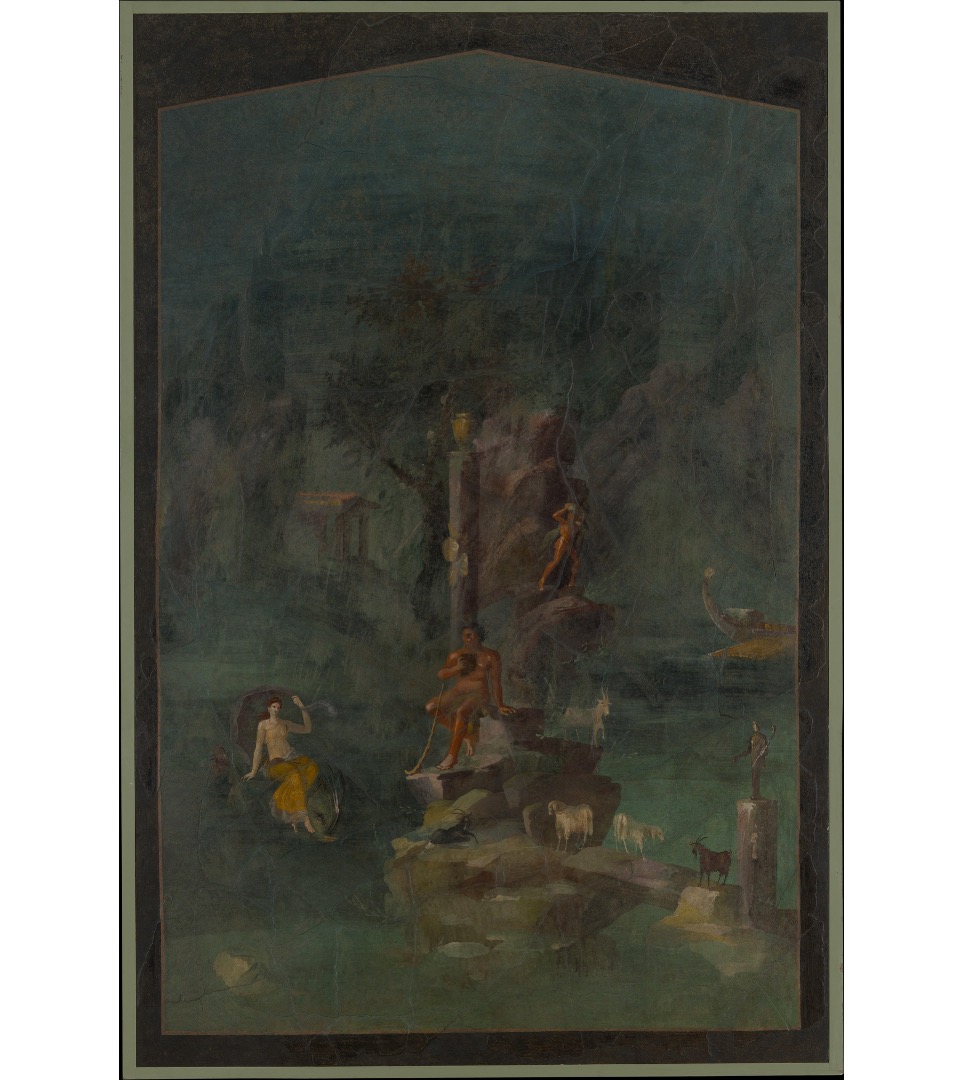
Boscotrecase: Mythological Room- Polyphemus and Galatea (Third Style), Augustan, after 11
BCE,
Third Style wall painting are derived from the repertoire of Hellenistic panel paintings. was built by Marcus Agrippa, as indicated by brick stamps, The so-called Mythological Roon in this villa near Pompeii was dominated by two large mythological landscape paintings showing Polyphemus’ love for Galatea and Perseus’ rescue of Andromeda, everything happens at once, time is bent in this frieze,
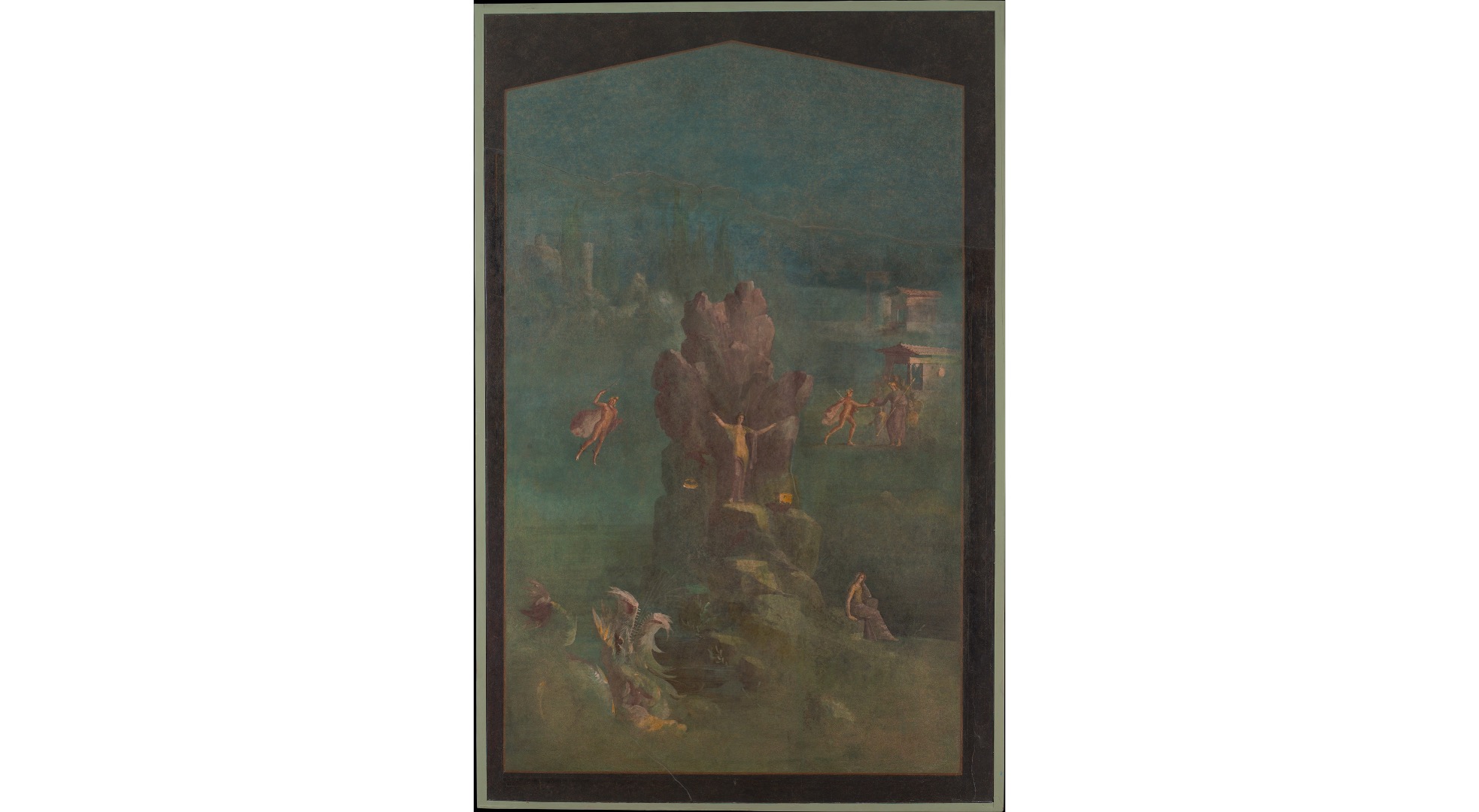
Boscotrecase: Mythological Room- Perseus and Andromeda (Third Style), Augustan, after 11 BCE
linked to other boscotrecase fresco through background and themes of love, Andromeda is chained to a rock by her father, about to be killed by a monster, when Perseus flies in to save her, in other part, her father is thanking him
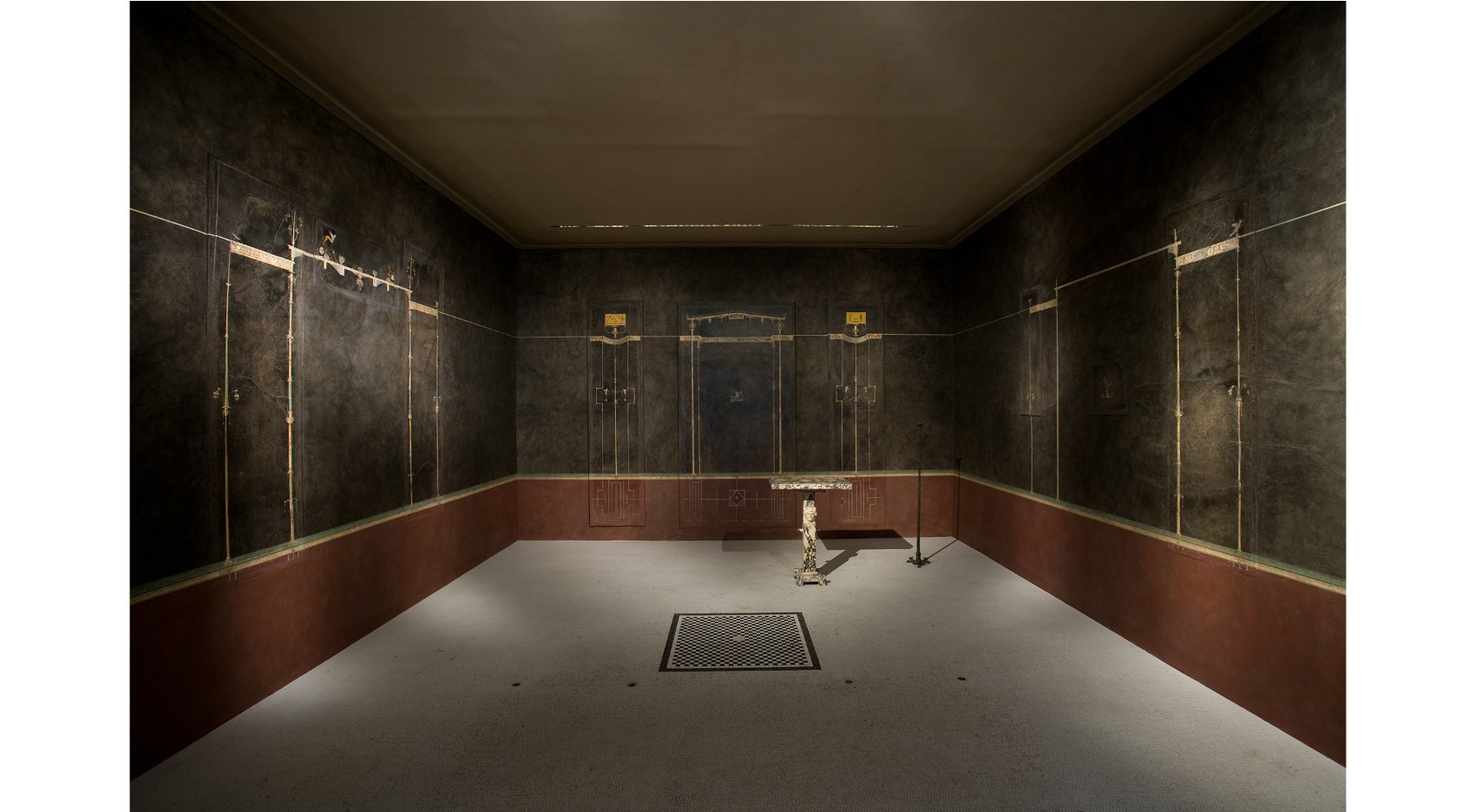
Boscotrecase: Black Room (Third Style), Augustan,
after 11 BCE,
Third style, The proper backdrop for the public figure is no longer highly public, indeed regal and verging on the sacred; instead, a more intimate and private luxury is in place, fits with Augustan state values, •The portraits are of two women, probably representations of Agrippa’s widow, Julia (Augustus’ daughter) and Livia. Livia was probably heavily involved in the marriage of Julia to Tiberius in 11 BCE, soon after Agrippa’s death. It is believed that this marriage was the occasion for the redecoration of the villa’s wall in Third Style.
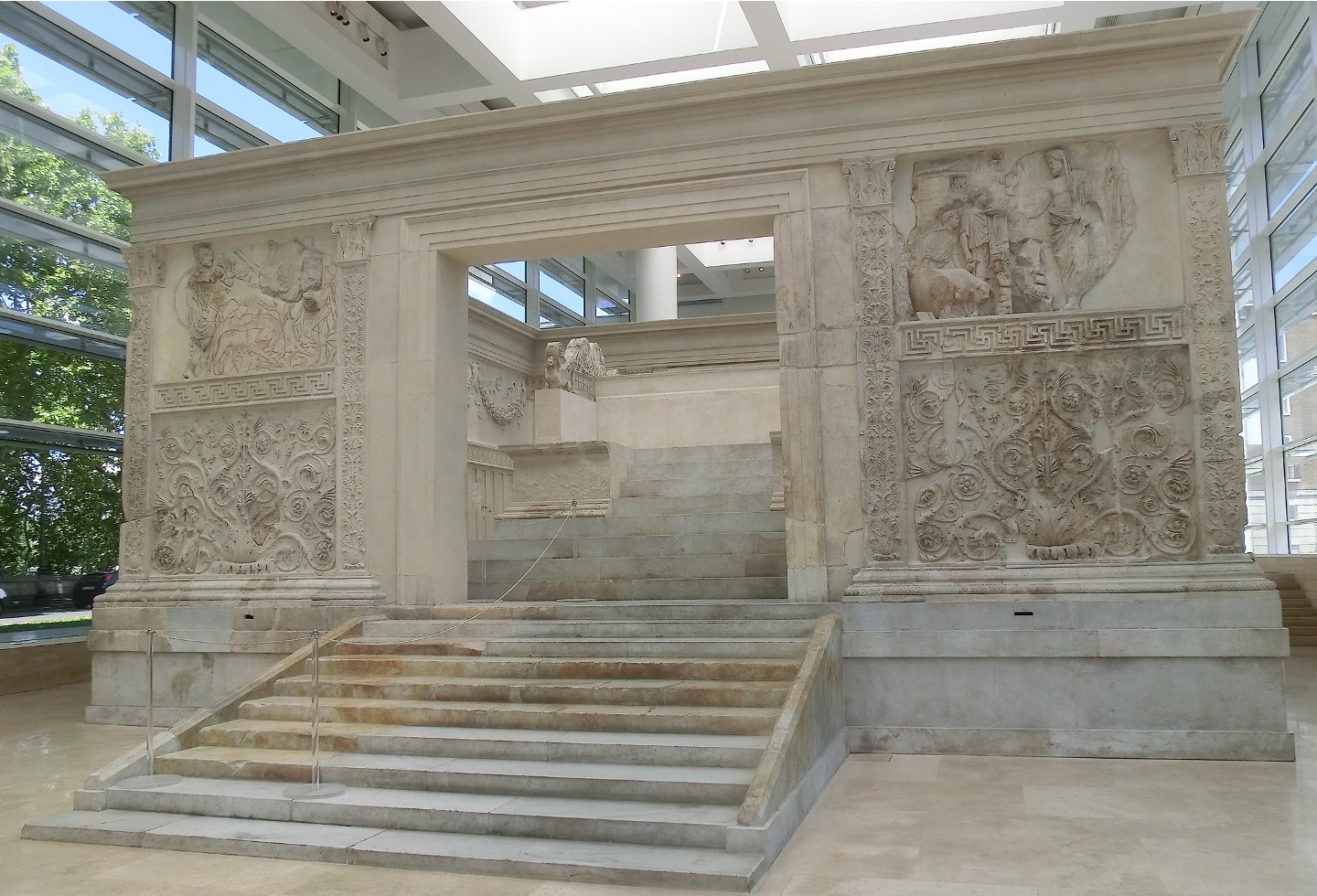
Rome: Ara Pacis, Augustan, ca. 13-9 BCE,
•Augustus took particular care to consolidate his position at Rome and turned the city into a capital worthy of a great empire. He claimed to have found it brick and left it marble- it was during his reign that the Luna (Carrara) quarries were developed, making marble easily accessible in Italy for the first time. He and his family beautified the city with many new monuments, including the completion of monuments begun by Julius Caesar.
marble reliefs
was a carefully planned, idealized reflection of the renewed Republic, designed not by order of Augustus, but by the Senate, to honor itself and the state. We see here the newly constituted leading aristocracy of Rome as it wished to be represented and as its wished, at least outwardly, to be closely identified with the new order
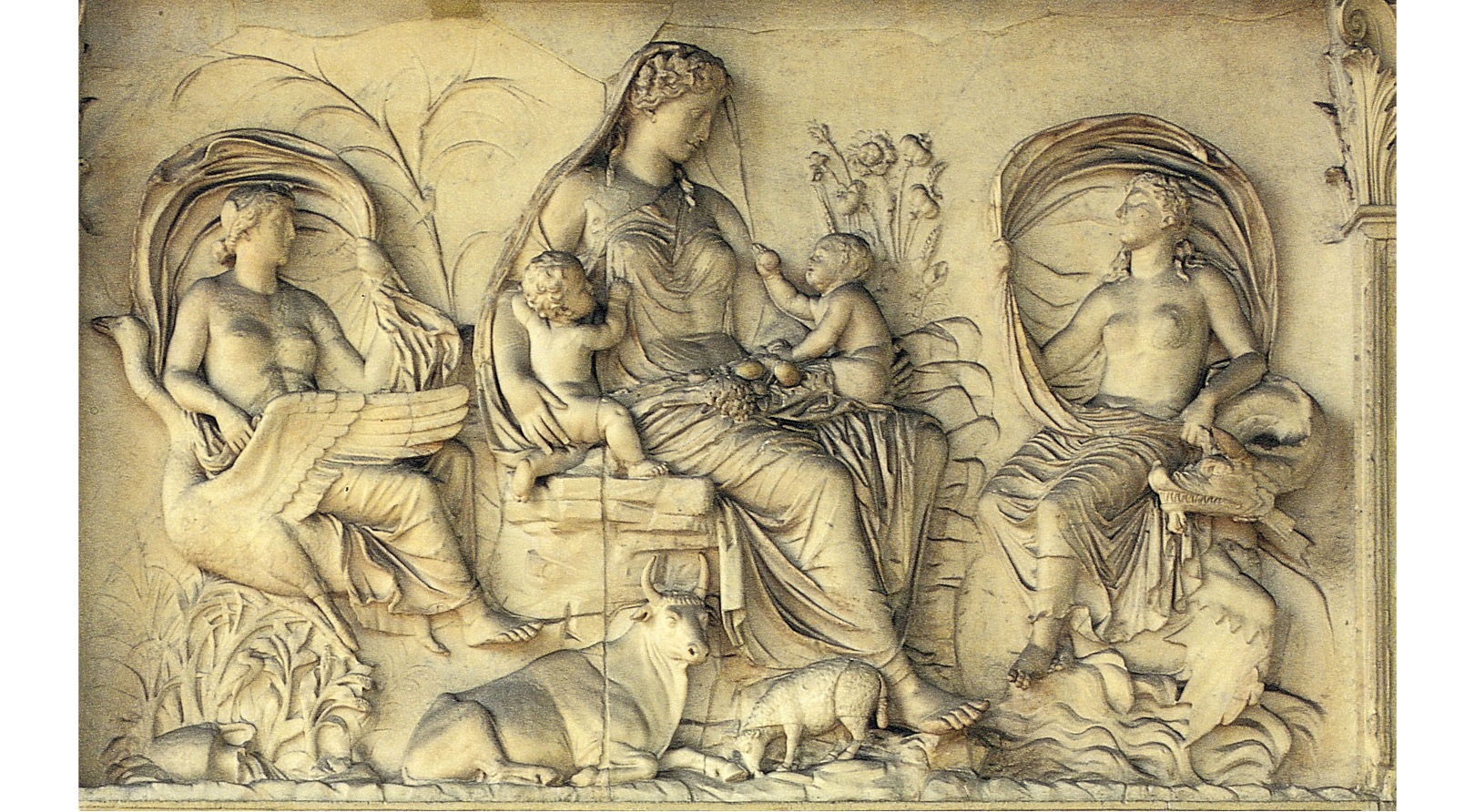
Rome, Ara Pacis: Tellus Relief, Augustan, ca. 13-9 BCE
Possible identifications of this flgure are Venus (indicated by the garment slipping off the shoulder), Ceres (suggested by the veil and presence of grain), and Tellus (implied by the landscape and rocky seat). (she is most likely Pax) Regardless of her identity, it is is immediately obvious that she is a divinity whose domain is growth and fertility. She is typical of the new personified deities of the Augustan religion who had no traditional mythology.
blessings of peace had been won by made secure by the newly fortified virtus of Roman arms

Rome, Ara Pacis: Aeneas Relief, Augustan, ca. 13-9 BCE,
Aeneas sacrificing 30 piglets to the gods, he looks classical, in old roman dress, themes of founding rome
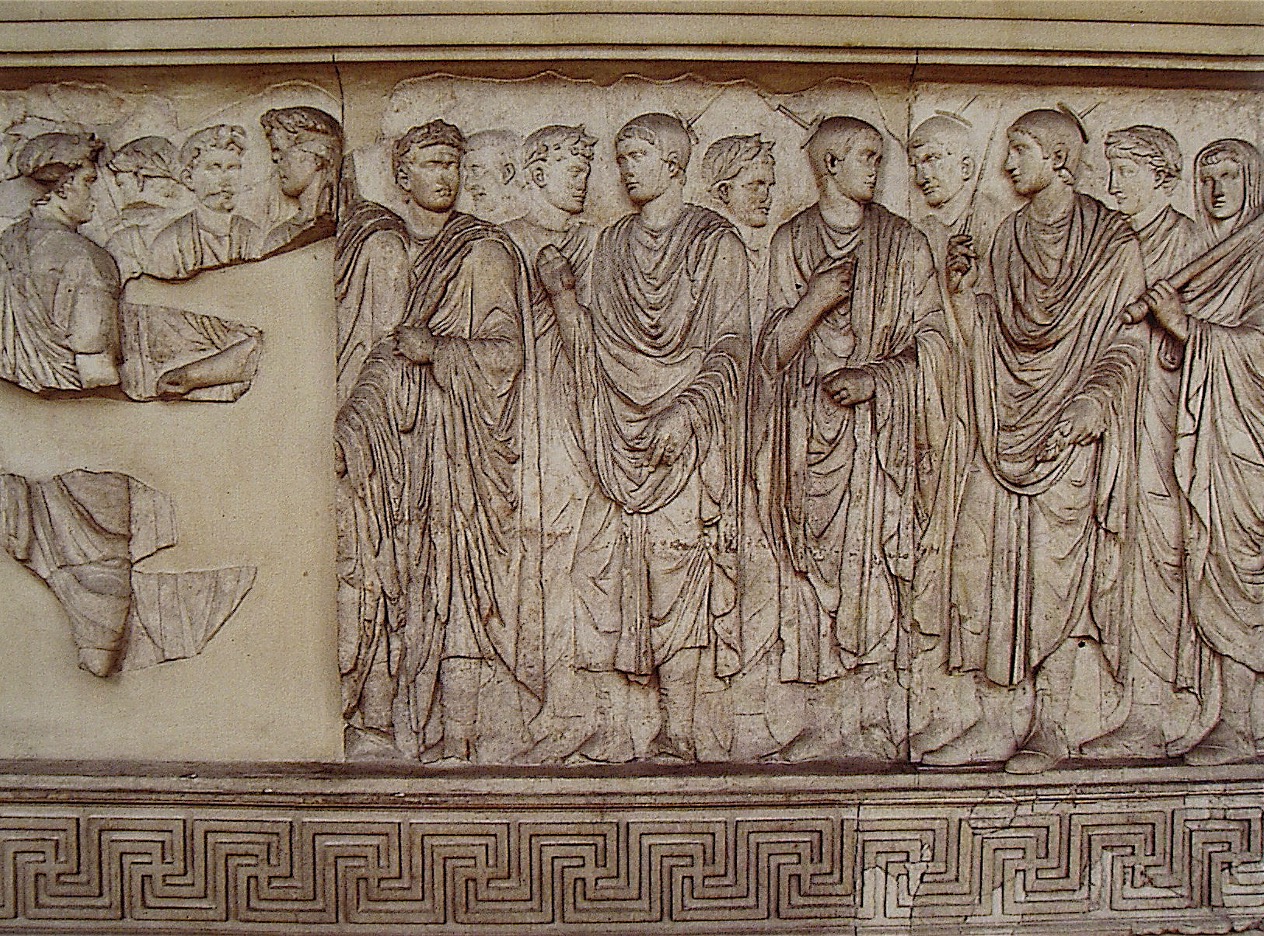
Rome, Ara Pacis: South Frieze, Flamens and Augustus Slabs, Augustan, ca. 13-9 BCE,
procession to altar, most likely inspired by Parthenon frieze of parade for Athena
Augustus as priest
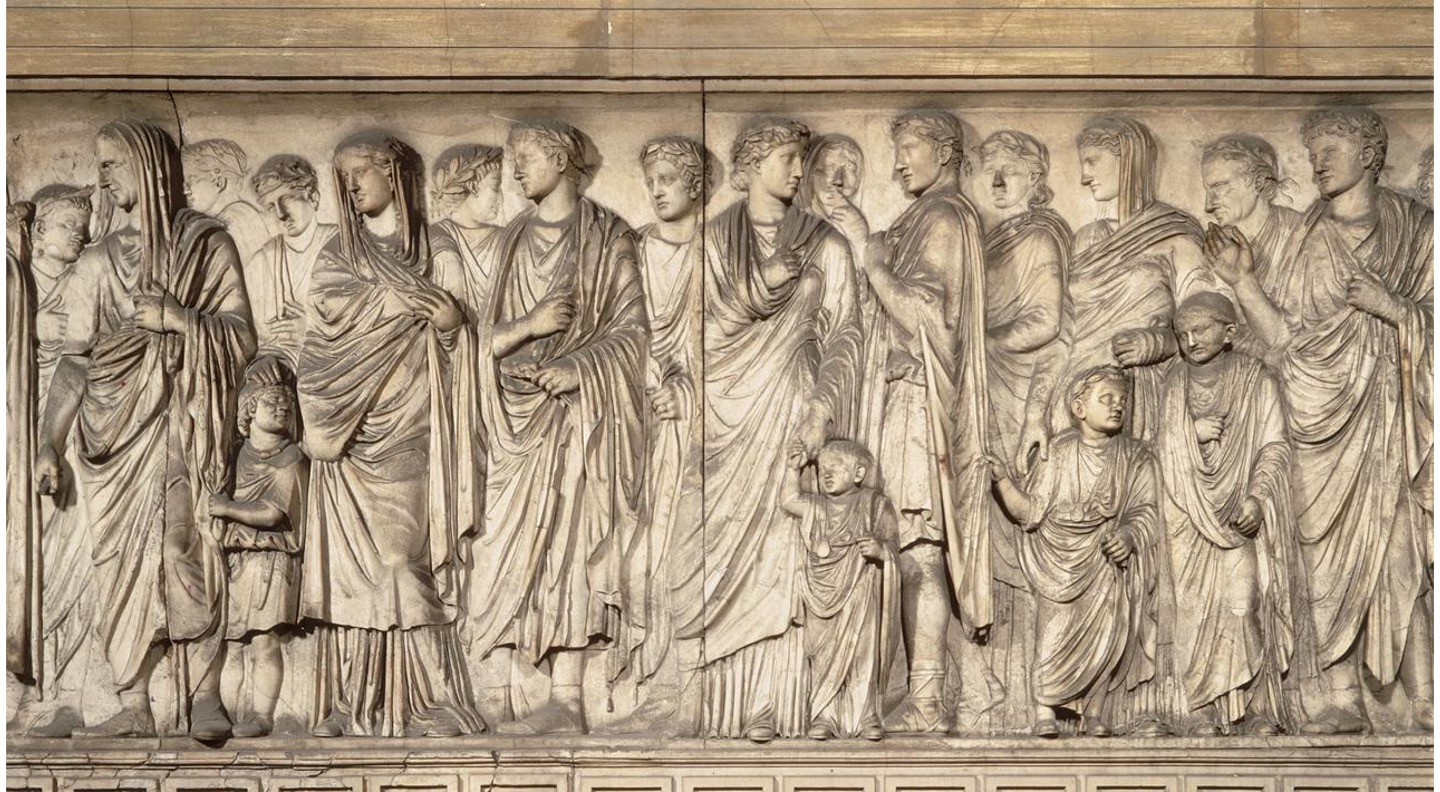
Rome, Ara Pacis: South Frieze, Imperial Family Slabs, Augustan, ca. 13-9 BCE
•The man on the far left appears to be Marcus Agrippa, who served as the pontifex maximus of Rome until his death in 12 BCE, when this monument was under construction. The veiled lady is probably Livia, followed by various other members of the imperial family, with their children and servants. Everyone is dressed in their best, the men and boys in the new Augustan official form of the toga and high-laced patrician boots, the women in all-enveloping mantle and stola.
important role of children, themes
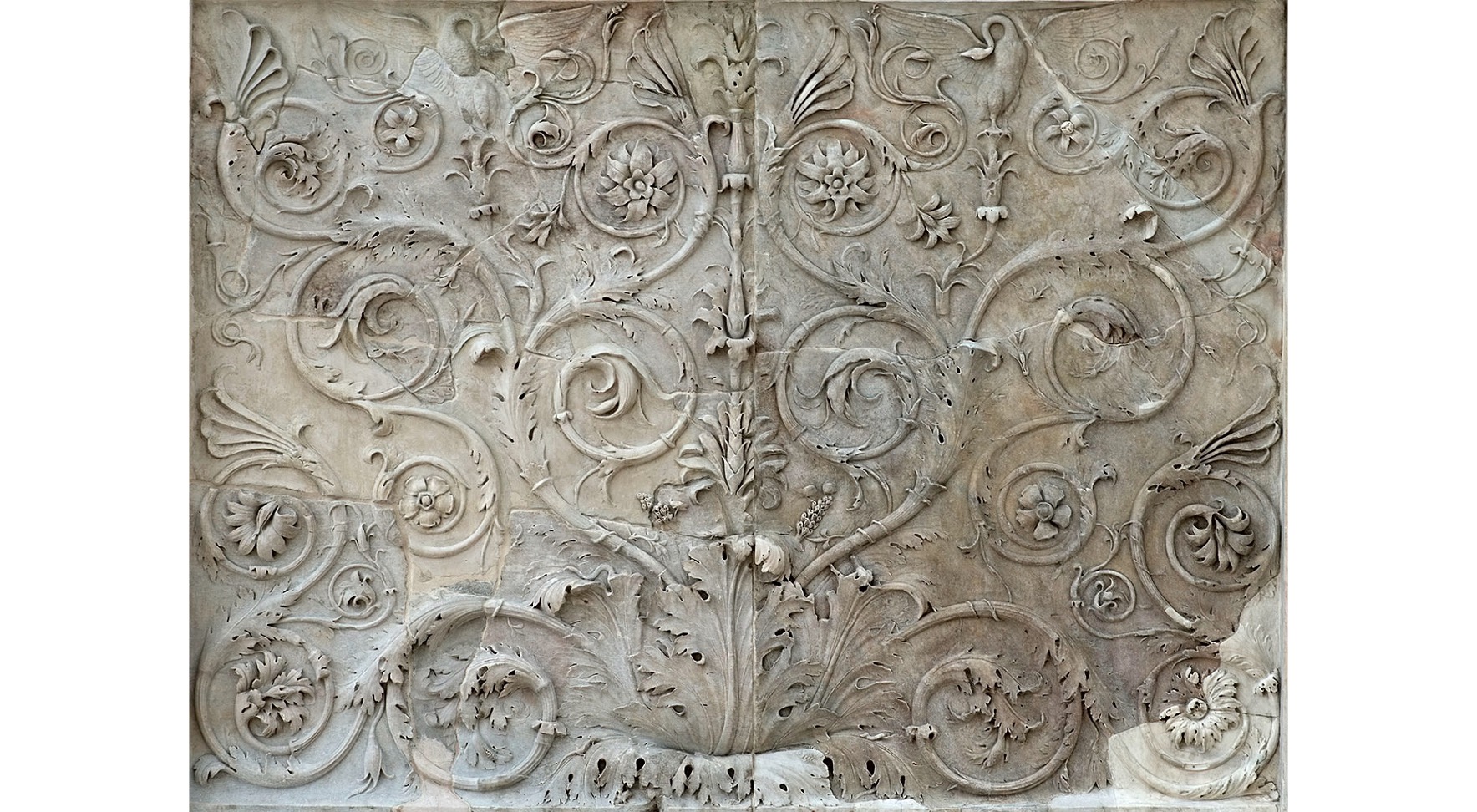
Rome, Ara Pacis: Acanthus Vine Relief, Augustan, ca. 13-9 BCE
the acanthus vine= fertility in Augustan period
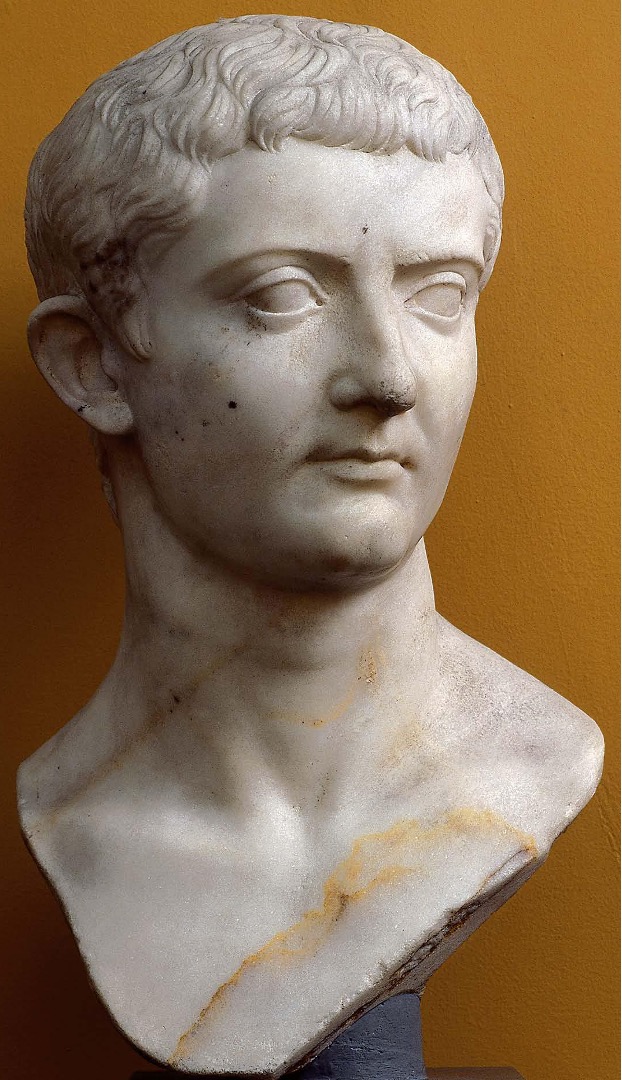
Portrait of Tiberius, Julio-Claudian,
14-37 CE
The emperors that immediately followed Augustus, known as the Julio-Claudians, inherited Augustus’ legacy in all aspects including the visual iconography he established during his reign.
adopted by Augustus, used a lot of his imagery in his portraits:comma shaped curls, sharp brow-ridges, aquiline nose, eternal youthfulness, and idealization. This was intentional because Tiberius greatly wanted to stress his familial tie to Augustus although they were not related by blood.
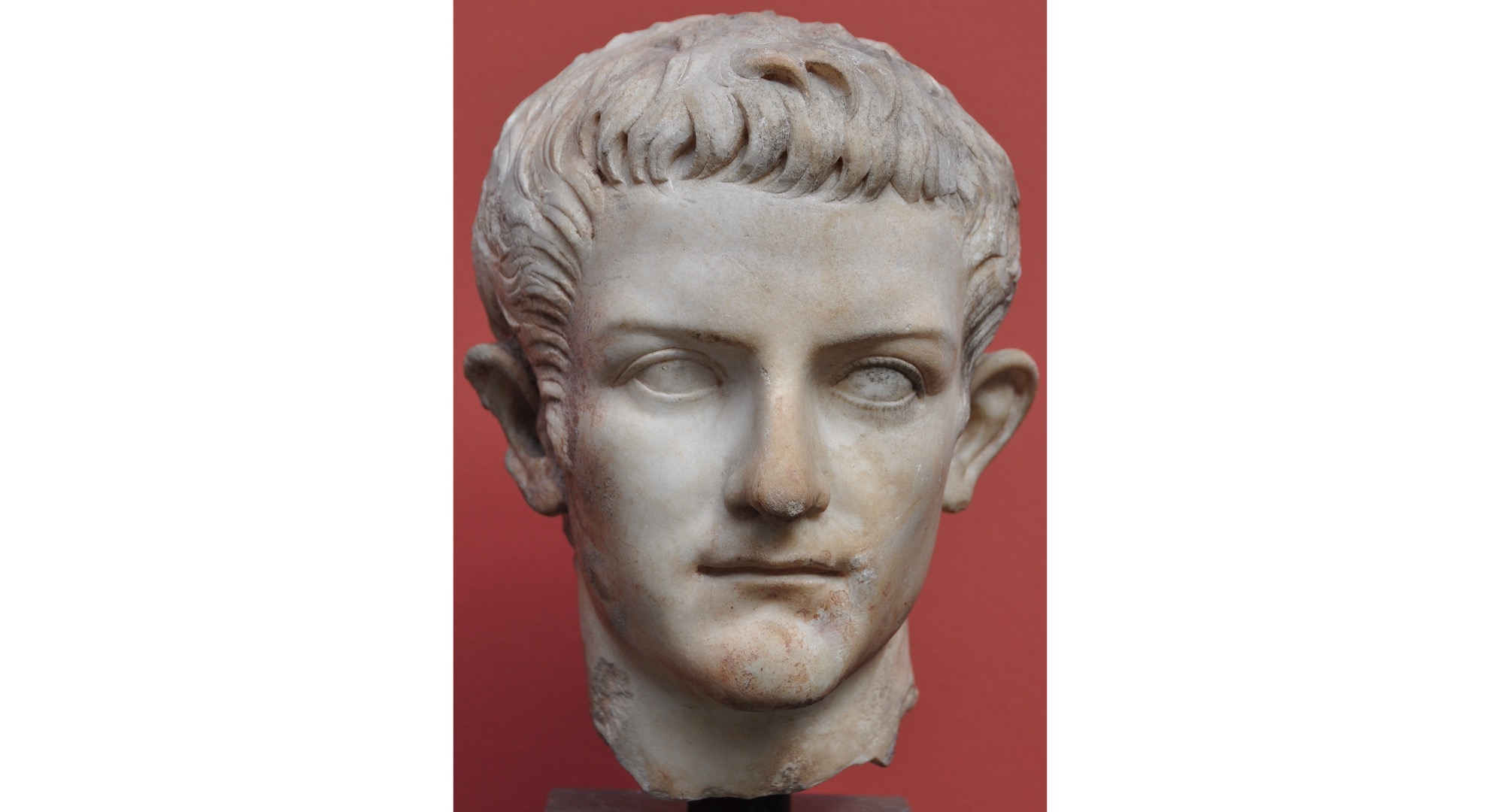
Portrait of Caligula, Julio-Claudian,
37-41 CE
accompanied his father at military locations as a child, groomed to become emperor
extremely cruel, abusive, incest…
Few of his portraits survive due to the damnatio memoriae after his death- erasing of his memory

Portrait of Claudius as Jupiter, Julio-Claudian,
42-43 CE, Caligula’s uncle, emperor by accident
but remained in the Praetorian’s favor by paying special attention to the army and participating personally in the invasion of Britain, for which he was awarded a triumph
likely killed by wife, because she wanted her son Nero to become emperor
deified after death
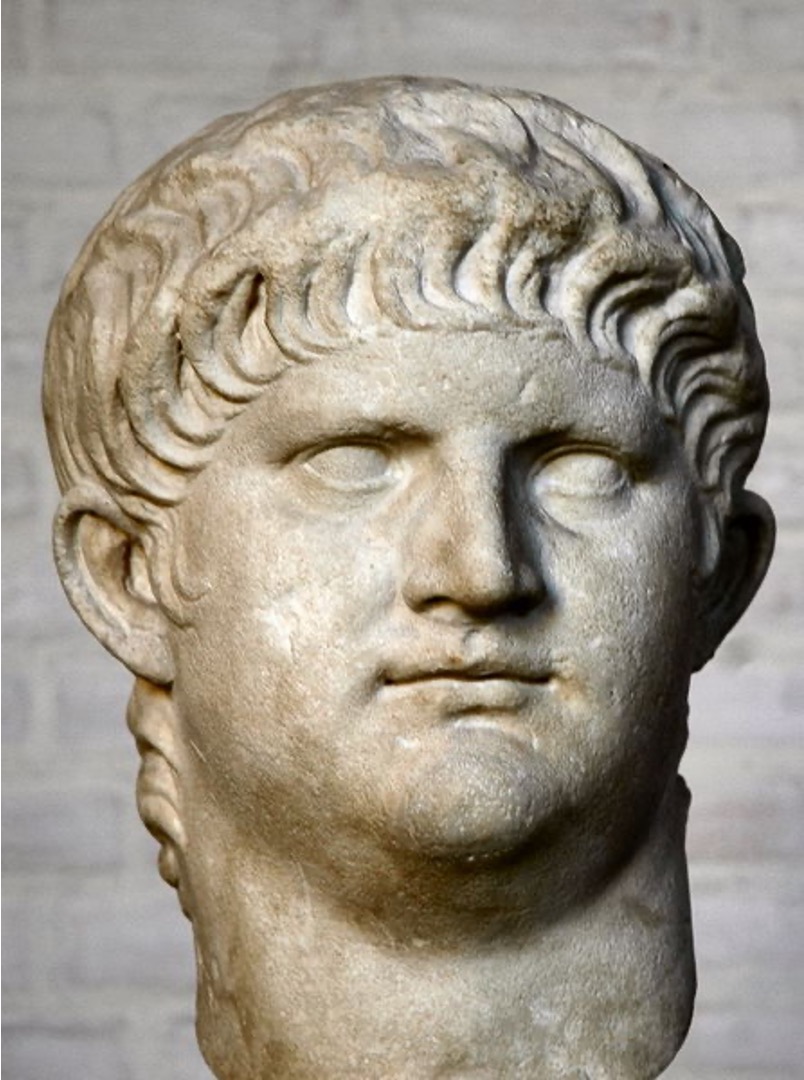
Portrait of Nero,
Julio-Claudian,
ca. 64 CE
emperor after Claudius
killed many family members
•He never engaged in military campaigns during his reign, but rather focused on fostering the arts and other forms of entertainment within Rome. He loved playing the lyre and reciting his own poetry. He was additionally fond of chariot racing, and even participated in the Olympic Games, which were fixed in his favor.
He took advantage of a major fire in 64 CEto appropriate nearly half of the central city for his private use in the form of a massive palatial complex including a huge garden and artificial lake,which turned public opinion against him.
After his death, a damnation memoriae was issued
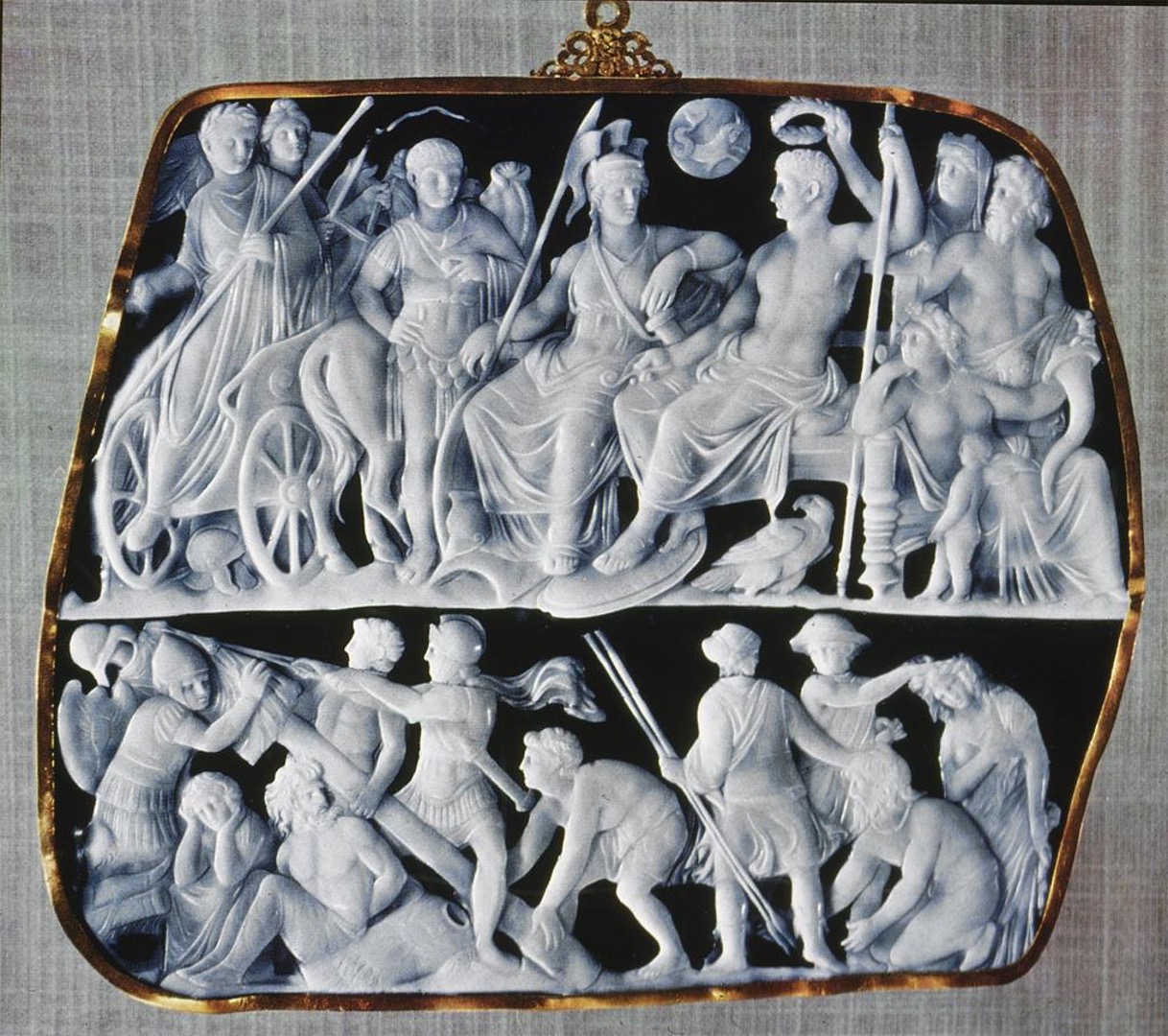
Gemma Augustea, Julio-Claudian, ca. 15 CE
cameo-carving details on multilayered gemstones or colored glass so as to leave a light surface in relief against a dark background. The art of gem cutting reached its peak under Augustus.
probably made during the reign of Tiberius. The clue to this is that Augustus is shown as deified (i.e. after his death). It seems to try to represent an official transfer of power from Augustus to Tiberius in 14 CE. In the lower zone, a trophy is being raised by Roman soldiers amid captured barbarian prisoners.
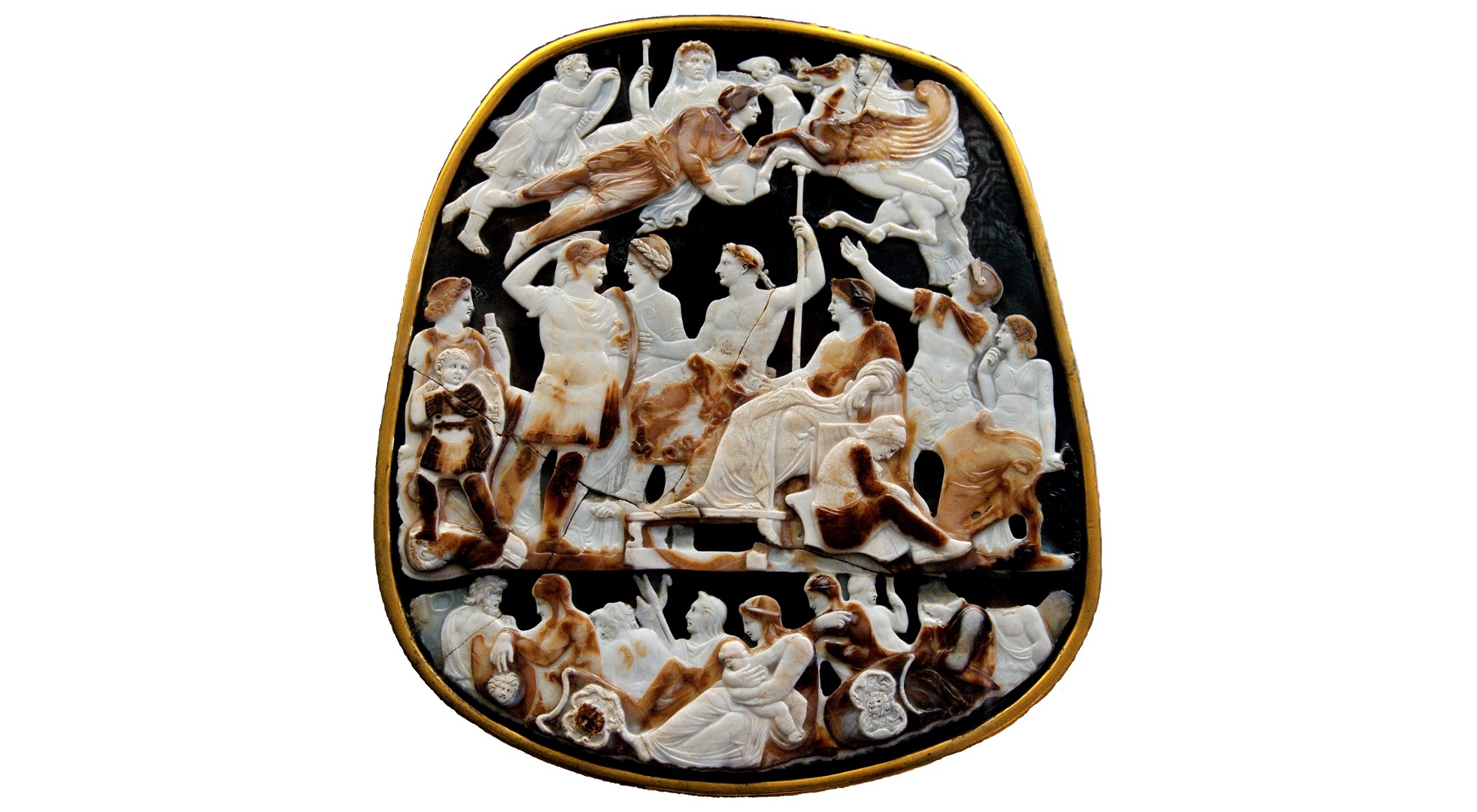
Grand Camée de France,
Julio-Claudian, ca. 26-29 or ca. 45 CE
cameo, glorification of the past, present, and future Julio-Claudian dynasty. The identification of the various figures depends a great deal on how one identifies the central figure- the general consensus is that he is Tiberius, although other scholars favor Claudius.
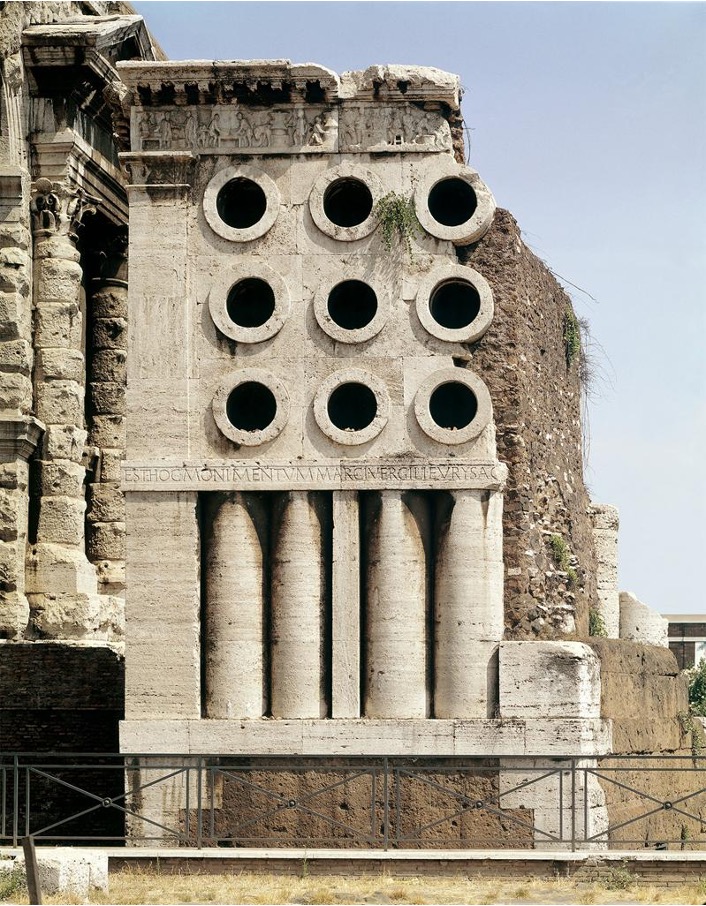
Tomb of the Baker (Eurysaces), Augustan, late 1st c. BCE
Built around 30 BCE, about 80 years before the aqueduct was built behind it, it occupied a very prominent location just outside the wall of Rome at the conjoining of two major roads leading out of the city. It was built by a freedman (ex-slave) for himself and his wife
made his fortune by supplying bread for the public ration in the mid 1st century BCE Eurysaces was immensely proud of his wealth and its source. The frieze wrapping around the top of the monument shows his bakery in operation
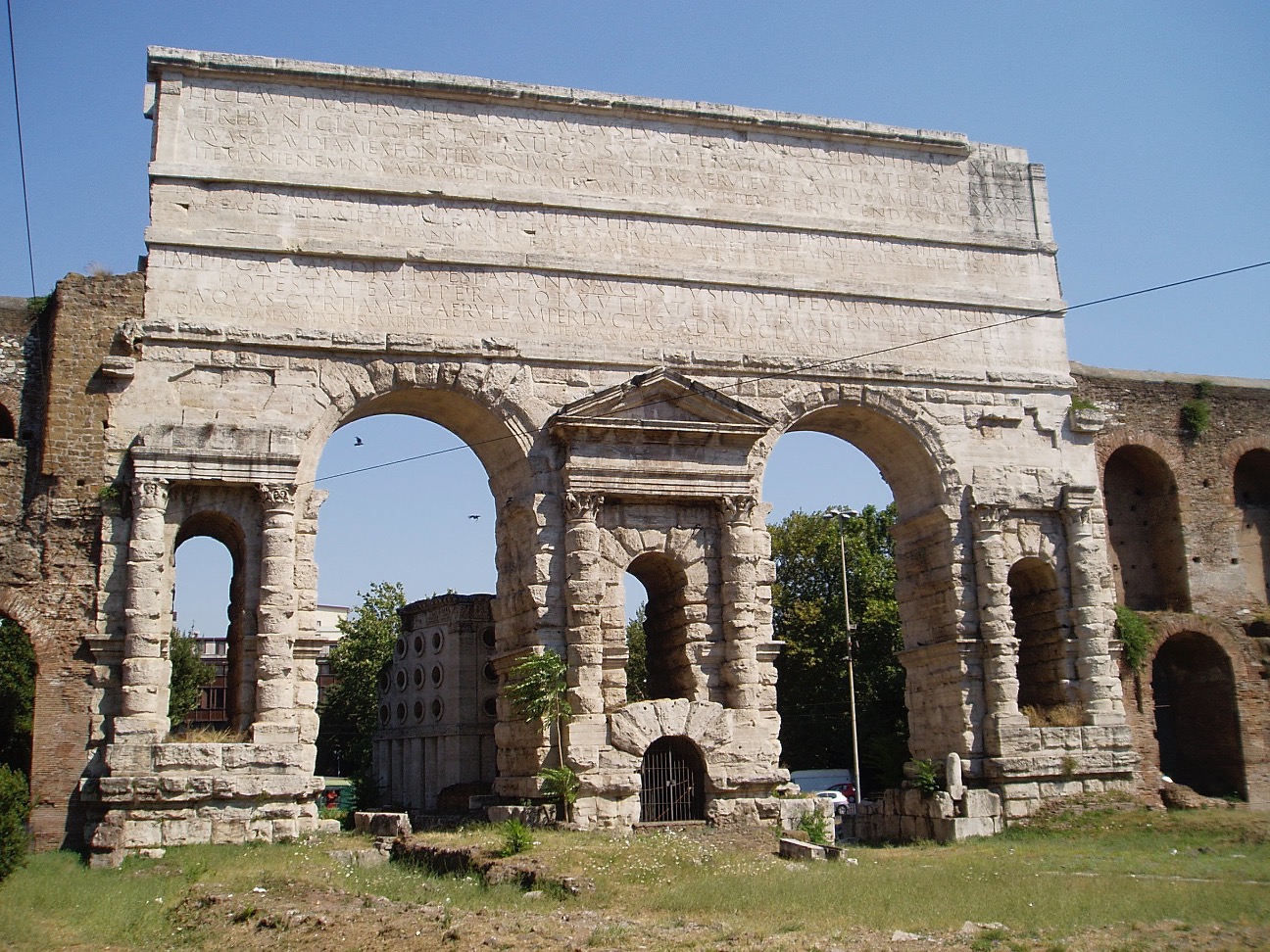
Rome: Porta Maggiore, Julio-Claudian, ca. 50 CE
An aqueduct is a structure for moving water over long distances. Originally, they were used for drainage, but later they became symbols of imperial power.
•The Porta Maggiore was built to serve as both a gate where two roads, the Via Labicana and the Via Praenestina, entered the city, but it was also meant to disguise the intersection of a whole series of aqueducts at the same point, including the Aqua Claudia and the Anio Novis, both of which were completed by the emperor Claudius, who also built the PortaMaggiore.
•The travertine masonry of the arches and their superstructure, even including the columns decorating it, are all in the “rusticated” style of exaggerated unfinish favored by Claudius. The monument is also identified as Claudian in origin by the inscription in the top register with a characteristically archaic spelling of Caesar. These old-fashioned elements might well be attributed to Claudius’ profession as a historian, and his fondness for the past.
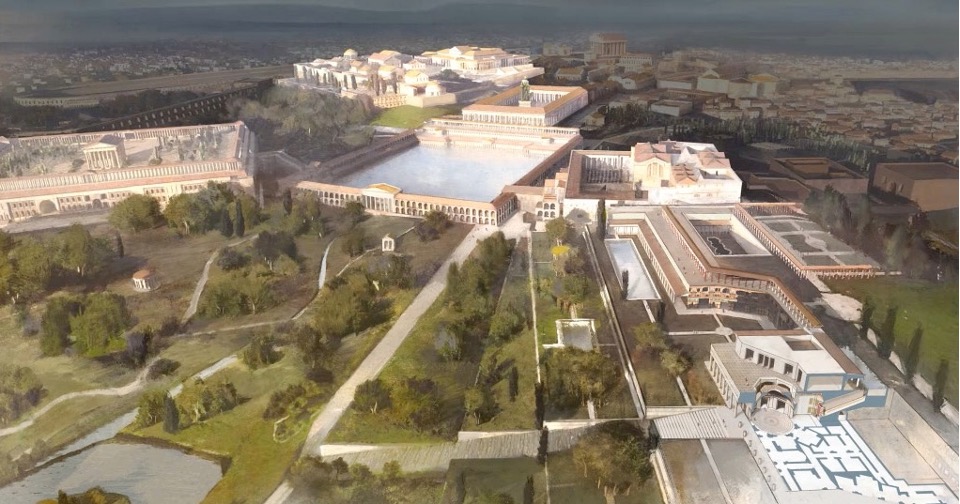
Rome: Domus Aurea, Julio-Claudian, 64-68 CE,
after the fire in Rome, Nero rebuilt more fire resistant housing for the lower classes, and also built his large palace
use of concrete created innovative spaces, curves, vaults, domes and arches, use of light, third and fourth style frescos
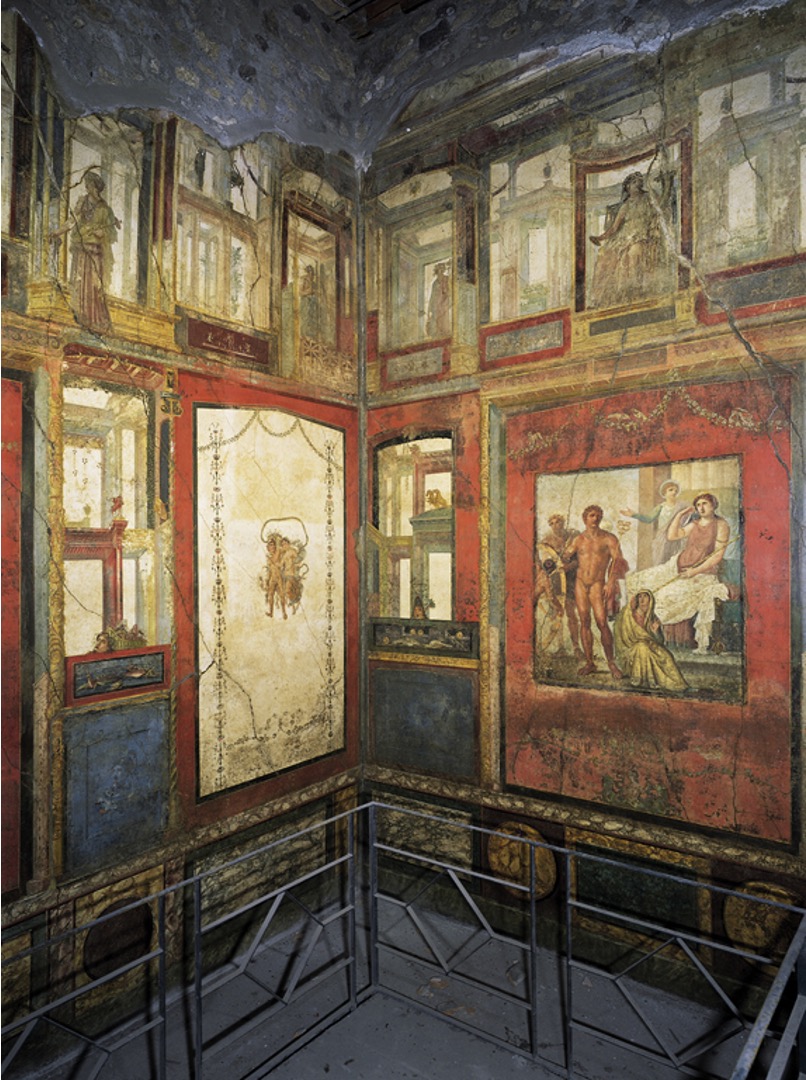
Pompeii: House of the Vettii – The Ixion Room (Fourth Style), Julio-Claudian, ca. 62-79 CE
Fourth Style wall paintings, many with mythological scenes and figures, owners were two freedmen
rather than intellectual, although patrons could well have chosen pictures that depicted favorite stories or evoke an exotic or literary atmosphere
Punishment of Ixion scene and Daedalus and Pasiphae scene

Portrait of Vespasian, Flavian, ca. 79 CE
served in military, was not related to Julio Claudian family- when Nero died, he was voted emperor by his own troops, beginning of the Flavian dynasty
victory in the Jewish Wars became the capstone of their careers and was the focus of the Flavian dynasty’s propaganda.
He was an old soldier of plebian ancestry who embraced generous practicality. Unlike Augustus and may of the subsequent Julio-Claudians, he did not depict himself as an idealized, Classical youth, but rather favored the native Italic tradition of veristic portraiture favored during the Republican period.
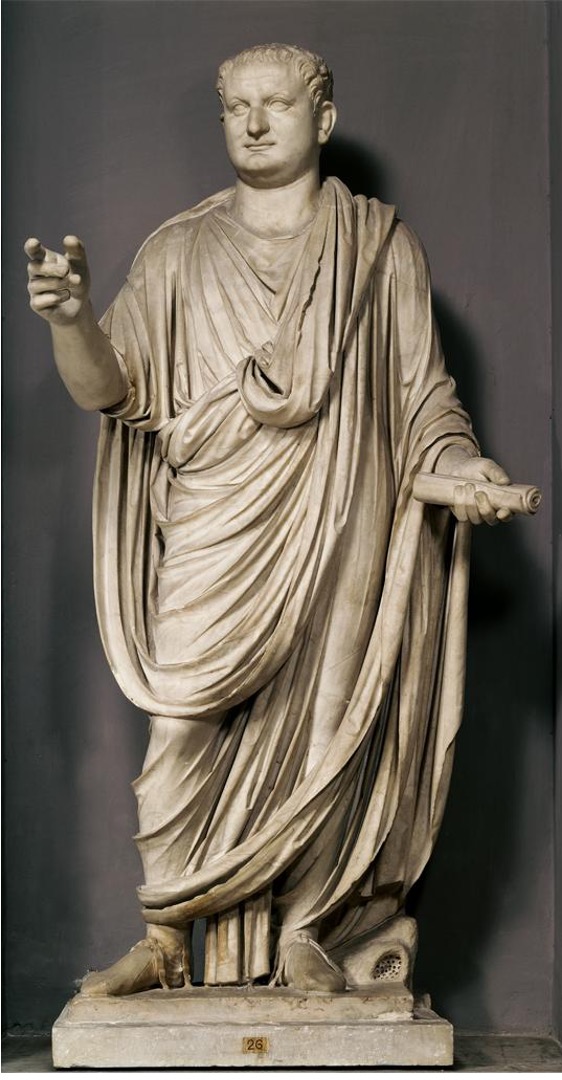
Portrait of Titus, Flavian,
ca. 81 CE
Titus, Vespasian’s eldest son, His military prowess was so great that Vespasian also appointed him Praetorian prefect, which meant that he ran the military side of the government. He displayed considerable ruthlessness in this post, which led to hisbeing somewhat unpopular, although he regained the people’s favor while emperor. His only child was a daughter, Julia Titi, who was the mistress of Domitian, her uncle
generous commissioning of public works, including the completion of the Colosseum and the Baths of Titus
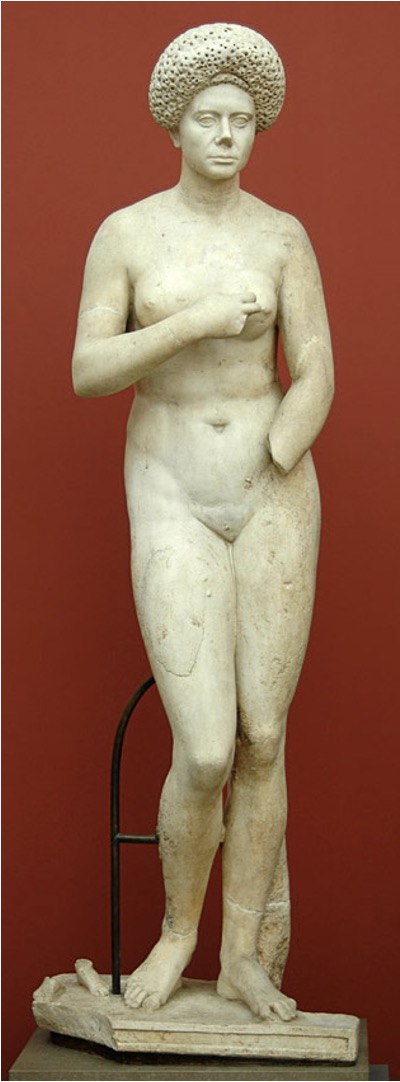
Portrait of Marcia Furnilla, Flavian,
ca. 79-81 CE
the surface finish in marble sculpture becomes more polished than before, and there is a good deal of obvious drillwork in the hair
•This is a portrait of Marcia Furnilla, Titus’ second wife and mother of his only child, Julia Titi. This full-length portrait features a middle aged face with typical Flavian realism in contrast with the much younger, voluptuous body, which is a replica of the Capitoline Venus. This incongruity of age between the head and the body is quite common in Roman art.
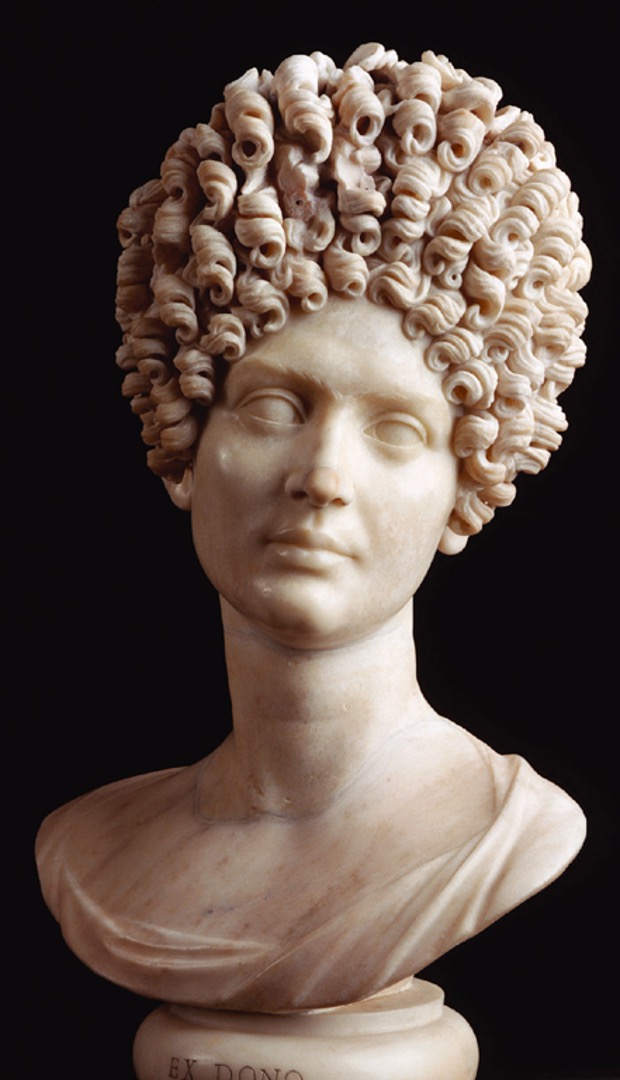
Portrait of a Flavian Lady, Flavian or Trajanic,
ca. 90-100 CE
hair is taller than wide-indicates time period,
unknown who it is, but is likely an imperial portrait
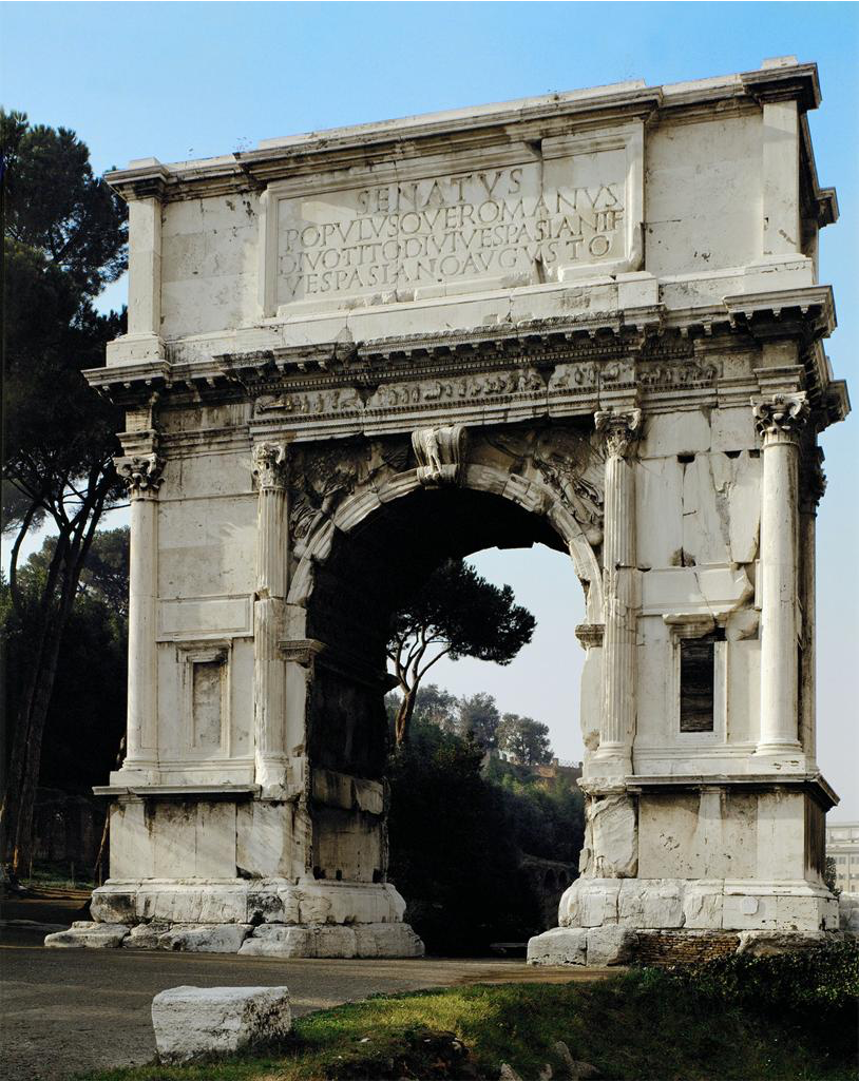
Rome: Arch of Titus, Flavian, after 81 CE
they stood as monumental instruments of propaganda in the permanent service of the triumphant Imperator and of the Roman state both at Rome and in the wide Empire
•The attic of the arch was reserved for the dedicatory inscription filled with the names and titles of the triumphator, complimentary adjectives about his worthiness, fortune, and invincibility, a reference to his specific military achievement, and a record of the Senatorial decree. On this arch, the inscription mentions “divo Tito,” which reveals that the arch was built, or at least completed after Titus’ death by his brother Domitian. Domitian was a notorious arch builder, but this is the only one that has survived.
Standing just on the edge of the Roman Forum, it spanned the Sacred Way that was travelled by all triumphal processions. The external sculpture is rather austere, the most complex imagery instead appears within the passageway itself.
In the interior, at the top of the arch is a plaque that shows the apotheosis of Titus. Bodies of the emperors were cremated on the Campus Martius, and it was believed that the spirit was carried heavenward by an eagle. This is the earliest surviving visual depiction of this concept
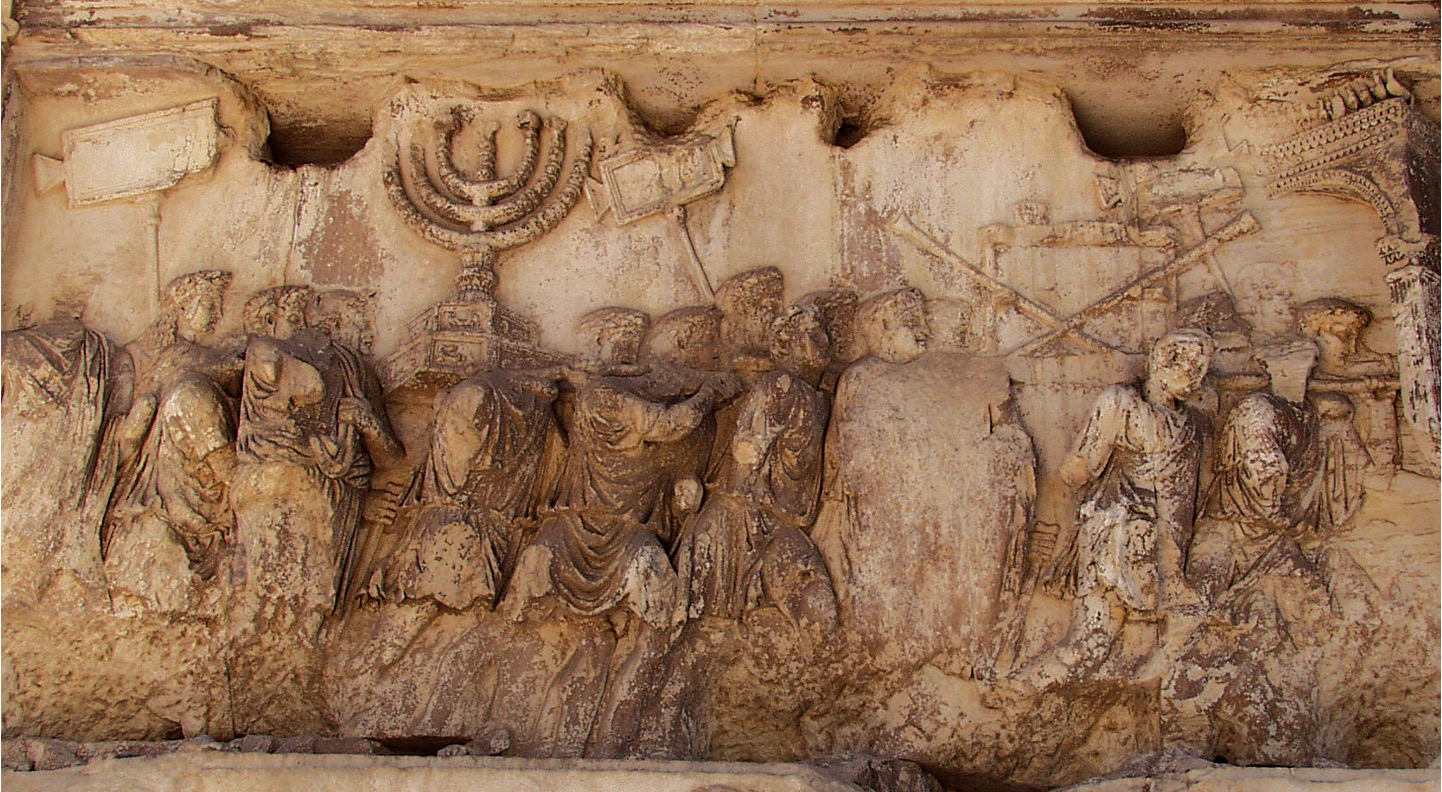
Rome, Arch of Titus: Spoils Relief, Flavian, after 81 CE
•At this stage of the development of the triumphal arch, the passage seems to have been the main area chosen for sculpture, and a theme of action or movement was particularly appropriate- represented here in this arch is the triumph of Titus and Vespasian after the capture of Jerusalem in 70 CE. The direction of the movement of the figures reflects the direction of the actual procession would have taken into the Forum and feels as through the procession was coming towards us (a painterly quality).
This panel shows the portion of the triumphal procession that came before the triumphator in his chariot (which is seen on the opposite panel). One can clearly recognize spoils brought back from the temple in Jerusalem that are carried on wooden stretchers by men in tunics: the golden table and silver trumpets on the first and the golden menorah on the second.
The arch is crowned with four figures- Domitian, Titus, Vespasian, and Minerva (Domitian’s patron goddess)- not a depiction of real life

Rome, Arch of Titus: Triumph Relief, Flavian,
after 81 CE
•The triumph was the highest honor that could be bestowed upon a man in ancient Rome, and it served a dual purpose as a cleansing ritual of the troops and a thank offering given to Jupiter on the Capitoline Hill.
Titus is shown being crowned by Victory while driving his chariot, Roma, Titus holds Jupiter’s scepter and a palm branch
The mixture of divine and human figures as well as the omission of Vespasian (who celebrated this triumph with Titus) indicate that this is not the depiction of an actual event.
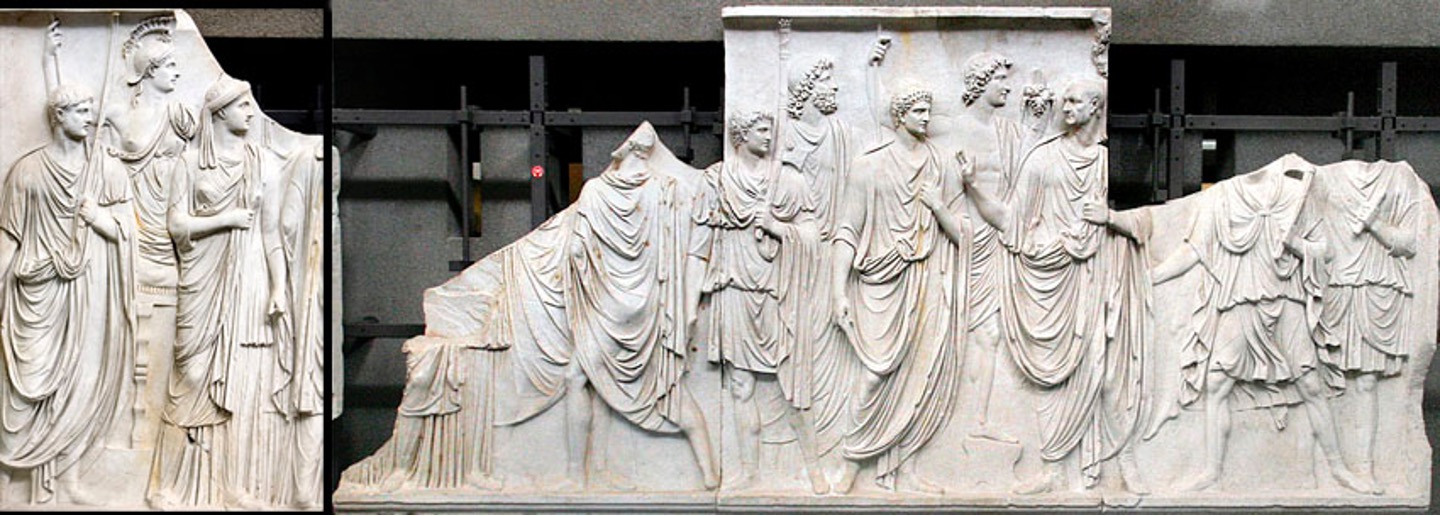
The Flavian Cancelleria Reliefs: Relief B- Adventus Scene, Flavian, after 81 CE
commissioned during the reign of Domitian, but it is unknown where they were originally located or how they were used
An adventus is one of a number of stock scenes depicting the emperor in his various roles in Roman art.
The adventus (meaning “arrival” in Latin) is the arrival of the emperor in Rome, usually after a successful military campaign
•as Vespasian’s return to Rome in 70 CE after his victories in Judaea and his being chosen as emperor by his troops. Domitian greets Vespasian, just to the right of center. Domitian has a slight beard on his cheeks and chin, which was probably worn by young men before the traditional first shave at age 20.
Roma
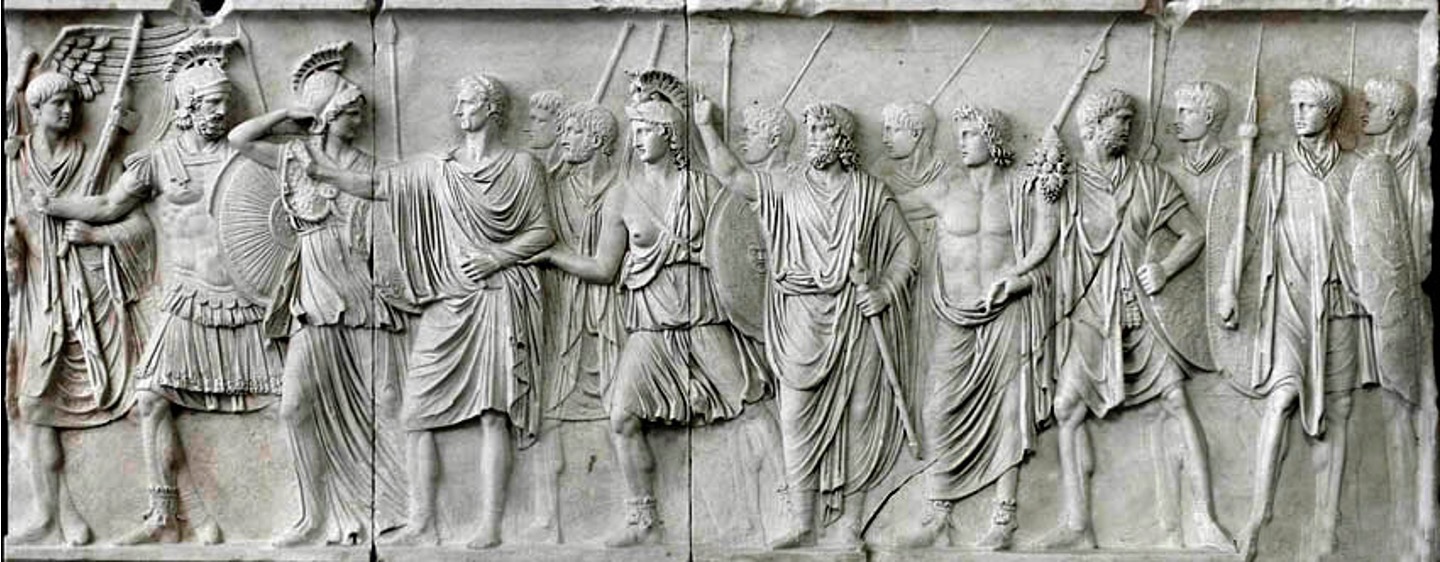
The Flavian Cancelleria Reliefs: Relief A- Profectio Scene, Flavian, after 81 CE
not entirely clear whether this is a profectio (departure) or adventus (arrival). If it is a profectio scene, perhaps Domitian was leaving on a military campaign against the Chatti (83 CE) or the Sarmatian War (92-93 CE).
Domitian is led by Victory (only the left wing survives), a lictor with a fasces, by Mars (dressed in cuirass, helmet, and shield), and Minerva (who was Domitian’s divine patroness). The special bond between Minerva and Domitian depicted by their intense gaze
As on the Adventus Relief and the Triumph Relief on the Arch of the Titus, deities are shown walking among mortals. Domitian during his lifetime insisted on being addressed as “lord and god,” which may help to explain this development in Flavian sculpture. This practice was one of the irritants that led to Domitian’s eventual assassination
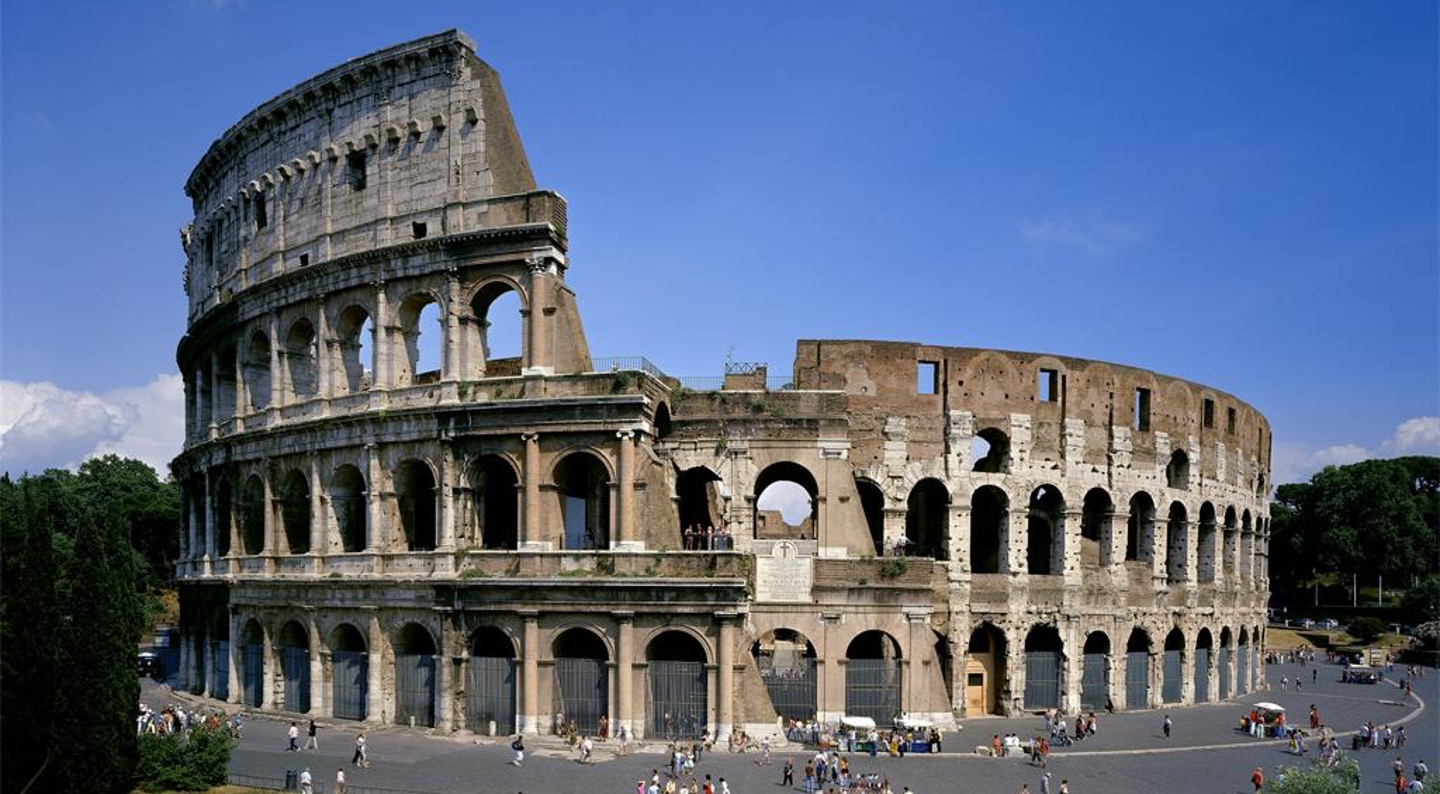
The Colosseum, Flavian, 70-80 CE
•Technically it was the Flavian Amphitheater and not called the Colosseum until 800 CE. Begun in 70 CE by Vespasian and completed up to the third storey before his death in 79, it was completed by Titus and inaugurated in 80 AD. It is the largest Roman amphitheater in the world by a considerable margin and served to replace the earlier Augustan stone amphitheater that was destroyed in the fire of 64 AD. Nero did not do much to rebuild an amphitheater because he was not interested in the games. Although it was never matched in scale nor in the refinements of its architecture, the basic design was emulated by many amphitheater builders throughout the Empire.
Gladiatorial contests are last mentioned as having taken place there in 434/5 CE, but animal hunts went on until at least 523 CE. By the later 6th century, a small church had been installed, using the arena as a cemetery and the many vaulted spaces were taken over as housing and workshops. They were still being rented out in the 12th century.
,,,, look at pp

Portrait Bust of Trajan, Trajanic,
ca. 108 CE
First of the Roman emperors to be born outside of Rome (in Spain), he was adopted by Nerva in 97 CE. He had an important military career and much of his art reflects his military exploits and their consequences for Rome
He was victorious against both the Dacians and the Parthians. He preferred the title princeps and did not want to be worshipped as a god during his lifetime as Domitian had done. His own virtuous persona was matched by that of his wife, Plotina, whose simple tastes, piety, and dignity were widely praised. Trajan had no children of his own, but Hadrian, who became emperor after Trajan’s death, was his ward.
In Rome he initiated public works, first concentrating on repairs and the building of roads. Trajan’s Dacian victories funded the construction of the Forum of Trajan, the Markets of Trajan, and the Baths of Trajan (fed by the Aqua Traiana).
Julio Claudian style, forever 45, The extension of the bust to the breastbone is characteristic of the Trajanic period.
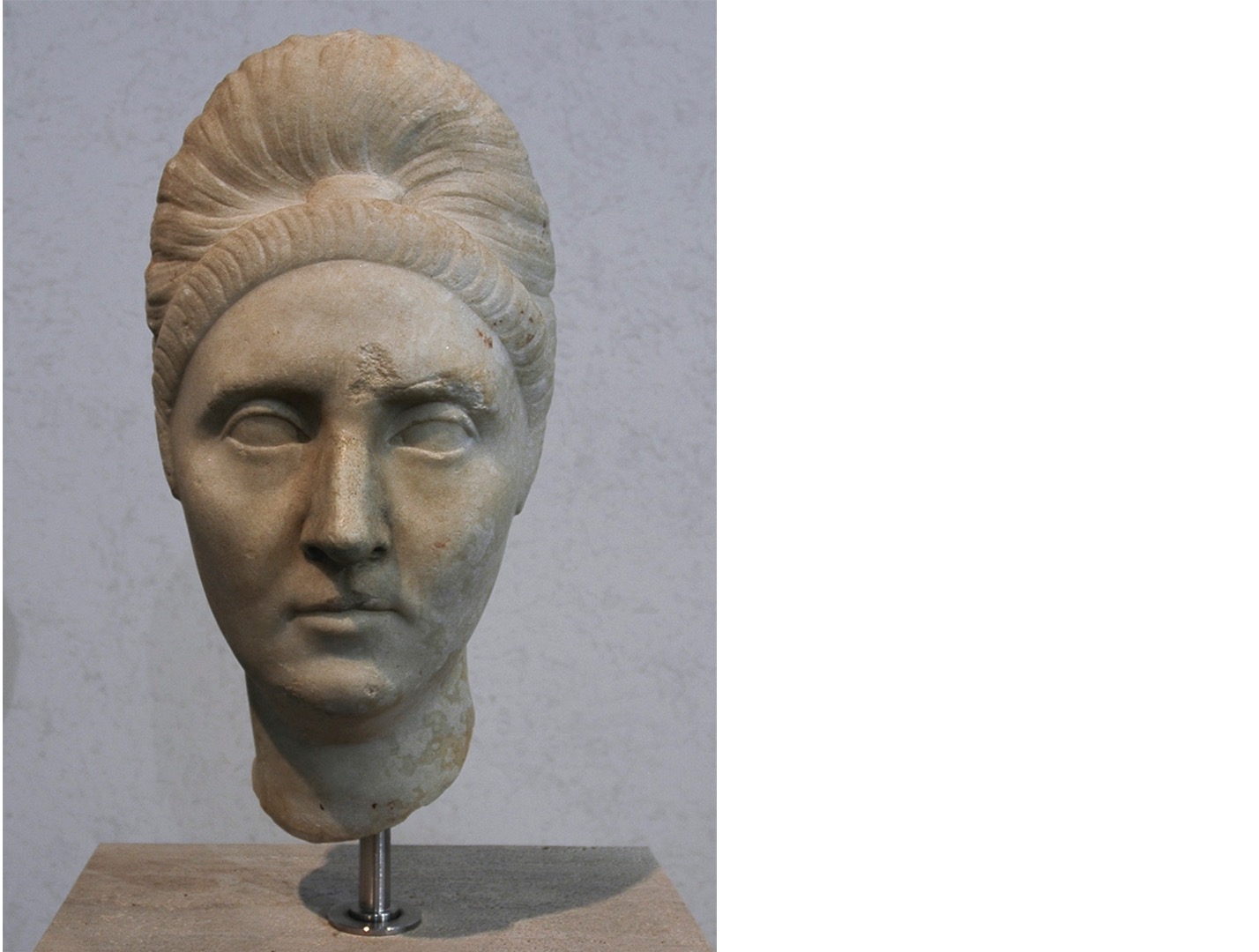
Portrait of Plotina, Trajanic, ca. 112 CE
Trajan’s wife was renowned for her virtuous nature. She is portrayed with a perfectly oval, ageless face.
•Plotina was pivotal in Hadrian inheriting the throne after Trajan’s death.
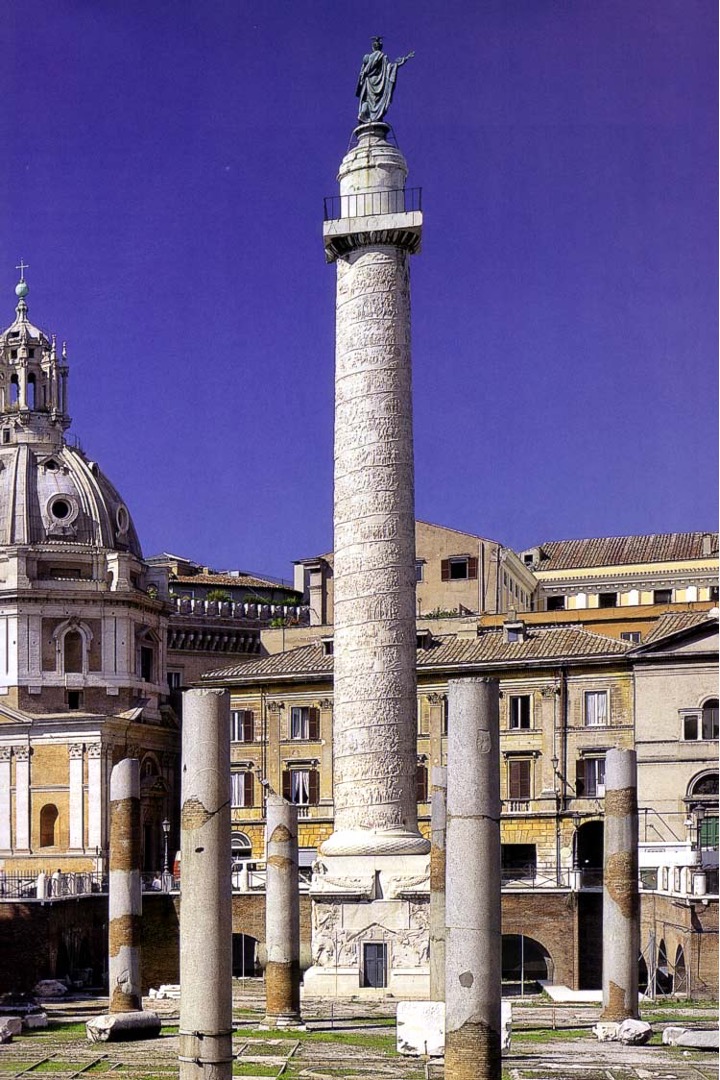
Column of Trajan,
Trajanic, 112-113 CE
The Column of Trajan stood in an open courtyard between the two libraries behind the Basilica Ulpia in the Forum of Trajan. Constructed of Luna marble, it is the first honorific column in Rome with a spiral frieze carved onto it. Free-standing columns were traditional victory monument in ancient Rome since the Republic and much of the decoration is appropriately triumphal. The frieze appears to have been carved in situ
•The helical frieze minutely carved in low relief on the outside of the shaft depicts the story of the two Dacian Wars (101-102 CE and 105-106 CE). Individual scenes represent traditional military events- the building of cities, the making of sacrifices, the adventus, the profectio, etc. and are depicted as such scenes were shown from the Augustan period onward. The designer probably also drew upon Roman triumphal paintings for inspiration. A third source may have been the illuminated scroll- we know that Trajan’s war commentaries were recorded on scrolls (i.e. the frieze in an unfurled scroll).
•. Three key scenes in the Column frieze are arranged on the vertical axis on the NW side towards the temple, whose front steps probably provided the best view of the shaft: 2nd band-Omen of Victory (at the start of the first campaign a man falls backwards off his mule watched by Trajan and his officers), 12th band-Victory writing on a shield, which signals the division between the two Dacian wars; 22nd band-Suicide of the Dacian king Decabalus- the end of the war.
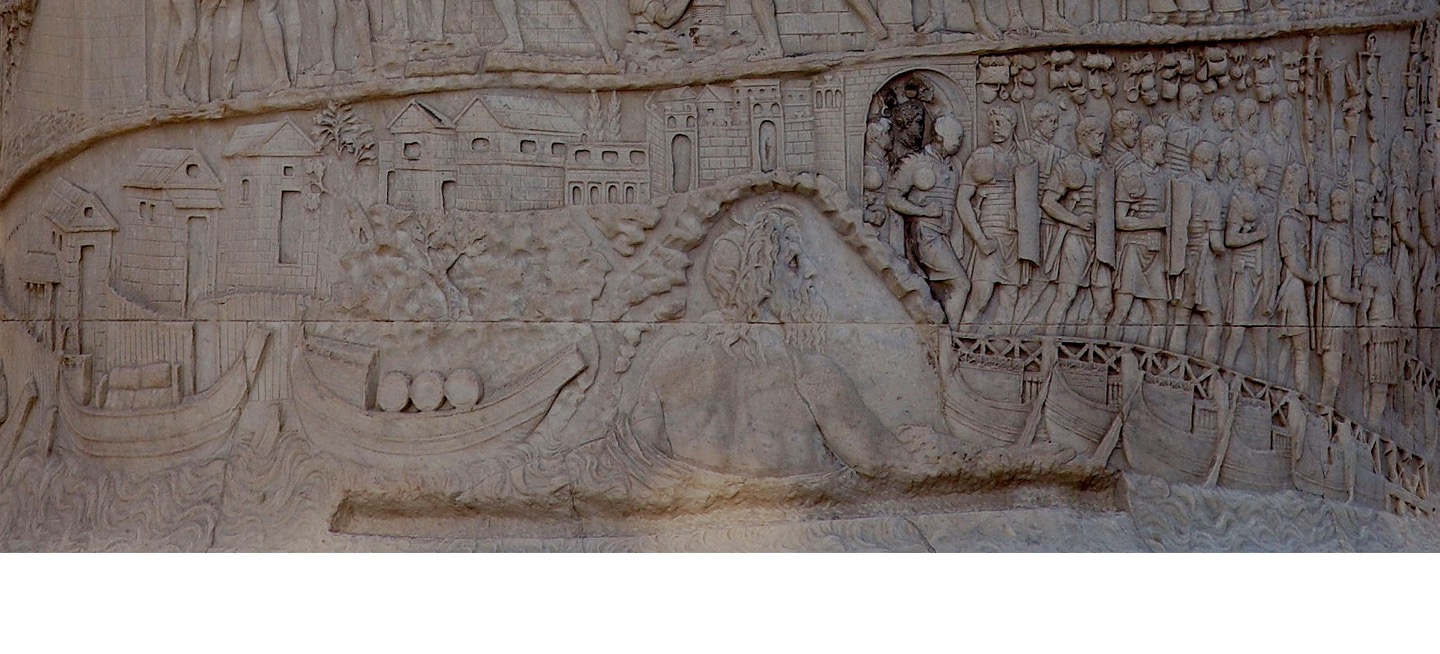
Column of Trajan: Danube Landscape,Trajanic,
112-113 CE
•The first campaign as depicted on the column begins on the Dacian frontier, where the Roman soldiers unload their provisions on the banks of the Danube. The buildings are those of a harbor town.
•The Danube River has been personified as a man wearing a crown of river reeds. It has been hypothesized that the branching “paths” or “channels” in the “rocks” behind the god’s head symbolize the canals that we know Trajan had very recently excavated along the southern bank of the river. However, this odd edging may also serve a similar function as the jagged corona-like inset-borders of a comic strip- a “flash” in short. The god is shown as benign and not at all upset at the crossing of the Romans
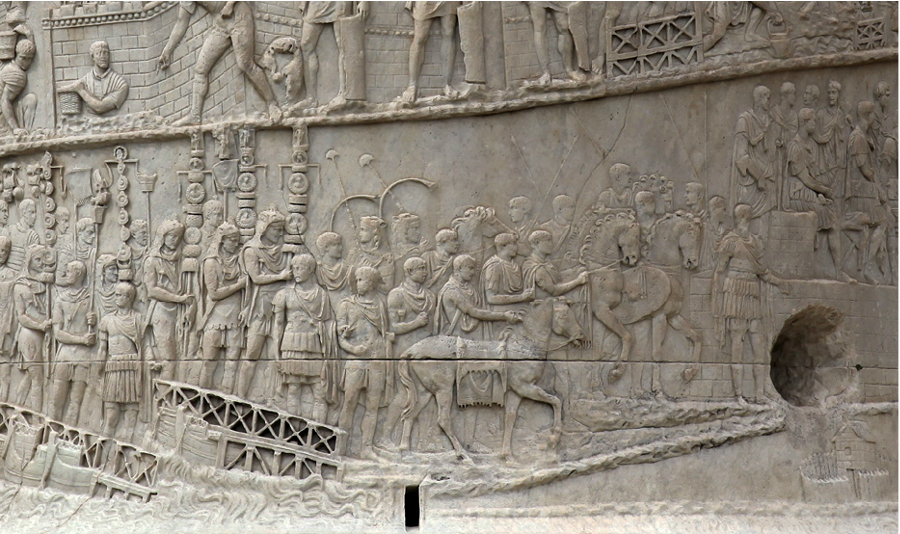
Column of Trajan: Crossing the Danube, Trajanic,
112-113 CE
bodyguard- this is the official start of the Roman invasion of Dacia. At the very front is the emperor himself.
•Here one can see the famous pontoon bridge with slats of boards laid across boats designed by Apollodorus, who was Trajan’s main military engineer and architect of the Forum of Trajan. It is unclear why there are two bridges. Did Trajan invade Dacia in 101 from two different starting points? Was there more than one pontoon bridge at one point? Or is it an artistic conceit to show the size of the invasion force or to work with the curved surface of the column?

Column of Trajan: Suovetaurilia and Dacian falling off mule, Trajanic, 112-113 CE
The suovetaurilia was a ritual sacrifice of a boar, a ram, and a bull to Mars which served to purify an army starting out on a campaign. Other circumstances when this sacrifice took place was the taking of a census and a founding of a new town.
•In the foreground on the right side, a barbarian man falls off his mule in a strangely awkward manner. Note the club (or scroll?) in the man’s right hand, also the curious pitted object on his saddle bow. Some see the round object as a cheese (or a sieve or a strainer). Perhaps it is the mushroom brought to Trajan from the Dacians and their allies that was inscribed with a message requesting that Rome desist from any military action in the region. The scene may be an expression of the superstition that the first blood to be shed presages the outcome of the entire campaign. That this is to be interpreted as a favorable omen might be suggested by Trajan’s gesture who stands on an outcropping of rock above.
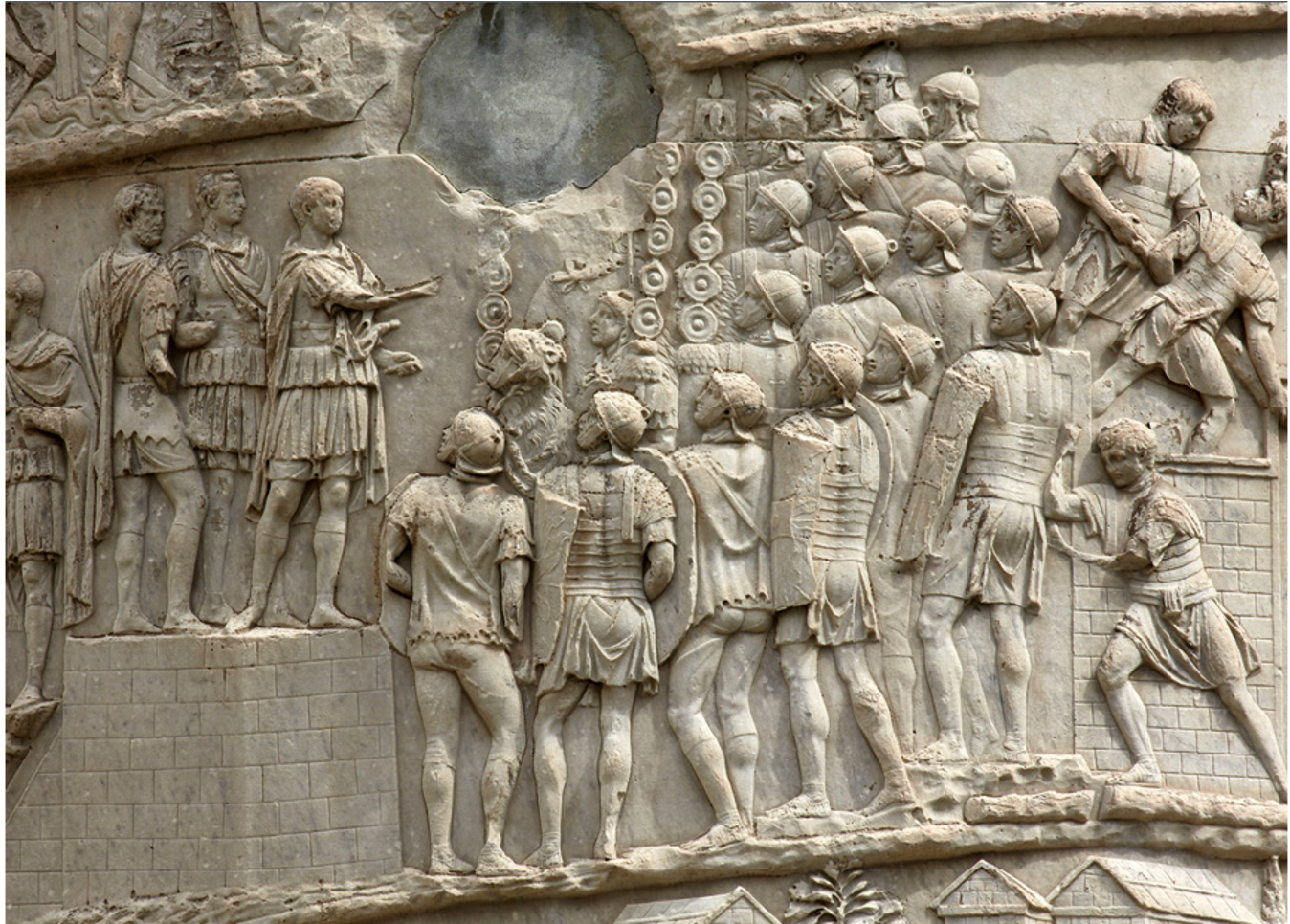
Column of Trajan: Adlocutio, Trajanic, 112-113 CE
Trajan addresses his troops before they start on their march.
This is a good example of spacing up of figures to create a sense of the crowd. Such spacing up allows the view to get the effect of each individual. This is the first time we see this kind of spacing up in imperial art, although it is used much earlier in plebian Roman art
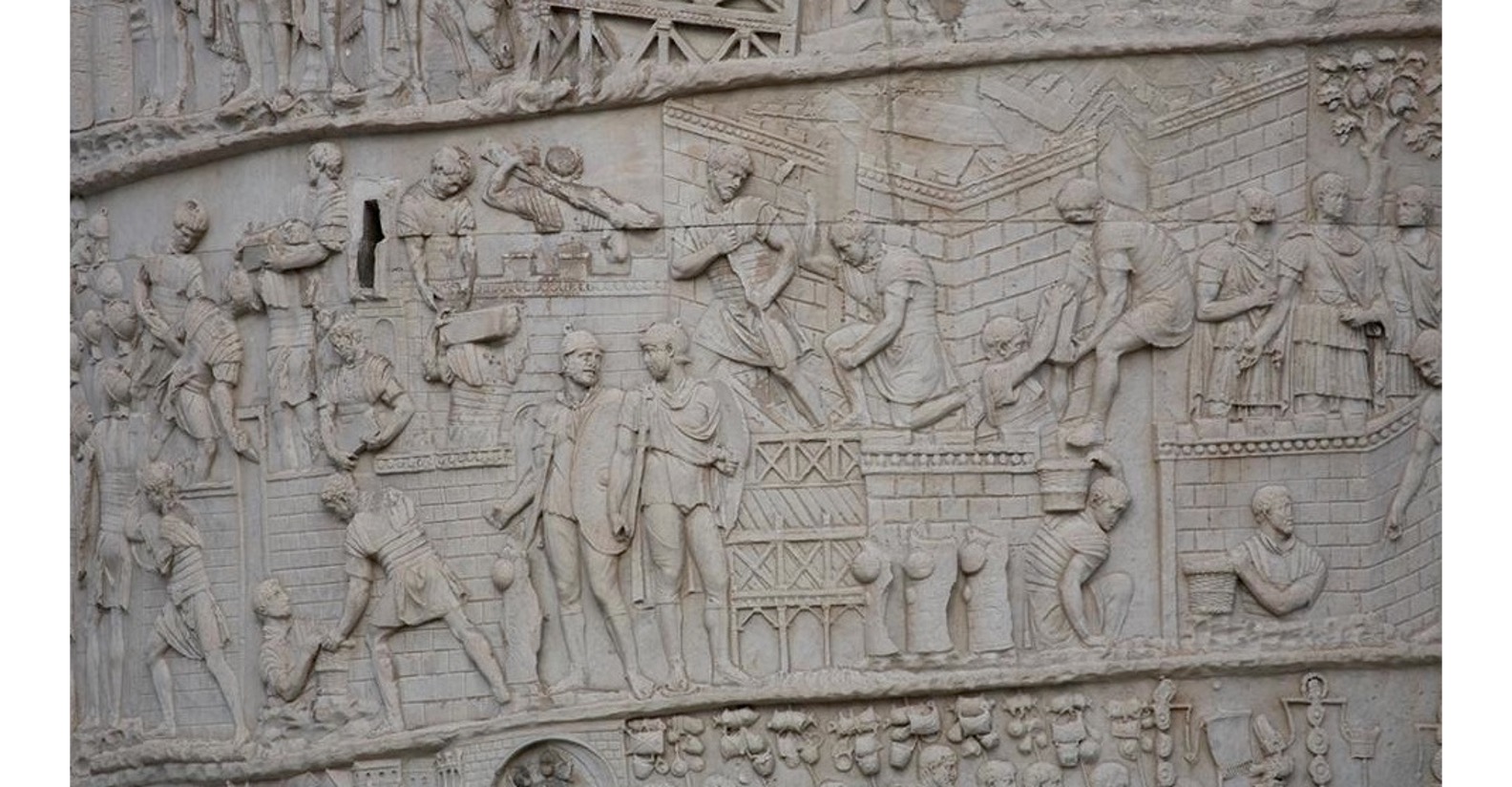
Column of Trajan: Building a fort, Trajanic, 112-113 CE
•Only about ¼ of the scenes involve a battle- most of the frieze depicts the army building forts, cities, and roads as well as transporting equipment- all elements involving preparation for battle rather than fighting. The emphasis is on depicting the efficiency and organization of the Roman army and its emperor as well as the benefits of exposure to Roman civilization (new cities, roads, and other technological comforts).
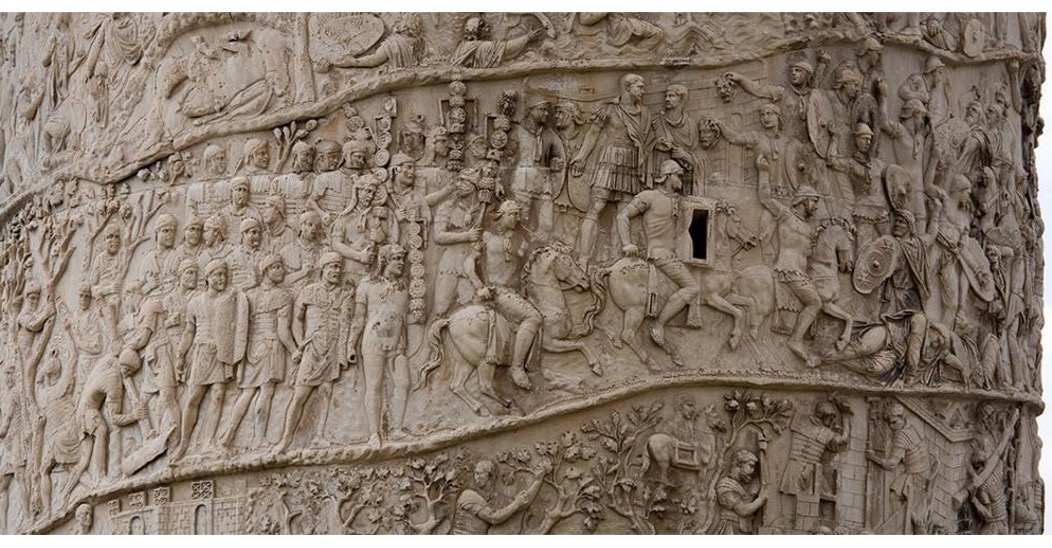
Column of Trajan: The First Battle, Trajanic,
112-113 CE
•Many of the positions of the soldiers are derived from Hellenistic battle scenes and are probably the product of pattern books.
Just above the wounded young Dacian, the brooding figure ofDecebaluslurks among the trees. Above him one can see the Dacian dragon standards are seen waving between the trees. In between him and Trajan, the battle is joined by Jupiter on high, level with the leading Roman auxiliaries. He directs his thunderbolt against the Romans’ enemies. Divinities are relatively very rare on this column and Jupiter is significant here.
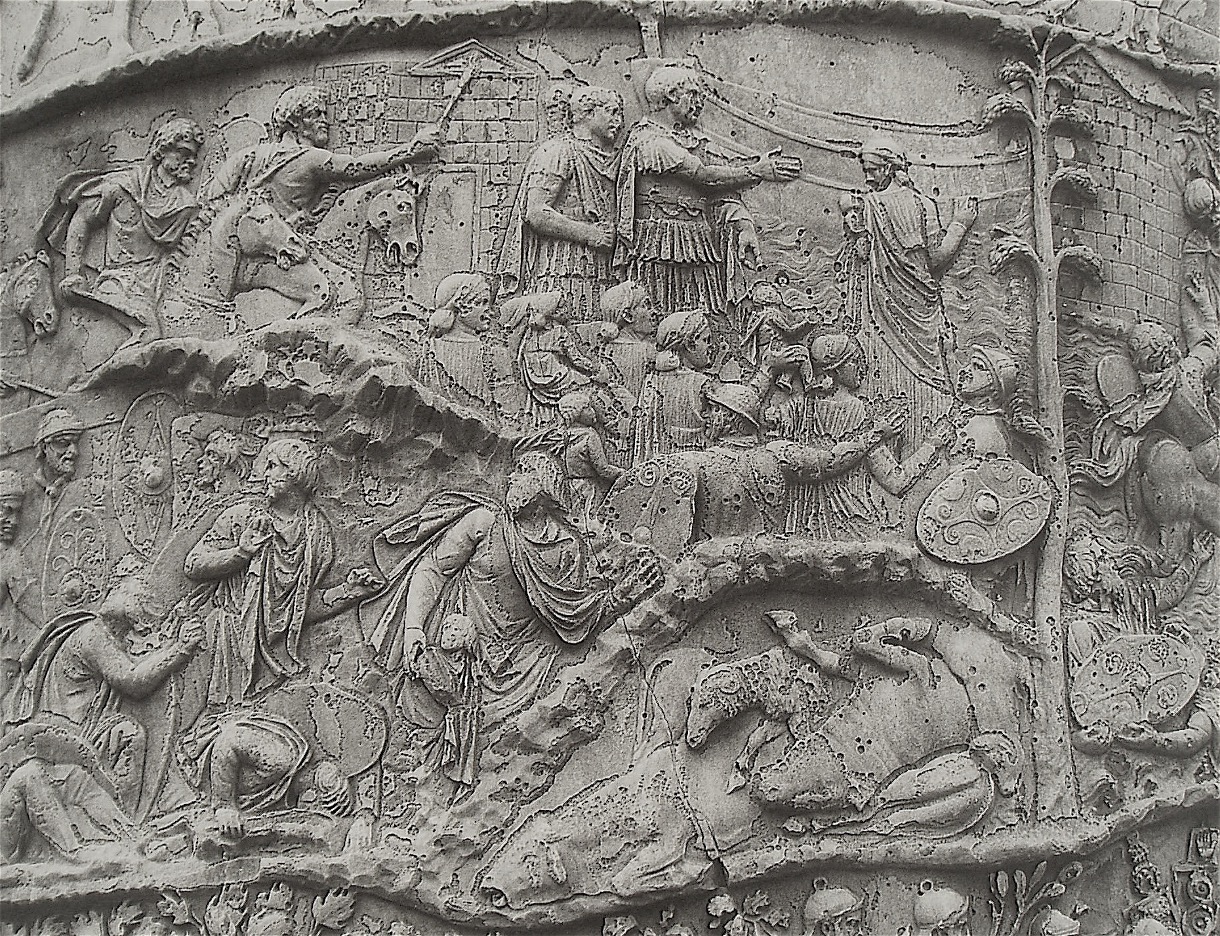
Column of Trajan: Captured Aristocratic Dacian Women, Trajanic,
112-113 CE
The noble lady at the head of her women is being led to the waiting ship that will take her away from the war. Trajan gestures towards the waiting ship. She is most often identified as Decebalus’ sister, who was captured during the first Dacian campaign. It was her capture that played a role in Decebalus’ initial surrender.
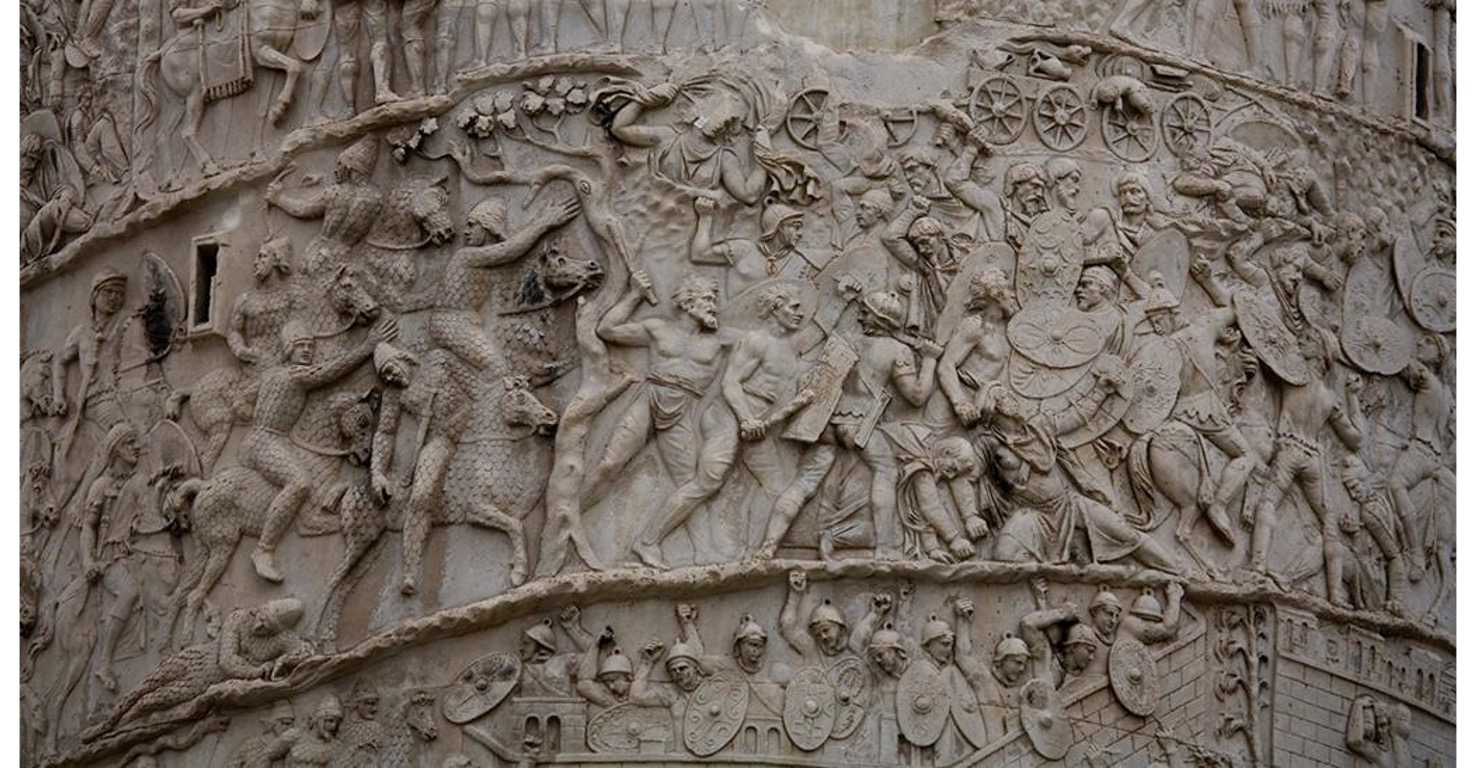
Column of Trajan: Night Battle Against the Dacians, Trajanic, 112-113 CE
•This scene is also informative about the equipment of various kinds of auxiliary infantry on the Roman side. In night-fighting, long-range weapons are of little use, clubs and swords and daggers are more to the purpose, and this is surely what the artist must be indicating here, though in absence of the original metal adjuncts it is hard to feel certain and one or two warriors seem at first sight to be leveling spears. The time of day (nighttime) is indicated by the presence of Nyx, the goddess of night, who is rather vaguely vignetted at the top left.
The Romans surprise the temporary encampment set up by theDacianswhile retreating from Lower Moesia.
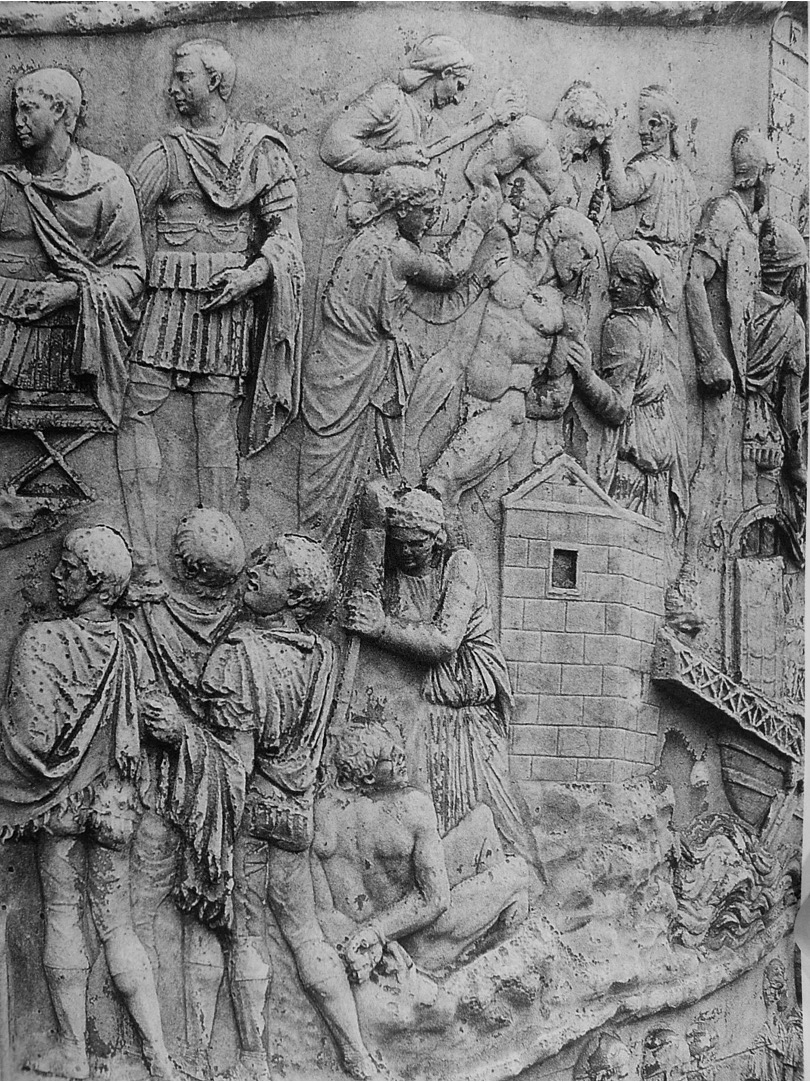
Column of Trajan: Torture of Prisoners,
Trajanic,
112-113 CE
•Five heavily draped women beat and burn three bound and naked men in a setting that is disturbingly bleak and frustrating for its lack of topographic specificity. The women seem to be characterized as non-Roman by their dress- a long-sleeved tunic, a sleeveless belted overdress, and mantle tied in front of the waist. Their hair is covered with a soft, close-fitting scarf.
This scene, one of the most controversial on the column, is usually taken as showing the contrast between the barbarousDacianand the civilized Roman ways of treating prisoners. It was originally thought that the women are widows of fallenDacianwarriors who aretorturing Roman prisoners of war, and ritual human sacrifice was a feature of theDacian religion.
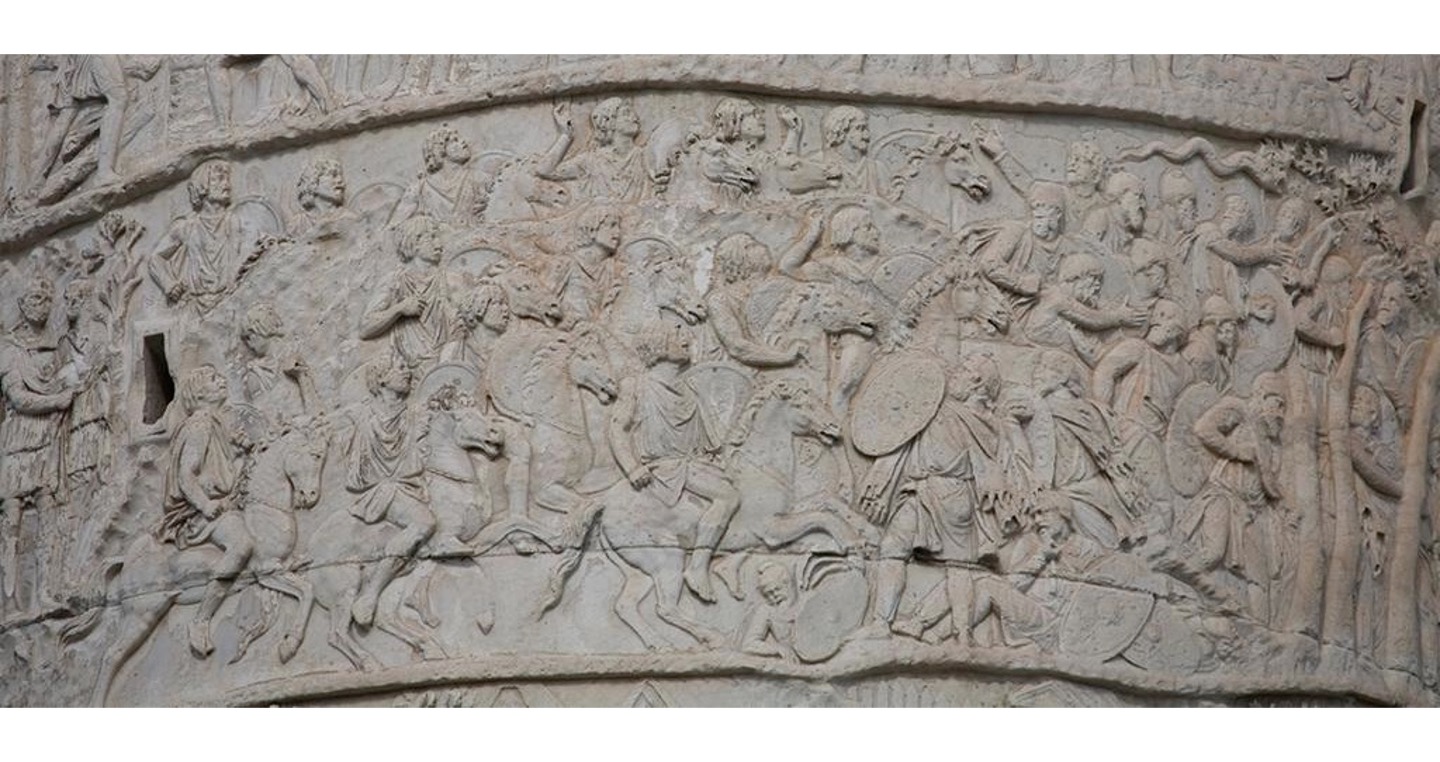
Column of Trajan: Cavalry from North Africa, Trajanic,
112-113 CE
The cavalry consists of curly-headed bare-back riders and they were unanimously (so far) identified with the Moorish irregulars mentioned by Dio Cassius as executing a decisive flanking-movement of some kind at this stage of this campaign. They seem to be attacking along three parallel tracks, with mountain-ridges between them, to converge on a large Dacian force which is thrown into extreme confusion
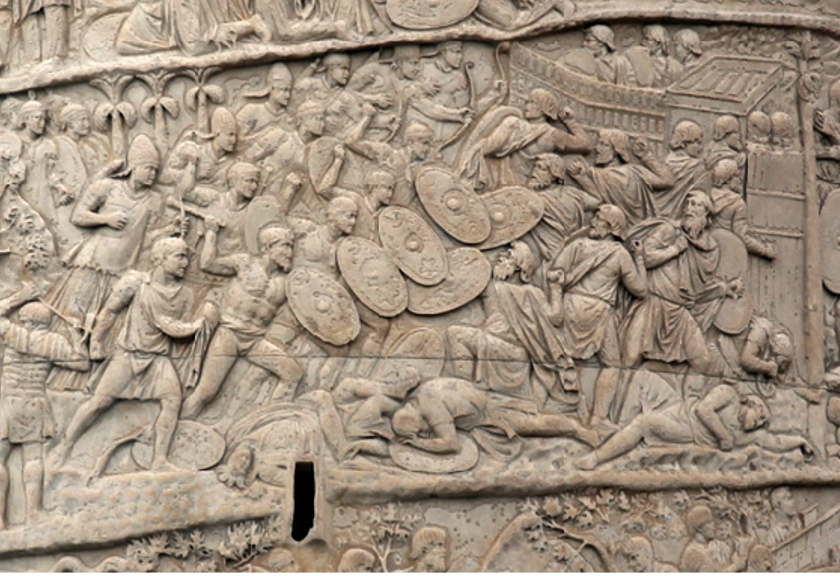
Column of Trajan: Storming of a Dacian Fortress, Trajanic,
112-113 CE
•This appears to be the artist’s first attempt to show Dacian wall construction techniques.
Note the use of the “tortoise” (testudo) maneuverin which thethe men in the front file and those at the sides of the following files kept their shield facing towards the front and sides respectively, while the remainder held their shields above their headsso as toform a roof to protect them from missiles thrown down at them by the defenders.
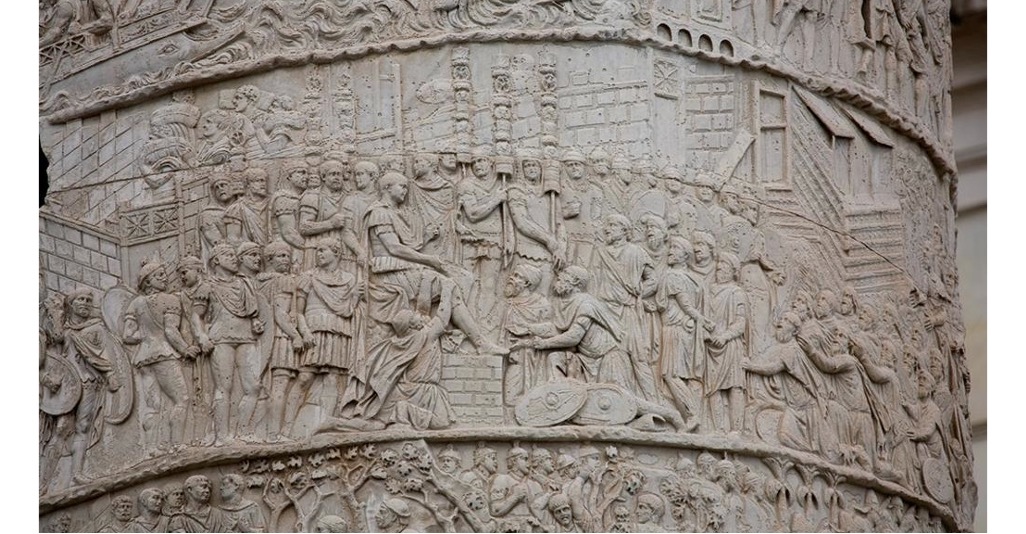
Column of Trajan: Submission of the Dacian People, Trajanic,
112-113 CE
•This scene marks the end of the First Dacian War. Near the left end, the emperor, suitably enthroned, faces forward, with his bodyguard and staff-officers at his back, and the rear of the stage is filled by Roman auxiliaries and praetorian standard bearers. No legionaries seem to be present. On the near side of the imperial throne, a single Dacian figure kneels on the ground and raises his arms in supplication. This composition is a traditional ideogram of the clementiaaugusti, a theme often featured on coins that demonstrates the mercy of the emperor toward his former enemies.

Column of Trajan: Departure of the Native Population, Trajanic,
112-113 CE
•The artist is trying to convey a number of points by means of irregularly disposed “sub-scenes” divided in a patchwork manner, and the buildings, mountains, and animals are merely stage-props with no particular topographicalsignificance.
The question is whether theDaciansin the lower half are being forced to move out of lands now confiscated by Rome or if they are fugitives from the war-zone now happily returning to their homes at the news of peace
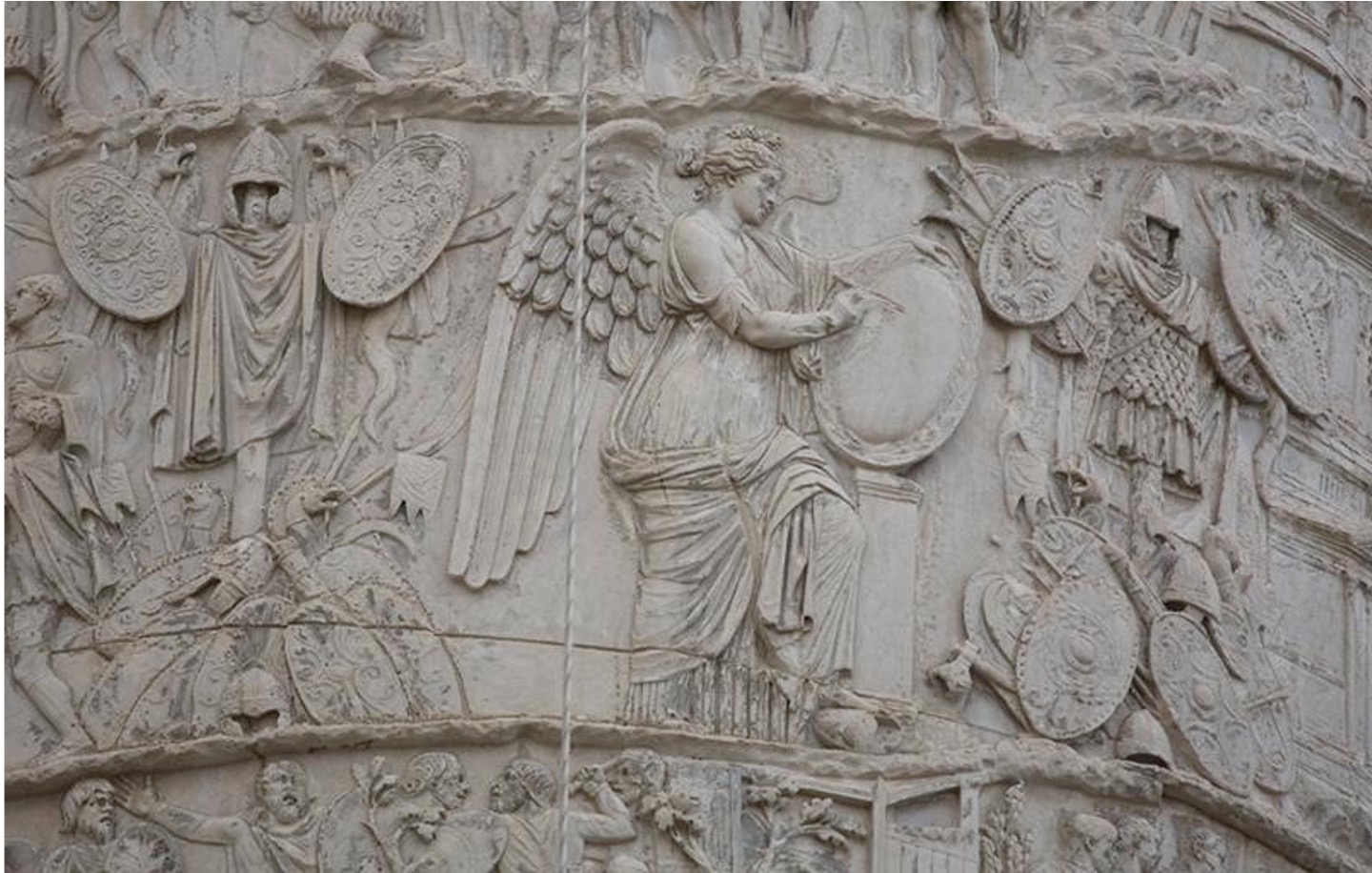
Column of Trajan: Victory and Trophies, Trajanic,
112-113 CE
•In the center a winged Victory inscribes a shield (Tallying up the scores of the war? Recording the names of those who died on behalf of the Roman state?) resting on a pillar and bordered with laurel leaves. All scholars are agreed that this elegant scene, which belongs on a different plane, far above the chronicles of human warfare to its left and right, was meant to symbolize the end of the First War. It is on the northwest side of the column, almost exactly at the half-way mark up the column.
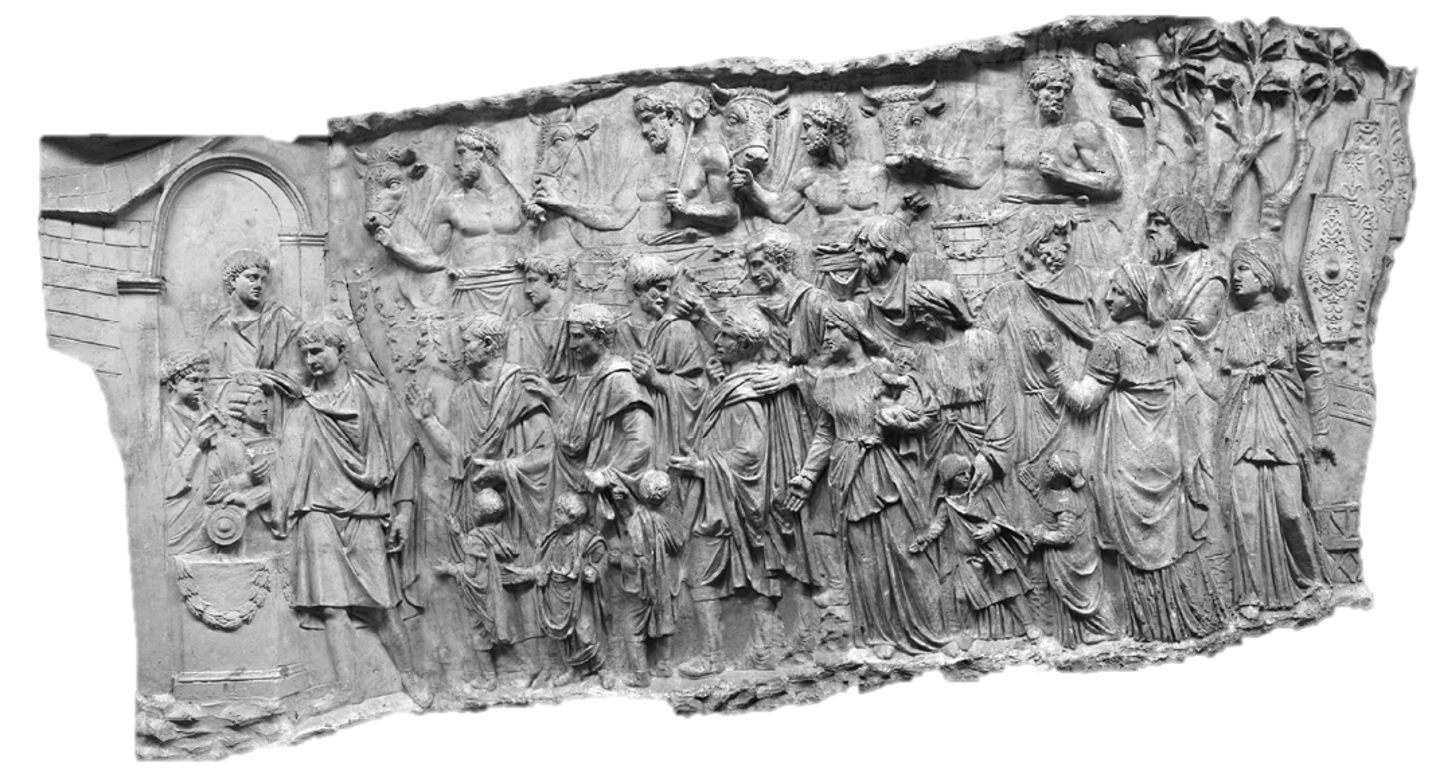
Column of Trajan: Sacrifice at Six Altars, Trajanic,
112-113 CE
•The six altars may represent the six leaders of Rome who had been deified by the time of Trajan’s reign: Julius Caesar, Augustus, Claudius, Vespasian, Titus, and Nerva.
•No other buildings are visible, but the place is clearly a religious site of major importance, and it is here that the emperor’s journey, for the moment at least, comes to a full stop, with Trajan himself in a static position and the assembled company all looking back to the left and away from what lies ahead.
•Trajan’s war against the Dacians was one of conquest and expansion whose ultimate aim was the incorporation of Dacia into the Roman Empire. In this light, one might interpret what seems to be pacified Dacian families attending the rituals of Roman state religion and peacefully coexisting with Roman families as symbolic of their potentiality as citizens, thus being an image of Roman imperialism as a civilizing influence.
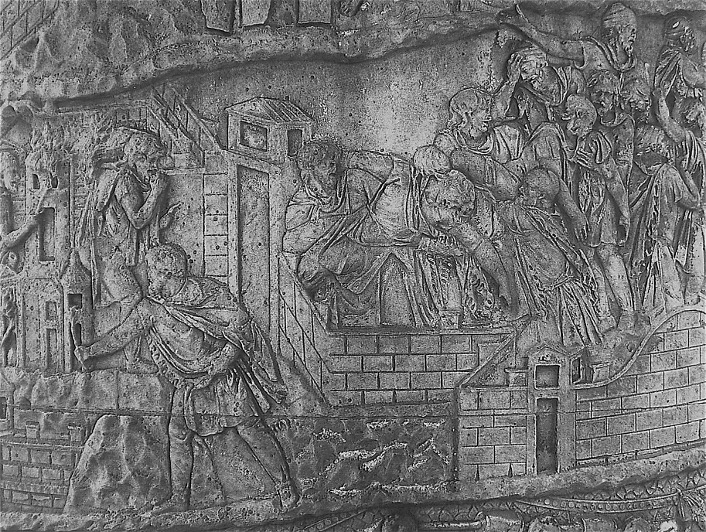
Column of Trajan: Suicide of the Dacian Noblemen, Trajanic, 112-113 CE
those who, wounded or spent by hunger, were just not fit enough to join the escapers, could then choose between poison and captivity.

Column of Trajan: Bringing In of Valuable Loot, Trajanic,
112-113 CE
•The lower right-hand animal appears to have a Dacian rider, whose head has been badly damaged at the drum-join, but whose legs are clearly covered by trousers. This could be the traitor Bikilis, involved in guiding this mixed party of legionaries and auxiliaries to the treasure’s hiding place.
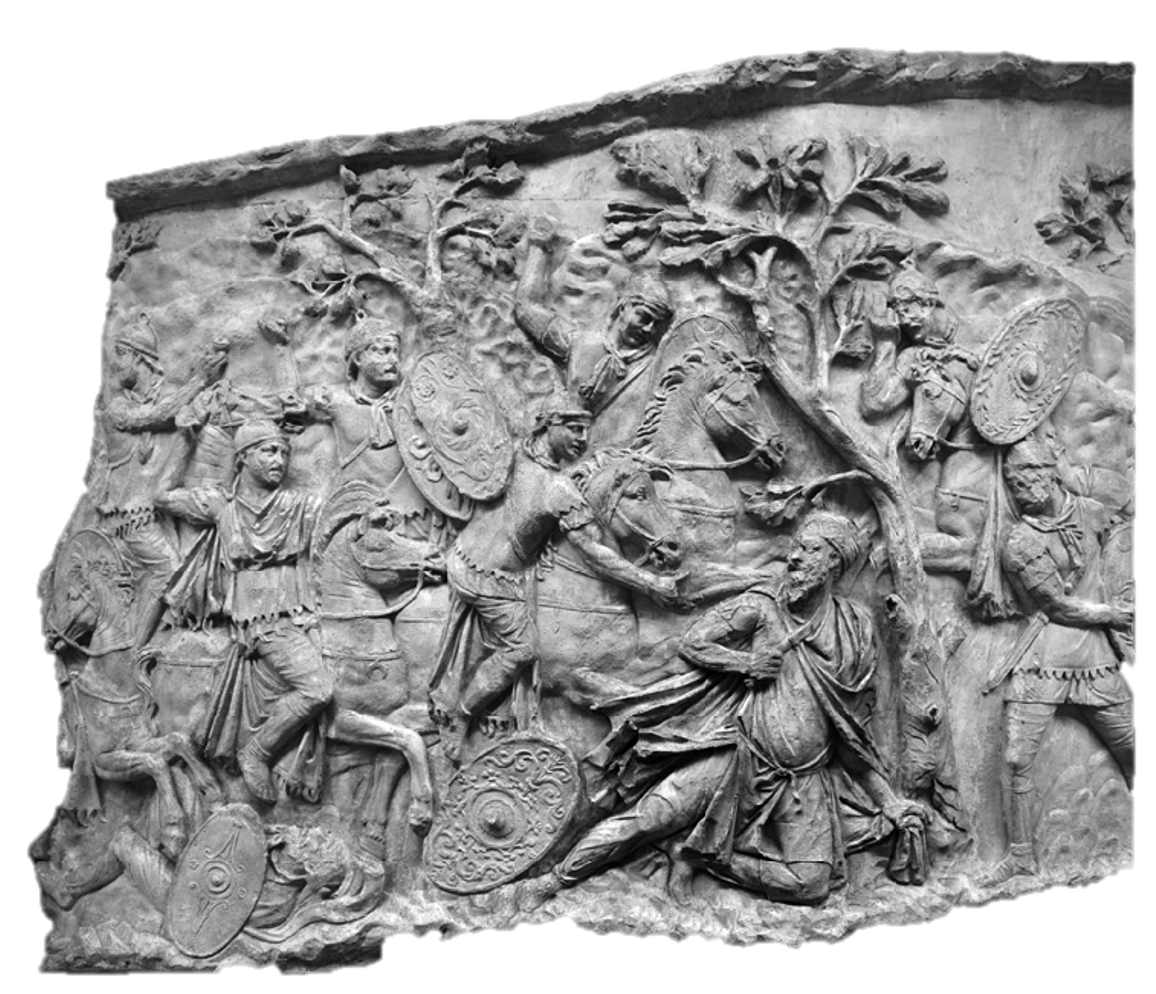
Column of Trajan: Death of Decebalus, Trajanic, 112-113 CE
•The Roman cavalrymen are about to catch up with Decebalus and have already killed two of his bodyguards, represented in the previous scene. The king kneels beneath an oak tree and slits his own throat with a long, curved sword (falx). The cavalryman trying unsuccessfully to stop him is Tiberius Claudius Maximus, whose role in this episode is portrayed (with slight variations) on his tombstone, discovered at Philippi. Two more cavalrymen converge on Decebalus from the right. One has already dismounted and is about to intervene, while the second, above, puts his hand to his head in despair.
•The Romans had hoped to take Decebalus alive in order to march him in Trajan’s triumph back in Rome before his execution as an ultimate humiliation.
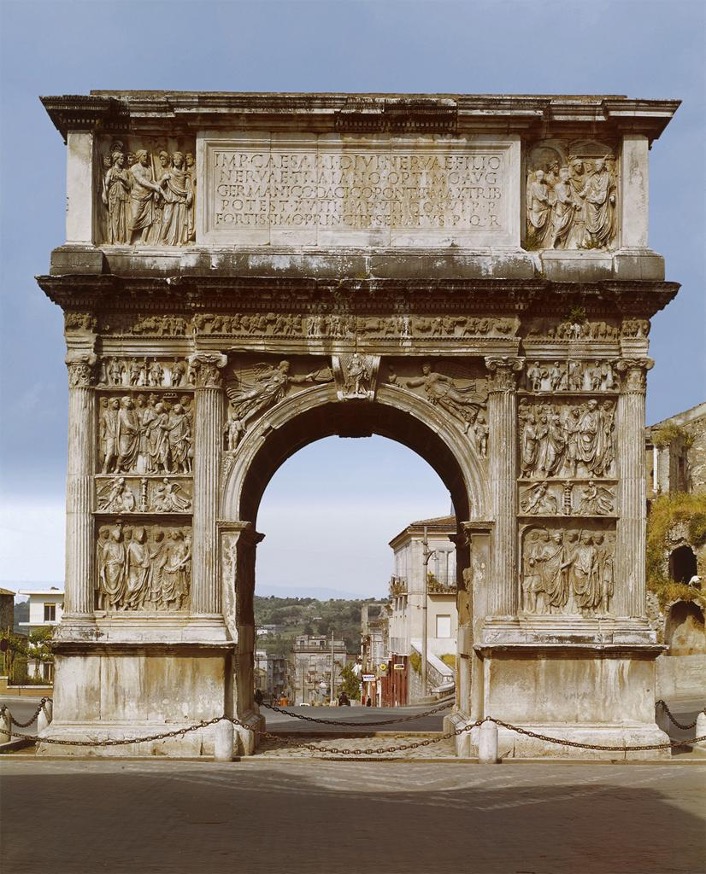
Benevento: Arch of Trajan, Trajanic, 114-118 CE
more decorated than the arch of Titus
•It is not a triumphal arch, but rather commemorates the the opening of the road leading to the port city of Brindisi, where all expeditions to the east set forth.
•The panels continue the Flavian tradition of depicting the interaction of human beings and divinities.
•The so-called “city” side faces Rome, while the “country” side faces away.
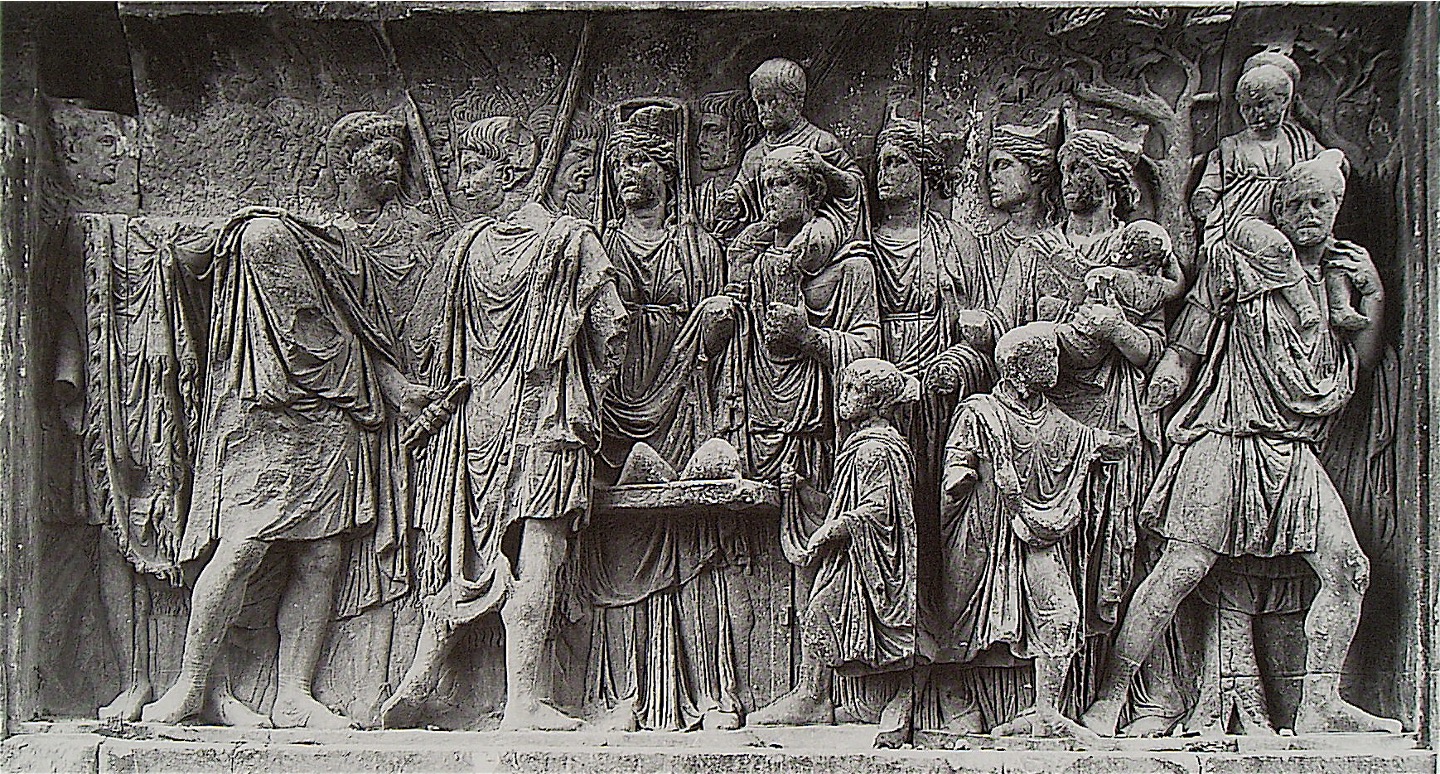
Benevento: Arch of Trajan- Interior, Alimentaria Panel, Trajanic, 114-118 CE
•Located in the central bay, the emperor, dressed in a short tunic covered by a mantle, stands on the left side of the relief. Before him are four female personifications of cities (Tyches) with crenellated crowns on their heads. Also portrayed are needy children, from babes in arms to 5-6-year olds, one held by one of the Tyches and two on their fathers’ shoulders.
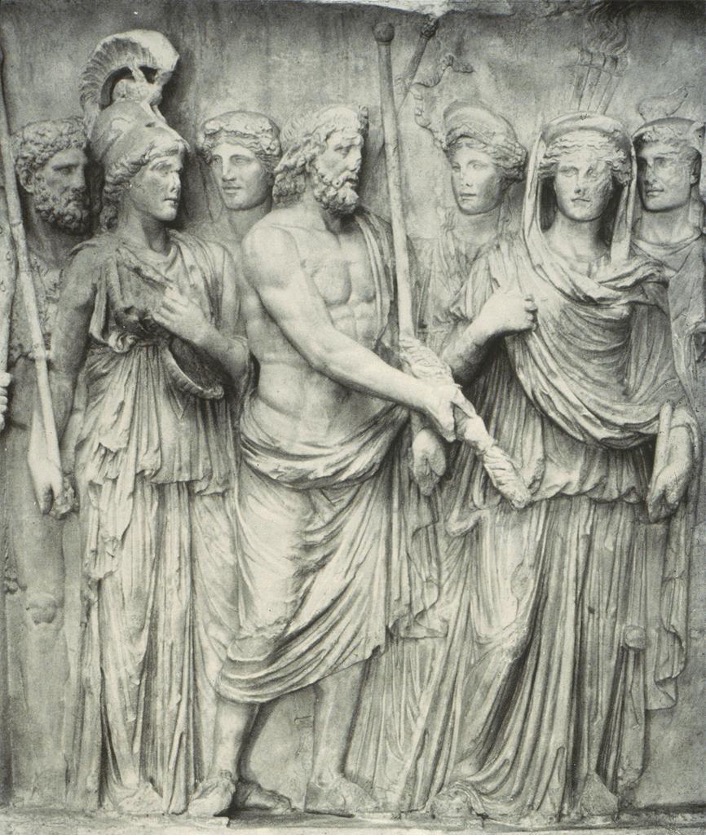
Arch of Trajan at Benevento: City Side- Attic, Adventus with Hadrian, Trajanic, 114-118 CE
•This adventus is that of 107 CE after the end of the Dacian campaign. In the left panel, the Capitoline Triad “greet” Trajan, who appears on the right panel. Jupiter with his right hand offers his thunderbolt to a toga-wearing Trajan, in a sense reaching across or behind the inscription plaque to hand this thunderbolt to Trajan, who is now a divus. Trajan receives this power before a Roman backdrop- he stands in front of the Capitolium (temple of Jupiter, Juno, and Minerva on the Capitoline Hill) with an arch nearby.
Most significant is the young, bearded male figure who is portrayed as an equal to Trajan in stature and stands on Trajan’s right. Both men turn their heads toward one another as if linked in a special way. The younger man is dressed in a breastplate, whereas Trajan istogate. The man’s beard and physiognomy identify him as Hadrian
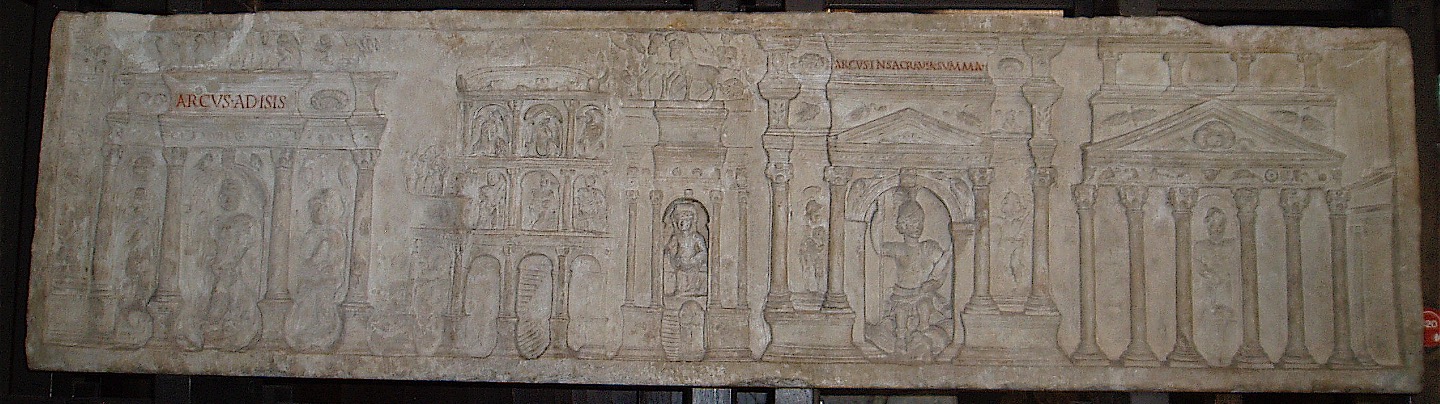
Tomb of the Haterii, Trajanic,
ca. 100 CE
During the late 1st century CE, freedmen tombs become quite elaborate with inscriptions providing abbreviated biographies of the deceased, giving such details as age, profession, family lineage, etc. as well as pictorial illustrations of the characteristic activities of the deceased during his or her lifetime. This tomb is either late Flavian or early Trajanic. It stood in a walled funerary garden ornamented with sculpture. It is not certain how all the surviving reliefs went together
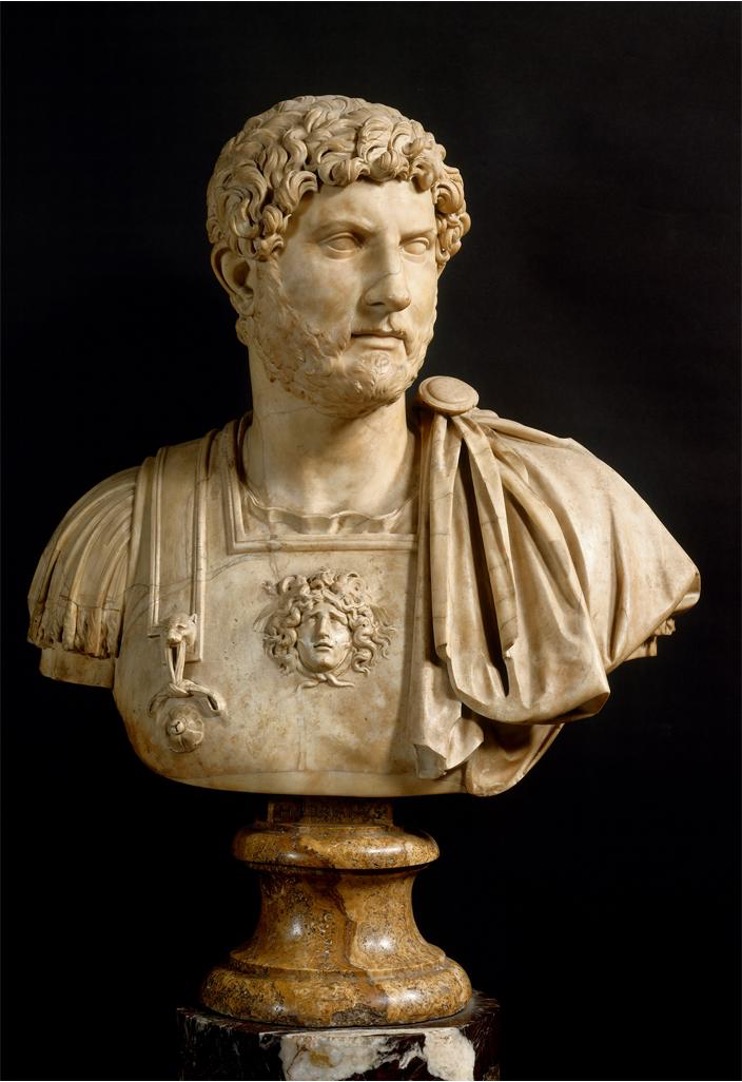
Portrait of Hadrian, Hadrianic,
ca. 117-138 CE
Trajan’s adopted successor
loved Greek culture, was not interested in military, depicted young, but with a beard!
Another innovation in portraiture in the Hadrianic period was the drilling of the pupil and iris of the eye.
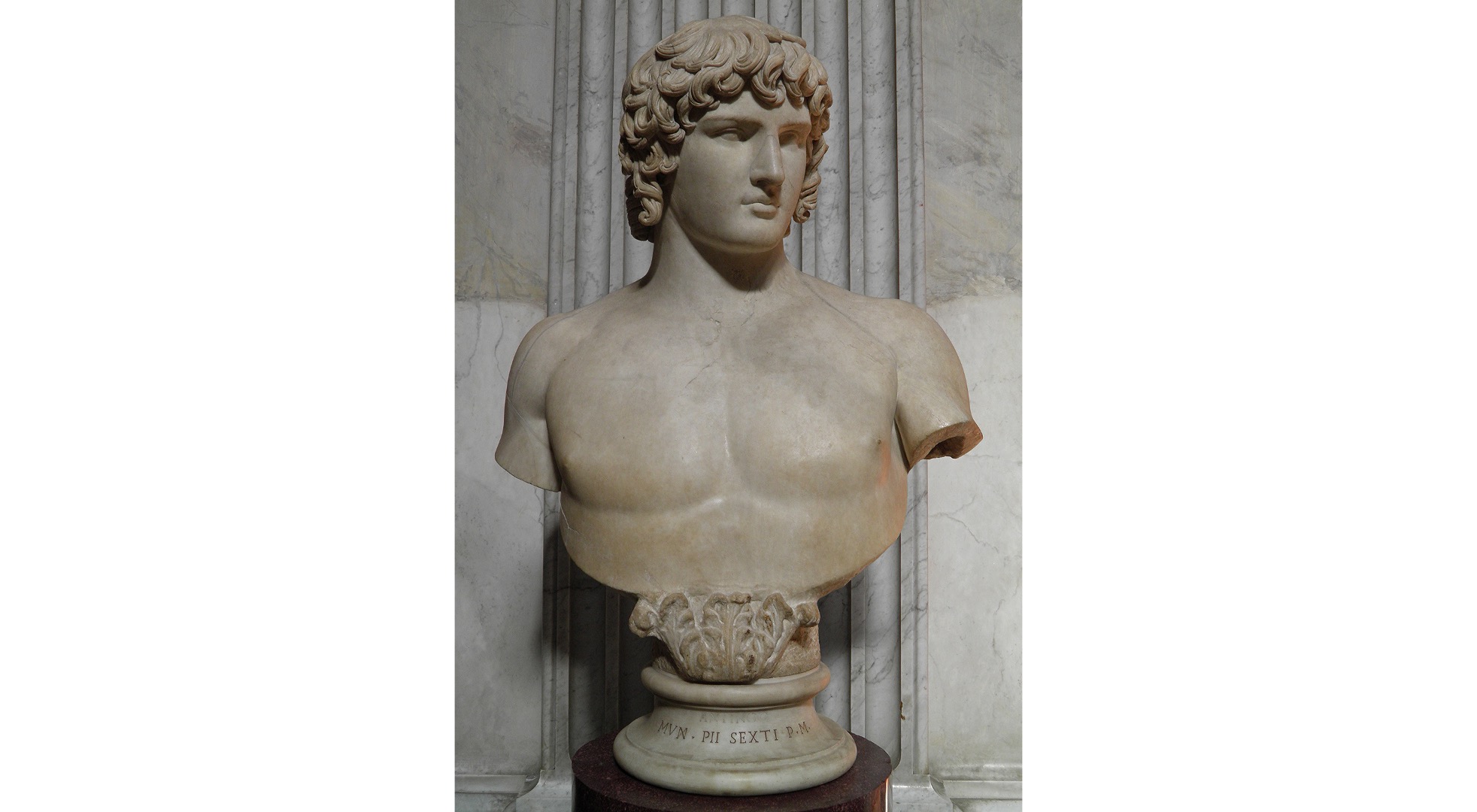
Portrait of Antinous, Hadrianic,
after 130 CE
Although Hadrian married his wife Sabina in 100 CE, the great love of his life was a beautiful young boy named Antinous
•He was born between 110 and 112 CE and accompanied Hadrian on some of his travels, including Hadrian’s ill-fated trip on the Nile in 130 CE when Antinous drowned. Some say the boy committed suicide, while others say that he gave his life to save Hadrian’s. Hadrian mourned him deeply, and insisted that he be deified, which he was in the eastern part of the Empire. Numerous statues of the young man were commissioned to be used in the worship of this cult.
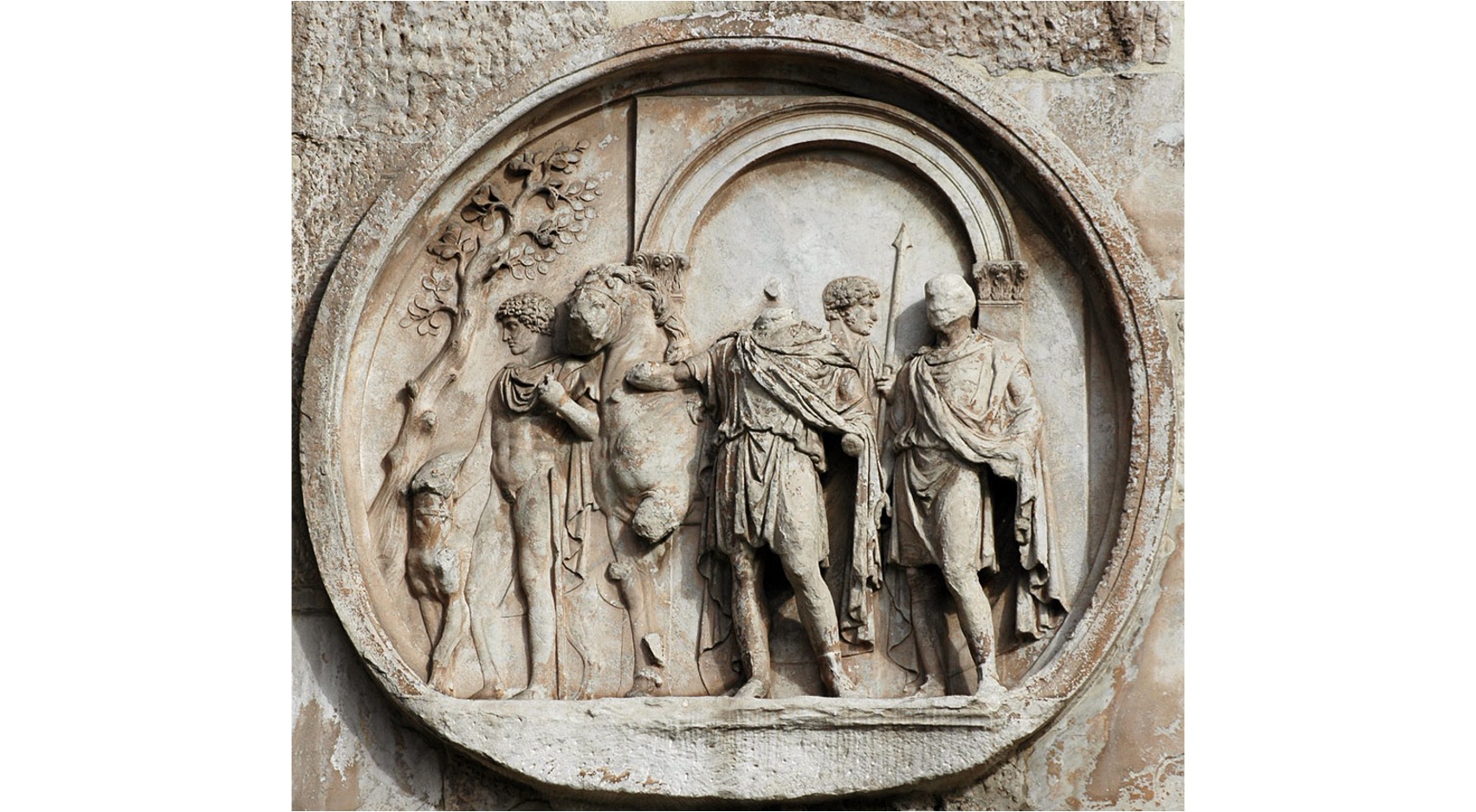
Arch of Constantine: Departure Tondo, Hadrianic,
130-136 CE
Hadrian was very fond of hunting and a monument commemorating this imperial hobby and also Hadrian’s travels was erected in Rome during his reign. This monument no longer survives, but eight tondi (round reliefs) that decorated it were reused in the Arch of Constantine.

Arch of Constantine: Lion Hunt Tondo, Hadrianic,
130-136 CE
•The four hunting tondi depict Hadrian in pursuit of different animals: bear, boar, and lion. The variety of garments and animals in the tondi suggest that the hunting scenes take place in different parts of the Roman world and that Hadrian’s travels with and without Antinous are re-enacted.
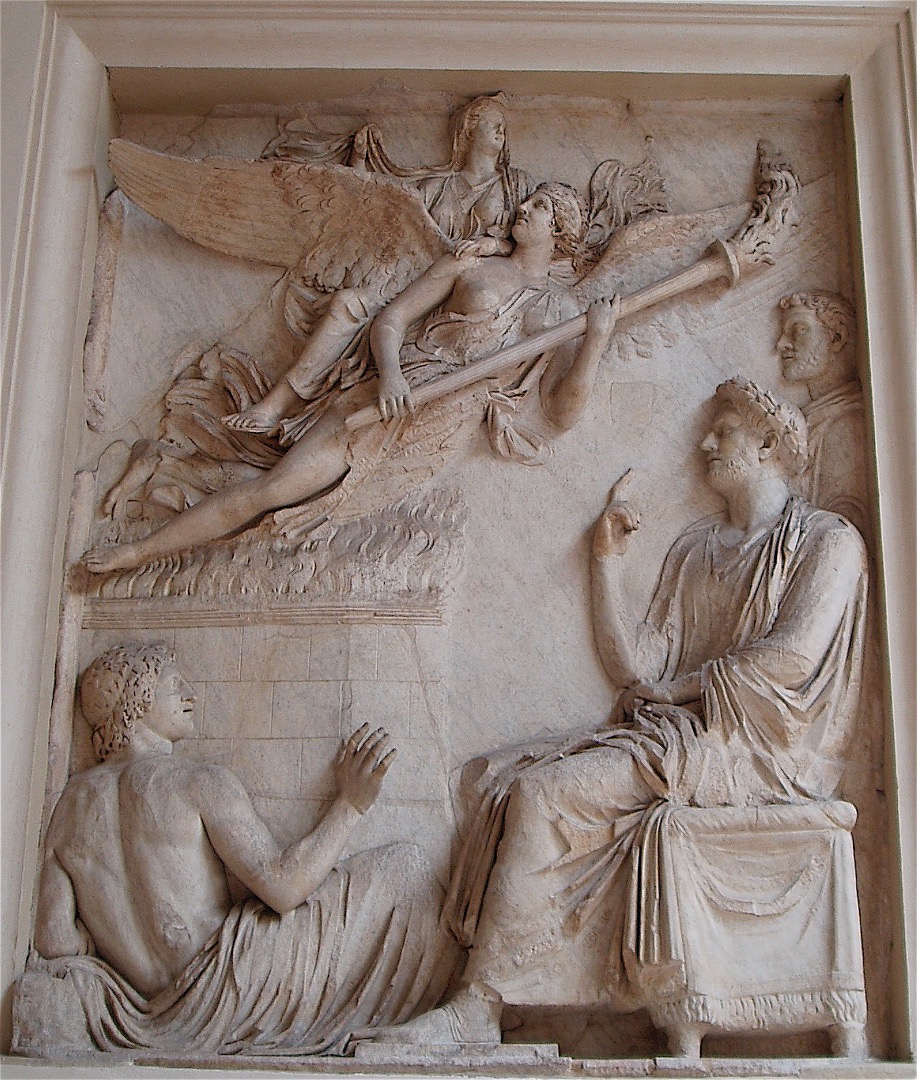
Arco di Portogallo: Apotheosis of Sabina, Hadrianic, 136-138 CE
This is one of the latest of the Hadrianic state reliefs. Here one can best see a distinctive Hadrianic style in state relief sculpture, marked by a preference for classicism. The original monument seems to have been to honor Sabina, Hadrian’s wife- she is deified and classicized
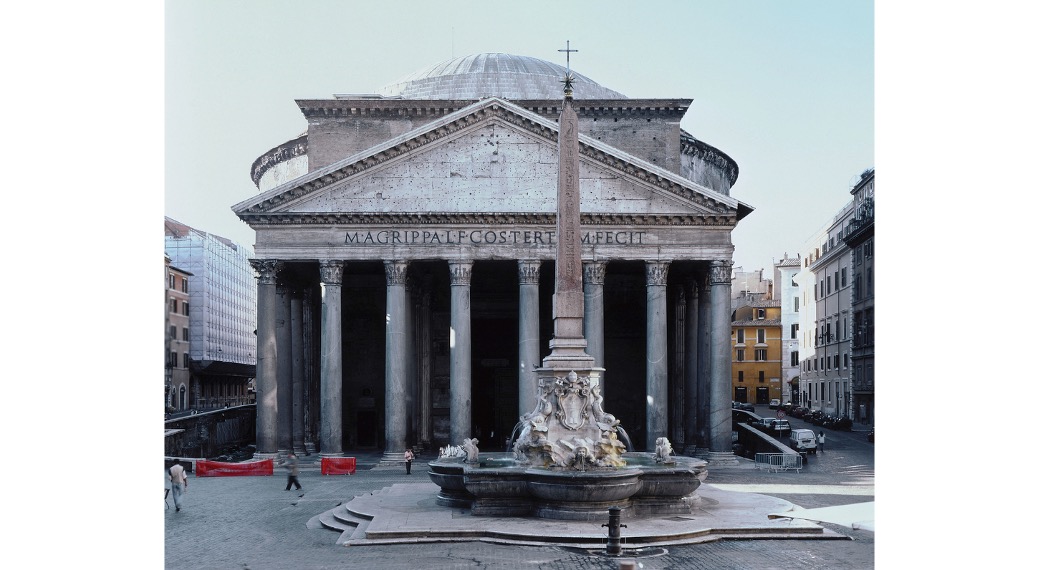
Rome: Pantheon, Hadrianic, 118-125 CE
concrete dome, oculus, traditional temple facade
•This is one of the most magnificent architectural monuments of antiquity. Even today its domed interior space inspires a special awe, not only because of its size (it held the world record for a concrete span until the CNIT building in Paris in 1958) but also the quality of the light, color, and sound. The building survived mainly because it was converted into a church in 608 CE (St. Mary of the Martyrs), but even more to the extraordinary strength and stability of its construction.
•This was the third “Pantheon” on the site. The first was build by Marcus Agrippa in 27-25 BCE and was destroyed in the great fire of 80 CE. It was rebuilt by Domitian, but it was struck by lightning and burned in 110 CE. Hadrian (as was his practice in all the buildings he restored or rebuilt in the city, with the exception of the Temple of Deified Trajan) did not dedicate the new Pantheon in his own name, but in that of the original dedicant; thus, the bold inscription on the front reads: M. AGRIPPA L.F. COS TERTIUM FECIT (Marcus Agrippa, son of Lucius, made this in his third consulship).
•The blank pediment should be filled with gilded bronze appliqué, and the pattern of holes suggests may have been an eagle and wreath (the attributes of Imperial Jupiter).
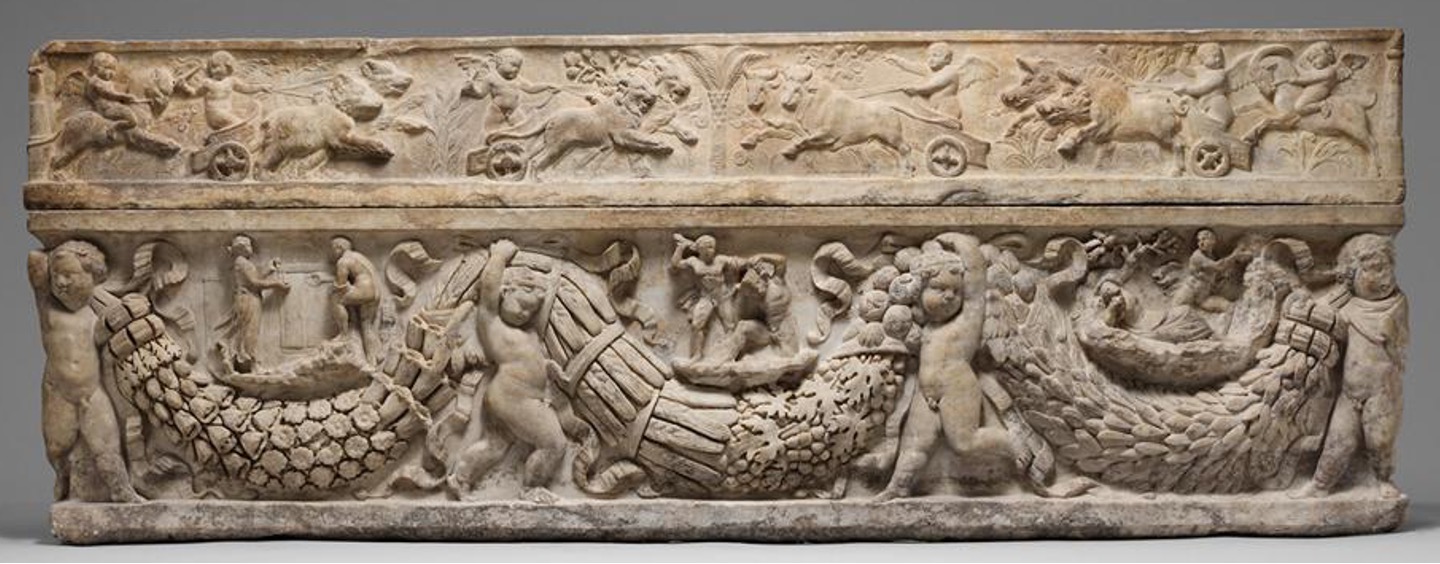
Garland Sarcophagus with Theseus and Ariadne, Hadrianic, 130-150 CE
•Not only did sarcophagi offer a more secure burial for the body that had housed the immortal soul, but a sarcophagus provided more space for the increasingly desired elaborate decoration that could serve to express the intensified eschatological hopes of the later Roman world, developed in mystery cult worship.
Sarcophagi provide the largest single body of sculptural material in Roman art in which we may study both the style and the subject matter of the art of the later Roman Empire when there are few other monuments with pictorial reliefs to which we can turn.
During the Hadrianic period, sarcophagi began to be produced in great numbers not only in Rome, but in major cities around the empire.
•The Seasons – also embodied in the changing elements of the garland – can represent nature’s cycles of death and rebirth, or of the successive stages of human life, thus making it an appropriate subject for a funerary context.
•The frontal panel of this sarcophagus is decorated with four winged putti carrying a heavy chain of garlands. They fill the height of the panel and move in a lively manner across the shallow relief plane. Above the swags are three stock mythological scenes taken from the story of Theseus and Ariadne. On the left Ariadne gives the thread to Theseus who stands in front of the entrance to the Labyrinth. In the center, the hero struggles with the Minotaur inside the labyrinth. On the right, the hero abandons Ariadne on Naxos. The subject of Ariadne and Theseus might be puzzling for a funerary monument, but Ariadne is found by Dionysos, who awakens her to a new and happy immortal life as his wife.
The four chubby cupids of the main frieze also have seasonal meaning and as such are the forerunners of the Seasons on Season sarcophagi, in independent iconographic type that begins early in the 3rdcentury
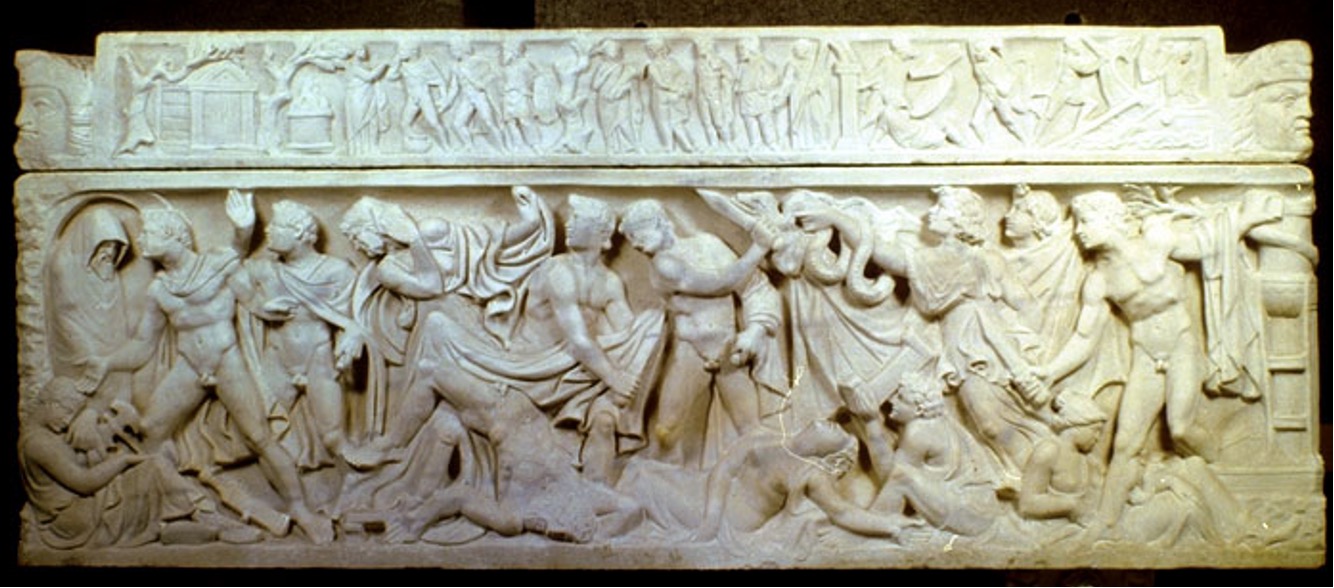
Orestes Sarcophagus, Hadrianic,
132-134 CE
One can see the trials of Orestes as signifying the trials of the deceased on earth, while the promise of his purification in the Delphic episode provides hope for the deceased spirit
Orestes must escape with sister and statue of Artemis
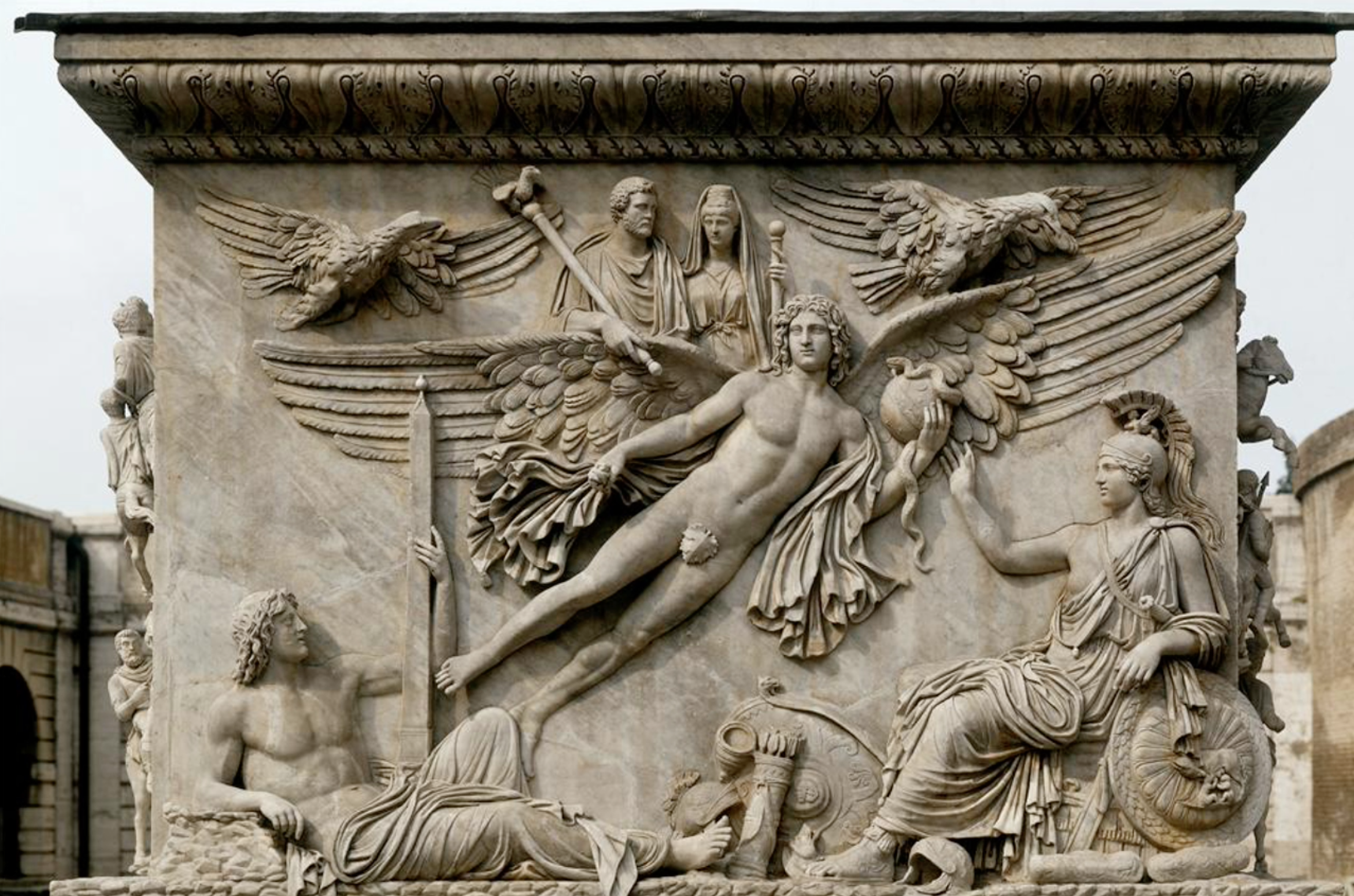
Rome, The Column of Antoninus Pius: Apotheosis of Antoninus Pius and Faustina, Antonine, ca. 161 CE
Antoninus was adopted by Hadrian, became emperor, peaceful emperor/reign, not a military leader,
constructed to honor him, sculpted reliefs and dedication
Antoninus and wife, shown as Jupiter and Juno, Roma, eagles, she wolf, deification,
they are carved as busts, typical in plebeian art
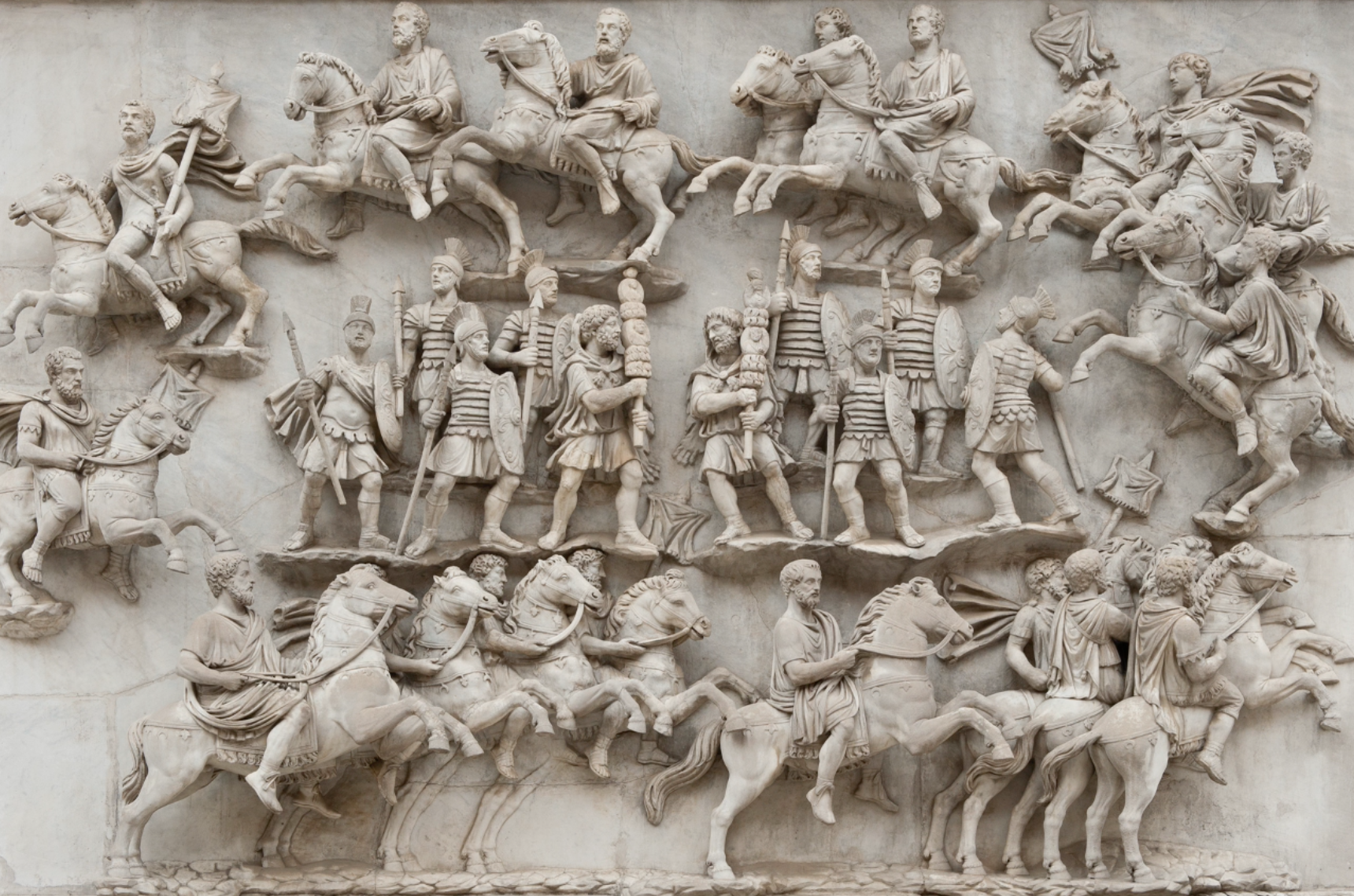
Rome, The Column of Antoninus Pius: Decursio, Antonine, ca. 161 CE
funeral procession, army and horses, circling legionary soldiers , Birds Eye view perspective, non classicized , plebeian art style taken by upper class
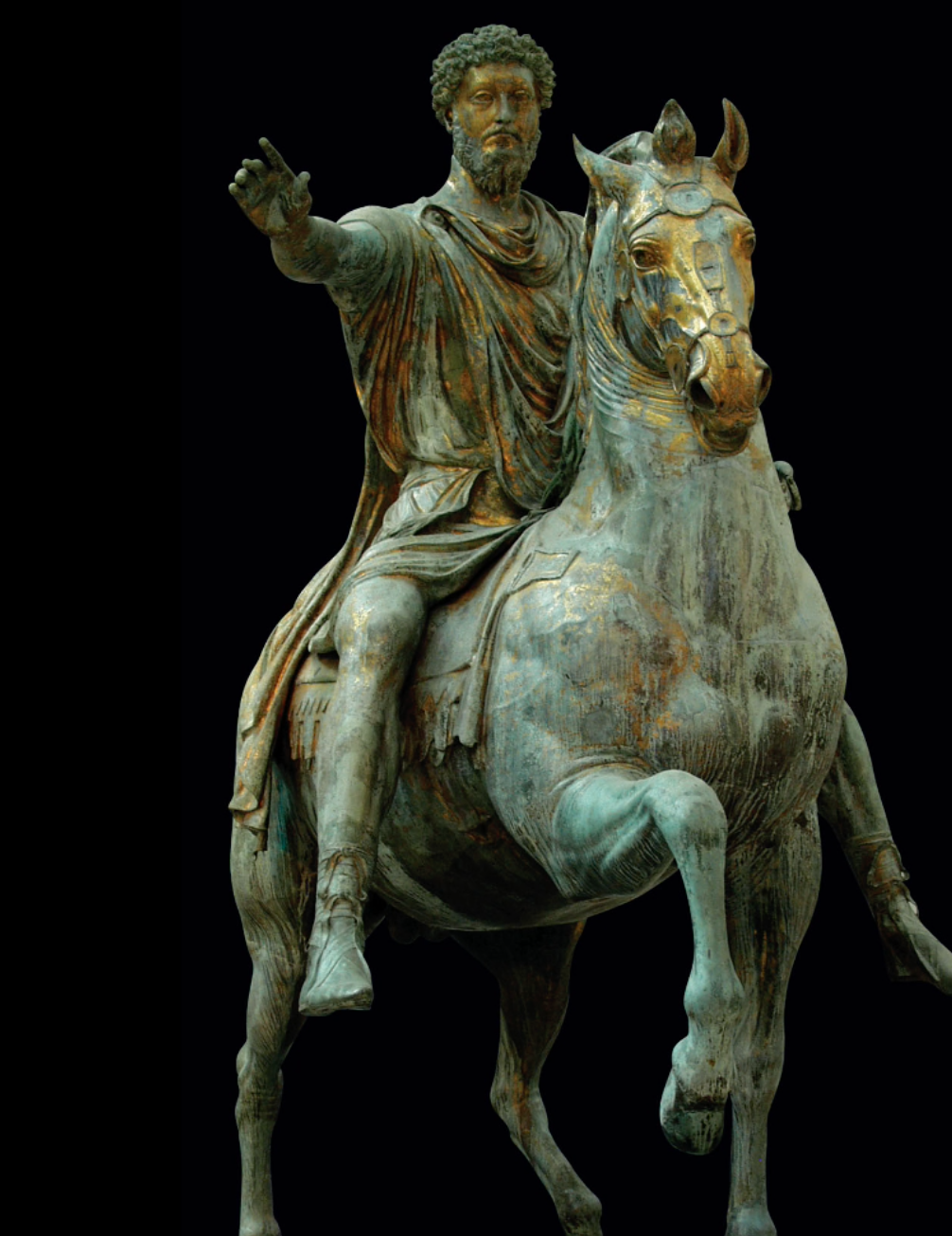
Equestrian Portrait of Marcus Aurelius, Antonine, ca. 176 CE Bronze, (survives because it was believed to be a portrait of Constantine)
orator pose, civilian dress, horse is being reigned in- possible missing piece of statue (maybe someone about to be trampled, like a barbarian)- showing him as being merciful
close with royal family, Antoninus’s brother in law
favored by Hadrian
only successful corulership with brother
revolts in Britain and Syria etc, much military battle
many portraits throughout his aging, modeled after Antinuous, Hadrians lover
in this period, psychological state of emperor is being shown in portraiture- showing his increasing distress about war in portraits
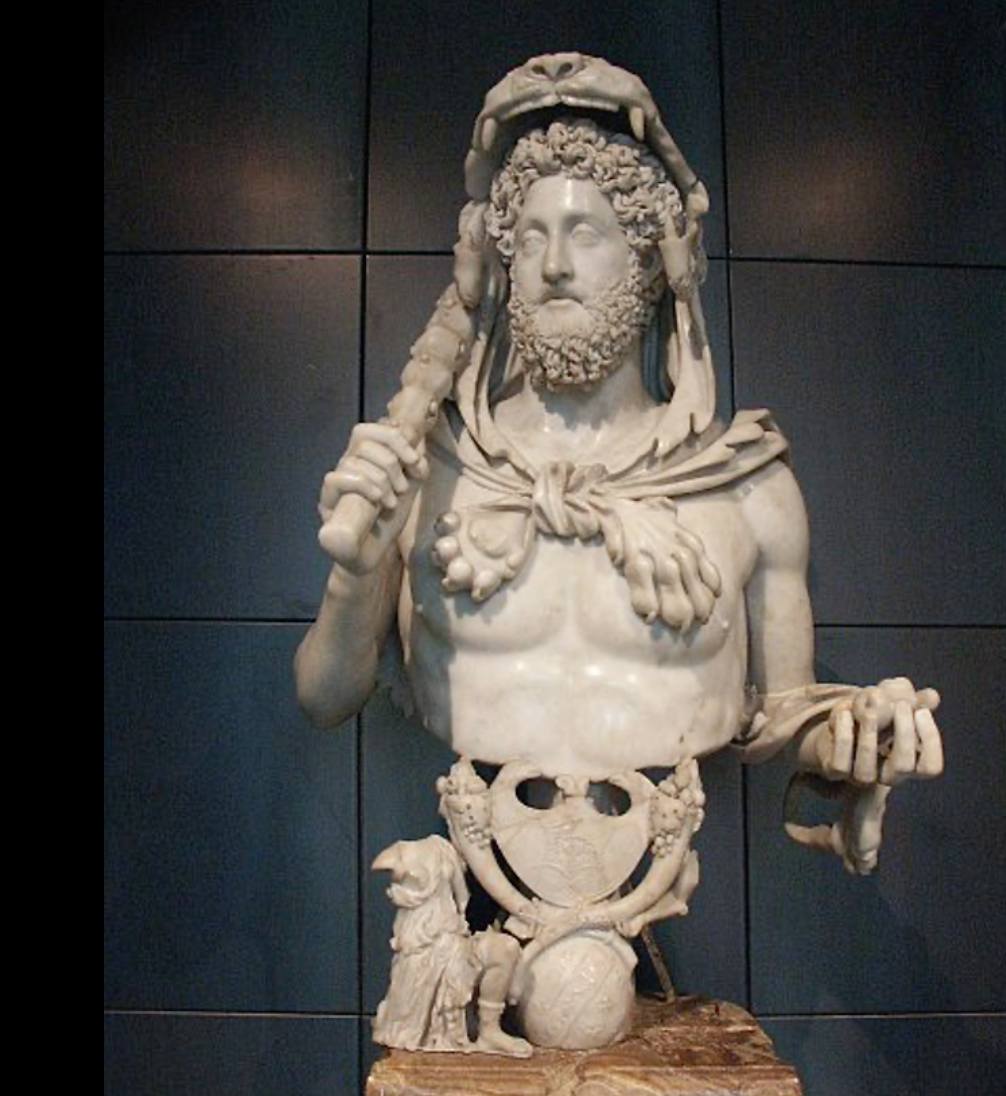
Portrait of Commodus in the Guise of Hercules, Antonine, ca. 191-2 CE
son of Marcus Aurelius, his successor, coruled with his father before Marcus Aurelius died, assassinated because of his tyrannical rulership- actually dresses like this as emperor,
would compete as a gladiator, which was rigged for him to win and would publicly execute people
damnatio memoria
sculpted base on the bust with orb, zodiac symbols, etc.
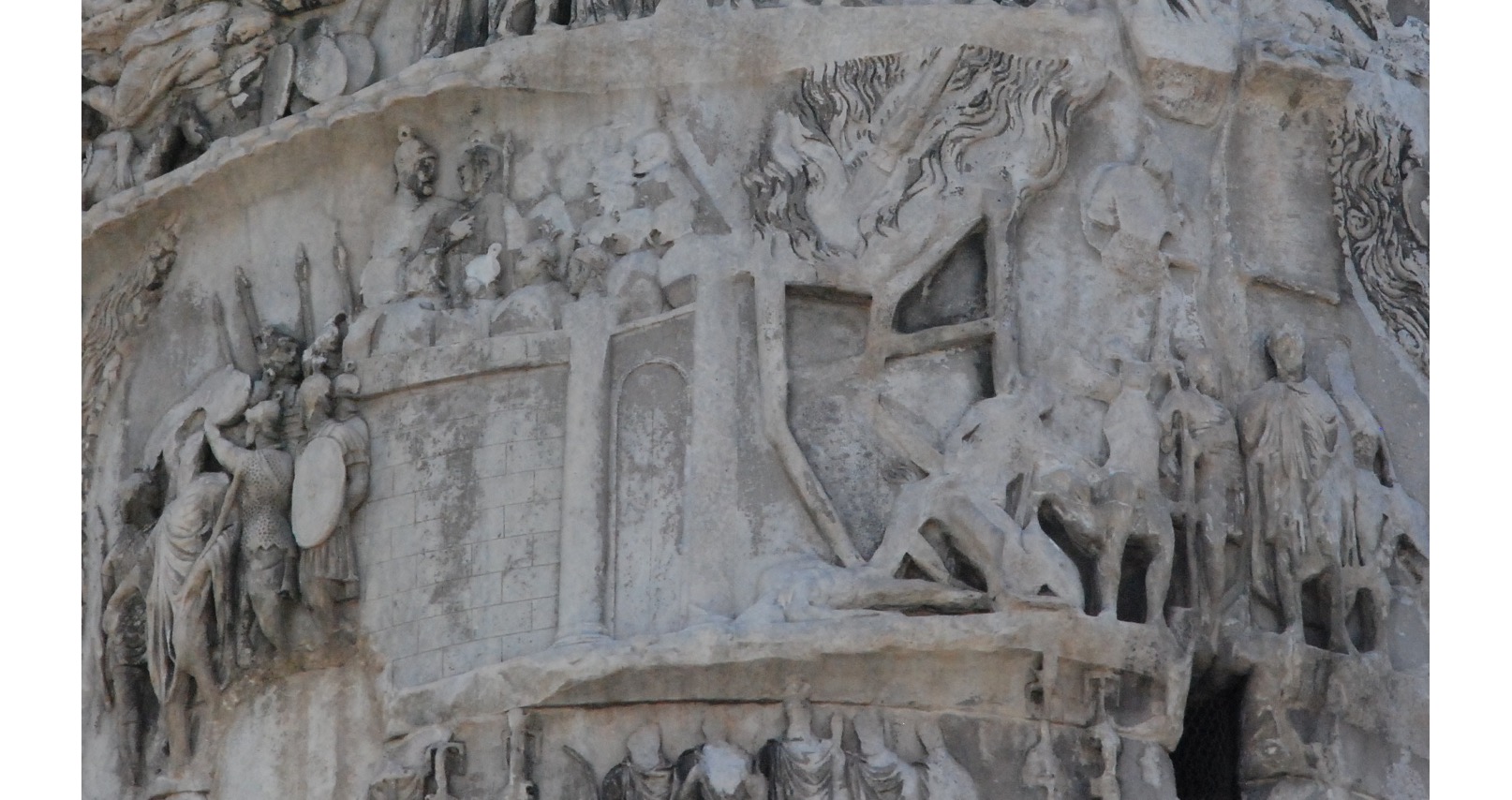
Rome, Column of Marcus Aurelius: Miracle of the Thunderbolt, Antonine, completed 193 CE
debated as to whether it was originally commissioned by Marcus Aurelius or by Commodus and when exactly it was finished
•Some of the “improvements” on the Column of Marcus Aurelius on the design of the Column of Trajan are the windows are carefully integrated into the plan, fewer spirals, figures depicted in higher relief, more repetition in poses, and an attempt by the master designer to line up the key scenes vertically. All these features makes the column much easier to read. However, because of these improvements, there is a loss in the variety of action and general lack of interest in the landscape setting and in the precise detail of military activities and historical events.
•The efficient war machine of Trajan that was constantly building is gone- here we have a more insecure army that spends more of its time vanquishing its barbarian enemies in bloody vignettes.
•The emperor is shown time and time again frontally while Trajan was always shown in profile. Here Marcus is more isolated from his soldiers except for the closest members of his staff. Trajan is the commander of his troops, a first among equals, but Marcus is more of a symbol of imperial power than a Roman general. This increasing tendency is a common feature of eastern religious art in the Roman period- it expresses the growing veneration for the person and office of the emperor and especially in the concept of his divinity.

Rome, Column of Marcus Aurelius: Destruction of a German Village, Antonine, completed 193 CE
•The village is weakly defended by Germans. At the bottom a German man with a shield and sword confronts a knight. Behind him, a praetorian, after having decapitated a foe, kills another fallen barbarian. Above, two low-ranking barbarians rush towards a house set on fire by the soldiers from which a high-ranking barbarian flees. Below this house, a lavishly dressed enemy is slain by the lance of a Roman while a woman, perhaps his wife, flees to the right holding the hand of a child. Behind them a barbarian falls face-down to the earth. She is grabbed by the hair by the Roman soldier who pursues her. Her right breast is exposed. Her head is turned back to the destruction, and her left arm is raised in a gesture of distress and horror.
•A woman has been caught by the hair and is being yanked backwards by a Roman soldier. The motif of hair pulling has a long tradition in Classical art in battle scenes such as Centauromachies and Amazonomachies as another method of depicting female subjugation and violation.
•On the right, in front of two houses, stands the emperor, dressed in the paludamentum, with his companions and knights, assisting in the killing of a kneeling barbarian.
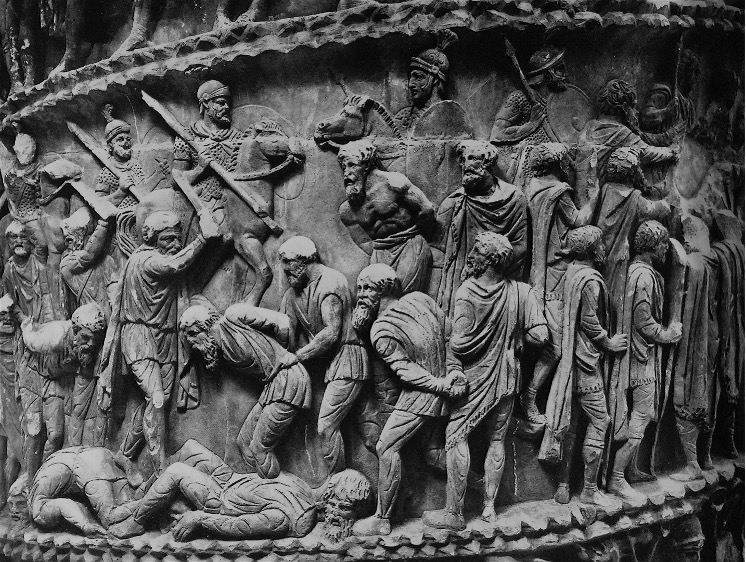
Rome: Column of Marcus Aurelius: Decapitation, Antonine, completed 193 CE
•This scene depicts a graphic mass decapitation of barbarian rebels. While on line, they must witness the beheading of their compatriots. A little further barbarians are hurled into an abyss and stabbed with lances by Romans on horseback.
Germanicwomenare forced to watch the decapitations as well. Each of the four women in the group has a sorrowful expression.
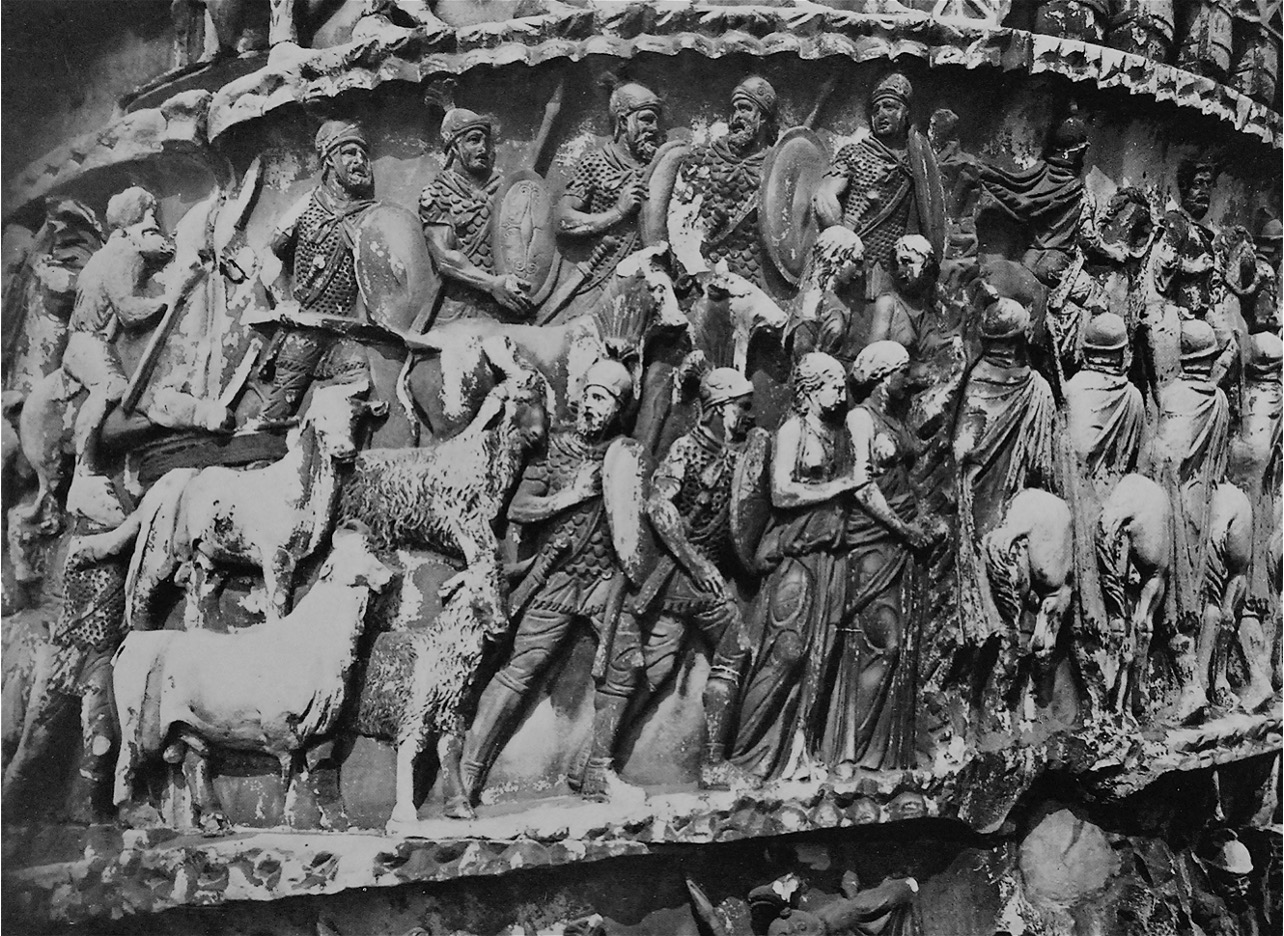
Rome, Column of Marcus Aurelius: Women and Animals Taken Captive, Antonine, completed 193 CE
•Women are being rounded up like the farm animals that accompany them- very dehumanizing. The captured barbarian woman’s future status as a slave is indicated here. A group of four women taken captive are elegantly (and scantily) attired in what seem to be sleeveless dresses belted at the waist and hips.
•Two of the women in this scene seem to wear their hair tied up but not covered, and two wear their hair loose. Loose hair perhaps signals sexual violation, since the dress of one of these women also slips down her arm, revealing a bare shoulder. Loose hair is one of the defining characteristics of the captured barbarian woman. It is a sign of her enslaved status.
•Women represent their community as a whole (think how the personifications of lands are female!), and thus barbarian women must be at least subjugated, if not completely obliterated in order to ensure the future security of Rome. Her brutal treatment and humiliation is a warning to those who would threaten and resist Roman imperial expansion.
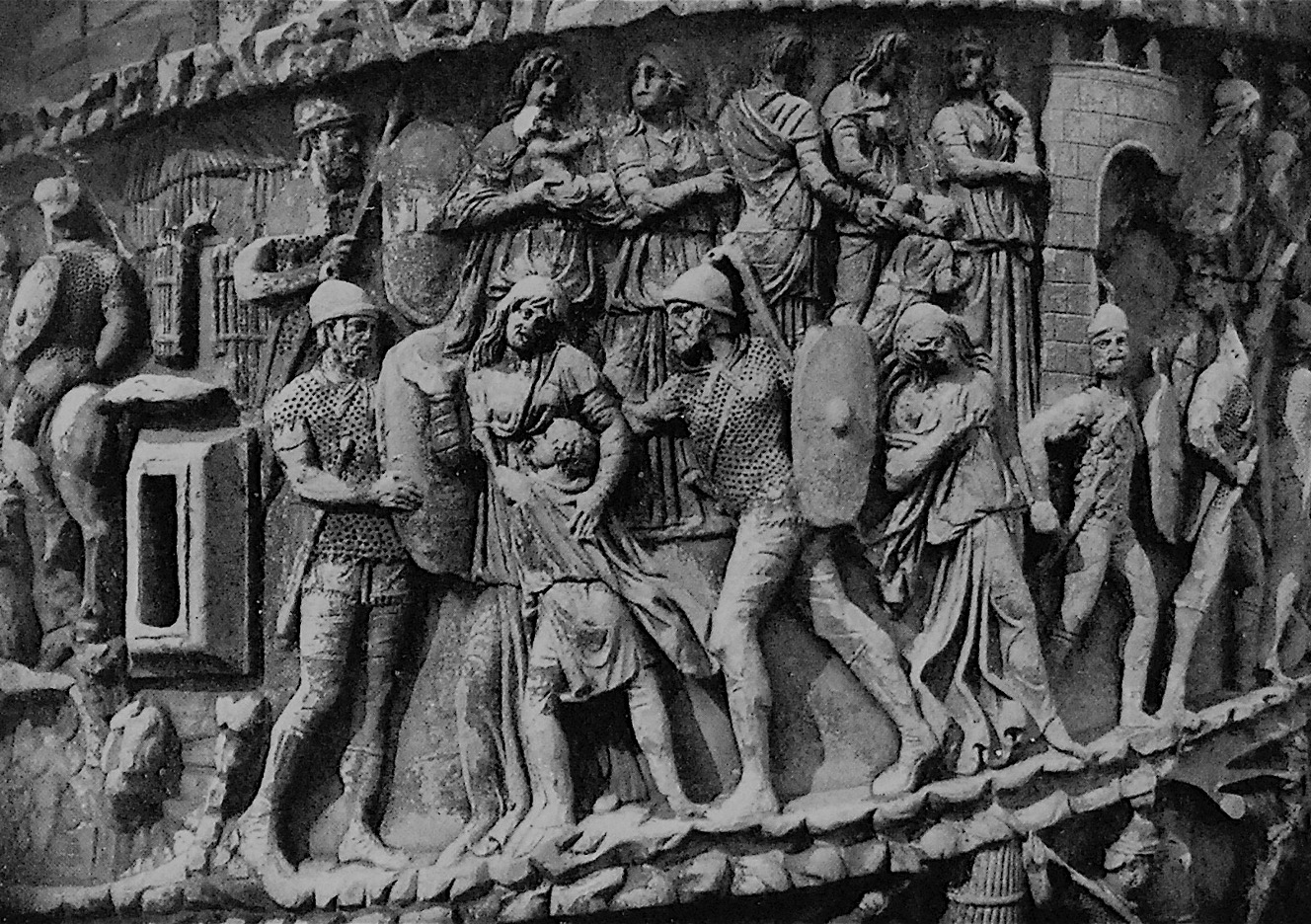
Rome, Column of Marcus Aurelius: Captive Women and Children, Antonine, completed 193 CE
•On this column, women and children are placed directly in the middle of the violent clash between Rome and its northern enemies, coming into frequent and direct physical contact with Roman soldiers. The are forcibly separated from their children, physically and sexually assaulted, and even killed. They lack male protection and are made to witness brutal executions. When they try to flee the scenes of carnage, they are caught by the hair, forcibly restrained and taken captive. There are no scenes on the Column of Marcus Aurelius of the emperor graciously escorting female captive to a waiting boat or entertaining provincial women with elaborate public sacrifices as there are on the Column of Trajan. The women on the Column of Marcus Aurelius do not keep refuge nor are they allowed to go peacefully into exile with their children and belongings in the company of older male relatives. Rather they are rounded up together with the farm animals, herded along at the point of spears and with shields, and pulled roughly by the wrist or the hair. Those who resist are forcibly subdued. The women react to their circumstances with terror and despair, clearly expressed through their dramatic gestures, defeated postures, and the disheveled state of their hair and dress.
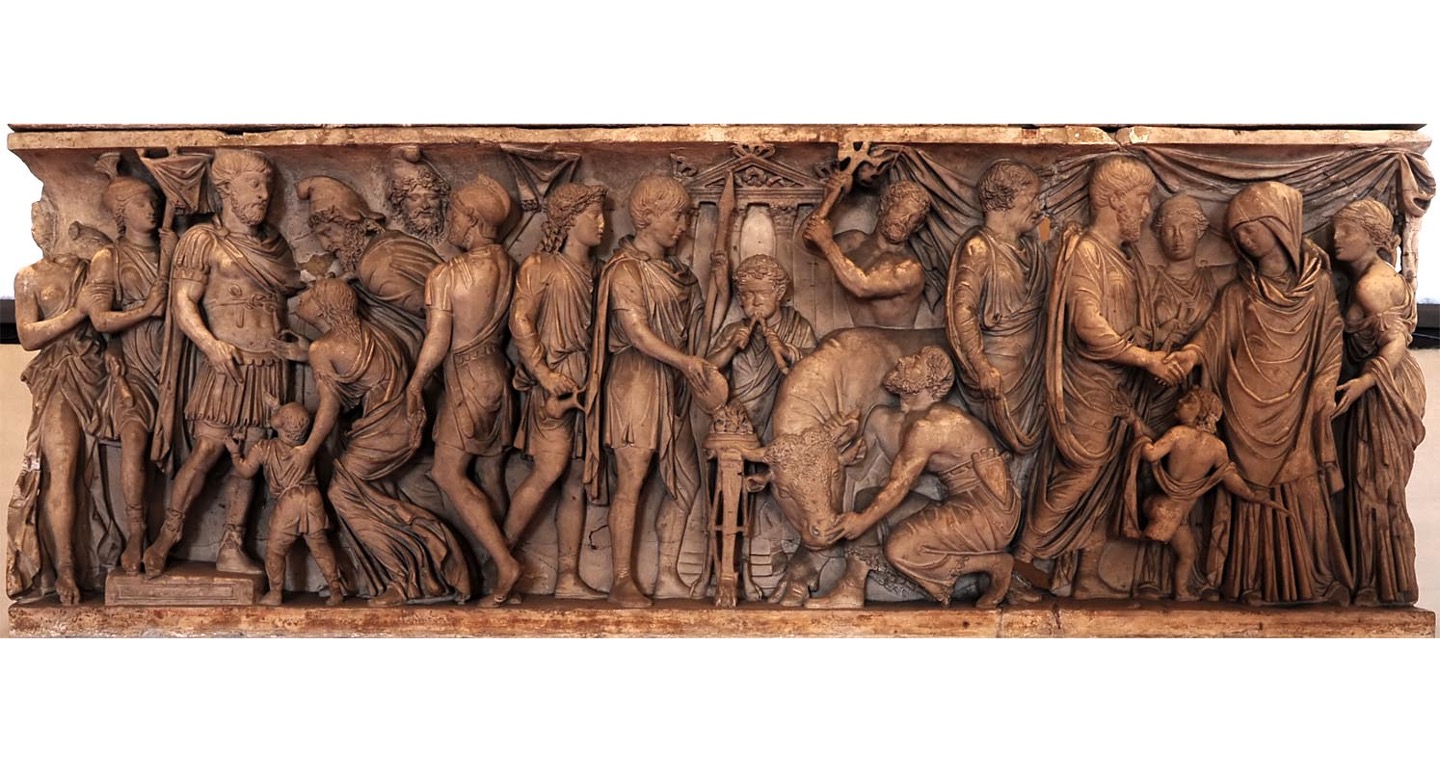
Marriage Sarcophagus, Antonine, ca. 170-180 CE
•This is an example of a biographical sarcophagus. These often include allusions to battle, although actually battle scenes are not described in detail. These depict scenes both from the public and public life of the deceased, usually a Roman general who is portrayed in scenes of clementia, sacrifice, marriage, and similar formal ceremonies. These scenes are spread across the main body of the sarcophagus, and sometimes continue to the lid and are close in subject matter, format, and style to comparable scenes in state relief sculpture. The major events of the deceased’s life are highlighted in shorthand vignettes. Many are Antonine in date. The scenes are not meant to be specific episodes from the deceased’s life, but rather highlight the qualities of the deceased: clemency, piety, and and concord. The deceased are private individuals who acquire the aura of immortality through imitation of imperial iconographical language.
The wedding scene, seen onthe right side of the front of the sarcophagus, is typical of those onAntoninebiographical sarcophagi. The husband and wife are joined together indextrarumiunctio(ahandshake of right hand to right hand).
•n the center, a bull is being sacrificed in front of the Temple of Jupiter Optimus Maximum on the Capitoline Hill, which is another common feature of these sacrifice scenes on biographical sarcophagi.

Portonaccio Sarcophagus, Antonine, ca. 180-190 CE
•Nearly all of the surviving Roman battle sarcophagi date to the period of 170-210 CE, which is not surprising considering the military preoccupations of the principate of Marcus Aurelius- the majority were probably used to house the remains of military commanders or soldiers who had won their reputations in pursuit of pacifying the northern provinces.
•Of all the battle sarcophagi, no two well-preserved examples appear to be from the same workshop, but similar figures and groups appear on most pieces- the barbarian falling from his horse, the mounted figure thrusting back at his enemy, the suicide of the barbarian chief, which must come from one common source. It seems that the inspiration for such battle sarcophagi comes from the commemoration of the victories of the kingdom of Pergamon over the Gauls during the late 3rd and 2nd centuries BCE Influence of this dramatic style runs right through the history of Roman sculpture. It has been suggested that the individual figures and groups of the sarcophagi were not taken from sculpture, but paintings of Pergamene battles. These scenes are “updated” by the inclusion of Victories and trophies and by the Roman dress of the victors, but in modeling and composition and feeling, Hellenistic art still dominates.
The main body is covered with a frenzied battle scene in which a mélange of Roman soldiers and barbarians are intertwined.
 Note
Note  Flashcards (106)