U1 Ch 2 - Livestock Safety & Handling - VET 217 Large Animal
 Studied by 0 people
 Call with Kai
 Learn
Learn Practice Test
 Spaced Repetition
 Match
Match Flashcards
 Knowt Play
1/24

Earn XP
Description and Tags
Name | Mastery | Learn | Test | Matching | Spaced | Call with Kai |
|---|
No study sessions yet.
25 Terms
What is one of the most dangerous occupations in the U.S.?
Agriculture.
Types of livestock safety concerns?
Tiredness, lack of attention, poor judgment, environmental hazards & attire, animal disease, grain handling, & fire hazards.
Livestock chemical safety hazards?
Some drugs can cause a pregnancy to abort after absorption through skin;
Some drugs can be fatal if accidentally injected into a human instead of the animal, eg. Tilmicosin.
Livestock environmental safety hazards?
Lightning & weather, inappropriate attire & jewelry, dehydration, farm equipment, slick & uneven flooring, & forgetting to close gates.
Livestock animal disease hazards?
Zoonotic potential & spreading disease from farm to farm.
What should be done between farm or site visits?
Clean & disinfect clothes (hats, coveralls, gloves, etc.) & shoes.
Grain handling safety concerns?
Avoid wearing loose clothing around augers & power takeoffs;
Be cautious around grain equipment & vehicles;
The storage of grain can be dangerous when it is piled (such as a silo), since it can develop air pockets that are almost impossible to get out of if a person falls in.
Livestock restraint types?
Physical & chemical.
What does good restraint of livestock involve?
Be flexible in your approach;
Understand the natural instincts of each species being handled, being able to read an individual’s temperament, and recognizing the extent of training that an individual has (or has not) received.
What is important to remember when handling or restraining livestock?
Realize that you can not force restraint on an animal that is intent on not accepting it, especially when the animal outweighs you and outmuscles you many times over.
Other livestock restraint advice?
Plan ahead and be familiar with equipment before using it;
Survey the area for potential hazards before beginning the procedure;
Avoid getting into a position or place from which you cannot leave quickly, such as a stall corner or between the animal and a fence or wall;
Speak up if you are uncomfortable in a situation.
In what order is a halter placed?
Place halter over the nose then the ears, then attach lead rope.
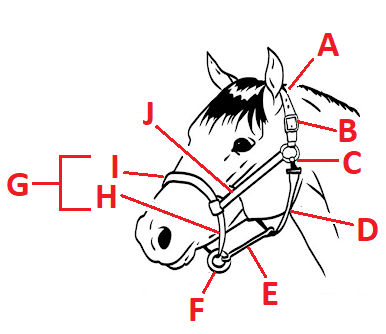
A = Crownpiece
B = Buckle
C = Snap
D = Throatlatch
E = Connecting strap
F = Tie ring
G = Noseband
H = (noseband) Chinpiece
I = (noseband) Nosepiece
J = Chinpiece
What should you not do when haltering a horse?
Try not to drag the halter over its eyes & ears, do not place your fingers through the halter, & do not coil the rope around your hand.
How should you approach a horse?
From the left side at a 45 degree angle to the shoulder, while in front of the shoulder, but behind the ears.
What place on a horse is good for initial contact before moving to other areas?
The neck or withers.
What do good horse handlers typically maintain while handling a horse?
Vocal & physical contact with the horse.
As the holder, where should you be during the horse’s physical exam?
On the same side as the vet.
As the holder, what should you do if you have any issues while the vet is examining the horse?
Pull the horses head towards you to move the hindquarters away from the vet.
How should you cover a horse’s eye to block its view while being worked on?
Use an open hand to the cup the eye on the same side that is being worked on, but do not try to close or completely cover its eye.
What is the most common way to tie a horse & other livestock?
Quick release knot.
What should you never do when tying a horse?
Never tie to something unstable or not sturdy, never tie with a chain over its nose or mouth, & never leave the horse unattended.
Where should you grasp a horse’s leg when asking it to pick up its foot?
Just above the fetlock.
How should you hold a horse’s foot?
Underneath and in line with the body - not pulled away.
What are some types of twitches?
Shoulder, ear, & lip (mechanical).
 Note
Note  Flashcards (24)