Empricist responses to innatism
 Studied by 0 people
 Call Kai
 Learn
Learn Practice Test
 Spaced Repetition
 Match
Match Flashcards
 Knowt Play
1/17

Earn XP
Description and Tags
Name | Mastery | Learn | Test | Matching | Spaced | Call with Kai |
|---|
No analytics yet
Send a link to your students to track their progress
18 Terms
Tabula Rasa
When we are born our minds are a blank slate no thoughts, or concepts
All our ideas are either derived from one of two sources:
Sensation: experience through sense
Reflection: the internal operations of our minds, providing ideas of perception, thinking, willing
Ockham Razor
Ockham razor is the argument that we should adopt the simplest explaantion
Locke uses this to support empricism against innatism
It could be that
a) we are born with an innate idea of each colour
It is certainly is the case that'
b) we see colour with our eyes
If we know b) that i gain knowledge with my senses whats the point of borthering with b)?
Locke uses the term “idea” to cover a very broad range of things, including sensations and concepts. The sensations of yellow is very different to the concept of yellow
Hume tries to give clearer terminology
Impressions - much more forceful related to sensing and feeling vivid. e.g. seeing colour, feeling heat
Ideas - related to thinking, e.g. looking back to when I was angry, when I saw the white paper (faint copy) like last week I was angry, last week I saw the colour blue
Simple and complex
All our ideas come from impressioms
Our impressiomns can be simple and complex
Our ideas can also be simple and complex
Simple impression -The smell of tea
Simple Impression - The taste of tea
Complex idea - The idea of tea (made of multiple simple ideas)
Complex Impression - Seeing tea (made of multiple simple impressions)
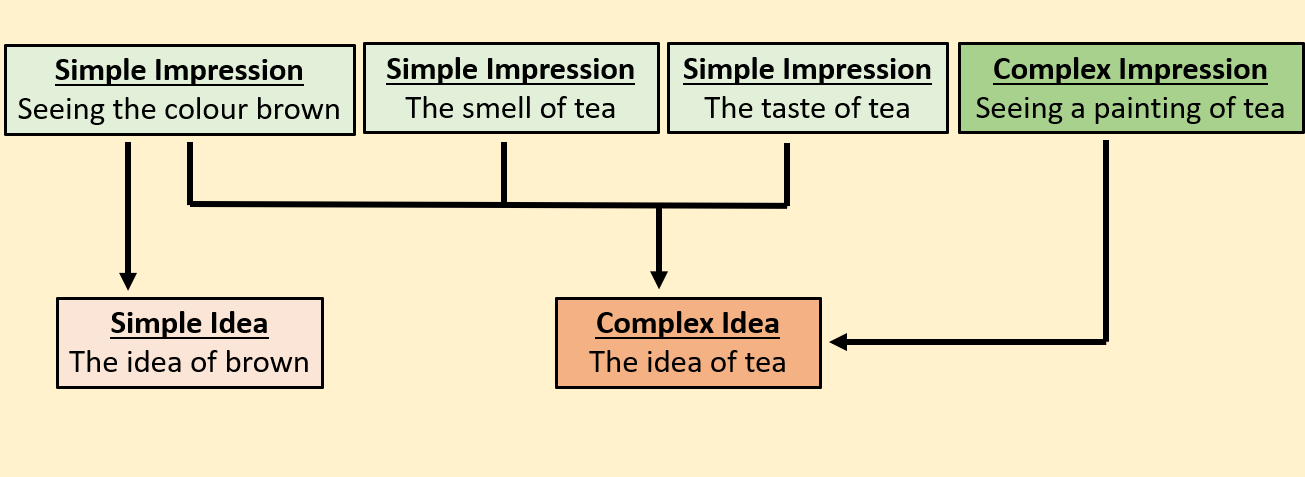
Simple and Complex
Concept empiricism is the view that all of our concepts are derived from sense impressions, either directly (like simple concepts) or by being made up of other concepts based on sense impressions (complex).
If Hume and Locke have successfully proved that all concepts ultimately come from experience, then innatism is false.
Theory of no innate concepts without impression e.g. you can trace dragons, friendship, God from impressions
You cannot think of a new animal
Hume empricism
Hume argues that anyone who has never had a certain impression cannot form the corresponding idea. Therefore, impressions are necessary for ideas.
Criticism 1: Do all simple ideas come from impressions?
If we can think of a missing shade between a darker and a lighter colour, this is an idea which did not come from an impression
This goes against their principle that nothing can exist in the mind that has not come through the senses first.
Response
Hume - maybe we can fill in that blank shade showing simple ideas are not always derived from corresponding impressions. However, this example is so singular it can be ignored
Other empiricists - We form the idea using the sensed impression of darkness and lightness and the idea blue
Problem with response
Surely if the idea of this shade is complex, then isn’t every idea of blue a complex one. Every example of blue is a particular shade - all complex
Can‘t be combined to complex ideas
Response to response
Well maybe we can’t imagine the missing shade then
Maybe we just have a general complex concept of blue formed of all the shades we have experienced
Criticism 2: Do all complex ideas relate to impressions?
Perhaps ideas do not have to always relate to impressions,
abstract ideas, such as JUSTICE or FREEDOM? Neither of these relates to any sense experience.
But these ideas can still be imagined and these ideas do not fully explain concepts
Response
That’s why abstract concepts are so vague, because it is hard to explain them in terms of sense experience.
Further criticism
Your idea of the cat, the mat, and sitting all come from sense impressions.
But what about the idea of on-ness?
What sense impression is this a copy of?
Criticism 3: We need more than just a sense impression
You now have the sense impression of “tove” – but this isn’t enough to give you the right concept.
Could be anything these ideas do not come from impression
e.g. If i said to a child this is yellow they could think the pencil is called yellow, or lifting is yellow
Intuition and deductive thesis
•Deductive – the conclusion is logically entailed by the premises. We can prove a conclusion based on the truth of the premises.
•Intuition – rational insight. Being able to understand something just by thinking about it (2+2=4)
•Intuition and Deduction Thesis – Descartes put the above methods together. We know a number of claims by rational intuition, and we can use these as premises in deductive arguments to gain knowledge of further claims.
3 Waves of doubt
He can doubt his senses he has a memory or body
Could be an evil demon
Criticism 3: We need more than just a sense impression
You now have the sense impression of “tove” – but this isn’t enough to give you the right concept.

