Emotion
 Studied by 0 people
 Call with Kai
 Learn
Learn Practice Test
 Spaced Repetition
 Match
Match Flashcards
 Knowt Play
1/20

There's no tags or description
Looks like no tags are added yet.
Name | Mastery | Learn | Test | Matching | Spaced | Call with Kai |
|---|
No study sessions yet.
21 Terms
Emotion definition
A coordinated psychological and physiological state comprising:
• Emotional expression (behavioural + physiological responses)
• Emotional experience (the subjective feeling)
• Neural substrates that generate and regulate these states, studied under affective neuroscience.
What does the James–Lange theory propose?
Emotions are felt as a result of physiological changes in the body.
Example: We feel fear because we notice our increased heart rate.
This reverses what we intuitively think. It argues that the body reacts first, and the emotional experience comes second.
What does the Cannon–Bard theory propose?
Emotional experience and emotional expression occur independently and simultaneously.
Signals reach the thalamus, which generates emotion even without bodily feedback.
Cannon showed that emotions persist in animals even when the autonomic system is removed, suggesting bodily feedback is not required.
Key differences: James–Lange vs Cannon–Bard
• James–Lange: Body → Emotion
• Cannon–Bard: Brain (thalamus) generates emotion independently of body signals.
The Limbic System
Broca’s Limbic Lobe:
Broca described the limbic lobe, a ring of cortical structures around the brainstem
Limbus means border
Includes:
• Cingulate gyrus
• Parahippocampal gyrus
• Subcallosal area
Which structures are included in the modern limbic system?
• Cingulate gyrus
—> role in complex motor control
—> pain perception
—> social interactions- mood
• Parahippocampal region and Hippocampus
—> primary function in memory(critical role in connecting certain sensations and emotions to these memories)
• Amygdala
—> Involved in learning and storage of emotional aspects of experience
• Septal nuclei
• Entorhinal cortex
All surround the corpus callosum
What is the major functional role of the limbic system?
Assigning emotional significance to stimuli and generating appropriate behavioural responses.
Damage → blunted or abnormal emotional responsiveness.
What does the Papez circuit propose?
A system linking cortex, hippocampus, hypothalamus, and thalamus creates emotional experience and expression.
What structures form the Papez circuit?
• Cingulate cortex
• Hippocampus
• Fornix
• Mammillary bodies
• Anterior thalamic nuclei
• Back to cingulate gyrus
Papez suggested the cortex is responsible for emotional experience, while hypothalamus drives expression.
What evidence shows hippocampus involvement in emotion?
Rabies infection heavily affects the hippocampus and causes hyperemotional behaviour.
Why is the idea of one “emotion centre” outdated?
• Emotions are diverse
• Many brain regions are involved
• No one-to-one mapping between region and specific emotion
How did early and modern theories differ?
• Early: Based on introspection and lesion studies
• Modern: Use imaging and computational models
Two major models:
– Basic emotion theories
– Dimensional theories
What is the basic emotion theory?
Emotions like fear, anger, disgust, happiness arise from distinct, dedicated neural circuits.
What do dimensional theories propose?
Emotions are combinations of underlying dimensions such as:
• Valence (pleasant–unpleasant)
• Arousal (low–high)
What is the amygdala and what emotions is it linked to?
Almond-shaped complex in the medial temporal lobe involved in fear, aggression, anxiety, and emotional learning.
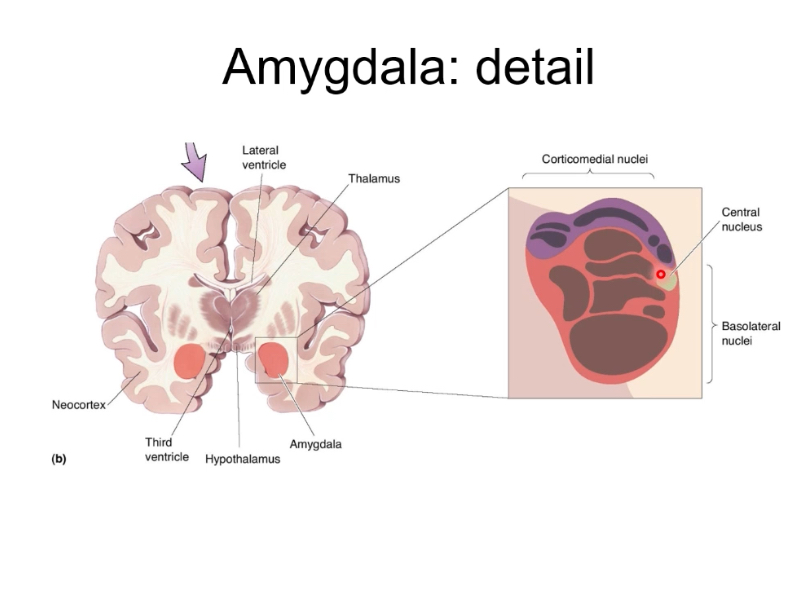
What are the key amygdala nuclei?
• Basolateral nuclei (BLA): Receive sensory input from cortex and thalamus
• Corticomedial nuclei: Olfactory and visceral input
• Central nucleus: Major output to hypothalamus and brainstem
The basolateral amygdala is essential for forming associations in fear conditioning.
The central nucleus is the controller of autonomic fear responses.
How is the amygdala connected to other brain areas?
Inputs: neocortex from all lobes, hippocampus, cingulate cortex
Outputs:
• Stria terminalis → hypothalamus
• Ventral amygdalofugal pathway → hypothalamus + brainstem
What roles does the amygdala play in fear?
• Detects threat
• Generates autonomic fear responses
• Forms emotional memories (fear conditioning)
How does the amygdala contribute to learned fear?
It integrates current sensory cues with past aversive experiences, enabling conditioned fear.
Confirmed by fMRI and PET imaging.
Forms memories of emotional and painful events
What are effects of amygdalectomy in humans?
• Reduced fear
• Reduced aggression
• Hypersexuality
• Oral tendencies
• Poor recognition of fearful facial expressions
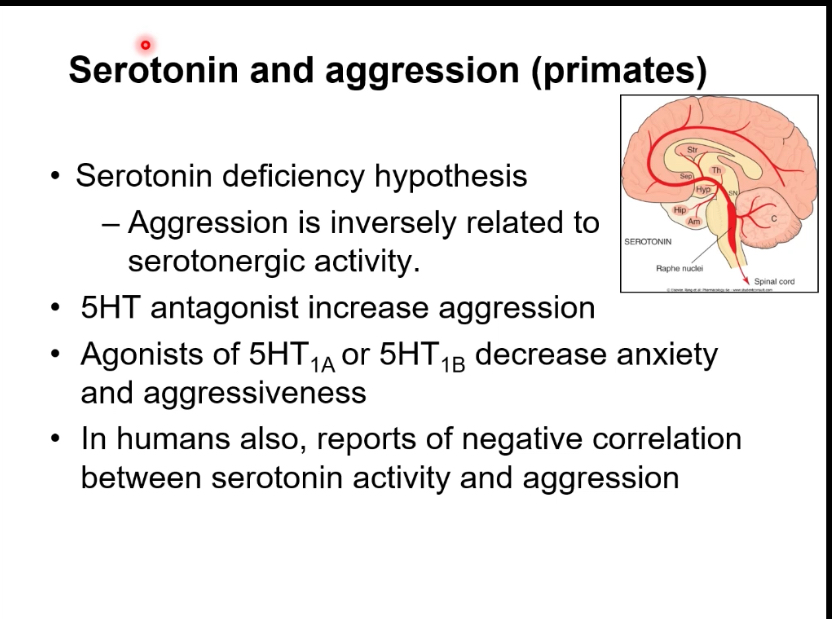
Aggression(and Serotonin)
Aggression is not one single behaviour; it includes different motivations such as survival (food), self-defence, dominance, power, and social control.
• Because the motives differ, the biological mechanisms behind aggression also differ.
Endocrine (hormonal) mechanisms
• Testosterone increases the likelihood and intensity of aggressive behaviour.
• Reducing testosterone (e.g. through castration in animal studies) reduces aggression.
• Hormones modulate aggression rather than directly causing it.
Brain mechanisms
• Different neural circuits control different types of aggression.
Predatory aggression
• Directed at members of another species.
• Purpose is obtaining food, not emotional expression.
• Behaviour is focused and goal-directed.
• Minimal or no sympathetic nervous system activation (no strong “fight-or-flight” response).
Affective (reactive) aggression
• Used for social signalling rather than killing.
• Includes threatening postures, displays, and fights within the same species.
• Important for establishing and maintaining social hierarchy.
• High sympathetic nervous system activity (increased heart rate, blood pressure, arousal).
• The amygdala plays a key role, especially in aggression linked to social status and emotional responses.
 Note
Note  Flashcards (80)