Chapter 10: Visual Imagery
 Studied by 0 people
 Call Kai
 Learn
Learn Practice Test
 Spaced Repetition
 Match
Match Flashcards
 Knowt Play
1/28

There's no tags or description
Looks like no tags are added yet.
Name | Mastery | Learn | Test | Matching | Spaced | Call with Kai |
|---|
No analytics yet
Send a link to your students to track their progress
29 Terms
Visual imagery
An experience of seeing something without any visual input; seeing in the absence of stimuli
The imageless thought debate
The debate on: “Do you require visual imagery for thinking?”
Four key players in the imageless thought debate
Wundt
Galton
Piavio
Pylyshyn
Wundt
Wundt was a structuralist, and he thought images were imperative to thoughts, for they were one of three basic elements of consciousness.
Francis Galton
Contended one does not require visual imagery for thinking, as he observed people who had great difficulty forming images who could still think
Paivio
Many of our thoughts do require images, as it’s easier to recall nouns that can be associated with an image (compare imagining ‘boat’ vs bravery)
Concrete nouns
Noun’s one can visualize, such as boat
Behaviourists (on the imageless-thought debate)
Mental imagery is unobservable and “not worthy of study”
Paivio and paired-associate learning
Paivio conducted word-pair list associations and found that concrete pairs, such as boat-hat, are easier to imagine than fear-school, because fear is an abstract noun.
Paired-visual imaging example
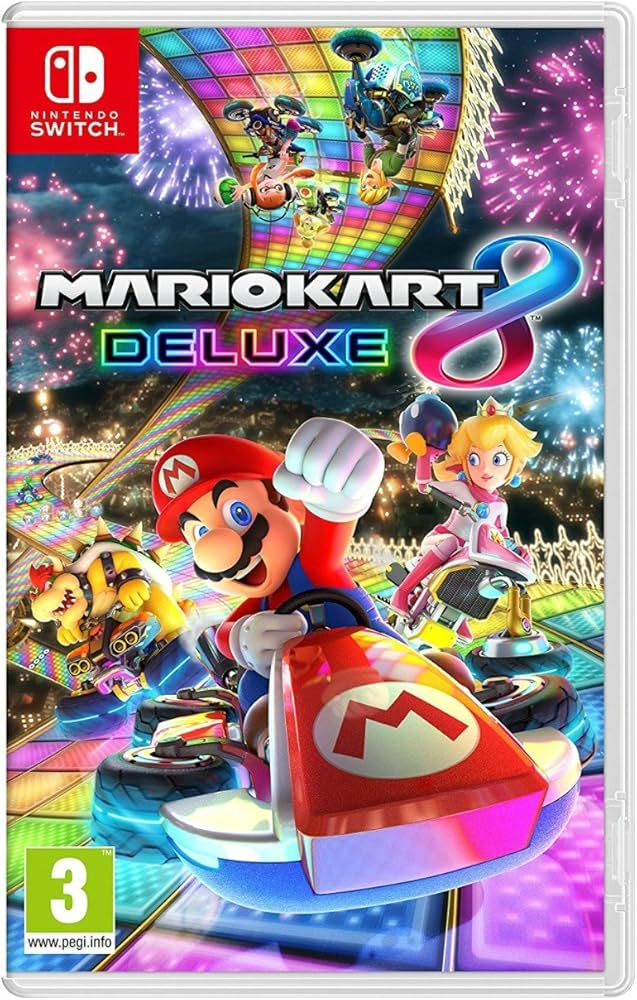
Imagining a hat on top of the boat–such as in the Mario Kart 8 race
Pylyshyn’s position on the imageless thought debate
Contended that mental images only seem spatial; they are actually an epiphenomena
Epiphenomena
Something that appears to be a real effect in the real world, but it only seems that way; the truth is something else
Pylyshyn’s theory regarding the imageless thought debate
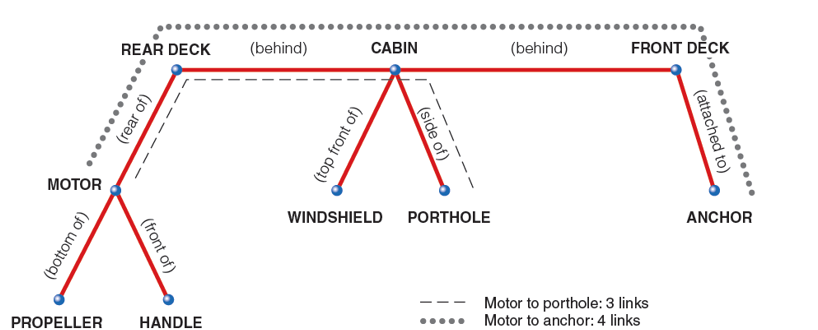
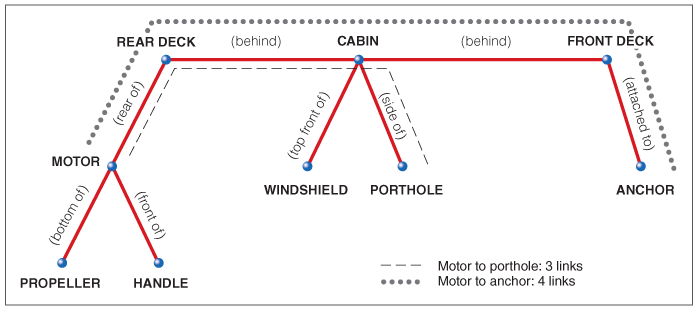
People have something similar to a “semantic network model” except in their mind
Pylyshyn’s theory example
Your knowledge of a boat looks more like the network model, rather than an image of a boat.
If you were asked, is the motor behind the cabin? You would “pull out” your network map of a boat and conclude the motor is behind the cabin instead of imaging a boat and going from there
What is one piece of evidence that visual imagery is spatial?
The further the distance in your imagination, the longer it takes you to generate it. It takes longer to imagine walking to building 9 from Dr. Hassall’s class than building 5, even though you’re walking at hyper speed.
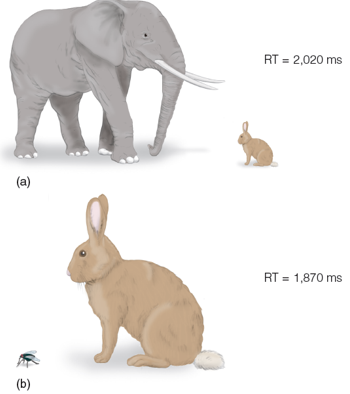
How does size effect visual imagery?
You can imagine walking towards the rabbit/fly faster than the rabbit/elephant, because you’d have to walk further to see the elephant, because of size and proportions, you imagine yourself closer to the rabbit and the fly.
Spatial vs propositional representations
Spatial uses mental pictures, like a map, where parts correspond to physical layout (e.g., "cat under table" is a picture), whereas propositional uses abstract symbols and language, like a logical sentence (e.g., UNDER [cat, table])
![<p>Spatial uses mental pictures, like a map, where parts correspond to physical layout (e.g., "cat under table" is a picture), whereas propositional uses abstract symbols and language, like a logical sentence (e.g., UNDER [cat, table])</p>](https://knowt-user-attachments.s3.amazonaws.com/a400d373-d235-4a25-960f-ab50eb5a7ad8.png)
How might the images in our mind actually be propositional rather than spatial?
When you hear about a part of a boat, say the propellor, you do not picture the Titanic, but a map of a boat’s layout
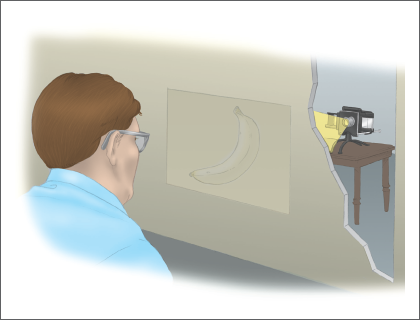
How did the banana experiment indicate how perception and imagery interact?
When the angled banana was very subliminally advertised, and the researcher later asked the participant to imagine a banana, their image would be of a slightly angled banana.
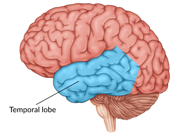
What brain region deals with both perception and imagery?
The temporal lobe
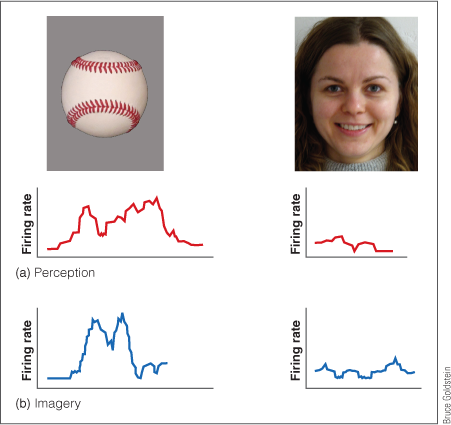
What is one way we know, from a neuropsychological perspective, that perception and imagery are linked?
Because of imagery neurons, which fire in the same way when a person sees a picture of an object and when a person creates a visual image of the object.
What is another way we know, neuropsychologically, that the visual cortex is important for imagery?
Because patient M.G.S., who had part of her right occipital lobe had been removed, said an imagined image of a horse filled her visual field when standing 35 feet away, rather than the original 15.
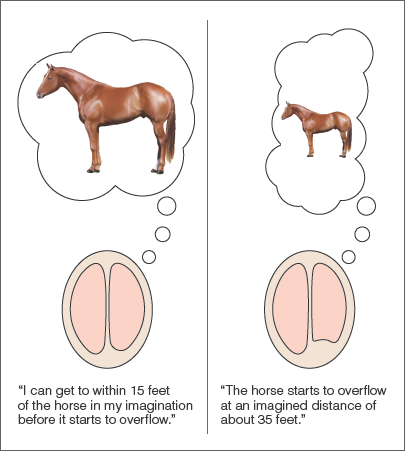
What lobe also get’s activated for imagery questions?
The occipital lobe
How do we know the occipital lobe is activated for imagery and not just sight-related questions?
If you show a picture of a tree on a screen and leave it on for 30 seconds, the occipital lobe is active. BUT, when you take it away for 30 seconds and are merely imagining the tree, the occipital lobe is still active (albeit less).
Unilateral neglect
When one brain field is damaged, while the other is fine.
Ex. People with this condition often only eat half of the food on their plate

How do we know that visual imagery and perception aren’t exactly the same?
Because a person with visual agnosia (one who cannot identify objects) can still draw them from memory.
Such a result shows that perception and visual imagery aren’t exactly the same, because if they were, people wouldn’t be able to complete these tasks separately
How does the manipulation of images tell us that perception and imagery aren’t exactly the same?
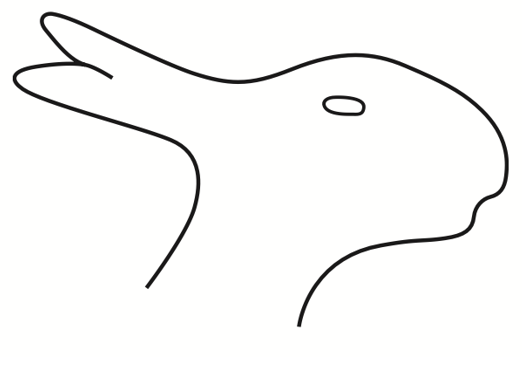
Because ambiguous images are easy to manipulate perceptually, but they are challenging to manipulate through imagery
What are three strategies for using imagery to improve memory?
Linking words to images (such as the boat-tree test)
Methods of Loci
The pegword technique
Vividness of Visual Imagery Questionnaire
A test in which people are asked to rate the vividness of mental images they create. This test is designed to measure object imagery ability.
Explore top notes
 Note
Note Explore top flashcards
 Flashcards (52)