AP Psychology Chapter 4 Vocabulary Terms
 Studied by 0 people
 Call Kai
 Learn
Learn Practice Test
 Spaced Repetition
 Match
Match Flashcards
 Knowt Play
1/76

There's no tags or description
Looks like no tags are added yet.
Name | Mastery | Learn | Test | Matching | Spaced |
|---|
No study sessions yet.
77 Terms
Cocktail Party Effect
two people could be talking at a cocktail party and they are just focused on each other; they drowned out the other people
The second someone says their name, they are unfocused and are paying attention to that person now (why are they talking about me, something bad, etc.)
Sensation
The process by which our sensory receptors and nervous system receive and represent stimulus energies from our environment
Vision, hearing, Touch, pain, smell
Perception
the process of organizing and interpreting sensory information, enabling us to recognize meaningful object and events
Every day experiences - sensation and perception blend into one continuous process
Our sensory and perceptual processes work together to help us decipher the world around us
Bottom-up Processing
analysis that begins with the sensory receptors and works up to the brains integration of sensory information
Sensory receptors works up to higher levels of processing
When we have no prior knowledge - we start at the bottom and work our way up
Example, new job or new house
Top-down Processing
info processing, guided by higher level mental processes, as when we construct perception drawing on our experience and expectations
We have prior knowledge
Example, have already been to a high school grade; Have already been around the college before attending
Selective Attention
the focusing of conscious awareness on a particular stimulus
Through this, your awareness focuses, like a flashlight beam, on a minute aspect of all that you experience
Five senses - 11,000,000 bits of info per second; we only consciously process around 40
ADHD Theory
idea that people with ADHD lack selective attention
Instead of filtering out unimportant info, they attend to all stimuli
This can make it very difficult to process info and focus
Inattentional Blindness
failing to see visible objects when our attention is directed somewhere else
So focus on one thing that you miss another obvious
Example: when told to look at a specific object on the screen and count how many there are, you might miss an obvious object that is moving back-and-forth on the screen
Change Blindness
failing to notice changes in the environment
Transduction
conversion of one form of energy into another. In sensation, the transforming of stimulus energies, such as sites, sounds, and spells, into neural impulses our brain can interpret
Example: when you see a friend and you’re able to recognize their face based on the visible light that your photo receptors intake to be converted into electrical signals in your retina
Psychophysics
the study of relationships between the physical characteristics of stimuli, such as their intensity, and our psychological experience of them
Absolute Thresholds
The minimum stimulation needed to detect a particular stimulus 50% of the time.
Example: How many sprays of perfume needs to be sprayed for people to notice?
Example: how bright does the candle have to be to see it in the dark from far away?
Absolute threshold applies to site smell and really anything
Signal Detection Theory
A theory predicting how, and when we detect the presence of a faint stimulus (signal) amid background stimulation (noise). assumes that there is no single absolute threshold, and that detection depends partly on a person’s experience, expectations, motivation, and alertness.
Example: a parent being able to detect their child’s voice/cry (signal) in a household full of noise (noise)
Subliminal
Below ones absolute threshold for conscious awareness
Example: The FedEx logo contains an arrow hidden between the "E" and the "x," implying direct delivery
Prime
The activation often unconsciously, of certain associations, thus predisposing, one’s perception, memory, or response
Example: semantic priming, where hearing "doctor" speeds up recognition of the word "nurse," and perceptual priming, where seeing an incomplete word like "b__t_r" makes you more likely to complete it as "butter" after smelling a bakery
Difference Threshold
the minimum difference between two stimuli required for detection 50% of the time. We experienced the difference threshold as a just noticeable difference (or JND)
Example: commercials are louder at halftime - it is noticeable
Extremely similar to just noticeable difference (JND)
Just Noticible Difference (JND)
The minimal amount of change in the signal that is still recognizable
Very similar to difference threshold
Weber’s Law
The principal that, to be perceived as different, two stimuli must differ by a constant minimum percentage (rather than a constant amount)
Example: when you are in a noisy environment, you have to shout to be heard. However, being quiet in a quiet room works
Sensory Adaptation
diminished sensitivity as a consequence of constant stimulation
Focuses our attention on informative changes in our environment
Example: when you first get into the ocean, it’s freezing, but after you have been in it for a while, it doesn’t feel that bad
Not changing, so I don’t have to worry about it as much - diminished sensitivity
Perceptual Set
A mental predisposition to perceive one thing and not another
Can influence what we hear, taste, feel, and see (photo 17.1 page 164)
Can also affect what we hear
Example: a pilot can hear cheer up or gear up at the same
Think to brain games - when you didn’t know what word the girl was saying, you didn’t know what sound to hear. However, when you did, didn’t know what she was saying, you were able to understand it
Synesthesia (Joined Senses)
signals are interpreted as more than one sensation because they go to the places in the brain they weren’t originally meant to be
Letters have a specific color, numbers have a specific color, etc.
Sound and sight - one of the most common subtypes (between 60 and 80)
Wavelength
the distance from the peak of one light or sound wave to the next peak of the next. Electromagnetic wavelengths vary from the short lips of cosmic rays to the long pulses of radio transmission.
Example: wavelength is the color for vision and the pitch for sound
Light’s wavelength determines it’s hue
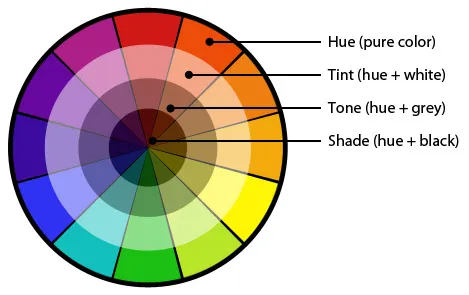
Hue
The dimension of color that is determined by the wavelength of light; what we know as the color names, blue, green, and so forth
Indensity
The amount of energy in a light or sound wave, which we perceive as brightness or loudness, as determined by the wave’s amplitude or height
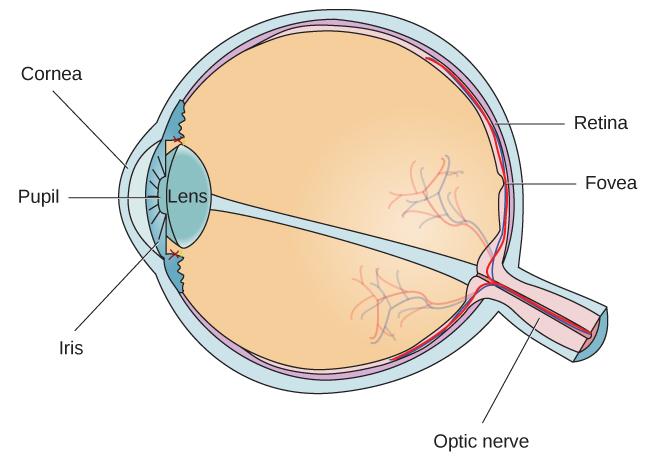
Pupil
the adjustable opening in the center of the eye through which light enters
Light enters the eye through the cornea, which protects the eye and bends light to provide focus
It then passes through the pupil

Iris
A ring of muscle tissue that forms the colored portion of the eye around the pupil and controls the size of the pupil opening
Dilate or constrict in response to light, intensity, and inner emotions
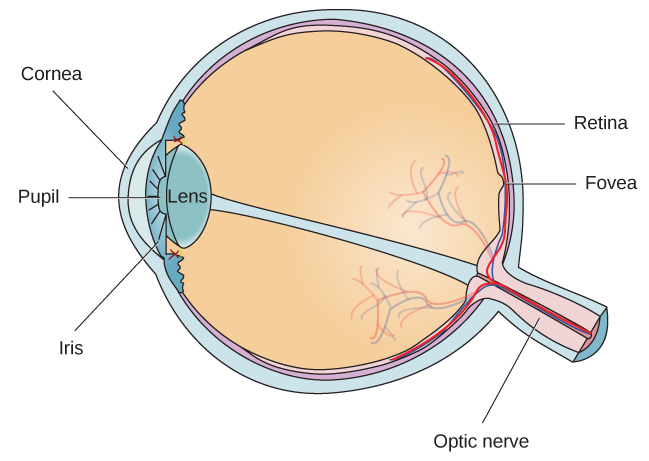
Lens
The transparent structure behind the pupil that changes shape to help focus images on the retina
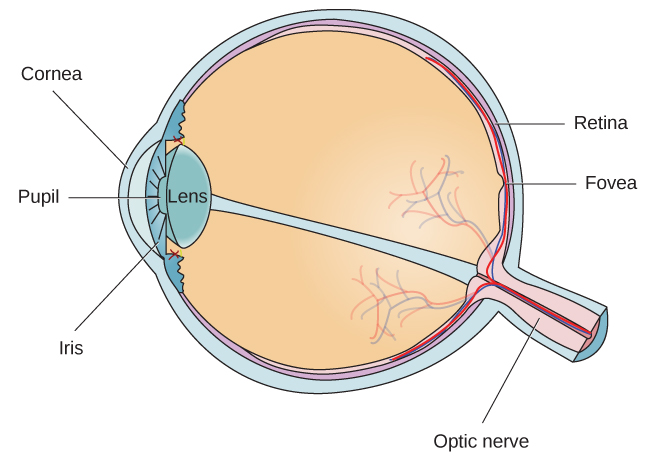
Retina
The light-sensitive inner service of the eye, contain the receptor rods and cones plus layers of neurons that begin the processing of visual information
Accommodation
The process by which the eye’s lens changes shape to focus near or far object objects on the retina
Behind the pupil is a lens that focuses incoming light rays into an image on the retina
The lens focuses on the rays by changing its curvature in a process called accommodation
Example: a child adjusting their focus from a distant whiteboard to a close-up book, or an adult shifting their gaze from a computer screen to a colleague across the room
Photoreceptors
Light sensitive cell; response to light falling on it
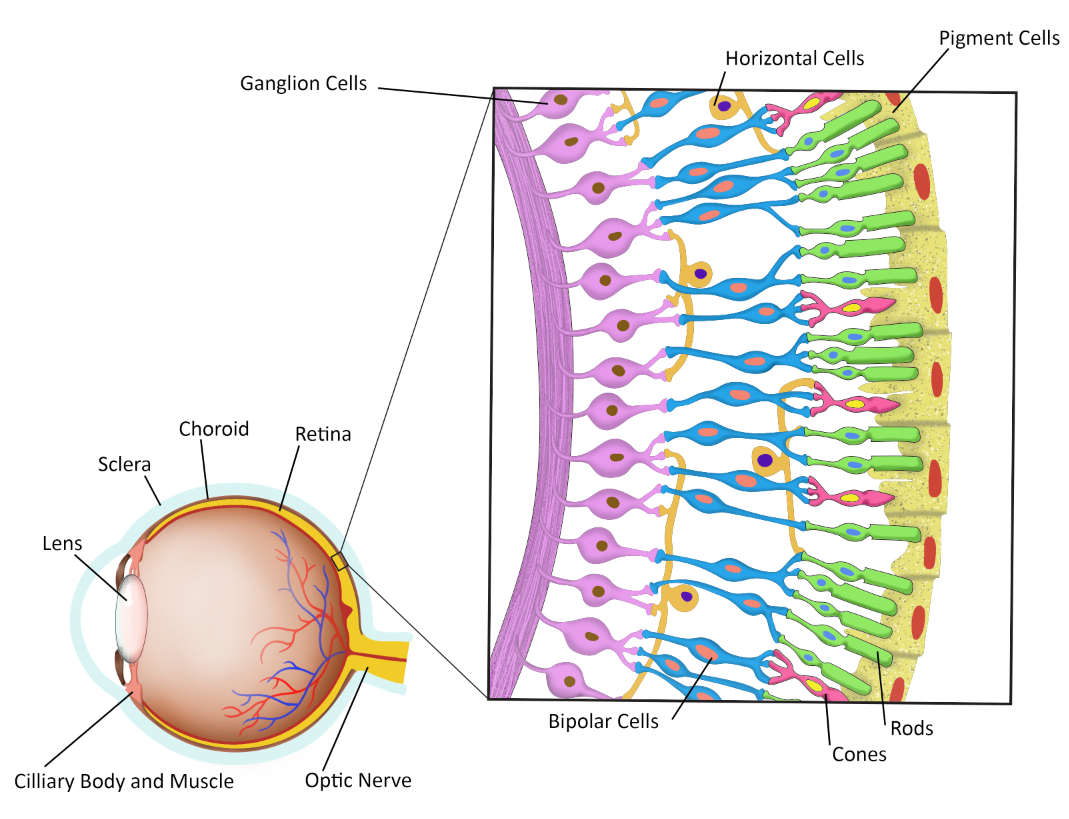
Rods
Retinal receptors, that detect black, white, and gray; necessary for peripheral and twilight vision, when cones don’t respond
Cones
Retinal receptor cells that are concentrated near the center of the retina and the function in daylight or in well-lit conditions
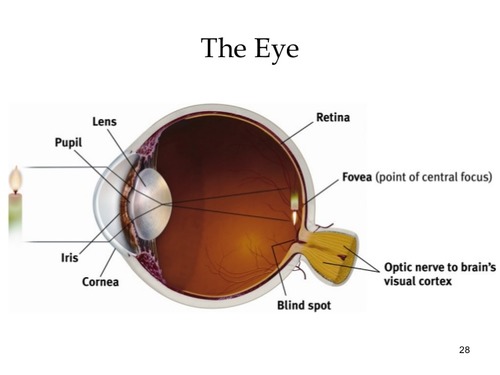
Blind Spot
The point where the optic nerve exits the eye and where there are no photoreceptors (rods and cones). Any stimulus that falls on this area cannot be seen.
An optic nerve creates a Blindspot
Optic Nerve
The nerve that carries neural impulses from the eye to the brain
Bundle of neurons
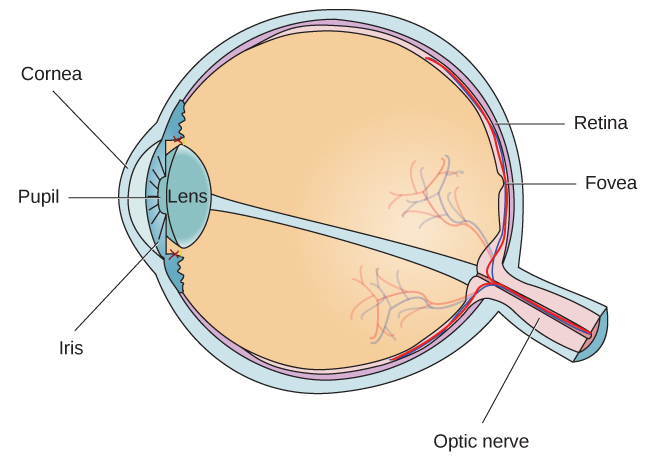
Fovea
The central focal point in the retina, around which the eye’s cones cluster
Feature Detectors
Nerve cells in the brain that respond to specific features of the stimulus, such as shape, an angle, or movement
Parallel Processing
The processing of many aspects of a problem simultaneously; the brain’s natural mode of information processing for any functions, including vision
Example: driving a car (processing visual cues like color and motion, and auditory input from conversation) or looking at an object (analyzing its color, shape, and movement at the same time)
Young-Helmholtz Trichromatic (Three Color) Theory
The theory that the retina contains three different color receptors - one most sensitive to red, one to green, one to blue - which, when stimulated in combination, can produce the perception of any color
Opponent - Process Theory
The theory that opposing retinal processes (red/green, yellow/blue, white/black) enable color vision. For example, some cells are stimulated by green and inhibited by red; others are stimulated by red and inhibited by green.
These two theories that were stated, and the research supporting them, show that color processing occurs in two stages
Gestalt
an organized whole. Gestalt psychologist, emphasized our tendency to integrate pieces of information into meaningful whole
German word meaning a “form” or a “whole”
All about how you perceive things
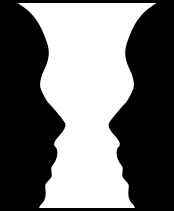
Figure - Ground
The organization of the visual field into object objects (the figures) that stand out from their surroundings (the ground)
The figure is what you see/focus on
The background is what is left in the back
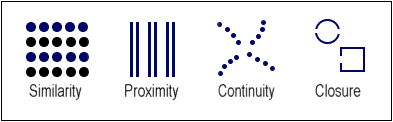
Grouping
the perceptual tendency to organize stimuli into coherent groups
Three types of grouping…
Proximity, continuity, and closure

Proximity
we group nearby figures together
Example: we see three sets of two lines, not six lines

Continuity
we perceived smooth, continuous patterns, rather than discontinuous ones, this pattern could be a series of alternating semicircles, but we perceive it as two continuous lines - one wavy and one straight

Closure
we will fill in gaps to create a complete, whole object; thus, we assume that the circle is on the right are complete but partially blocked by the (illusory) triangle
Theories of Constancy
The idea that the context in which you see a shape or color can change and you continue to see the same image
Example: perceptual, color, size, and shape
Perceptual and color are the two most important ones
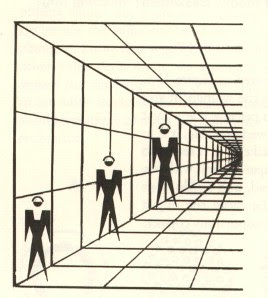
Depth Perception
The ability to see objects in three dimensions, although the images that strike, the retina are two-dimensional; allows us to judge distance
Example: think back to the brain games - the golf ball and the soccer ball. The golf ball seemed smaller because it was further away, but it was actually bigger.
Visual Cliff
A laboratory device for testing depth, perception in infants and young animals
Example: what a toddler peeing over the rim perceived the dangerous drop off and drawback? (picture in book module 19)
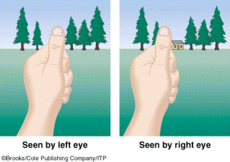
Binocular Cues
depth, cues, such as retinal disparity, that depends on the use of two eyes.
Two eyes are better than one
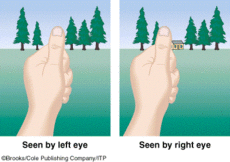
Retinal Disparity
a binocular cue for perceiving depth; by comparing images from the retinas in the two eyes, the brain computes distance - the greater the disparity/difference between the two images, the closer the object

Monocular Depth Cue of Interposition
if one object partially blocked our view of another, then we perceive it as closer.
Example: the image of the deer; the frontier is closer to us because it is in front of the other deer
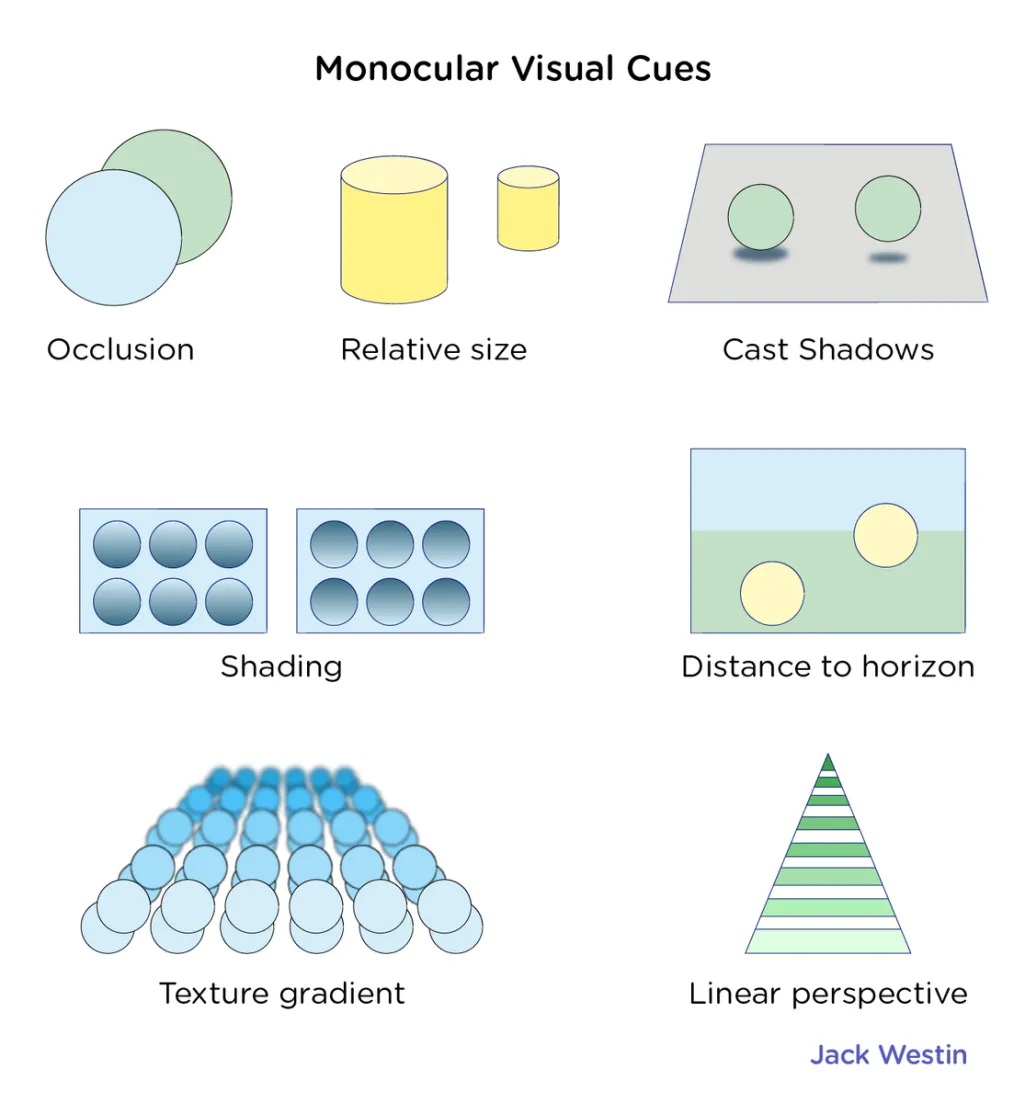
Monocular Cues
depth cues, such as interposition and linear perspective, available to either eye alone

Phi Phenomenon
an illusion of movement created when two or more adjacent lights blink on and off in quick succession

Perceptual Constancy
receiving objects as unchanging (having consistent shapes, size, brightness, and color) even as illumination and retinal images change
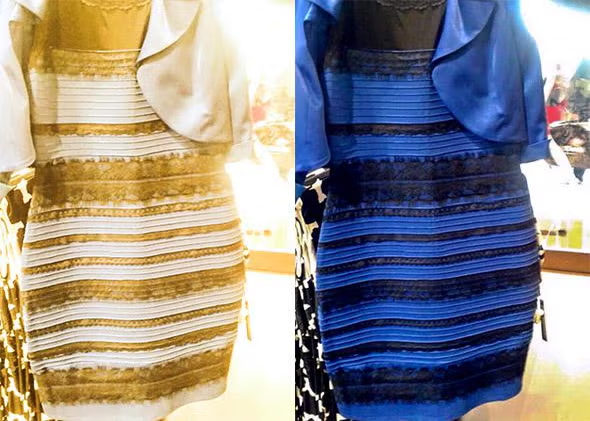
Color Constancy
perceiving familiar objects as having consistent color, even if changing illumination, alters wavelengths, reflected by the object
Chain of Command
Rods / Cones
Bipolar Cells
Ganglion Cells (the axons of which became the optic nerve)
Thalamus (directs things)
Visual Cortex in the Ocipital Lobe
Perceptual Adaptation
In vision, the ability to adjust to an artificially displaces or even inverted visual field
Audition
The sense or act of hearing
Highly adaptive sense
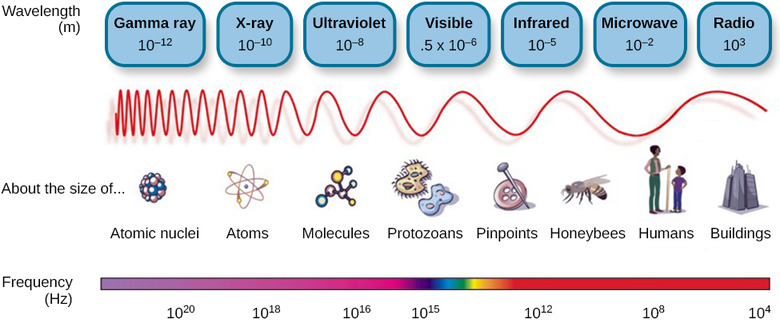
Frequency
The number of complete wavelengths that pass a point in a given time
Example: Per second
Low Frequency = Longer wavelengths and lower pitch
High Frequency = Shorter wavelengths and higher pitch
Pitch
A tone’s experienced highness or lowness; depends on frequency
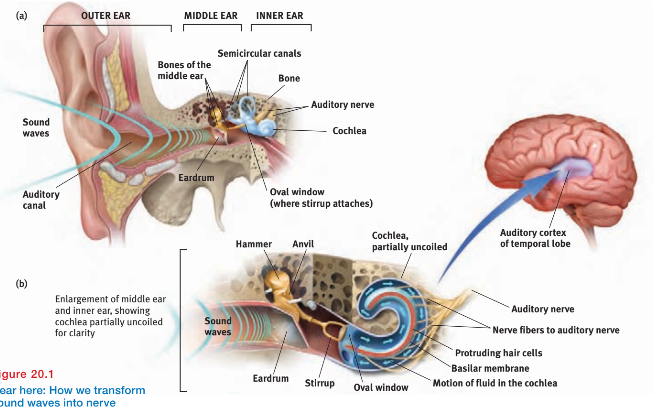
The middle ear
The camber between the eardrum and cochlea containing three tiny bones (hammer, anvil, and stirrup) that concentrate the vibrations of the eardrum on the cochlea’s oval window
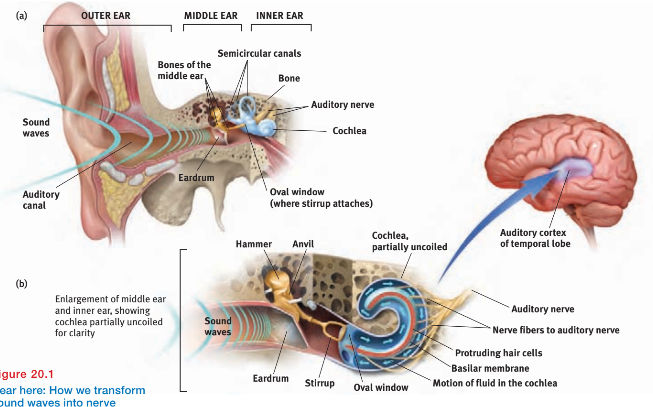
Cochlea
A coiled, bony, fluid-filled tube in the inner ear; sound waves traveling through the cochlear fluid trigger nerve impulses
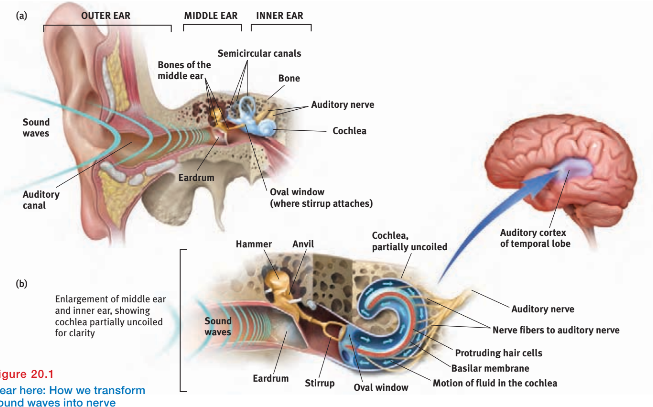
Inner Ear
The innermost part of the ear, containing the cochlea, semicircular canals, and vestibular sacs
Sensorineural Hearing Loss
Hearing loss caused by damage to the cochlea’s receptor cells or to the auditory nerves; also called nerve deafness
Conduction Hearing Loss
Hearing loss caused by damage to the mechanical system that conducts sound waves to the cochlea
Cochlear Implant
A device for converting sounds into electrical signals and stimulating the auditory nerve through electrodes threaded into the cochlea
Place Theory
In hearing, the theory that links the pitch we hear with the place where the cochlea’s membrane is stimulated
Example: high-pitched sounds like a cymbal crash activate the base of the membrane, while low-pitched sounds like a tuba stimulate the apex
Frequency Theory
In hearing, the theory that the rate of nerve impulses traveling up the auditory nerve matches the frequency of a tone thus enabling us to sense its pitch
a 600 Hz sound will be perceived as higher in pitch because it generates 600 nerve impulses per second, while a lower frequency sound generates fewer impulses
Nociceptors
Sensory receptors that detect hurtful temperatures, pressure, and chemicals
Competitive Inhibition - When you are hurt and someone rubs it, you confuse your brain into thinking you are in less pain than you really are
Gate-control Theory
The theory that the spinal cord contains a neurological “gate” that blocks pain signals or allows them to pass on to the brain. The “gate” is opened by the activity of pain signals traveling up small nerve fibers and is closed by activity in larger fibers or by information coming from the brain
The brain can ignore / block off pain signals at this gate in the spinal cord
Similar to placebos (fake medicine to make you feel better)
Example: Can fight through an injury in times of danger
Supertasters
A person who tastes certain flavors and foods more strongly than other people
Have more taste buds and receptors
Mainly sensitive to bitter flavors
Smell means…
Olfacation
Kinesthesia
The system for sensing the position and movement of individual body parts
Your body knows what to do without looking
Example: Typing on a keyboard without learning
Vestibular Sense
The sense of body movement and position including the sense of balance
Monitors your head’s position and movement
Example: the feeling of spinning on a ride, the ability to walk on a curb without falling, and keeping your vision steady while running
Sensory Interaction
The principle that one sense may influence another, as when the smell of food influences its taste
Smell + Texture + Taste = Flavor
Oleogustus
The unique taste of fat - rancid / disgusting
Embodied Cognition
In psychological science, the influence of bodily sensations, gestures, and other states on cognitive preferences and judgments
 Note
Note  Flashcards (38)