SLHS 3306 Quiz 1
 Studied by 4 people
 Call Kai
 Learn
Learn Practice Test
 Spaced Repetition
 Match
Match Flashcards
 Knowt Play
1/76

There's no tags or description
Looks like no tags are added yet.
Name | Mastery | Learn | Test | Matching | Spaced | Call with Kai |
|---|
No analytics yet
Send a link to your students to track their progress
77 Terms
Sound is…
alterations between higher and lower pressure.
Central zero line in a waveform is…
it does not refer to zero pressure. It means that the pressure is the same as the regular air pressure in the environment.
Waveform show us…
pressure (y) over time (x). Y axis is not height the soundwave moves slightly forward and backward as it travels.
One cycle
a full sequence of pressure change and returning to the original value.
Ex: high pressure—> low—> high again
Sound frequency:
how many cycles per second.
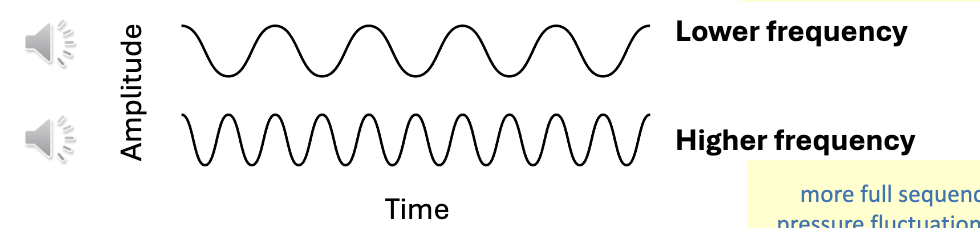
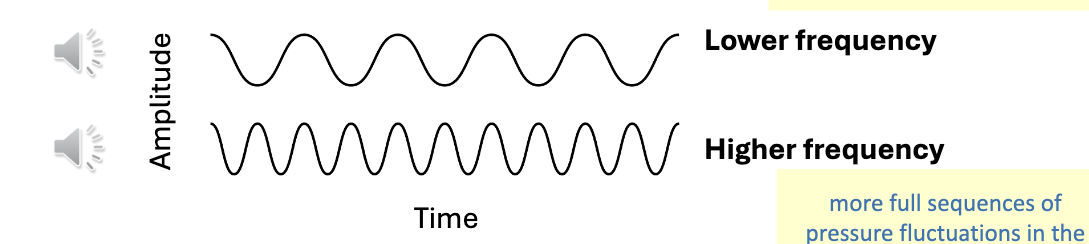
Lower frequency vs higher frequency
lower: fewer full sequences of pressure fluctuations in the same amount of time
Higher: more full sequences of pressure fluctuations in the same amount of time
What is the range of audible frequencies?
~30Hz—> 16,000 Hz but humans can hear up to 20,000Hz.
What does show us about sound?
A specturm shows us the frequencies that are in a sound.
What are two key components of a sine wave?
Frequency and intensity
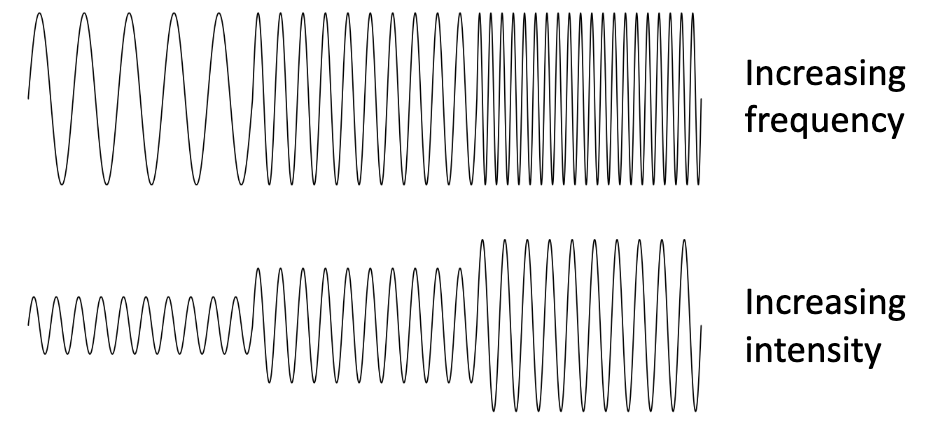
What is the third component of a sine wave?
Phase- a singular point along that path. While a cycle is the full shape of a sine wave.
Aliasing
When we don’t sample the signal quickly enough to capture its rapid fluctuations, we can severely underestimate the frequency.
The shape of a sound wave represents the …. in air pressure.
fluctuations
A full shape of a sine wave is a …, and a singular point along the shape is a ...
cycle, phase
A sound has multiple frequencies in it, and you want to know which one of those frequencies is the loudest (most intense). To find out, you would look at the?
Spectrum.
ITD- Inter-aural timing
sound arrived first at the right ear:
probably coming from the right
ILD: Inter-aural level difference
Sound louder in the right ear:
probably coming from the right.
Duplex theory
Sounds are localized through a combination of interaural time differences (ITD) for low-frequency sounds and interaural level differences (ILD) for high-frequency sounds.
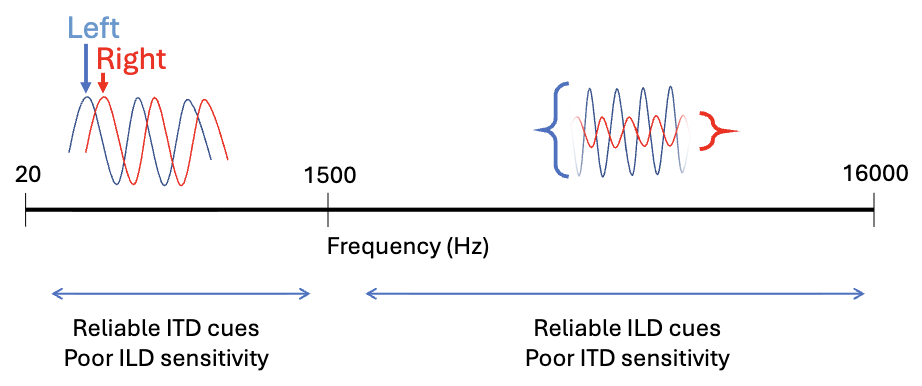
ITD sound traveling to the ears
When sound is a little bit off from the right, then the sound will arrive at the left about 100 microseconds earlier.
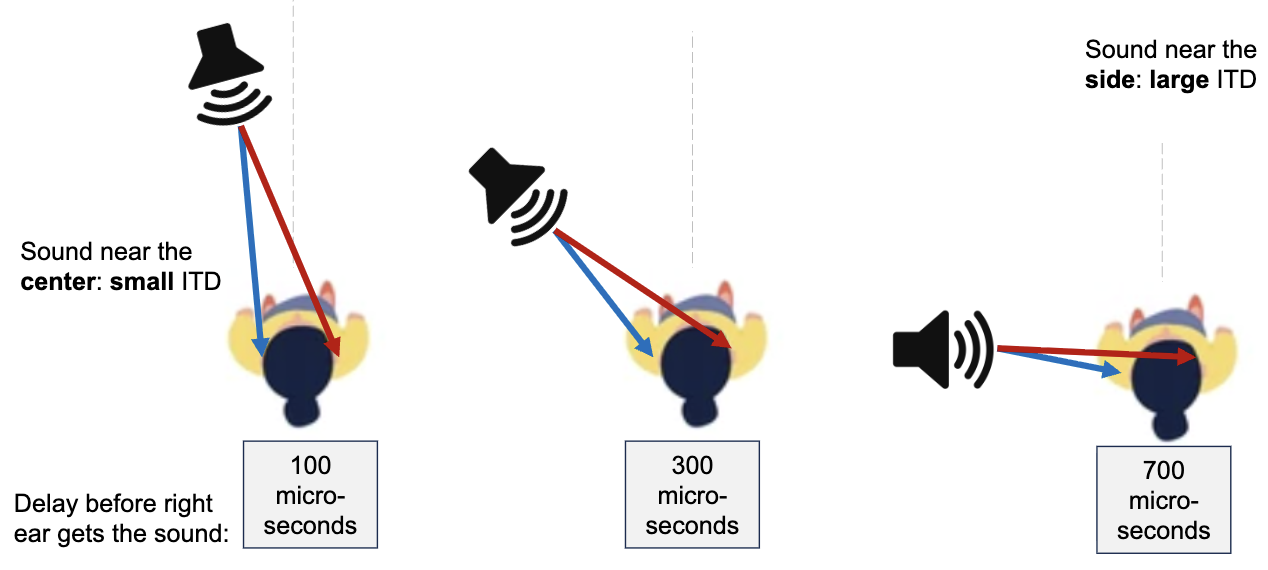
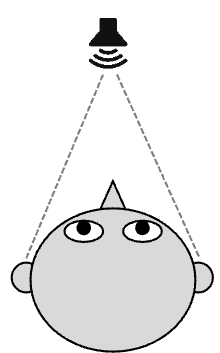
Which ear has the greater dB for ILDs.
the ILD produced by this sound is 0 dB.
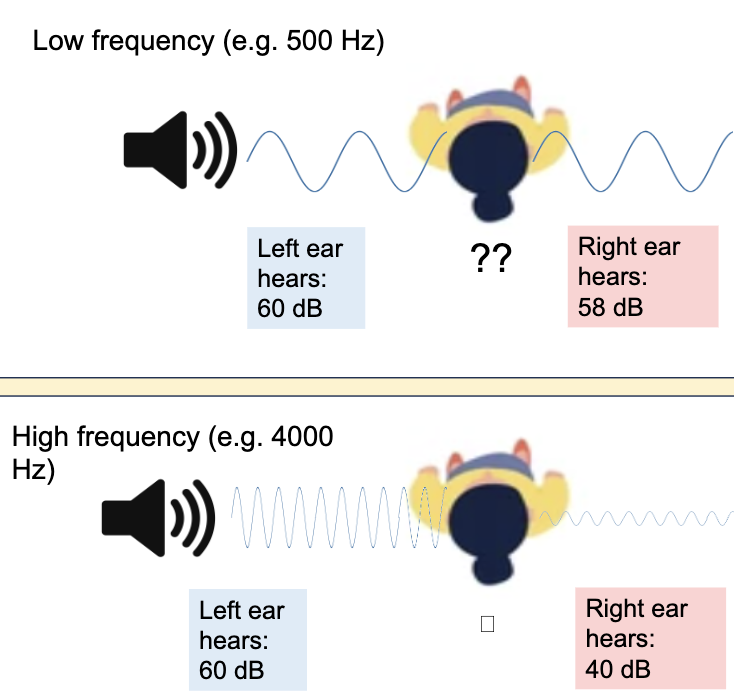
How much dB can high-frequenices sounds lose.
20 dB by being blocked by the head.
How much dB can low-frequenices sounds lose.
Low frequency sound are not blocked by the head, so they don’t lose much energy across the ears.
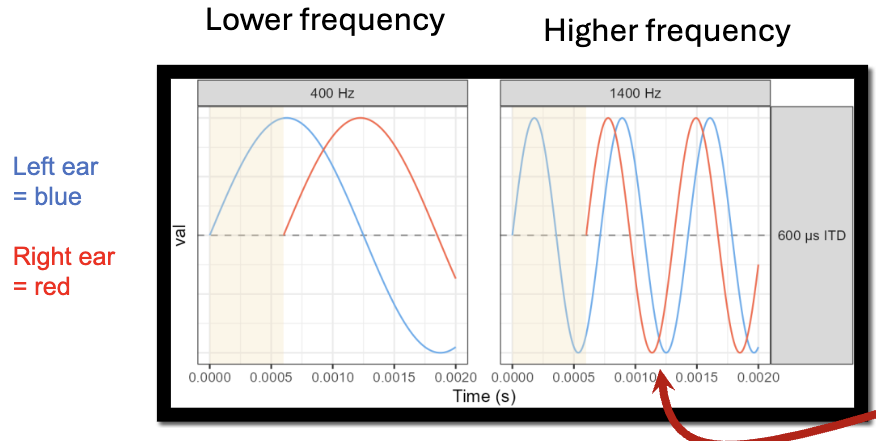
Which ear is leading?
For the higher-frequency sound, the true ITD is left-leading 600 μs, but in the time that it takes the sound to travel to the other ear, the left ear starts to receive another cycle that appears to trail the right ear signal
The frequency where ITD becomes ambiguous is determined by?
WIdth of your head.
We are best at localizing sounds in which dimension?
Horizontal (left/right): because ears are separated this way, the sound will arrive at the ears differently.
Why do we not use ILD to localize low-frequency sounds?
The ILD is small because the sound doesn’t lose energy between the ears.
Hasn’t lost energy, so the product would be very similar.
The largest interaural timing difference that you would ever encounter would be about:
700 microseconds.
The smallest interaural timing difference that is detectable (can be determined to be left leading or right leading) by a person with typical hearing in two ears is about:
10 microseconds.
Interaural timing differences are used to determine the location of what sounds?
Low-frequency sounds.
When you are listening to a person speak, and there is background noise coming from a different direction,
The person is easier to hear (the multiple directions are helpful).
DO high-frequency sounds have big or small ITDs?
High-frequency sounds don’t have smaller ITs.
ILD depends on the frequency.
Intensity of low-frequency sounds is not reduced very much. Can mostly bend around the head.
Intensity of high-frequency sounds is reduced by the head acting as a barrier.
Tinnitus
Perception of ringing, buzzing, clicking, hissing, roaring, or rushing, without any external stimulating sound.
-More likely in older age.
-More likely if have hearing loss.
Explain how tinnitus works.
Tinnitus is always happening in the background, but external sound perception is masking it out.
-Mostly heard 10 dB above your hearing threshold.
-When the nosies are gone, the tinnitus doesn’t start, it becomes easier to hear.
When will you notice tinnitus more?
In a sound booth
When using earplugs.
When using noise cancelling headphones, These can only block external sound.
How do we account for tinnitus while testing hearing?
Audiologist can mask it by playing white noise in your ear while playing the pure tone.
Explain how noise cancelling headphones work.
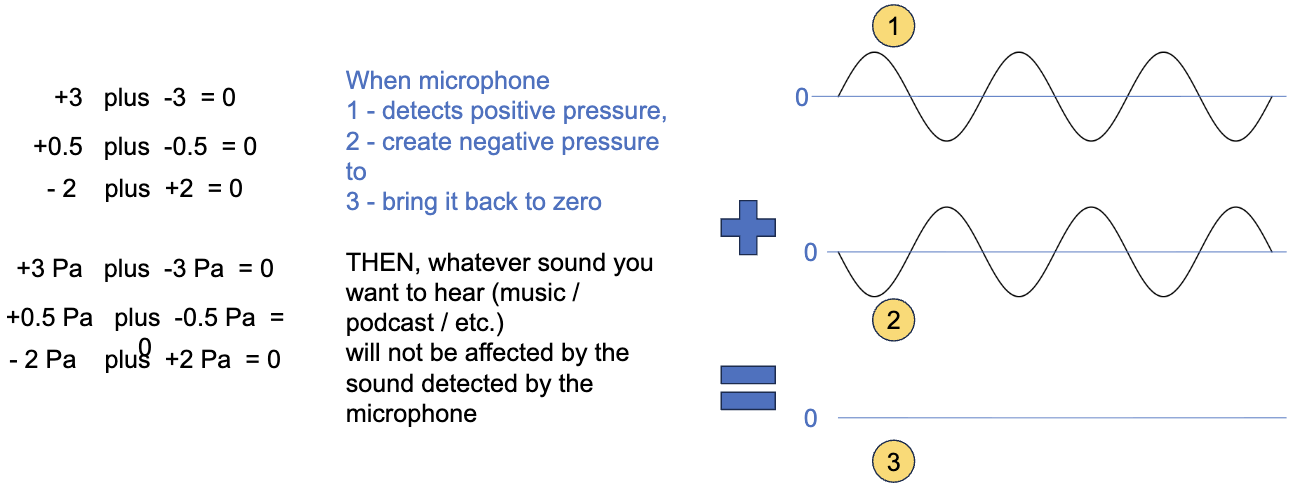
Noise-cancelling headphones operate through destructive interference.
When microphone detects positive pressure, it creates negative pressure to bring it back to zero. Then whatever sound you want to hear, will not be affected by the sound detected by the microphone.
What are some general causes of tinnitus?
More strongly related to hearing loss and noise exposure.
Side effect of medications.
Neurologic causes: head injuries, whiplash, etc.
Infectious causes.
What types of sounds are noise cancelling headphones not good at detecting? Why?
Clicks, because they are harder to neutralize. By the time they are detected the sound is over.
When it is quiet what kind of noise is that?
Low frequency.
How can tinnitus change over time?
Acute tinnitus can last a few minutes to a few weeks after noise exposure.
If it persists beyond 2 years, it is considered chronic and irreversible.
Intensity can worsen and the frequency usually remains stable.
75% of cases disappear spontaneously.
Hearing sound within your own body is called?
Somatosound/autophony
Hyperacusis
physical discomfort or pain when any sound reaches a certain level of loudness that would be comfortable for most people.
This is not a result of ear damage but a result of brain hyperactivation.
Is there a cure for tinnitus?
Nope
Can hyperacusis co-occur with tinnitus?
yes, people with hyperacusis- 90% also have tinnitus.
Explain central gain.
A potential explanation for both tinnitus and hyperacusis. Hearing loss reduces signaling in the pathway toward brain. When you are in a quiet place, that pathway can compensate by applying gain to the signal.
Your brain is creating a louder signal when there doesn’t need to be one.
Loudness recruitment
Abnormally high perceived loudness of medium- to high- intensity sounds, due to hearing loss.
Not a result of actual ear damage.
Annoyance hyperacusis
persistent negative emotional reaction to sounds (irrational, anxiety, tension)
Fear hyperacusis
Aversive response to sounds that results in an anticipatory response and avoidance behavior.
Pain hyperacusis
experience of pain at much lower sound levels than listeners with normal hearing. This can be reported, as stabbing pain in the ear or head.
What sound would be the easiest to localize?
White noise because it offers you low and high frequency sounds.
Why do we not use ITD to localize high-frequency sounds?
The ITD is ambiguous because too many wave cycles complete before the sound reaches the farther ear.
There are so many landmarks, you don’t know what to compare it to.
When sounds are farther away…
The high-frequency energy is lower.
When loud sounds cause physical discomfort or pain, this is called…
hyperacusis
the range between the softest sound you can hear and the loudest sound you can hear is called?
Dynamic range
What is spatial release from masking?
Is the improvement in a listener’s ability to understand a target sound when the target and the masking noise come from different locations in space, rather than the same location.
Your brain understands speech better when the noise and the talker are in different places.
Why does spatial release happen?
ITDs: sound reaches one ear slightly different than the other depending on location.
ILDs: sound are louder in the ear closer to the source.
Head shadow effect: your head blocks sound energy, especially high frequencies, reducing noise in one ear.
Example of spatial release from masking.
Trying to talk to a friend in a noisy restaurant.
Classroom setting: The teacher is at the front of the room and students whispering behind or to the side. Students understand the teacher better because the speech and noise are spatially separated. (use a table to better prove this)
What is are some of the functions of the outer ear?
Filters sound entering the auditory system.
The pinna captures sound and directs it into the ear canal.
Sound amplification from ear canal resonance.
Influences the frequencies lost because of noise induced hearing loss.
Provides important cues for localizing of sound.
What are some functions of the middle ear?
It amplifies sound entering the auditory system.
Pressure gets applied to the eardrum and is concentrated onto a tiny spot that enters the cochlea.
Also reacts to loud sounds by partially softening them.
The best sound to use to measure the resonance spectrum of the ear canal is:
white noise (has all the noises at once)
The resonance frequency of the ear canal is about:
3,000 Hz
The main role of the middle ear structures is to:
increase sound intensity
The biggest contribution to sound by the middle ear is:
The concentration of pressure from a large eardrum to a small stapes
We can determine the vertical location of a sound through:
The pinna filtering the sound
What are some functions of the ear canal?
it boosts sound energy that has a frequency close to its resonance frequency
Why is there resonance?
At the closed end of the tube (the eardrum), it’s more difficult for air particles to move around, because there is a barrier on one side. (particles constrained= pressure can’t change very much)
At the open end of the tube (opening of the ear canal), it’s very easy for air particles to move around, because there are no constraints. (pressure are not constrained= pressure can change maximally)
If the ear canal is longer than then the resonance frequency will be lower or higher?
Lower
longer string then lower note
Do all ear canal resonance have to be 3000 Hz?
No because the canal is not an idealized cylinder. It has twists and curves and it is not a hard perfectly reflective cavity.
sound filtering
energy from some frequencies is lowered and energy from some frequencies is raised.
What does a hearing aid need to be able to do to work?
Amplify sounds at the frequency of the hearing loss AND also the ear canal resonance frequency that was taken away by inserting the hearing aid.
How does the audiologist determine the ear canal resonance?
Play a flat-spectrum sound (white noise) and record the sound level at the ear drum using a super-small microphone.
What do basic earplugs to do the spectrum of incoming sound.
the distortion does not change the pitch or timing of sound but changes the timbre of the sound.
the same frequencies are there, but some of them are lower in intensity (loudness)
What does the outer ear provide cues to?
Sound elevation. As a sound moves up and down, the reflection off of the pinna and other ear structures produce peaks and notches in the spectrum.
The pinna filters the sound and because of that filtering, you know that the sound came from a specific height.
Since everyone has a different pinna, the filter that works for me might not work for you.
What is the main role of middle ear amplification?
increase sound intensity/make it louder. It also amplifies most frequencies by the same amount.
Impedance mismatch
Sound traveling through air encounters minimal resistance. When that pressure wave arrives at the cochlea, it must set FLUID into motion. The fluid puts up more resistance. To overcome this and maintain the pressure of the input, amplification is needed.
Occlusion effect
it happens because the sound generated from your own voice will naturally resonate within your own head and partially escape through your ear canal.
If you block escape path, it just remains in your ear canal, resonating back into your auditory system.
Acoustic reflect threshold
when you hear a loud sound, these muscles will contract- this will stiffen the movement of the ossicles and reducing the loudness of the incoming sound. This kicks into gear when you talk.
 Note
Note  Flashcards (71)