TP53 and Apoptosis

0.0(0)
studied byStudied by 0 people
0.0(0)
call with kaiCall with Kai
learnLearn
examPractice Test
spaced repetitionSpaced Repetition
heart puzzleMatch
flashcardsFlashcards
GameKnowt Play
Card Sorting

1/25

encourage image

There's no tags or description

Looks like no tags are added yet.

Study Analytics
Name
Mastery
Learn
Test
Matching
Spaced
Call with Kai

No study sessions yet.

26 Terms

1
New cards

What is the role of TP53 and which chromosome is it found on?

Chromosome 17

  • TF

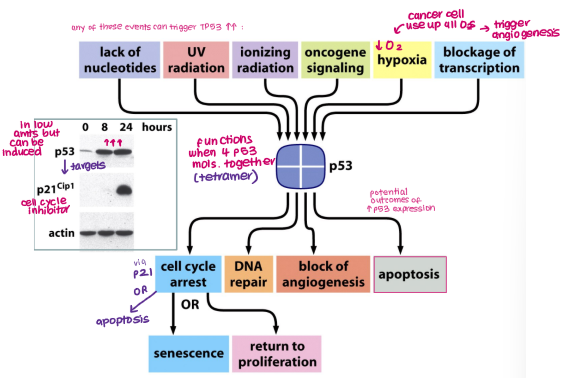
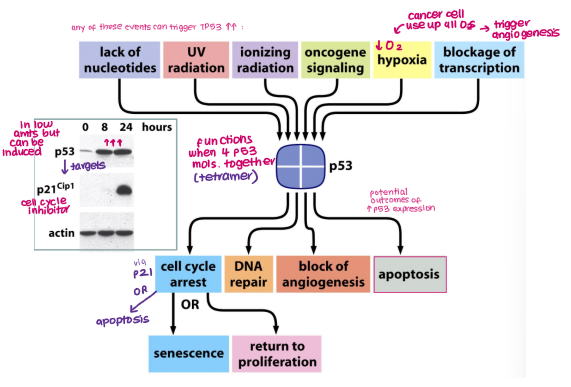
  • Guardian of the genome: responds to various events (e.g. hypoxia, DNA damage, oncogene signalling) and induces senescence, DNA repair, blocking angiogenesis and apoptosis

2
New cards

TP53 is triggered by certain events:

  • Hypoxia

  • DNA damage (UV radiation, Lack of nucleotides)

  • Oncogene signalling

  • Blockage of transcription

<ul><li><p>Hypoxia</p></li><li><p>DNA damage (UV radiation, Lack of nucleotides)</p></li><li><p>Oncogene signalling</p></li><li><p>Blockage of transcription</p></li></ul><p></p>
3
New cards

TP53 responds to events by inducing:

  1. Senescence

  2. DNA repair

  3. Apoptosis

  4. Blocking angiogenesis

<ol><li><p>Senescence</p></li><li><p>DNA repair</p></li><li><p>Apoptosis</p></li><li><p>Blocking angiogenesis</p></li></ol><p></p>
4
New cards

Which two hallmarks of cancer is TP53 most implicated in?

  1. Evading growth suppressors

  2. Resisting apoptosis

5
New cards

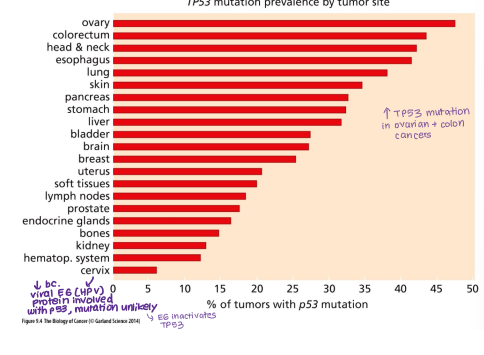
TP53 mutations cause which syndrome? Which cancer is this implicated in?

Li-Fraumeni syndrome

Many cancers (e.g. ovarian, colon)
<p>Li-Fraumeni syndrome</p><p>Many cancers (e.g. ovarian, colon)</p>
6
New cards

Why is TP53 mutation not commonly seen in cervical cancer?

HPV E6 protein already inactivates TP53

7
New cards

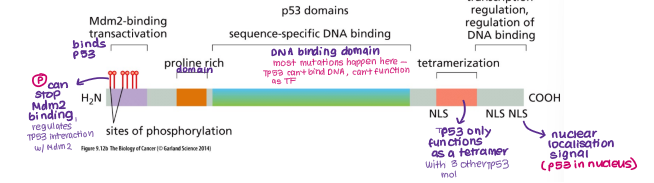
What is the structure of the TP53 gene like?

  • DNA binding domain (most mutations happen here)

  • NLS (TP53 is TF so stays in nucleus)

  • Mdm2 binding site (Mdm2 binds and degrades TP53)

  • Tetramerization site

<ul><li><p>DNA binding domain (most mutations happen here)</p></li><li><p>NLS (TP53 is TF so stays in nucleus)</p></li><li><p>Mdm2 binding site (Mdm2 binds and degrades TP53)</p></li><li><p>Tetramerization site </p></li></ul><p></p>
8
New cards

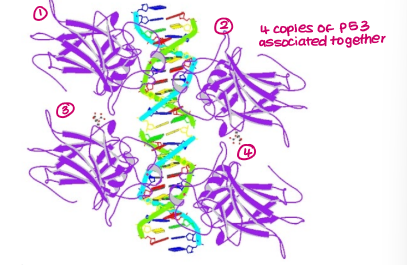
For TP53 to function, what needs to happen first?

forms tetramer with 3 other TP53 molecules
<p>forms tetramer with 3 other TP53 molecules</p>
9
New cards

TP53 regulates expression of different genes. Give examples.

  • Mdm2

  • Growth arrest genes

  • DNA repair genes

  • Regulators of apoptosis (PTEN, BCl2, Bax)
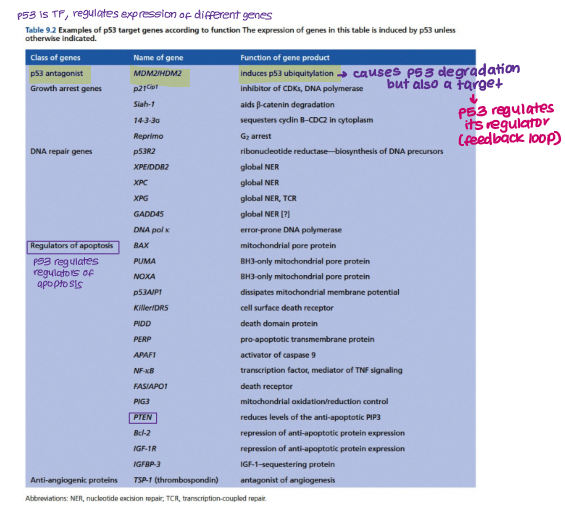
<ul><li><p>Mdm2</p></li><li><p>Growth arrest genes</p></li><li><p>DNA repair genes</p></li><li><p>Regulators of apoptosis (PTEN, BCl2, Bax)</p></li></ul><p></p>
10
New cards

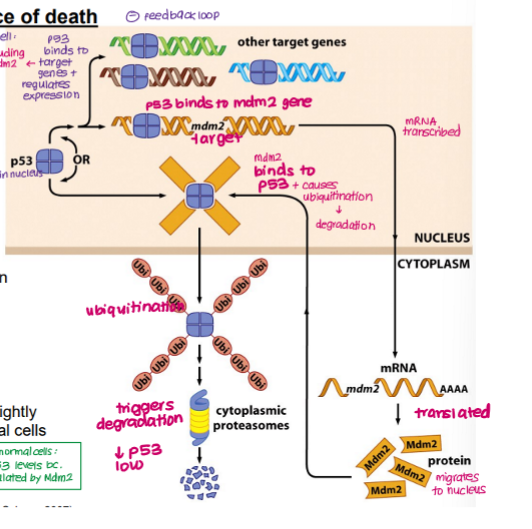
Which protein regulates TP53?

Mdm2 (negative regulator of TP53) BUT TP53 also regulates Mdm2 in a negative feedback loop
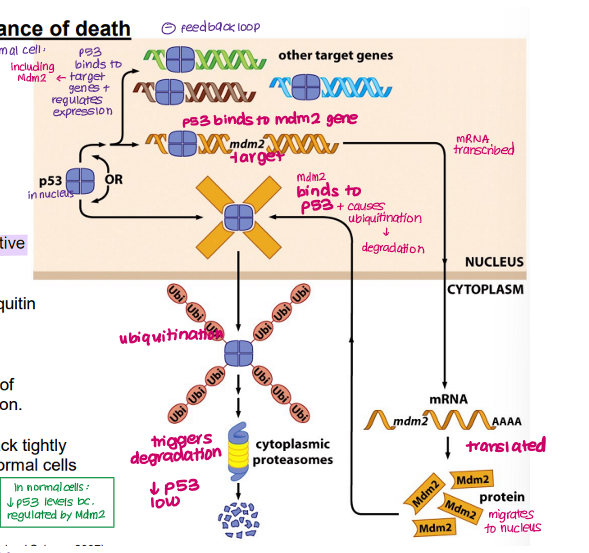
<p>Mdm2 (negative regulator of TP53) <strong>BUT </strong>TP53 also regulates Mdm2 in a <strong>negative feedback loop</strong></p>
11
New cards

Explain how the balance between TP53 and Mdm2 is maintained in a normal cell.

  • TP53 binds and regulates expression of target genes (e.g. Bad, BCl2) via DNA binding domain

  • TP53 also binds Mdm2, increasing expression

  • MdM2 → transcribed and translated → Mdm2 protein

  • Mdm2 protein migrates to nucleus, binds TP53

  • TP53 ubiquitinated and degraded (prevents accumulation of TP53)

  • LOW TP53

<ul><li><p>TP53 binds and regulates expression of target genes (e.g. Bad, BCl2) via DNA binding domain</p></li><li><p>TP53 also binds <strong>Mdm2, </strong>increasing expression</p></li><li><p>MdM2 → transcribed and translated → Mdm2 protein</p></li><li><p>Mdm2 protein migrates to nucleus, <strong>binds TP53</strong></p></li><li><p><mark data-color="red" style="background-color: red; color: inherit;">TP53 ubiquitinated and degraded (prevents accumulation of TP53)</mark></p></li><li><p><strong><mark data-color="red" style="background-color: red; color: inherit;">LOW TP53</mark></strong></p></li></ul><p></p>
12
New cards

Explain how the balance between TP53 and Mdm2 is maintained in a normal cell when DNA damage occurs

TP53 phosphorylated in response to DNA damage

  • DNA damage/stress activates kinases which activate other kinases

  • Chk1/2 phosphorylates TP53 → ACTIVE

  • Phosphorylated/activated TP53 inhibits Mdm2 binding → no degradation

  • Chk1/2 phosphorylates Mdm2 → INACTIVE

  • TP53 accumulates → HIGH TP53

  • TP53 binds and induces expression of target genes (e.g. DNA repair genes, pro-apoptotic genes and Mdm2 itself)

  • Akt survival signals phosphorylate Mdm2 → ACTIVE

  • Active Mdm2 binds TP53 → ubiquitination → degradation → LOW TP53
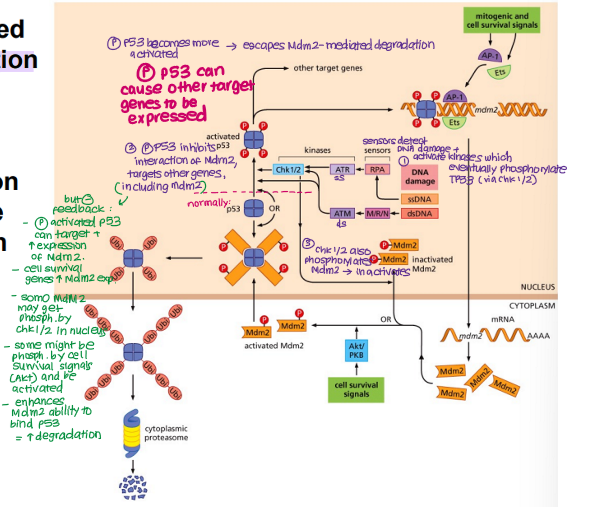
<p>TP53 <strong>phosphorylated </strong>in response to DNA damage</p><ul><li><p>DNA damage/stress activates <strong>kinases </strong>which activate other kinases</p></li><li><p><strong><mark data-color="green" style="background-color: green; color: inherit;">Chk1/2 phosphorylates TP53 → ACTIVE</mark></strong></p></li><li><p>Phosphorylated/activated TP53 inhibits Mdm2 binding → no degradation</p></li><li><p><strong><mark data-color="blue" style="background-color: blue; color: inherit;">Chk1/2 phosphorylates Mdm2 → INACTIVE</mark></strong></p></li><li><p>TP53 accumulates → <strong><mark data-color="green" style="background-color: green; color: inherit;">HIGH TP53</mark></strong></p></li></ul><p></p><ul><li><p>TP53 binds and induces expression of target genes (e.g. DNA repair genes, pro-apoptotic genes and <strong>Mdm2 itself)</strong> </p></li><li><p><strong><mark data-color="blue" style="background-color: blue; color: inherit;">Akt survival signals phosphorylate Mdm2 → ACTIVE</mark></strong></p></li><li><p><mark data-color="red" style="background-color: red; color: inherit;">Active Mdm2 binds TP53 → ubiquitination → degradation → </mark><strong><mark data-color="red" style="background-color: red; color: inherit;">LOW TP53</mark></strong></p></li></ul><p></p>
13
New cards

Give two factors that affect Mdm2/TP53 interaction?

  1. Phosphorylation

  2. Cell cycle progression

14
New cards

Phosphorylation __________ TP53 activity and ___________ Mdm2 activity

Increases TP53 activity

Decreases Mdm2 activity (via Chl1/2) and increases activity via Akt surviv
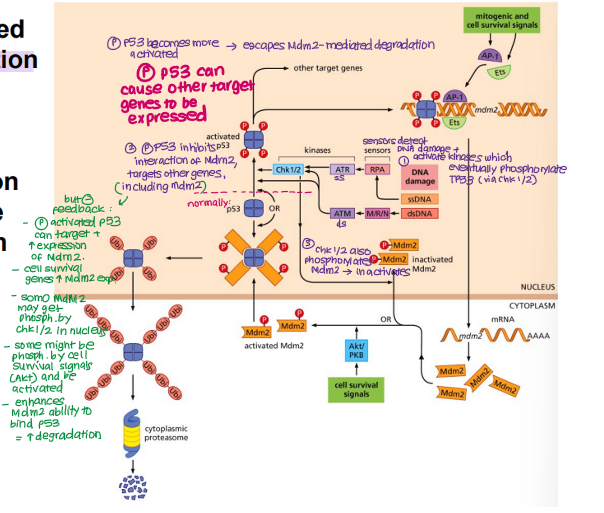
<p><strong><u>Increases </u></strong>TP53 activity</p><p><strong><u>Decreases </u></strong>Mdm2 activity (via Chl1/2) and <strong><u>increases </u></strong>activity via Akt surviv</p>
15
New cards

How does cell cycle progression affect MDM2 and TP53?

When cells proliferate → Rb inhibited → E2F activated

E2F drives expression of:

  • genes needed for G1→S phase progression

  • ARF tumour suppressor

ARF inhibits Mdm2 → can’t degrade TP53 → increases TP53
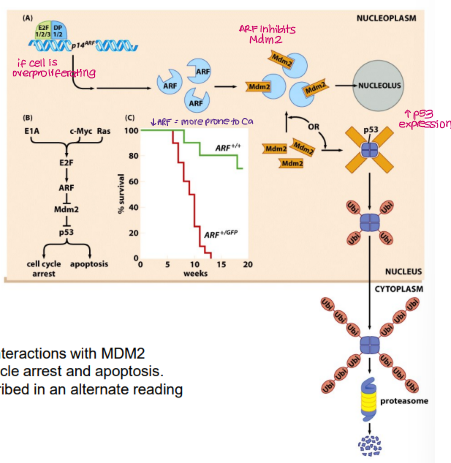
<p>When cells proliferate → Rb inhibited → E2F activated </p><p>E2F drives expression of:</p><ul><li><p>genes needed for G1→S phase progression</p></li><li><p><strong>ARF tumour suppressor</strong></p></li></ul><p></p><p><mark data-color="blue" style="background-color: blue; color: inherit;">ARF inhibits Mdm2 → can’t degrade TP53 → increases TP53</mark></p>
16
New cards

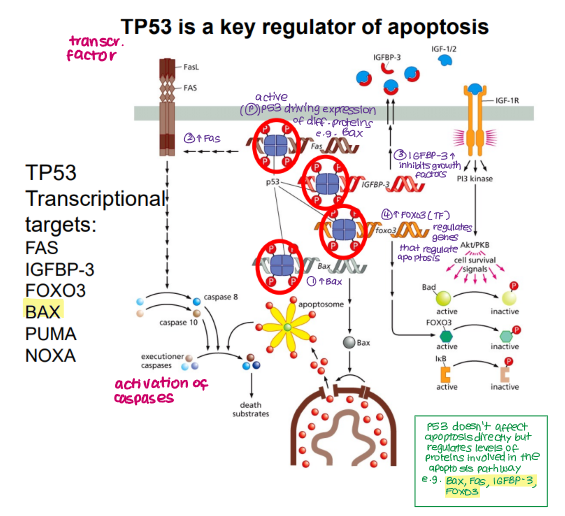
How does TP53 affect apoptosis?

Doesn’t affect apoptosis directly but regulates levels of proteins involved in the apoptotic pathway

17
New cards

Give examples of proteins involved in apoptosis regulated by TP53

  • Fas (extrinsic)

  • Bax BH123 protein (intrinsic)

  • IGFBP-3

  • FOXO3

  • PUMA

  • NOXA

<ul><li><p><mark data-color="blue" style="background-color: blue; color: inherit;">Fas (extrinsic)</mark></p></li><li><p><mark data-color="blue" style="background-color: blue; color: inherit;">Bax BH123 protein (intrinsic)</mark></p></li><li><p>IGFBP-3</p></li><li><p>FOXO3</p></li><li><p>PUMA </p></li><li><p>NOXA </p></li></ul><p></p>
18
New cards

What are the two apoptotic pathways mediated by and where do they converge?

  1. Extrinsic (receptor mediated, e.g. Fas death receptor, TGF receptor)

  2. Intrinsic (mitochondria mediated, CD8+ T cells, cell injury, lack of growth signals)

Converge at proteolytic executioner caspases
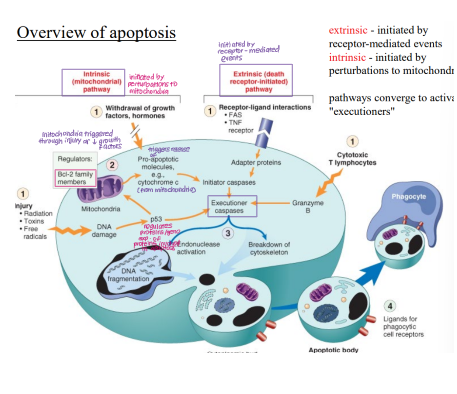
<ol><li><p><strong>Extrinsic </strong>(receptor mediated, e.g. Fas death receptor, TGF receptor)</p></li><li><p><strong>Intrinsic </strong>(mitochondria mediated, CD8+ T cells, cell injury, lack of growth signals)</p></li></ol><p>Converge at <strong>proteolytic executioner caspases</strong></p>
19
New cards

Describe the extrinsic apoptotic pathway and TP53 involvement

TP53 increases death receptor expression (Fas)

  • Fas ligand binds to Fas death receptor

  • DISC (death induced silencing complex) forms

  • Activates procaspases → caspases → executioner caspases
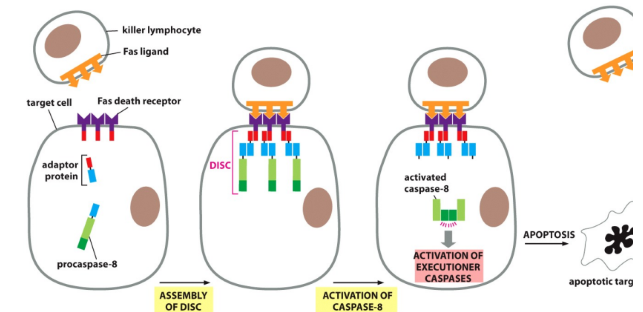
<p>TP53 increases <strong>death receptor expression (Fas)</strong></p><ul><li><p>Fas ligand binds to Fas death receptor </p></li><li><p>DISC (death induced silencing complex) forms</p></li><li><p>Activates procaspases → caspases → <strong>executioner caspases</strong></p></li></ul><p></p>
20
New cards

Describe the intrinsic apoptotic pathway and TP53 involvement

TP53 induces expression of pro-apoptotic genes (BH123 and BH3-only proteins) and inhibits expression of anti-apoptotic BCl2 genes

  • Mitochondria releases cytochrome C

  • Activates caspases → executioner caspases
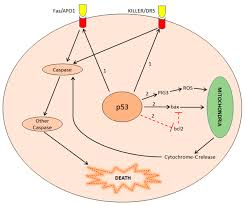
<p>TP53 induces expression of <strong>pro-apoptotic </strong>genes (BH123 and BH3-only proteins) and inhibits expression of anti-apoptotic BCl2 genes </p><ul><li><p>Mitochondria releases cytochrome C</p></li><li><p>Activates caspases → <strong>executioner caspases</strong></p></li></ul><p></p>
21
New cards

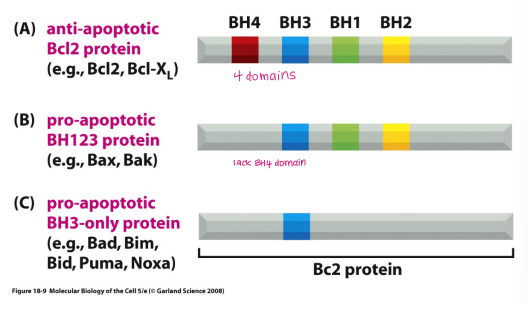
Intrinsic apoptotic pathway is regulated by

BCl2 family proteins

  • BCl2 proteins → ANTI-apoptotic

  • BH123 proteins → PRO-apoptotic

  • BH3-only proteins → PRO-apoptotic

<p>BCl2 family proteins</p><ul><li><p><mark data-color="red" style="background-color: red; color: inherit;">BCl2 proteins → ANTI-apoptotic</mark></p></li><li><p><mark data-color="green" style="background-color: green; color: inherit;">BH123 proteins → PRO-apoptotic</mark></p></li><li><p><mark data-color="green" style="background-color: green; color: inherit;">BH3-only proteins → PRO-apoptotic</mark></p></li></ul><p></p>
22
New cards

Give an example of BH123 proteins

Pro-apoptotic

  • Bax

  • Bak

23
New cards

Give an example of BH3-only proteins

  • Bad

  • Bid

  • Bim

  • Puma

  • Noxa

24
New cards

How do Bcl2 proteins regulate apoptosis?

  • Intrinsic pro-apoptotic signals trigger aggregation of BH123 proteins Bak and Bax in the mitochondrial outer membrane, causing release of cytochrome C

  • Anti-apoptotic Bcl2 binds BH123 proteins and inhibits aggregation

  • Bcl2 is inhibited by BH3-only proteins (e.g. Bad, Bid, Bim, Puma, Noxa)
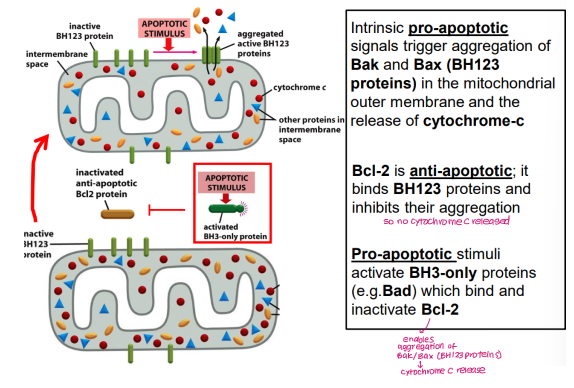
<ul><li><p>Intrinsic pro-apoptotic signals trigger aggregation of <strong>BH123 proteins </strong>Bak and Bax in the mitochondrial outer membrane, causing release of cytochrome C</p></li><li><p>Anti-apoptotic Bcl2 binds BH123 proteins and inhibits aggregation</p></li><li><p>Bcl2 is inhibited by <strong>BH3-only proteins </strong>(e.g. Bad, Bid, Bim, Puma, Noxa)</p></li></ul><p></p>
25
New cards

Bcl2 is regulated by

survival factors (repress apoptosis)
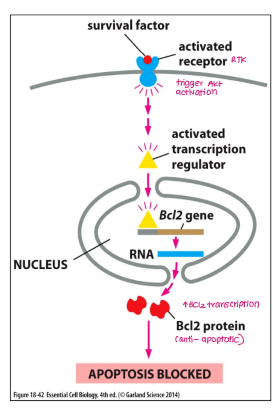
<p>survival factors (repress apoptosis)</p>
26
New cards

BH3-only proteins are regulated by

PI3K/Akt pathway

Akt inhibits Bad via 14-3-3 scaffold protein → inhibits apoptosis
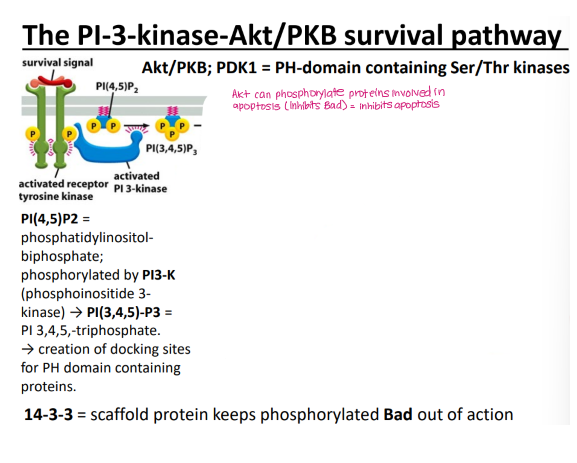
<p>PI3K/Akt pathway</p><p><mark data-color="blue" style="background-color: blue; color: inherit;">Akt inhibits Bad </mark>via 14-3-3 scaffold protein → <strong>inhibits apoptosis</strong></p>