ARTH 205 Maddox Midterm (SG Questions)
 Studied by 0 people
 Call Kai
 Learn
Learn Practice Test
 Spaced Repetition
 Match
Match Flashcards
 Knowt Play
1/71

There's no tags or description
Looks like no tags are added yet.
Name | Mastery | Learn | Test | Matching | Spaced |
|---|
No study sessions yet.
72 Terms
What cognitive capability and critical abilities sets us apart from our predecessors and from all of our contemporary animal relatives?
Humans stand out for complex language, abstract thinking, and the ability to learn and build on others’ knowledge.
Sophisticated stone tools appearing by 1.6 million years ago such as the Acheulean hand axe are indicative of certain changes in our ancestors’ physical and cognitive
abilities and should be understood in certain terms. Explain in terms of performance and Process.
Performance: Better, sharper tools for cutting.
Process: Showed planning, skill, and learning through teaching.
As exemplified by the famous Woman from Willendorf (the “w” is pronounced as a “v”), there are certain characteristics shared by most female figurines. What are these characteristics and what, according to your text, may they represent?
They have big hips, breasts, and bellies which were symbols of fertility, health, and life
Study the following example of this art on MDID: People and Animals. Learn from the lecture what is distinctive about this art, what differentiates it from Upper Paleolithic art. Note that Lepinsky Vir (p. 14) is Mesolithic as opposed to Neolithic. Why?
Shows people and animals in daily life, less about big animals. Lepenski Vir is Mesolithic because it’s before farming but after the Ice Age
The size of megalithic structures indicates what about the social structure of the peoples who built them?
The size of megalithic structures shows teamwork, leaders, and organized communities
The rituals associated with large, elaborate structures, such as Newgrange in Ireland, most likely fostered what social response?
They fostered individual and group identity and cohesion.
Bronze production and use had what effect upon European peoples?
Bronze use led to advances in tools and weapons, trade growth, and more complex social hierarchies
The people of the ancient Near East were polytheists (learn the term). But, each city had a special relationship with one deity. What is the special relationship that was believed to exist between the city and its primary deity?
Each ancient Near Eastern city believed its main deity was its protector and that the city belonged to that god or goddess
What are ziggurats and what was their function? Compare this function to the purpose served by the Egyptian pyramids
Ziggurats were stepped temple towers for worship and offerings to the gods, while Egyptian pyramids were tombs for pharaohs’ afterlife journeys
The famous Uruk vase is a representation of what event and what is the purpose of this event? (This vase is a good example of hieratic scale.)
The Uruk vase shows a ritual offering to the goddess Inanna, symbolizing the giving of agricultural goods to the divine and showing social hierarchy through hieratic scale
What was the purpose of votive statues such as the well-known collection from the Square Temple, Eshnunna?
Votive statues stood in temples as constant worshippers for the donor, offering prayers and representing them before the deity when they couldn’t be there
Study the Disk of Enheduanna. What is the “first” with which her name is associated and what is represented on the disk?
Enheduanna was the first known author in history; her disk shows her performing a ritual offering to the moon god Inanna
What new, precedent setting status (claim) did Naram-Sin assume?
Naram-Sin claimed divine status for himself, calling himself a god, the first Mesopotamian ruler to do so
One does not find major temple structures among the ancient Persians. Explain the reason for this. (From the lectures)
The Persians didn’t build large temples because they worshipped outdoors, believing the natural world was sacred
The sculpture associated with the Apadana of Darius and Xerxes emphasize what three aspects of the power and control of the Persian rulers?
The Apadana sculptures show the Persians’ power through their wealth, unity among diverse peoples, and the authority of the king
What was the world’s first large scale “archaeological” expedition and what effect did it have on European culture?
Napoleon’s expedition to Egypt was the first large-scale archaeological expedition; it sparked European fascination with ancient Egypt
What protections were the Egyptian rulers to provide for their subjects?
Egyptian rulers were expected to protect their people from chaos, ensure justice, and maintain order and prosperity
Egyptian religious beliefs reflect an ordered cosmos.” Explain this feature of Egyptian culture as described in Stokstad. Consider the idea of an ordered cosmos with respect to the concept of ma’at as presented in the lectures. The goddess Ma’at is a manifestation of this concept
Egyptians believed in ma’at, the divine order and balance of the universe; their religion and art reflected harmony, stability, and the idea of cosmic order upheld by the pharaoh and goddess Ma’at
The political control of dynastic rulers was strengthened by their having become considered as and revered as what?
Dynastic rulers were considered divine or semi-divine and were worshipped as gods on earth.
What was the convention for the representation of the human body in ancient Egypt, and were sculptors capable of representing the human body in other ways?
Egyptian artists followed strict conventions: heads and legs in profile, eyes and shoulders front-facing. Yes, sculptors could represent the body naturally, but did not because art was meant to show order, not realism
A considerable proportion of extant ancient Egyptian art and architecture is the result of the belief in the existence of the ka. What is the ka, what are it’s needs and how are these needs fulfilled? Whats its relationship to the ba and akh?
The ka is a person’s life force that needed food, drink, and a preserved body to survive, offerings and statues fulfilled these needs. The ba is the spirit that moves between worlds, and the akh is the transformed soul that lives eternally
Why was it important to provide for the kings the means (pyramids, grave goods, etc.) for a comfortable afterlife?
Providing pyramids and grave goods ensured the king’s comfort and immortality in the afterlife, maintaining divine order and the kingdom’s stability
Who is the first architect in history whose name is known? His fame rests in his design for what structure? What is new about the design?
The first known architect is Imhotep, who designed King Djoser’s Step Pyramid, the first monumental stone structure
Why was the site of the pyramids of Menkaura, Khafra and Khufu east-west oriented?
The pyramids were aligned east–west to follow the sun’s path, symbolizing the pharaoh’s rebirth with the rising sun
Is the Seated Scribe a ka statue? Make your deduction based on its location and attend to the lectures
The Seated Scribe is not a ka statue; it was found in a tomb but represents a servant or official, not meant to house a ka
The tomb statuettes of servants, reliefs, paintings and models served what function?
Tomb statuettes, reliefs, and models provided the deceased with servants, food, and activities needed for a happy afterlife
Scenes of royal hunts, such as seen in Ti Watching a Hippopotamus Hunt, reflect what royal power (responsibility)? Why is a hippo hunt not simply sport? It represented the courage of the deceased and was a metaphor for the triumph over what
Royal hunts like Ti Watching a Hippopotamus Hunt symbolized the ruler’s power to maintain order. The hippo represented chaos, so defeating it meant triumph over evil
Who were permitted to enter the sanctuary of Amun? What were the purposes of Egyptian tomb art? Substantiate your reply by including in your discussion examples of 1) a specific wall relief or a tomb painting, 2) a statue and 3) a small model. What purpose did each of these works serve? Note that the question has to do with tomb art only. Be sure that you do not confuse non-tomb art with tomb art in your reading of our textbook. (from the text and, importantly, the lectures)
Only priests and the pharaoh could enter Amun’s sanctuary. Tomb art served to ensure eternal life. Wall reliefs/paintings (Ti Watching a Hippopotamus Hunt) showed the deceased’s life and ensured rebirth. Statues (Ka statue of Khafra) housed the ka. Models (servant models) magically provided daily services in the afterlife.
Describe the daily “life” of the statue of the god Amun at the Karnak temple dedicated to him. Note that this treatment of sacred sculptures occurred elsewhere in Egypt. Similar treatment of statues is also found in ancient Greece and is a practice found in Hinduism to this day, such as at the temple of Minakshi-Sundareshvara in Tamil Nadu, India.
Amun’s statue at Karnak was treated like a living god—bathed, dressed, fed, and paraded daily in rituals to honor and sustain him.
To what extent and with what type of sculpture were the interiors of temple halls decorated?
Temple halls were decorated with large relief sculptures carved directly into the walls, showing gods, kings, and religious scenes
What is particularly unusual about the status of Hatshepsut?
Hatshepsut was unusual because she was a female pharaoh who ruled as king and was often depicted with male symbols of power
Describe the new religion Akhenaten founded and his role in that religion such as his relationship to Aten. What does his name mean?
Akhenaten created a monotheistic religion worshipping the sun disk Aten; he was seen as Aten’s sole representative. His name means “Servant of Aten.”
How is the wall painting of the Girl Gathering Saffron Crocus Flowers related to the function of the room within which it is located?
The Girl Gathering Saffron Crocus Flowers painting fits the room’s healing function as saffron was used for health and fertility
As exemplified by the case of the Girl Gathering Saffron Crocus Flowers, what might one consider in the search for meaning?
To find meaning, one should consider the painting’s context, such as location, use, and symbolic or ritual purpose
Characterize the technique and style of Minoan wall painting
Minoan wall painting used fresco technique, with lively, flowing lines, bright colors, and natural movement
Explain the way in which Minoan wall painting is similar to and yet differs from Egyptian painting. (from the text and lectures)
Like Egyptian art, Minoan painting shows profiles and flat colors, but it is more fluid, natural, and focused on life and motion rather than strict order.
Learn the function of rhytons as presented in the lectures and study and learn the formal characteristics of the scene in the Harvester Vase that distinguish it from Egyptian and Near Eastern art and learn what is new in the scene. Observe that there is a new sense of time, of the contingent, of immediacy that distinguish the scene from the eternal timelessness of Egyptian and Near Eastern art. (from the text and lectures)
Rhytons were ritual vessels for pouring liquids; the Harvester Vase shows animated, realistic movement and emotion, introducing a new sense of time and energy unlike the static Egyptian and Near Eastern art.
The Mycenaean megaron came to be associated with what social and political rank by archaeologists? To what purpose did the Greeks adapt the megaron
The megaron was the great hall of Mycenaean kings; the Greeks later adapted it as the design basis for their temple
What structure was for more than a thousand years the largest uninterrupted interior space built in Europe, and what building superceded it being so? Answer: the Treasury of Atreus and the Parthenon
The Treasury of Atreus was the largest interior space in Europe for over a thousand years, until the Parthenon surpassed it.
The vault of the Treasury of Atreus is of what type of construction?
The vault of the Treasury of Atreus is a corbeled dome, built by stacking stones in overlapping rings that meet at the top.
In the broadest terms, describe how Greek art can be differentiated from Egyptian art and culture. This information is presented in several places in the section “The Emergence of Greek Civilization” and “The Geometric Period.” See also “The Temple of Aphaia on Aegina
Greek art focused on humanism, naturalism, and balance, while Egyptian art emphasized order, permanence, and divine rule
Discuss the differences and similarities to be observed in the way the Greeks and the Egyptians visualized their gods and in their relationship to them. Read the Art and Its Context textbox “Greek and Roman Deities.
Egyptian gods were distant and rigidly idealized, while Greek gods looked human, showed emotion, and interacted closely with people
Describe the ways that distinguish Greek sanctuaries from the religious complexes of the Egyptians
Greek sanctuaries were open complexes with multiple buildings for worship and gathering; Egyptian temples were enclosed and restricted, built for the gods and pharaohs only.
Ancient Egyptian and Greek funerary art and beliefs concerning the afterlife differ considerably. Explain
Egyptians focused on preserving the body for eternal life; Greeks focused on honoring the dead through memory and beauty, not bodily preservation
The Treasury of the Siphnians at Delphi is the first known example of a new trend in the representation of space. What is this trend and how is it achieved? (rf. in part to the lectures
The Treasury of the Siphnians shows a new trend toward spatial depth and movement, achieved by overlapping figures and diagonal poses in relief sculpture
What are the three Classical Greek architectural orders? They are constructed on what system and on what basis are the proportions determined?
The three Classical Greek architectural orders are Doric, Ionic, and Corinthian. They are built on a post-and-lintel system, with proportions based on mathematical ratios
In the same text box, study the basic features that distinguish each of the three orders
Doric are simple, sturdy, no base, plain capital. Ionic are lender, has a base, scroll-shaped (volute) capital. Corinthian are elaborate, with acanthus leaf capitals
Read very carefully the introduction to the Early Classical period. Note the interrelationship of the concepts of humanism, rationalism and idealism.
Greek art reflected humanism (value of the human), rationalism (reason and balance), and idealism (pursuit of perfection). All are interconnected in Classical thought
Note that the representation of the human figure is based on close observation and a system of ideal, perfect, mathematical proportions. The ideal system of perfect mathematical proportions is derived (in part) from close observation of the body and the belief in the existence of a universal ideal. This information is of importance to 49 above
The Greek human figure was based on careful observation and mathematical proportion, showing an idealized yet natural human form that expressed universal beauty
The Erechtheion stands on the site of what mythological event?
The Erechtheion stands on the spot where Athena and Poseidon competed for control of Athens. Athena gave the olive tree, Poseidon struck the rock with his trident
Describe the characteristics that differentiate fourth century sculptures from the preceding fifth century, and who are the three most significant artists of the fourth century BCE in Greece?
Fourth-century sculptures are more emotional, natural, and relaxed than the balanced, ideal forms of the fifth century. The key artists are Praxiteles, Skopas, and Lysippos
In what ways does Hermes and the Infant Dionysos by Praxiteles exemplify the character of fourth century sculpture and distinguish it from fifth century sculpture? Information presented in the lectures is required for a complete answer to this question.
Hermes and the Infant Dionysos shows gentle movement, softer modeling. But it also shows Hermes teasing Dionysus, holding grapes just out of the babies reach
Learn the characteristics of Hellenistic art and architecture so that you might be able to distinguish an example of this style from earlier styles. In other words, you might be shown two works unknown to you and be asked to identify one style from another and justify your determination. The lectures are important for relevant (required) information
Hellenistic art is dramatic, emotional, dynamic, and realistic, showing movement, tension, and deep expression, unlike the calm idealism of Classical art.
There are two divergent stylistic trends clearly observable in Hellenistic period sculpture. Explain
Realism and emotional intensity (dramatic, expressive works), and Idealized beauty and elegance (refined works).
Study very carefully the description of the frieze on the Pergamon altar, the formal features and those features that mark it as Hellenistic, as distinct from Classical art.
The Pergamon Altar frieze shows swirling motion, deep carving, and intense emotion—figures strain and twist, creating drama and shadow, marking it as Hellenistic rather than calm and ordered like Classical art.
The very famous Aphrodite of Melos (Venus de Milo) is an example of a renewed interest in what style and yet is also has features that mark it as a work of Hellenistic art. Explain.
The Aphrodite of Melos (Venus de Milo) revives the Classical ideal of beauty but adds movement, sensuality, and dramatic contrasts, showing both Classical calm and Hellenistic energy.
One of the most recent interpretations of Paleolithic parietal art is a neuropsychological model based on studies of shamanism and the human experience called the heightened state of consciousness. a) Briefly explain this theory, including a description of the stages a shaman undergoes to reach the spirit world. b) Identify (title, location, style, date) two examples of works of art that are thought to justify this theory and explain what about them seems to justify the theory.
Paleolithic cave art reflects shamanic visions seen in trance states. Shamans move through three stages: geometric visions, transformation, and entering the spirit world. Examples: Lascaux Cave (France, c. 15,000 BCE) and Chauvet Cave (France, c. 30,000 BCE) show swirling, layered animals and abstract signs that mirror trance imagery.
The way of seeing what we now call Paleolithic parietal art changed between the 17th and the 21st centuries. This was presented as part of the presentation of the concept that seeing is, in part, a culturally mediated act. Explain this concept. Why did the 17th century visitors to the Niaux cave not “see” the art therein as they are “seen” today? What were the changes (as presented in the lectures) that contributed to the changed way of seeing, of responding to Paleolithic parietal art?
“Seeing” is culturally shaped. 17th-century visitors to Niaux Cave saw markings as random because they lacked the idea of prehistoric art. Later discoveries, science, and cultural awareness changed perception, allowing modern viewers to recognize intentional imagery and meaning.
The three concepts humanism, rationalism, and idealism have been said to be the foundation of Greek art. Define each of these terms, and discuss how the first two contributed to the idealism that is seen in Greek art.
Humanism – belief in human worth and beauty.
Rationalism – use of reason, order, and proportion.
Idealism – pursuit of perfect form.
Humanism inspired focus on the body, and rationalism guided proportion and balance—together they produced Greek idealism
A considerable proportion of extant ancient Egyptian art and architecture is the result of the belief in the existence of the ka. What is the ka, what are its needs and how are these needs fulfilled? What is its relationship to the ba and akh?
The ka is a person’s life force needing food and a preserved body. Offerings and statues sustained it. The ba is the soul that moves between worlds, and the akh is the reunited, eternal spirit.
Discuss the innovations in the style of the Second Palace Period Minoan art as seen in the Harvester Vase.
In the Second Palace Period, Minoan art like the Harvester Vase shows natural movement, rhythm, and individuality, creating liveliness and a sense of real human emotion unseen in earlier, static styles

Ankh=symbol of life.
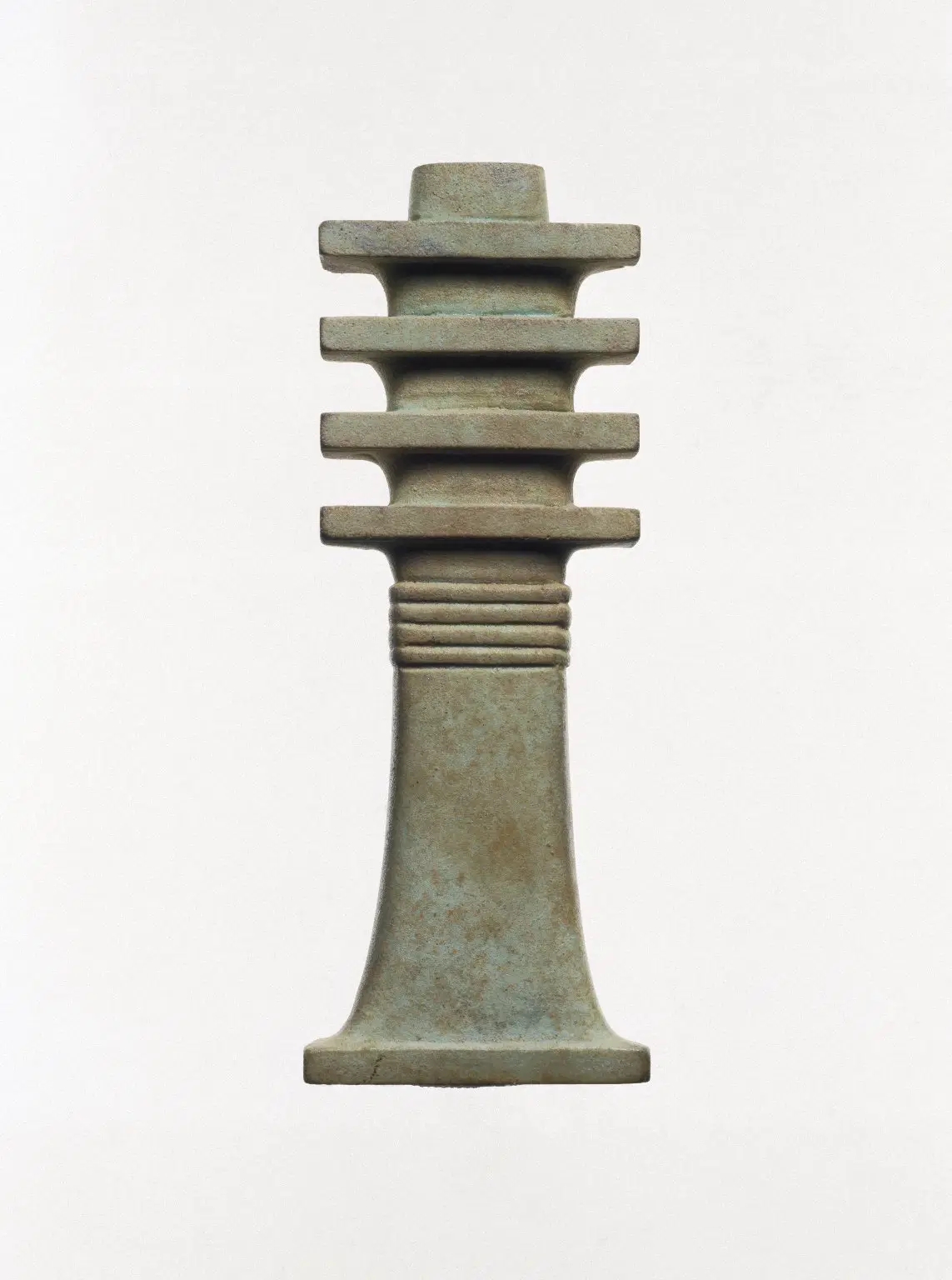
Djed pillar=stability.
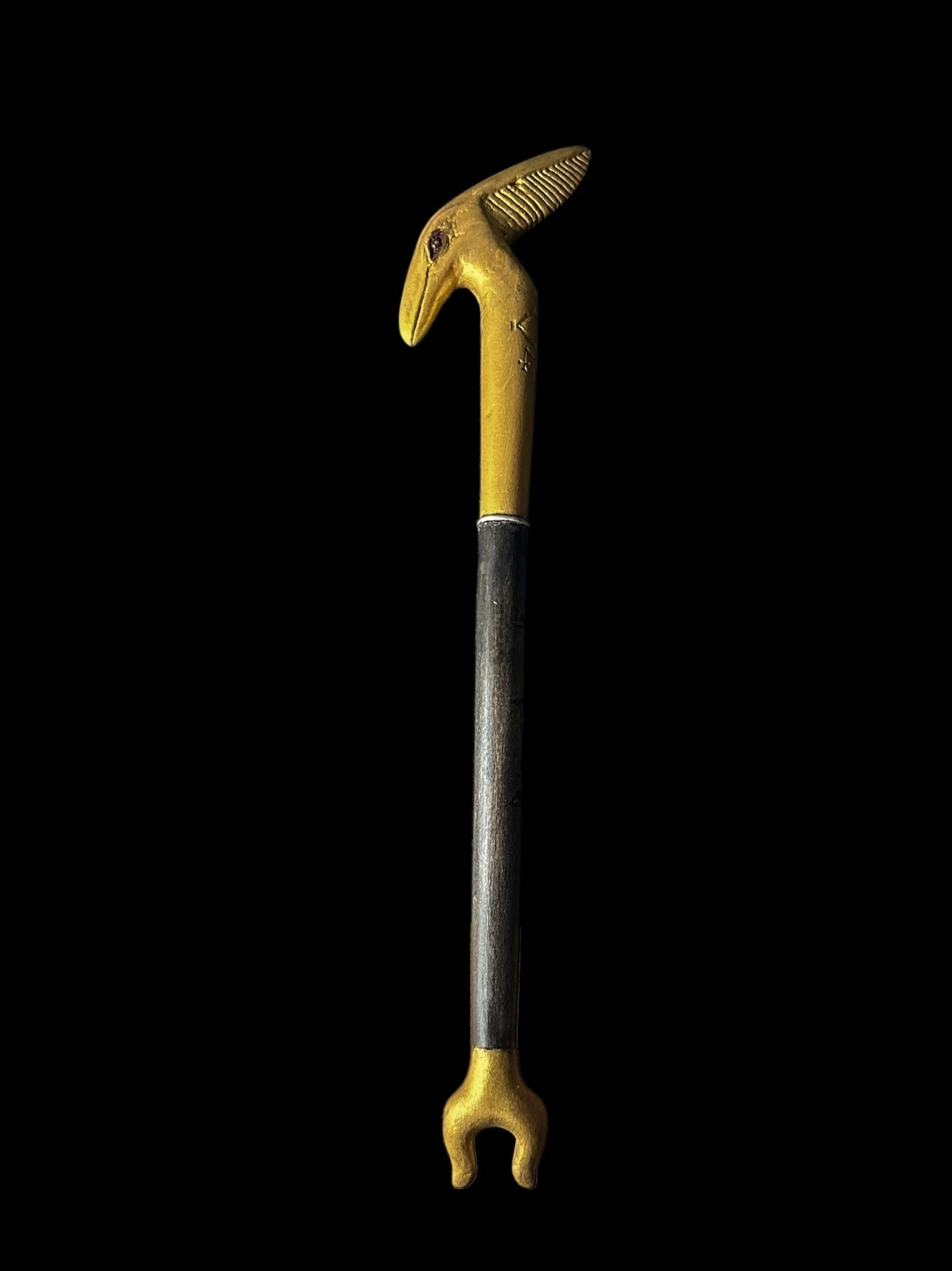
Was scepter=power and dominion
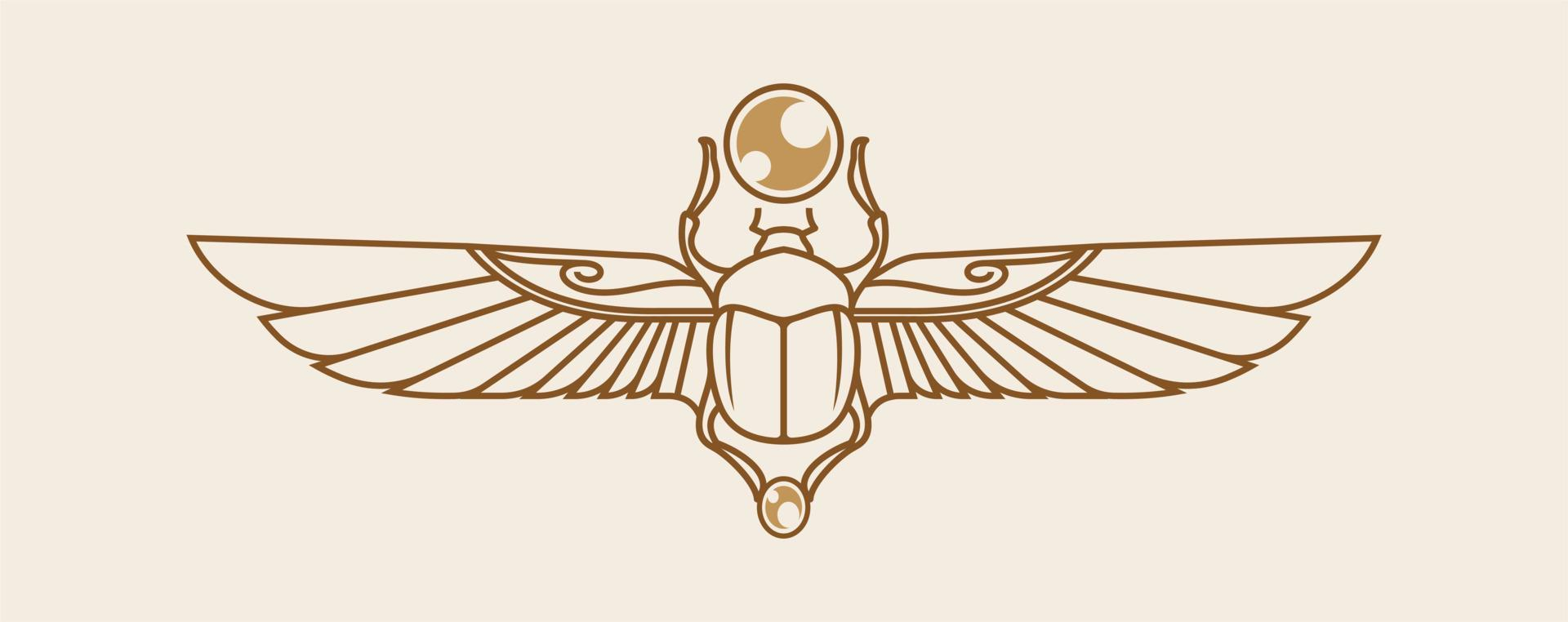
Scarab=rebirth
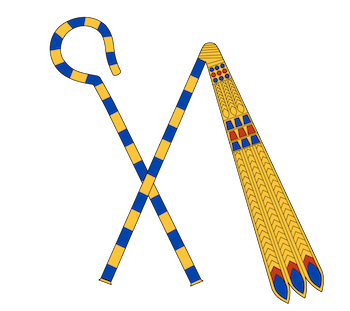
Crook and flail=kingship and authority
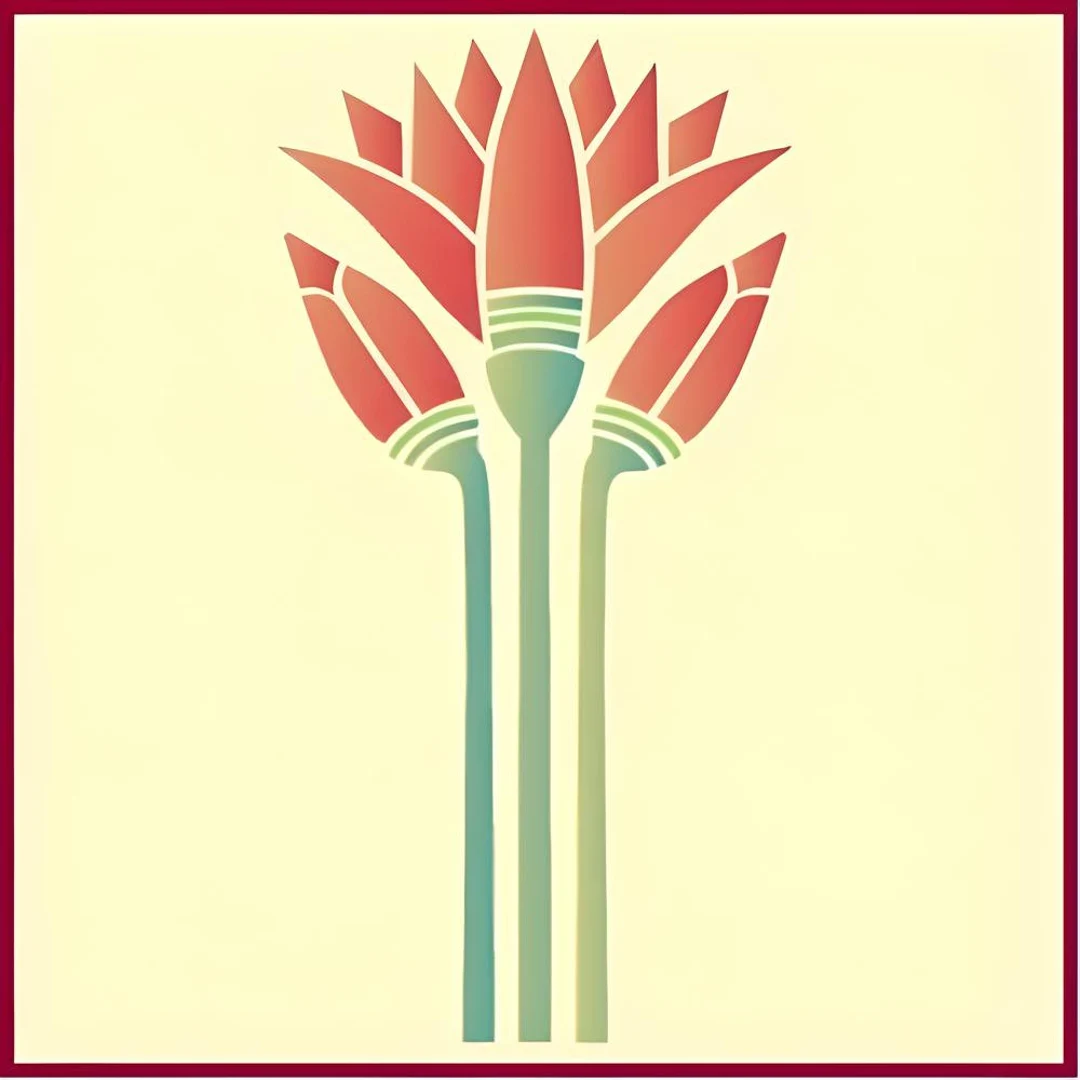
Lotus=creation and rebirth
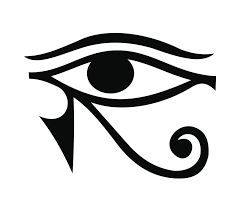
Wedjat Eye/Eye of Horus=healing, protection, and the sun
falcon=Horus
white crown of upper egypt
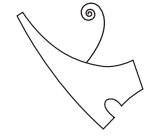
red crown of lower egypt
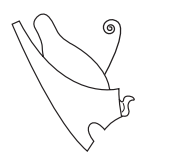
double crown of unified egypt
 Note
Note  Flashcards (38)