Romanian Orphan studies: effects of institutionalisation
 Studied by 1 person
 Call Kai
 Learn
Learn Practice Test
 Spaced Repetition
 Match
Match Flashcards
 Knowt Play
1/12

There's no tags or description
Looks like no tags are added yet.
Name | Mastery | Learn | Test | Matching | Spaced |
|---|
No study sessions yet.
13 Terms
What is institutionalisation?
The effects of living in an institutional setting. Institution refers to the place like a hospital or orphanage where children live for a long, continuous period of time. There is often little emotional care provided.
What are the effects of institutionalisation?
social, mental and physical underdevelopment- some of which may be irreversible
What happened in Romania that can help inform psychologists on the effects of institutionalisation?
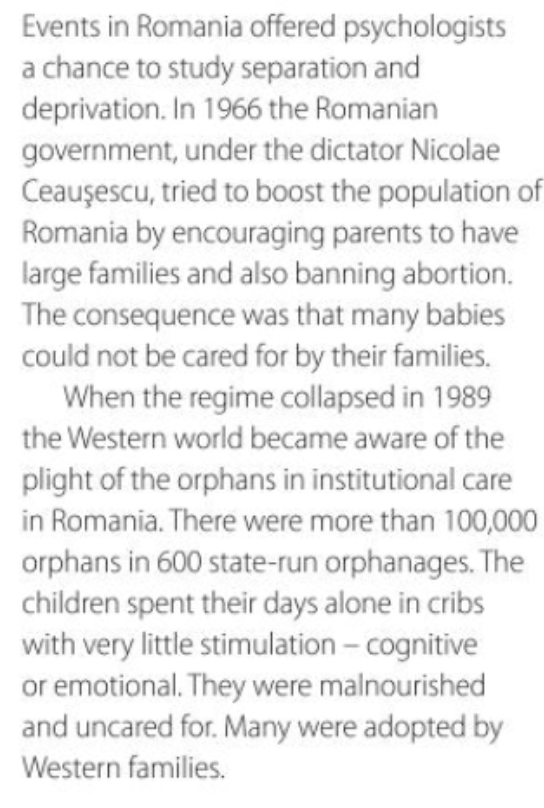
Rutter English and Romance Adoptee study (2011): procedure
165 Romanian orphans adopted in Britain to test to what extent good care could make up for poor experiences in institutions
Physical, cognitive and emotional development assessed at 4,6,11 and 15 years old and 22-25 years
Control group – 52 British children adopted around the same time
Rutter English and Romance Adoptee study (2011): findings: intellectual developments
When first arrived in UK half adoptees showed signs of delayed intellectual development
At 11 yo the adopted children showed different rates of recovery that were related to their age of adoption (good quality aftercare):
- Mean IQ for those adopted BEFORE 6 months – 102
- Adopted between 6m – 2 yo = 86
- Adopted after 2 yo = 77
Beckett et al (2010) found that these differences continued to be apparent at 16 years old
Rutter English and Romance Adoptee study (2011): findings: frequency of disinhibited attachment (type D)
Equally friendly and affectionate to people they know well or who are strangers – this is unusual behaviour – 2 yo usually show stranger anxiety
Rutter argues this is the result of adapting to living with multiple caregivers during the sensitive period
The children adopted after 6 months showed signs of disinhibited attachment
Symptoms included attention seeking, clinginess and social behaviour directed indiscriminately towards all adults
Children adopted before 6 months rarely displayed disinhibited attachment
Rutter English and Romance Adoptee study (2011): conclusions
Findings support Bowlby’s view that there is a sensitive period in the development of attachments – a failure to form an attachment before the age of 6 months appears to have long lasting effects.
Rutter English and Romance Adoptee study (2011): Evaluation
+Longitudinal study – lots of detailed information over a long period of time
-Natural experiment – IV when they were adopted - may have been other variables The adopted group may have been more socially skilled making them easier to place in adoptive families
-All children are Romanian – may not be the same for other children, so cannot generalise - lack of population validity
Zenah Bucharest Early Intervention Project: Procedure
95 children aged 12-31 months
Average had spent 90% of life in institutional care
Control group – 50 children who had never lived in an institution
Attachment type measured using Strange situation
carers were asked about unusual social behaviour including clingy, attention- type D
Zenah Bucharest Early Intervention Project: findings and conclusion
Type B:
74% of the control group were securely attached
19% of the institutional group were securely attached
Type D:
Disinhibited attachment - 44% of institutionalised children as opposed to 20% of the controls
Zenah Bucharest Early Intervention Project: evaluation
+Natural experiment
-Social sensitivity - suggesting type D is not ‘good’
-Interviews with carers - retrospective and subjective
Evaluation of effects of institutionalisation: real world application
Studying Romanian orphans has important practical applications.
Led to improvements in orphanages and care homes.
Use of key workers
Real life applications for looked after children
Avoidance of disinhibited attachment
However, there may be issues with generalisability in Romanian studies.
Unusual situation means you cannot generalise to others (lacks external validity)
Evaluation of effects of institutionalisation: social sensitive
suggests there implication for children in care/ adopted children
The results show that late adopted children typically have poor development outcomes
But research might benefit future institutionalised children
 Note
Note  Flashcards (20)