7. Communication - not for exam just for case
 Call Kai
 Learn
Learn Practice Test
 Spaced Repetition
 Match
Match Flashcards
 Knowt Play
1/10

There's no tags or description
Looks like no tags are added yet.
Name | Mastery | Learn | Test | Matching | Spaced | Call with Kai |
|---|
No analytics yet
Send a link to your students to track their progress
11 Terms
Why is risk communication important?
Consumers are an important stakeholder/group
They have relatively little expertise in food safety
Yet, both food and safety are key in people’s daily lives.
What is riks expert vs consumer
Expert view:
The chance of injury, damage or loss (taking into account severity and probability)
Objective, real risk, identified through scientific research & systematic procedures
Traditional:
subjective, emotional, irrational, hampered by lack of knowledge
To be amended by communication of expert knowledge (education)
What do people use to assess risk?
Television, on a TV set or via the internet
Exchanges with family, friends, neighbours or colleagues
Internet search engine
etc.
Goals of communication about risks associated with food
To educate the public about safe food handling and healthy diets
Avoid ‘unnecessary’ food scares
To encourage people to accept technological advances
Knowledge/information deficit model
Information will lead to change
If the public does not agree with an expert message, it means they don’t understand it
Therefore we should focus on the spreading knowledge.
Public vs expert risk rating
Experts perceive less risks in food than consumers
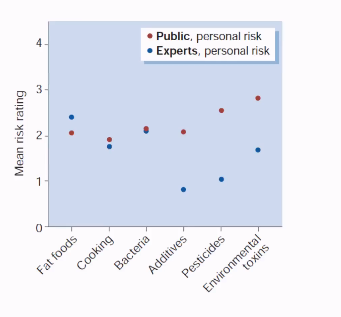
Why do lay people judge risks higher than experts?
Expert judgments: their estimates correlated highly with technical estimates of annual fatality rates
Laypeople asked to use the ‘fatality’ data come up with almost similar estimates
Lay people are capable of judging risk correctly if they are provided with the information.
However fatality rates are not the only way to judge risk
What are the two main risk dimensions among non-experts?
Unknown factor
Dread factors
Unknown factors - risk dimensions
People evaluate risk depending upon when the risk is:
Observable/unobservable: mold vs toxin
Known to those exposed/unknown
Effect immediate/delayed
Risks known to science/unkown
Naturalness: coloring
Dread factors—risk dimensions
People assess the risk according to various factors:
Control: pilot vs passenger
Catastrophic: bike vs plane accident
Low vs. high risk for future generations
Exposure easy vs. difficult to reduce
Risks are decreasing/risks increasing over time
Voluntary exposure: snowboarding vs crime
Fatality
Less concerned if controllable and not catastrophic
Think of food scandals, major outbreaks

