ch14 mendel
 Call Kai
 Learn
Learn Practice Test
 Spaced Repetition
 Match
Match Flashcards
 Knowt Play
1/38

There's no tags or description
Looks like no tags are added yet.
Name | Mastery | Learn | Test | Matching | Spaced | Call with Kai |
|---|
No analytics yet
Send a link to your students to track their progress
39 Terms
what is the “blending” hypothesis
the idea that genetic materia lfrom the two parents blends together. definition of heredity from the mid-19th century
what was the alternative to the blending model, and what was this called?
the gene idea: parents pass on discrete heritable units, genes
what are some traits of the pea plants mendel used to his advantage
their distinct heritable features (characters), like their color or their character variants like the two colors
what is the parental generation called
P generation
what are the hybrid offspring of the P generation referred to as
F_{1} generation
what happens when the F_{1} generation self-pollinates?
F_{2} generation is made
what does monohybrid cross do for inheritance
tracks the inheritance of a single character
what is true-breeding?
plants that produce offspring of the same variety when they self-pollinate
the law of segregation
by mendel, it reveals the F_{1} generation of cross-breeding between pure-breeding plants. this led to his naming of dominant and recessive traits based on their frequency of appearance.
what do we call a “heritable factor”
a gene
what was mendel’s model to explain the F_{2} offspring
3:1 inheritance pattern. made of four related concepts, these being: alleles, genetic locus per homologous chromosome, dominant/recessive alleles, alleles for a heritable character segregate during gamete formation and end up in different gametes
what is an allele in the context of mendel’s work
alternative versions of genes that account for variations in inherited characters
describe the second part of mendel’s segregation model
for each character an organism inherits two alleles, one from each parent. a genetic locus is actually represented twice (one per homologous chromosome)
describe the third part of mendel’s law of segregation
the two alleles at a locus differ: the dominant allele determines the organism’s appearance, the recessive allele has no noticeable effect on the organism’s appearance
what’s the difference between mendel’s laws of segregation and independent assortment
genes segregating
what is the final part of mendel’s theory of segregation
the two alleles for heritable character segregate during gamete formation and end up in different gametes
how should you define an organism that is homozygous for a particular gene
has a pair of identical alleles for that gene
exhibits true-breeding
how would you define an organism that’s heterozygous for a particular gene
has a pair of alleles that are different for that gene
doesn’t exhibit true breeding
what is a testcross and what is it used for
an individual with an unknown genotype is crossed with a homozygous individual expressing the recessive trait
describe mendel’s law of independent assortment
states that each pair of alleles segregates independently from each other’s alleles during gamete formation. rumored to be only those who are located near each other.
how did mendel create his law of independent assortment
he followed two characters at once instead of one. by producing dihybrids who are heterozygous, the dihybrid cross determines whether two characters are transmitted to offspring as a package or independently
what does mendel’s law of independent assortment apply to
different nonhomologous chromosomes
what is the multiplication rule of probability
the probability that two or more independent events will occur together is the product of their individual proabilities
what rule do you use to determine the probability of an F_{1} monohybrid cross
multiplication rule
probability rule of addition
the probability that any one of two or more exclusive events will occur is calculated by adding together their individual probabilities
what can the rule of addition be used for
ex. the probability that an F_{2} plant from a monohybrid cross will be heterozygous rather than homozygous
what rule is used for the following probability equation:
probability of YYRR x yyrr → YyRr
the probability of Yy ___ Rr is ___
the probability of Y ___ or y is ____
Yy and Rr is multiplied, Y or y is added
describe the probability in a dihybrid cross
probability of one trait times the probability of the second trait
ex.
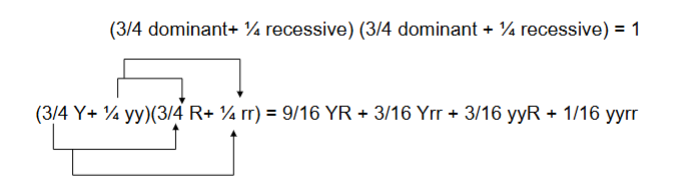
what is the only thing you can use a punnett square for
monohybrid cross
what are the degrees of dominance
complete: when phenotypes of the heterozygote and dominant homozygote are identical
incomplete: phenotype of F_{1} hybrids is somewhere between the phenotypes of two parental varieties
codominance: two dominant alleles affect the phenotype in separate, distinguishable ways
what are alleles
variations in a gene’s nucleotide sequence
are dominant alleles the most common in a population?
not necessarily
what is pleiotropy
when genes have multiple phenotypic effects
what is polygenic inheritance
some traits may be determined by two or more genes. for example, many human characters vary in the population along a continuum and are called quantitative characters
what is epistasis
a gene at one locus alters the phenotypic expression of a gene at a second locus. example, in mice their coat color depends on two genes: one for pigment and one for whether the pigment will be deposited in the hair.
quantitative variation indicated what type of inheritance
polygenic, an additive effect of two or more genes on a single phenotype
an organism’s phenotype includes what information
physical appearance, internal anatomy, physiology, behavior, and reflects the overall genotype and unique environmental history
why are humans bad subjects for genetic research?
generational period lasts too long, parents produce relatively few offspring, and breeding experiments are unacceptable
pedigrees do what for us
can be used to trace inheritance patterns of specific traits

