2.2.1 The Endocrine System
 Studied by 1 person
 Call Kai
 Learn
Learn Practice Test
 Spaced Repetition
 Match
Match Flashcards
 Knowt Play
1/32

There's no tags or description
Looks like no tags are added yet.
Name | Mastery | Learn | Test | Matching | Spaced | Call with Kai |
|---|
No analytics yet
Send a link to your students to track their progress
33 Terms
Describe the basic mechanism of hormone action in the human body?
Hormones act as chemical messengers that travel through the bloodstream to find specific target cells equipped with matching receptors. Once a hormone binds to its receptor—either on the cell surface or inside the cell—it triggers a chain reaction that alters the cell's activity. This process typically results in the activation of specific genes to create new proteins or the modification of existing enzymes to regulate bodily functions like growth, metabolism, and mood.
Explain how internal and external factors can impact homeostasis in the body?
External factors, such as extreme temperatures or varying oxygen levels, force the body to initiate protective responses like sweating or rapid breathing to prevent damage. Internal factors, including fluctuating blood glucose or pH levels, trigger the release of hormones and enzymes to restore chemical balance. Together, the nervous and endocrine systems monitor these shifts and use negative feedback loops to return the body to its ideal "set point."
What is the endocrine system similar to and why? How are they different?
The nervous system! They both control communication in the body.While the nervous system communicates using electrical signals, the body’s endocrine system uses chemical signals, called hormones, to regulate body functioning.
Hormones are what macromolecule and what are some of their jobs?
They are proteins and they carry messages between organs and cells and are responsible for your body’s energy level, growth and development, mood, and sleep!
How doe she nervous system and endocrine system work in tandem?
The nervous system sometimes controls the release of hormones from endocrine glands, while the hormones that endocrine glands release can influence behavior and emotions through their actions on the nervous system.
What do these actions of the body help with communication?
Homeostasis-it is the internal balance of the human body for normal levels.
What secret the substances+hormones?
Glands-organs located throughout the body that produce and release substances such as hormones, digestive juices, tears, sweat, saliva, or milk
What are the two main types of glands and their job?
Exocrine(think EX leaving)NONHORMONAL-Such as sweat glands, secrete substances through openings or ducts onto your body surfaces
Endocrine(Enter sign)-secrete hormones directly into the bloodstream to reach their targets.
What does each hormone have?
A specific target tissues, and in many cases, these targets include other endocrine glands
Talk out the process of hormone secretion
ANSWER IN IMAGE
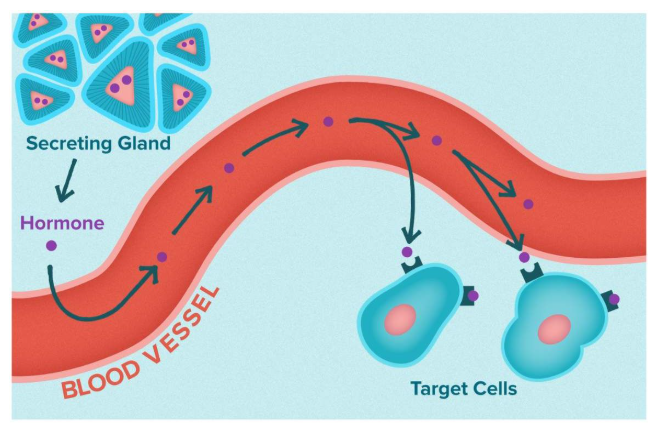
Describe basic mechanism of hormone action in the human body.*KNOW HOW THIS PROCESS WORKS,PRACTICE WRITING IT OUT*
Hormones act as the body's primary chemical messengers, produced by the endocrine system to regulate complex biological processes. Within this system, a specialized organ known as a gland—such as the pancreas—synthesizes and releases a specific hormone (like insulin) directly into the bloodstream.
As these chemicals travel throughout the body, they only affect specific target cells that possess the unique receptor required to "read" the signal. For example, when the pancreas releases insulin, it travels to muscle and liver cells, binding to their surface receptors to signal the cell to absorb glucose from the blood, thereby maintaining metabolic balance.
Endocrine glands release hormones into the bloodstream and out of the body through ducts. T OR F
F-Endocrine glands release hormones into the blood only and do not use ducts.
Hormones act more quickly than a nerve impulse.
T OR F
False
A target cell responds to a hormone because it has a specific _____ for that hormone.
Receptor
What are regulated by feedback mechanism?
Temperature, heart rate, and concentration of sugar in the blood, are all regulated by feedback mechanisms.
What do these feedback mechanisms show?
These feedback mechanisms ensure that hormone levels in the body stay stable.
What is insulin?
A protein hormone secreted by the pancreas. It is essential for the metabolism of carbohydrates and the regulation of glucose levels in the blood.
What is glucagon?
A hormone secreted by pancreatic endocrine cells that raises blood glucose levels; an antagonistic hormone to insulin
What do insulin and glucagon d overall?
They regulate the level of sugar in your blood.
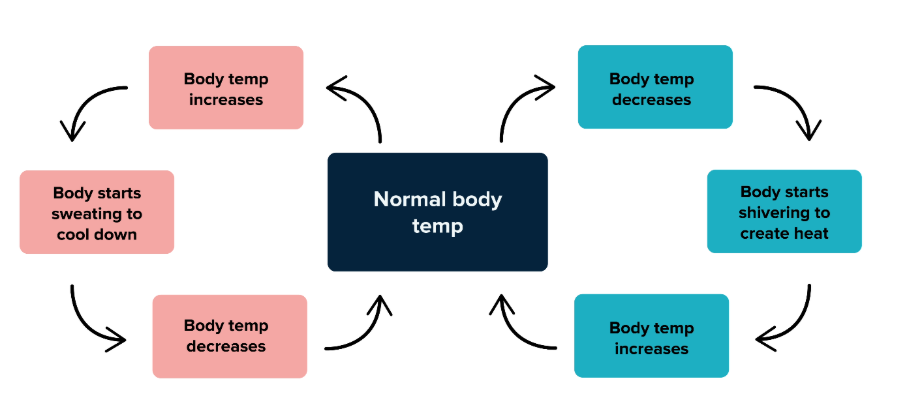
Describe how a feedback loop works?
Body temperature is maintained through a negative feedback loop where the hypothalamus (acting as the control center) monitors internal and external changes to keep the body at a stable set point.
When too hot: The brain signals effectors to trigger vasodilation (widening blood vessels) and sweating to release excess heat.
When too cold: The brain triggers vasoconstriction (narrowing blood vessels) and shivering to generate and conserve heat.
This process is a classic example of homeostasis, where the body’s response directly "negates" the original stimulus to return the system to balance.
How your body maintains the proper level of sugar in the blood.
The pancreas (an endocrine gland) regulates blood sugar through a negative feedback loop using two antagonistic hormones: insulin and glucagon. When blood sugar is high, insulin is released to signal target cells to absorb glucose; when blood sugar is low, glucagon signals the liver to release stored glucose back into the bloodstream. Together, these hormones ensure blood sugar levels remain within a stable range to maintain homeostasis.
How insulin and glucagon work.
Insulin and glucagon function as an antagonistic pair to maintain blood glucose homeostasis via a negative feedback loop. Both hormones are secreted by specialized clusters of cells in the pancreas (an endocrine gland) known as the Islets of Langerhans.
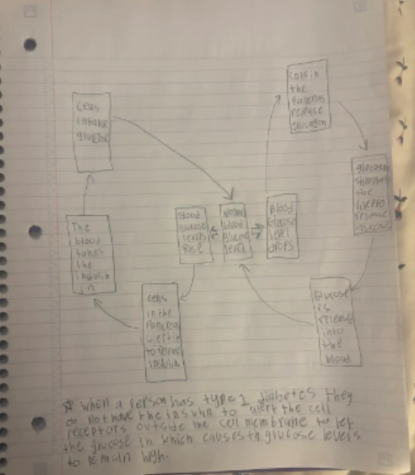
What is the process for maintaining glucose levels when it is low?
Blood glucose level drops
ALPHA Cells in the pancreas release glucagon
glucagon stimulates the liver to release stored glycogen
The liver breaks down stored glycogen and releases glucose
Glucose is released into the blood
(Arrow returns to Normal Blood Glucose Level)
Where does type 1 diabetes happen in this feedback loop?
Stimulus: Blood glucose rises (e.g., after eating).
The Breakdown: The pancreas (Gland) fails to release the hormone (Insulin).
Result: Because the signal is never sent, the target cells never receive the "alert" to open their receptors.
Consequence: The glucose stays in the bloodstream instead of entering cells, and the feedback loop fails to return the body to homeostasis.
Where does type 2 diabetes happen in this feedback loop?
Stimulus: Blood glucose levels rise after a meal.
Hormone Release: The pancreas (gland) functions correctly and releases insulin into the blood.
The Breakdown: When insulin reaches the target cells (muscle, liver, and fat), the receptors do not respond properly. This is called Insulin Resistance.
+1
Result: Because the "lock" (receptor) is "sticky" or broken, the cell does not open its channels to let glucose in.
Consequence: The pancreas tries to compensate by pumping out more insulin (overdrive), but eventually, it cannot keep up. Glucose remains high in the blood, and the loop fails to return to homeostasis
Body system Organiser
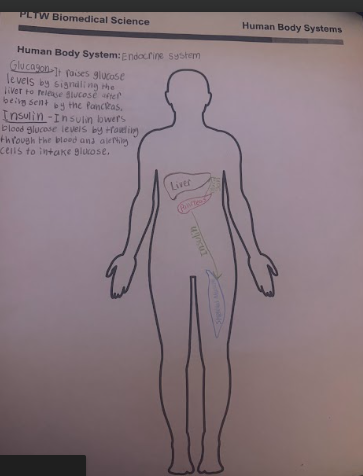
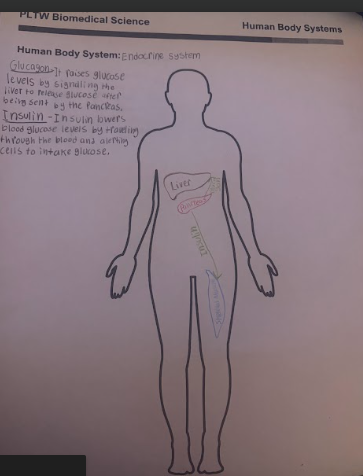
Body System Organiser-Glucagon
It raises glucose levels by signaling the liver to release glucose levels by signaling the liver to release glucose after being sent by the pancreas.
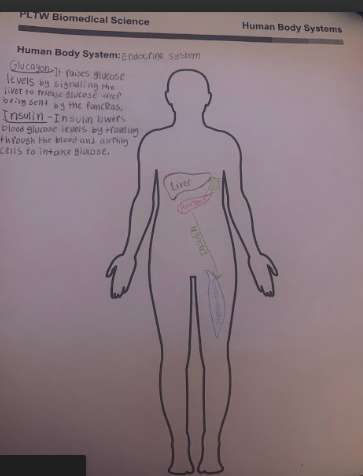
Body system Organizer-Insulin
Insulin lowers blood glucose levels by traveling through the blood and alerting cells.
Body system Organiser-What goes to the liver and what goes to skeletal muscle?
Pancreas→Glucagon→Liver
Pancreas→Insulin→Skeletal Muscle
Endocrine system slideshow
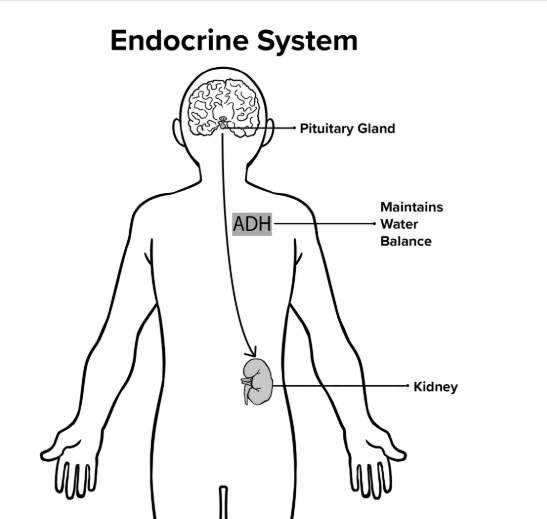
The pituitary gland in the brain releases a hormone called ADH, which helps the kidneys maintain water balance.
You previously learned about another class of chemicals that helps send signals in the body—neurotransmitters. How are neurotransmitters and hormones similar and how are they different?
Neurotransmitters and hormones are similar in the way that they use chemical signals to communicate between cells but are different because neurotransmitters communicate with each cell to cell directly through a synapse while hormones typically travel further and have an overall slower process to communication through the bloodstream.
How can an endocrine system issue cause problems in another system of the body?
For example,if the cells in the pancreas are not producing insulin than blood glucose levels will become high because the cells are not taking in glucose. This will cause issues in the kidneys as high blood glucose levels will damage the filtering system that the kidney uses to filter waste from the blood. The kidney is a part of the urinary system.-type 1
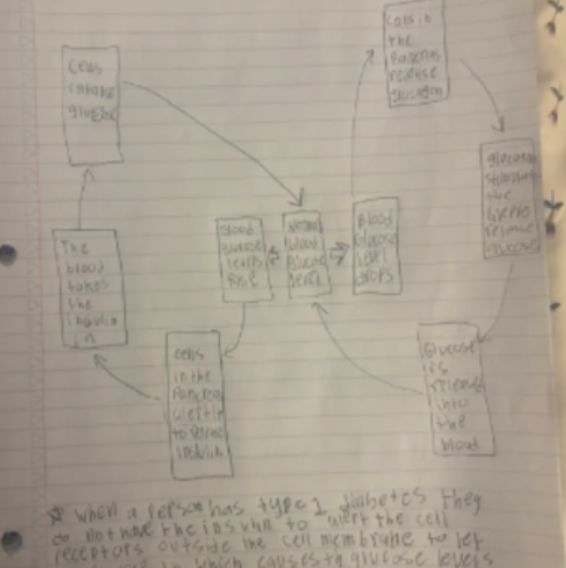
What is the process for maintaining glucose levels when it is high?
Blood glucose levels rise
BETA Cells in the Pancreas alert it to release insulin
The blood takes the insulin in
Cells intake glucose
(Arrow returns to Normal Blood Glucose Level)
 Note
Note  Flashcards (31)