PSC 156 Chapter 4 Life Mcadams Narratives Whitbourne Identity Theory
 Studied by 0 people
 Call Kai
 Learn
Learn Practice Test
 Spaced Repetition
 Match
Match Flashcards
 Knowt Play
1/6

There's no tags or description
Looks like no tags are added yet.
Name | Mastery | Learn | Test | Matching | Spaced | Call with Kai |
|---|
No analytics yet
Send a link to your students to track their progress
7 Terms
What is conversational remembering? What does it do for a person and what could it create?
Elaboration of past experiences = memory
consolidation
• Assists with creating/maintaining social bonds
• Particularly important for older adults’ sense of
identity → meaning-making
• Can lead to a more positive perception
• Conversational remembering → false memories
What is McAdams Narrative identity?
Change in identity – creating a life story
Influenced by sociocultural forces
(re)creating one’s life story can include both
explicit and implicit processes
End goal: a story that is coherent and integrated
Telling one’s life story is a joint product of
speaker and listener
Can involve conversational remembering
A life story is based on past, present, and future (i.e., who they will become)
• It is created and revised throughout adulthood as people change and the changing
environment places different demands on them
• Generativity marks the attempt to create an appealing “ending” that will generate new
beginnings for future generations
(Would be in identity vs confusion)
Difference between
Erikson’s theory
and McAdam’s
Narrative Identity
theory?
Erikson offers a developmental, stage-based model focused on resolving crises at specific life periods, while McAdams proposes a cognitive, story-based model focusing on how individuals construct a "life story" to create meaning and unity in their lives autobiographical author" (the third layer of personality) who constructs a personal, evolving, and internalized story to provide life with purpose and unity
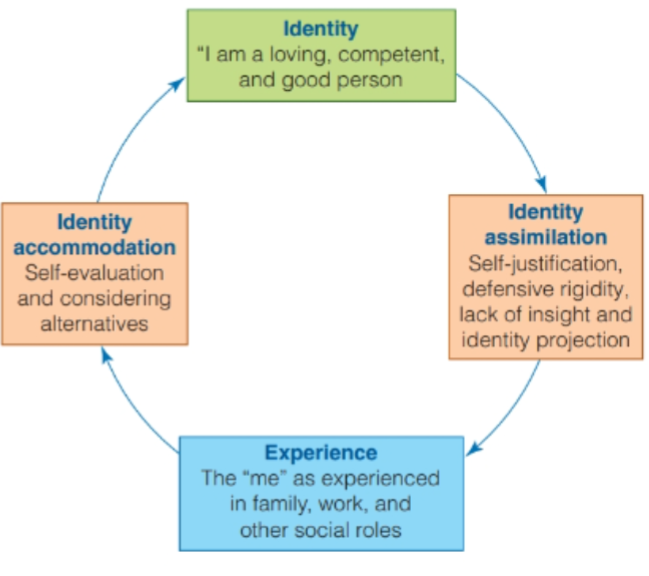
What is Whitbourne’s identity Theory?
Argues that people build conceptions of how their lives should proceed
• The life-span construct has two parts:
• A scenario (the map for how our plans will unfold)
• A life story (an autobiography)
• Piaget’s concepts of assimilation and accommodation are integral in changes.
Holds no evidence for stages
• Life transitions not related to age
• A constantly changing identity (via
accommodation) = poor psychological health
• Identity assimilation = positive self-regard,
successful aging
Which of the following statements best aligns with Whitbourne’s
Identity Theory regarding identity and psychological health?
A. People undergo identity changes primarily during specific life stages
tied to age-related transitions.
B. Frequent accommodation of identity leads to poor psychological
health due to a lack of stability.
C. Identity assimilation undermines psychological well-being by
preventing necessary adaptation to life changes.
D. A stable identity is best maintained by avoiding both accommodation
and assimilation.
B
Yuki, a 68-year-old, has always viewed herself as a strong,
independent person. Recently, she broke her leg and needed help
from her family for daily tasks. Instead of feeling discouraged,
Yuki reframed the situation as a temporary setback that doesn’t
change her sense of independence. According to Whitbourne’s
Identity Theory, which process is Yuki most likely using?
A. Identity foreclosure
B. Identity diffusion
C. Identity accommodation
D. Identity assimilation
D
Which of the following scenarios best illustrates Whitbourne’s Identity
Theory? Which best illustrates McAdams’ Narrative Identity Theory?
A. Kei reflects on her life and identifies recurring themes of resilience and
growth, weaving these experiences into a personal story that gives her life
meaning.
B. Hiro struggles to maintain a consistent self-view as he adjusts his identity
with each new life challenge, leading to feelings of instability and poor
psychological health.
C. Mei adapts her identity by focusing on her long-term sense of competence
while reframing setbacks to align with her positive self-view.
D. Yuta creates a vivid life story by recalling specific memories and linking
them to his aspirations, emphasizing how his narrative has changed over
time.
A McAdams, B Whitbourne, C Whitbourne, D McAdams
 Note
Note  Flashcards (131)