ENT 119- Apiculture Midterm 1
 Call Kai
 Learn
Learn Practice Test
 Spaced Repetition
 Match
Match Flashcards
 Knowt Play
1/130

There's no tags or description
Looks like no tags are added yet.
Name | Mastery | Learn | Test | Matching | Spaced | Call with Kai | Chat |
|---|
No analytics yet
Send a link to your students to track their progress
131 Terms
Example of clearly domesticated insect
Bombyx mori (silk moth)
kept for 5,000 years, domesticated in china
cannot live without humans and cannot fly
Why is it difficult to conduct artificial selection in honey bees
queens mate with 12 random males
takes expensive equipment to control mating
example of an animal that is kept but not domesticated
Asian elephant
captured from the wild and trained
What is beekeeping?
based on knowledge of bee biology and behavior
find out triggers of aggression and avoid them
figure out what makes bees swarm and avoid it
figure out what hakes bees make more honey and do it
Langstroth hive
removable combs allows for less destruction to bees, less wasted wax, less aggressive bees
What is domestication?
May be domination: humans select for useful traits; animals change to meet our needs
May be mutualism: humans and animals rely on each other; both change to accommodate
(in contemporary evolution theory it is mutualism)
Argument for honey bee domestification
kept for thousands of years in artificial hives
selected for gentleness and other traits
insect domestication is possible (silkworms)
argument against honey bee domestification
Bees are not dependent on humans; they go wild all the time
Most apis mellifera are wild bc they live in africa where beekeeping is not common
We cannot artificially select bees because it is hard to artificially breed them
Cues
information left passively in the environment by an animal
can be used by anyone
eg tracks, odors, sounds
Signals
Information intentionally sent by one animal to another (usually within species)
can be used by others (eavesdropping)
How do signals evolve from cues
signals= exaggerated cues
For example, threat signals evolve from the moment preceding an attack
selection works to increase both the production of the cue and the sensitivity of the receiver
How did the waggle dance evolve
In a hypothetical ancestor, inactive workers can use nest activity as a cue for how much foraging is occurring. Over time, workers learn to exaggerate the cue after finding food
How do we tell what a signal means?
observe the context in which it is produced (is a predator present?)
Observe the receiver and what is their response (prey of that predator responds by running)
Example of a complex signal (birds)
Bird mating signals can have different meanings for males and females
For males, it may indicate territoriality
for females, it may act as a mating call
Complex signal
a signal that can have multiple meanings for different individuals
this is common in social insects
Types of honey bee communication signals
Chemical (pheromones):
fertility
alarm
flower visitation
colony membership
mate attraction
Mechanical / acoustical:
dances
other buzzing/shaking/vibrating type signals
What two types of signals do foragers produce
signals with info about food sources (received by other foragers; telling them to go collect nectar)
signals to coordinate activity (received by middle age bees; telling them to help process nectar)
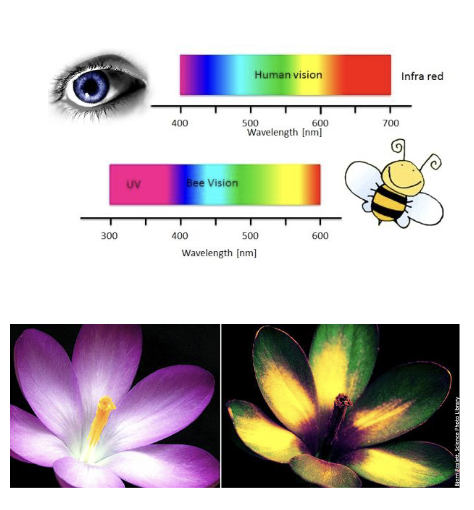
Spectrum of color vision in humans compared to bees
Bees can see a lower wavelength of light than us, they see UV but not red
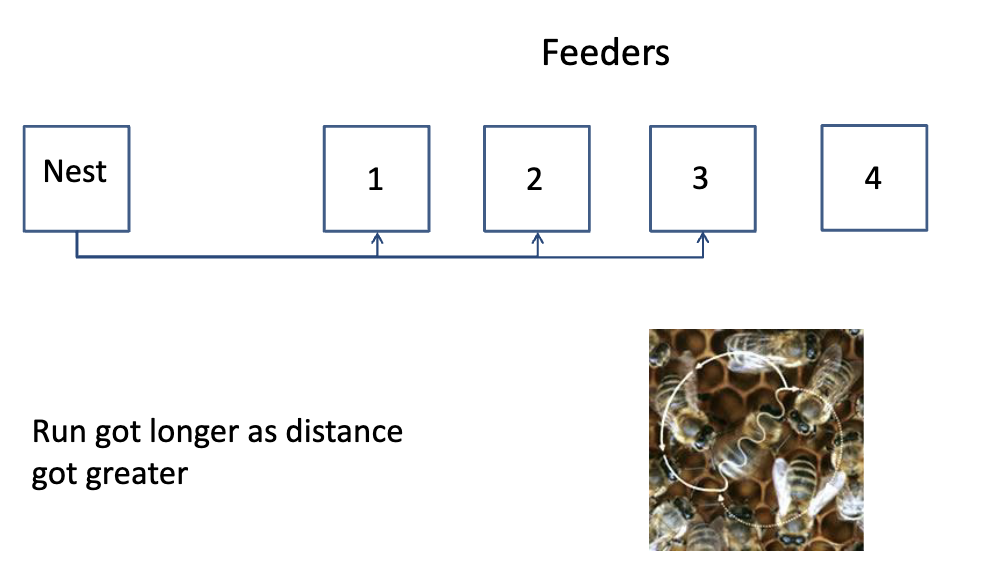
Distance experimental design (waggle dance)
Food source was moved different distances in the same direction. As the food source got farther away, the “waggle” part of the dance got longer
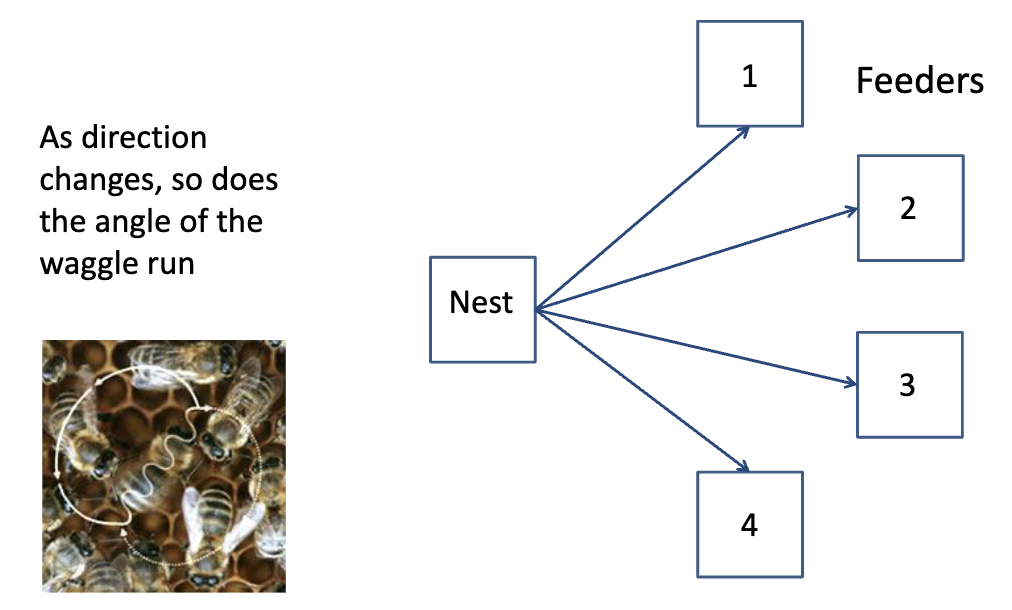
Direction Experimental design (waggle dance)
Food source was moved the same distance but in different directions. As the angle of the feeder changed, the angle of the dance changed.
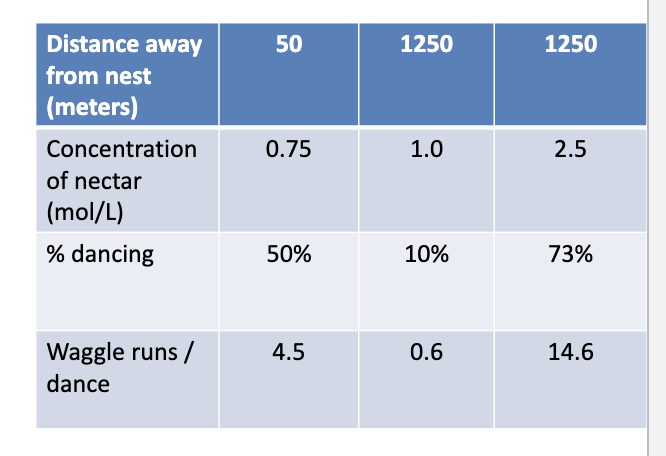
How do bees communicate the quality of a food patch?
The number of waggle dances the bee performs correlates to the quality of the food
How do bees determine site quality?
Bees use energy gain as metric for site quality
a combination of distance from nest and nectar concentration
via what sensory modalities is the waggle dance communicated?
releasing pheromones (a blend of hydrocarbons)
send sound, motion, and vibrations
How do bees measure distance?
optic flow: the rate of image flow across the retina
Optic flow experiment
make foragers fly down a narrow tube to a feeder
narrow tube increases optic flow, but not time or energy used
Results: recruits of bees that flew down tunnel flew significantly further, indicating the original bee communicated a farther distance
Bees radiated when ______ radiated
Flowering plants
What makes bees the major insect pollinator
hairy bodies adapted to moving pollen
specialists on using pollen as a protein source
minor pollinators include:
birds, flies, butterflies, other insects
Most Hymenoptera are _____
parasitoids: laying the egg in the body of another organism
Aculeates
all Hymenoptera with stingers
Why can male aculeates not sting?
the stinger is a modified ovipositor in hymenoptera, meaning males do not have one
Families of bees (must know bolded ones)
stenoritidae
collectidae
halictidae
andrenidae
malittidae
megachilidae
apidae
solitary bee life history
1- adult female mates
2- a cell is constructed from leaves, wood, soil, etc
3- nectar and pollen are collected to make a provision ball which is placed in the cell
4- egg is laid on pollen ball
5- cell is sealed
6- process repeats
*females make as many cells as they can before they die or the season runs out
Halictidae (sweat bees)
very common
often small and metallic
diverse biology: solitary, parasites, primitively social
How are alkali bees used commercially?
Used for pollination of alfalfa, mostly in the pacific northwest
pros and cons of using alkali bees (halictids) commercially
Pros:
can build up a large permanent population and provide all pollination services
cons:
takes time to build up population
can be wiped out by disease or pests
needs particular soil and habitat
Megachilidae (Mason and leafcutter bees)
a large group of robust bees
show typical life history patterns
build cells out of leaves or soil and provision each with pollen
inefficient pollen collectors makes them good pollinators (no pollen basket)
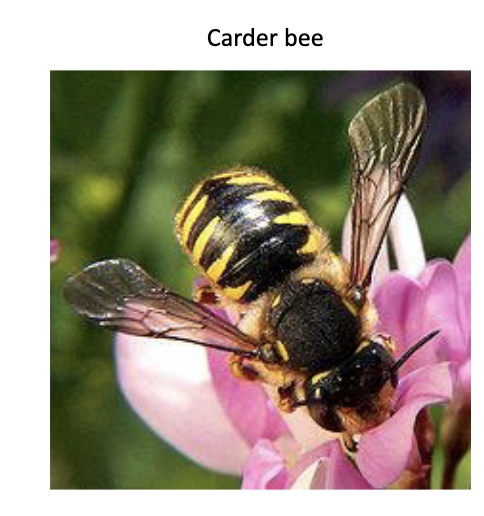
Alfalfa leafcutter bee (megachilid)
Introduced to US in 1930s
separates cells with cut leaves
used for alfalfa pollination mostly in PNW, Canada, and west coast
Pros and cons of alfalfa leafcutter bee
Pros:
can be purchsed in large number
reliable pollinators
cons:
many pests and diseases can become a problem
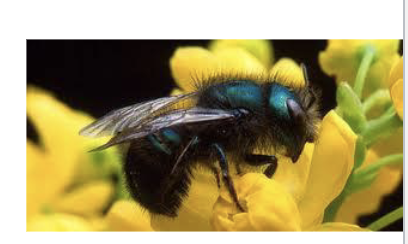
Blue mason bee (megachilid)
used for pollination of tree fruit
separates nest cells with mud
moves row to row in orchards (honey bees move down rows)
not yet used on a large scale
Apidae
large and diverse group of bees
some have scopae (hairy legs for pollen transfer)
some have pollen baskets (curved depression on hind leg)
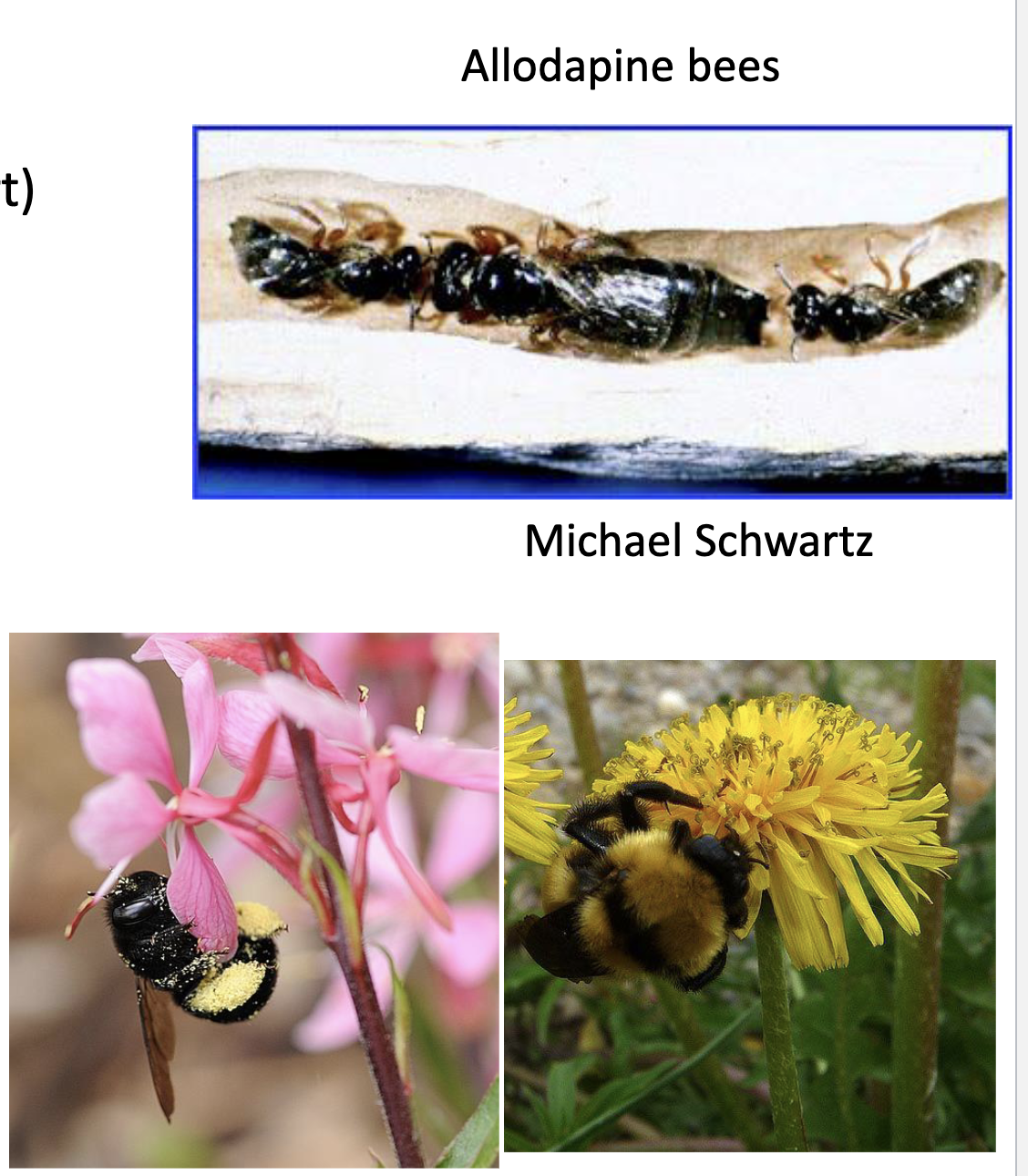
Orchid bees
often large and long lived
males collect odors from flowers
females prefer males with more complex odors
Bumble bee life cycle
1- fertilized queen overwinters as adult
2- in the spring they find a new nest and start a colony (often mouse burrow)
3- Queen stops foraging when first brood develops
4- workers produced early in season
5- new queens and males produced late in season
In what situation are bumblebees used as pollinators?
bumblebees are used in greenhouses for commercial pollination
bumblebees perform buzz pollination, which is necessary for pollination of nightshades
honeybees dont do well indoors
Bumble bee behavior
colonies only get to be a couple hundred strong
queens and workers have similar physiology
weak division of labor
workers can communicate the presence of food but not location
Queen incubated egg with thoracic shivering
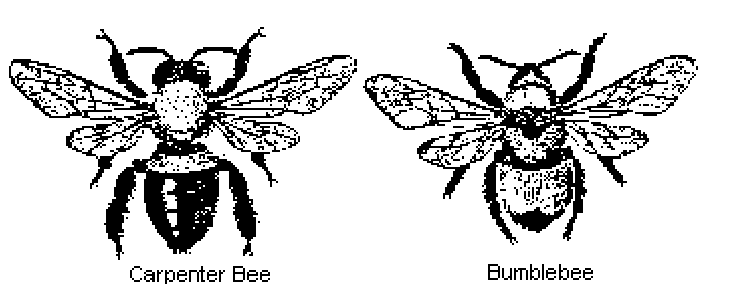
Carpenter bees vs bumble bees
Bumble bees
form small colonies
nest in soil
pollen basket
more closely related to honey bees than carpenter bees
usually hairy all over
Carpenter bees
usually solitary
nest in wood
scopae
No hair on abdomen
Nectar robbing
Stealing nectar from flowers without pollinating
carpenter bees use their strong jaws to cut into the side of the flower to steal nectar
honey bees cannot cut the flower themselves but they can use slits cut by carpenter bees
carpenter bee biology
nest in dead wood (can bore nest hole in a day)
line nest with glandular secretions
show parental care (mother guards nest)
Aggregation
clustering and working together in a simple way
Sawflies: form tight aggregations that move together and exhibit group defense (possibly thermoregulation and group feeding)
Sawflies use toxic secondary compounds they sequester for group defense
living in groups causes higher exposure to pathogens, being easier to find by predators
Parental care
Any help beyond host site selection and egg laying
starting point for the evolution of sociality
rare in all orders of insects except earwigs; although there are examples from many orders
Incipiently eusocial behavior
simplest social groups
social groups are family groups
Found in aphids, thrips, ambrosia beetles
social aphids
all aphids in a gall are clones
some become clones with sword-like appendages; may be venomous
Simplest eusocial pattern
alternation of tasks
colony typically 2-6 individuals
Dominant: reproduction, guarding, building
Subordinate: foraging, building
subordinate have a high probability of taking over or leaving
Team-like societies
dozens to hundreds of workers
queen lays eggs and stays in nest
queen has physiological specialization
simple communication: pheromones and mechanical signals
flexible workers; no true castes
bumble bees, paper wasps
Factory like society
thousands to millions of individuals
permanent dimorphism between queen and workers
inflexible castes (physical or temporal)
elaborate communication systems
honey bees, army ants, leafcutter ants, swarm founding wasps
Trends in eusocial behavior
Social evolution is characterized by:
more division of labor in larger societies
more communication in larger societies
Superorganism concept
A society of cells (organism) acts as a society of individuals (superorganism) due to convergent evolution
Organization:
organism: anatomy (organs and tissues)
superorganism: castes (age-based and physical)
Coordination:
organism: physiology (hormones, nerve cells)
superorganism: communication (pheromones, acoustics, mechanical signals)
Teams vs factory society analogy
Team like society = small business
everyone is flexible
someone may need to fill in for others
individuals broadly trained
uncertainty handled by flexible individuals
Factory like society = corporation
everyone is specialized
never fill in for others outside your group
uncertainty handled through plans and procedures
Major social lineages
Social Wasps, Social bees, ants, termites
Social wasps
paper wasps:
team like society
similar to bumblebees
Swarm founding wasps:
factory like society
similar to honeybees
Social bees
Incipiently eusocial
Halictids
alodapine bees
Primitively eusocial
bumblebees
some halictids
advanced eusocial
honey bees
stingless bees
Ants (social groups)
all highly social
ponerines
team like society of large hunting ants
bullet ants, meat ants, bulldog ants, etc
painful stings
Large colony ants
many kinds
harvester ants, fire ants, argentine ants, wood ants
Termites (social groups)
all highly social
much convergence in colony design with ants (soldiers, fungus gardening)
Hemimetabolous (many moults, can be very complex)
Social classes of termites
Lower termites
simple organization similar to paper wasps or bumble bees
Higher termites
mound builders, etc
live in large colonies
some grow fungus
soldiers
complicated and poorly understood
What is a temporal caste?
Bees of different ages specialize on different task sets
physiology changes to specialize bees for their tasks
bees go through 3 puberties
“regular” adult development
Juvenile form: play behavior, incomplete muscular development
Adult form: secondary sexual characteristics develop, behavior changes
Hormones change to facilitate different forms
Honey bee temporal castes
Days 1-4 Newly emerged
Days 4-12 Nurses
Days 12-21 Middle age bees
Day 21+ Forager
Newly emerged bees
clean cells
continue to develop (exoskeleton hardens)
Nurse bees
feed the queen and young
provide protein to all bees
can feed queen more or less to determine egg output
Middle age bees
process food
build and guard nest
remove dead
Store pollen as “bee bread” (mix of pollen and honey)
Foragers
collect food
defend nest?
Are task sets discretized in honey bees(is there overlap)?
Any overlap in task sets is due to variability in the time spent in each caste. Marking bees by caste and not age shows this separation of tasks
Worker flexibility test
remove foragers from two colonies
give 1 group a week to recover
record foraging rates
hive with recovery time had higher foraging rates
scan sampling
periodic snap shots of collective behavior
Focal animal observations
continuous monitoring of animal behavior in time and place
Stop signal
high pitched piping sound and head butting
produced after harassment at a feeder
received by forager dancing for that site (identified by odor)
respnds by stoping dancing
Tremble dance
looks like waggle dance with no figure 8
tells other bees to increase effort toward nectar unloading
produced by foragers after difficulty unloadding nectar
received by other bees
response: head toward dance floor and help unload nectar
Shaking signal
bee grabs another bee and shakes it
“work bell”: tells others to stop or start work
produced at start of foraging or night
produced by foragers
received by everyone
response: start working or stop working
brood pheromone
complex signal
induces brood food production in nurses
increases rate of foraging in foragers
interacts with queen pheromone to control activation of worker ovaries and production of new queens
Worker pheromones
Defense
foraging
control division of labor
reproductive biology
division of labor hormone
ethyl oleate
produced mainly by foragers
delays growth rate from middle age to forager
more Ethyl oleate results in slower development (more foragers present)
alarm pheromone
isopentyl acetate
released when bee stings
excites other bees to sting
encourages adult bees to attack while young bees retreat (complex signal)
Nasonov pheromone
used in aggregation (foraging, finding new home, swarming)
made by nasnov gland
Flower signals
bees mark visited flowers with a pheromone
marked (depleted) flowers avoided for at least an hour
Bees collect 4 things
nectar
pollen
water
propolis (tree resin)
How do bees determine site quality?
sugar concentration
distance to flowers
time of year (food availability)
state of the nest (how much food they already have)
How do bees confer site quality using waggle dance?
bees perform more repetitions of the dance to recruit more foragers to the site
Do bees compare waggle dances?
No, recruits follow the first dance they see
The number of recruits to each site matches the number of dance repetitions
the allocation of bees to each patch matches the bees quality assessment of that patch
Scouting behavior
Scouting bees don’t follow waggle dances
they consistently look for new sources of food
during dearths they are the only bees foraging
consistently monitoring; may find better sources
Collective decision making
Each bee only knows her piece of information
With all bees contributing their information, the colony contains all of the information
total allocation of recruits matches the number of dances performed matches the distribution of quality
Pollen collection
Bees only collect how much pollen they need
foragers unload pollen directly (unlike nectar where they get help)
colony maintains a stable supply of pollen
Middle age bees collect protein in their bodies so there is a buffer when pollen stores run low
How do foragers know how much pollen the colony has?
direct assessment: go around and count how much pollen is stored
indirectly sense lack of pollen through hunger in their own body
has been shown NOT to be indirect sense; disrupting digestion in bees had no effect on pollen foraging rate
Heat stress- effect on brood development
Too high of temperatures can cause abnormalities in brood development
too low of temperatures slow the rate of development
Thermoregulatory behavior
When colony was heated, these behaviors increased:
trophallaxis
wing flapping (fan)
tongue lash (collecting water in mouth and spreading it around colony)
evacuate (all bees not actively working evacuated)
bees formed long chain of wing flapping to provide cooling
bees create evaporative cooling by putting water around hive and flapping wings
How do bees gauge water need?
not known
possibly the amount of time it takes to unload water; if there is high demand for water they will be more likely to get more and recruit others to water sources
Swarming
splitting of the colony into 2 or more pieces
typically occurs in spring, sometimes a second peak in fall
old queen leaves with the swarm while new queen takes over nest
Swarm composition (who is in the swarm?)
old queen and about 70% of youngest bees in the nest
each worker carries about 40% of body weight in honey
remaining colony after swarming
about 40% of original bees
mostly older bees
lots of emerging brood
15-20 closed queen cells
Queen duels
colonies often produce more queens than needed
1st queen emerges and kills all other queens in their cells
if they are not killed in cells, they will fight to the death after emergence
worker interference (queen duels)
workers drag queen away before she can kill other queen cells
workers do not try to help full sisters win over half sisters