Circulatory System
 Studied by 2 people
 Call Kai
 Learn
Learn Practice Test
 Spaced Repetition
 Match
Match Flashcards
 Knowt Play
1/59

Earn XP
Description and Tags
Name | Mastery | Learn | Test | Matching | Spaced | Call with Kai |
|---|
No analytics yet
Send a link to your students to track their progress
60 Terms
Heart
the pump that imparts pressure to the blood to stablish the pressure gradient needed for blood to flow to the tissue
Blood vessels
the passageways through which blood is directed and distributed from the heart to all parts of the body and subsequently returned to the heart
Blood
transport medium
Hematocrite
the percentage of red blood cell volume to total blood volume in a centrifuged blood sample
The constant movement of blood
keeps the cellular elements rather evenly dispered within the plasma
Blood plasma
a complex liquid in which the cellular elements 55% of blood volume
Plasma consists of
90% water, 1% inorganic constituent (ions), 6-8% organic (plasma proteins), small percentage of organic substance are nutrients, watse, dissolved gasses and hormones
Albumins
found in the liver, is 60% of the total percentage, helps maintain colloid osmotic pressure
Globulins
found in the liver, is 30% of the total percentage, help maintain colloid osmotic pressure
Fibrinogen
found in the liver, is 4% of the total percentage, plays a key role in blood coagulation
Function of Plasma
Transports vital substances such as nutrients, gases ,waste and vitamins
Maintains stability of interstitial fluid
Distributes Heat
Maintaion pH
Erythrocyete
Red Blood Cells
RBC counts
the number of RBCs in a cubic millimeter of blood
RBC counts reflects
blood oxygen carrying capacity
Anatomic features of erythrocytes
Flat, disc-shaped cells indented in the middle on both side
Flexible membranes
they carry he
Disc-shaped cells indented in the middle on both sides
a larger surface area for diffusion of O2 from the plasma across the membrane
Flexible Membrane
deform as they squeeze single file through capillaries as narrow without rupturing
lacking organelles
to maximize its hemoglobin content
Hemo(globin)
a protien made up of four highly folded polypeptide chains
(Hemo)globin
four iron bonded with oxygen in a reversible reaction
destruction of RBCs occure
every 120 Days
Where does destruction of RBCs take place
the liver, spleen, and red bone marrow
what facilitates the destruction of RBCs
large white blood cells (macrophages)
The iron from the heme group will be stored in the
liver
The iron from the heme group will be stored as
ferritin
RBCs destruction
the heme molecules will be metabolized and biliverdin, a greenish pigment, will be released.
Biliveredin will then get convereted to bilirulain, will eneter the liver, then released into the digestive systems
The goblin molecules, broken down into amino, can be used to synthesis new proteins.
Leukocytes
White blood cells (WBC)
Leukocytes are classified according to
the appearance of their nuclei and the presence or absence of granules in their cytoplasm
Granular leukocyte /polymorphonuclear
Neutrophlis
Eosinophils
Basophils
Granulocytes
“granule-containing cells”. their nuclei are segmented into several lobes of varying shapes, and their cytoplasm contains an abundance of membrane- enclosed granules
Agranular leukocyte / mononuclear
Monocyte
Lymphocytes
Agranulocytes
“Cells lacking granules”. Both have a single, large, non-segmented nucleus and few granules
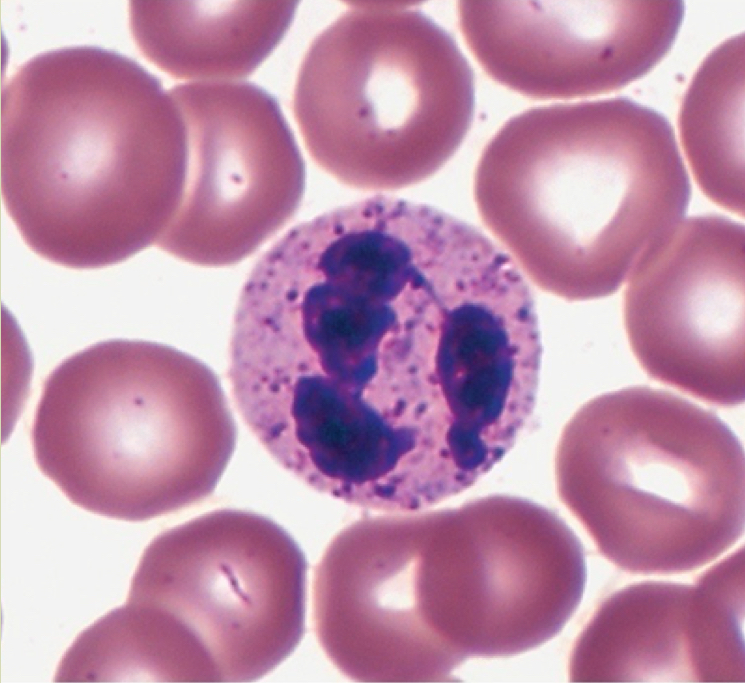
Neutrophils
50%-70% of leukocytes
multi-lobed nucleus
light purple granules (neutral stain)
specialized in phagocytosis
first responders
elevated in bacterial infection
Eosinophils
1%-3% of leukocytes
Bi-lobed nucleus
Deep red granules
Moderate allergic reaction
Elevated in parastic worm infections and allergic conditions
secretes enzyme that dissolve clots
Basophile
less than 1% of leukocytes
Nucleus lobed; cytoplasmic granules stained blue in hematoxylin stain
Similar structurally and functionally to mast cells
Synthesize and store histamine and heparin
Monocytes
3% - 9% of leukocytes
Spherical, kidney-shaped, nuclei
May leave bloodstreams to become macrophages
Phagocytize bacteria, dead cells and other debris
Lymphocytes
25%-33% of leukocytes
large spherical nucleus surrounded by thin rim of cytoplasm
lymphocytes provides immune defense
B lymphocytes: produce antibodies ( humoral immunity )
T lymphocytes (cell-mediated immunity) : directly destroy their specific target cells by releasing chemicals that punch holes in the victim cell
WBCs functions
defend against invading disease-producing by microorganisms
functions as cleanup crew that removes wornout cells and tissue debris
identifies and destroys cancer cells that arise in the body
blood platelets (thrombocytes)
cell fragments of megakaryocytes that lack a nucleus and are roughly half the size of RBC .
there is approximately 250/ml of blood
functions of blood platelets
help repair damaged blood vessel by sticking to broken surface
Hemostasis
stoppage of blood
action that limit or prevent blood loss
blood vessel spasm
formation of a platelet plug
blood coagulation
what happens when platelets are broken down
releases thromboplastin in the plasma which turns into prothrombin that then turns to thrombin which will release fibrinogene which will turn to fibrin
Where are RBCs produced in the fetus
by the liver and spleen
Where are RBCs produced after birth
red bone marrow
Blood cell production in children
bones are filled with red bone marrow
Blood cell production as a person matures
fatty yellow bone marrow incapable of erythropoiesis gradually replaces red marrow
which places do red bone marrow remain even after maturaity
the sternum, ribs, pelvis, and upper ends of the limb bones
how is Erythropoiesis controlled by erythropoietin
kidneys detect reduced O2- carrying capacity of blood
when less O2 is delivered to the kidneys, they secrete erythropoietin into blood
Erythropoietin stimulates erythropoiesis by red bone marrow
additional circulating erythrocytes increase O2- carrying capacity of blood
increases O2- carrying capacity relieves initial stimulus that triggered erythropoietin secretion
agglutination
clumping of red blood cells in response to a reaction between an antibody and an antigen
antigens
a chemical that stimulates cells to produce antibodies
antibodies
a protein that reacts against a specific target
ABO Blood Types
inherited antigens
Type A blood
contains A antigens and B antibodies
Type B blood
contains B antigens and A antibodies
Type AB blood
contains both A and B antigens and no antibodies
Type O blood
do not contain A or blood and both A and B antibodies
Rh blood group was named after
rhesus
Rh postive
presence of antigens D or other Rh antigens on the red blood cell membranes
 Note
Note  Flashcards (78)