2.1.6 Cell division, cell diversity and cellular organisation
 Studied by 0 people
 Call Kai
 Learn
Learn Practice Test
 Spaced Repetition
 Match
Match Flashcards
 Knowt Play
1/38

There's no tags or description
Looks like no tags are added yet.
Name | Mastery | Learn | Test | Matching | Spaced | Call with Kai |
|---|
No analytics yet
Send a link to your students to track their progress
39 Terms
What are the phases of the cell cycle
Interphase
Mitosis (nuclear division)
Cytokinesis (Cell division)
What are the 3 phases of interphase
G1 Phase
S Phase
G2 Phase
What is the cell cycle
A highly ordered sequence of events that takes place in a cell, resulting the division of the cell, and the formation of two genetically identical daughter cells
What happens in G1 of interphase
First growth phase:
Cells produce RNA, enzymes and other proteins required for cell growth
Cell receives a signal to divide (progress into the S phase) - controlled by cyclins
What happens in the S phase of interphase
Synthesis of new DNA:
DNA in the nucleus replicates - each chromosome contains two identical chromatids
What happens in G2 of Interphase
Second growth stage
Newly synthesised DNA is checked for any errors
Normally repaired
If not then apoptosis (controlled cell destruction)
Cell continues to increase in size
Energy stores increased
Tubulin made - needed for Mitosis
What is Mitosis
Period of cell division in which the nucleus divides
Consists of 4 stages: (PMAT)
Prophase
Metaphase
Anaphase
Telophase
What is mitosis used in
Growth of multicellular organisms (animals, plants, fungi)
unicellular zygotes can grow into multicellular organisms
Continued cell division in the meristem of plants
Replacement of cells and repair of tissues
Cell replacements in the skin and gut lining
Axolotls regenerating lost limbs and tails
Asexual reproduction - reproduction with single parent organisms
Unicellular Amoeba, budding in plants (& yeast) & runners
What is a centrosome
Organelle that becomes visible during mitosis
Helping pair up and move chromosomes
Contain 2 centrioles where spindle fibres emerge and attach to centromeres in the middle of chromatids (DNA molecules that make up DNA)
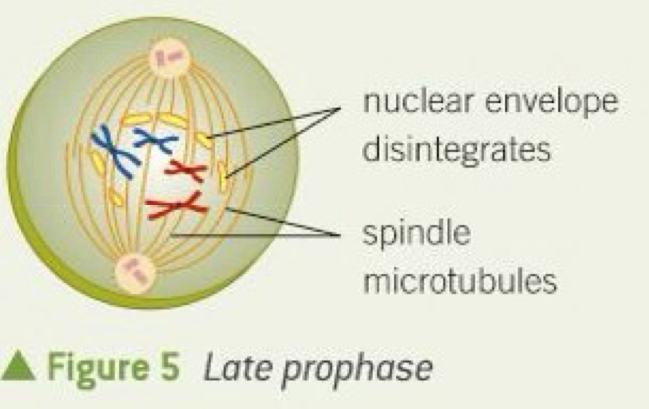
What happens in the Prophase stage of mitosis (4)
Chromatin condenses - forming chromosomes that are joined together at the centromere
Centrosomes move to opposite poles - spindle fibres emerge from them due to centrioles
Spindle fibres attach to specific areas on the centromeres and start to move the chromosomes to the centre of the cell
Nuclear envelope breaks down into vesicles + nucleolus disappears
What happens in the Metaphase stage of mitosis
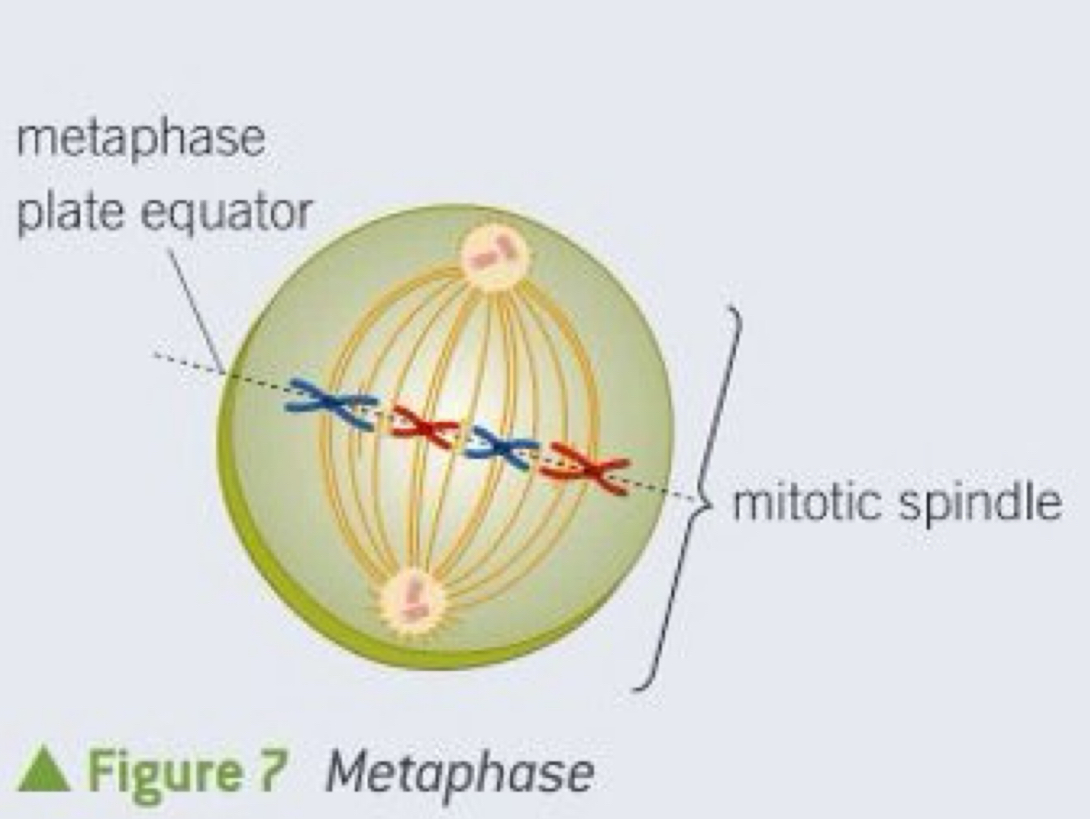
Chromosomes are lined up by the spindle fibres to form a plane at the equator (aka the metaphase plate)
Spindle fibres attach to chromosomes and hold them in position
What happens in the Anaphase stage of mitosis
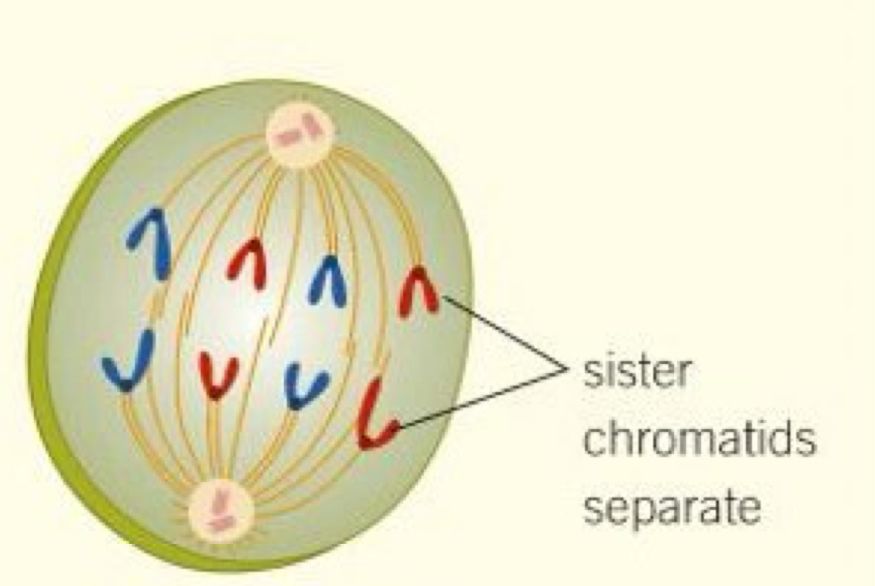
Sister chromatids separate at the centromere ( which divides in 2)
shortening spindle fibres and pull the separated sister chromatids (now called chromosomes) to opposite poles
What happens in the Telophase stage of mitosis
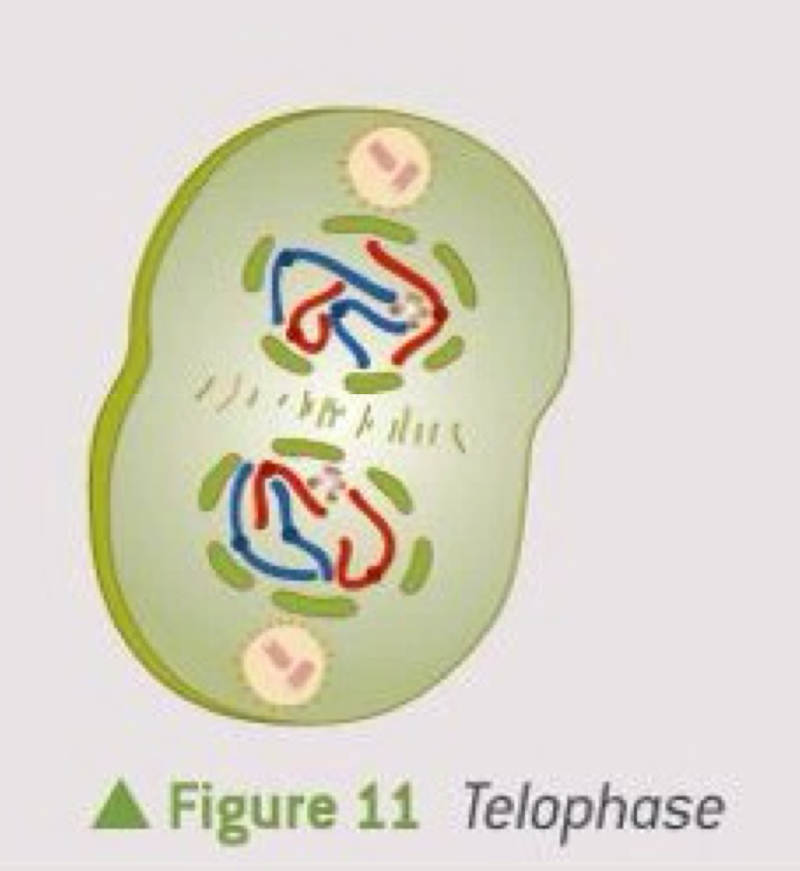
Chromosomes arrived at opposite poles
Nuclear envelope reforms around each set of chromosomes
Each chromatid contains one DNA molecule (which will replicate itself during interphase before the next division)
Spindle fibres break down
Chromosomes start to uncoil/de-condense and nucleous is formed
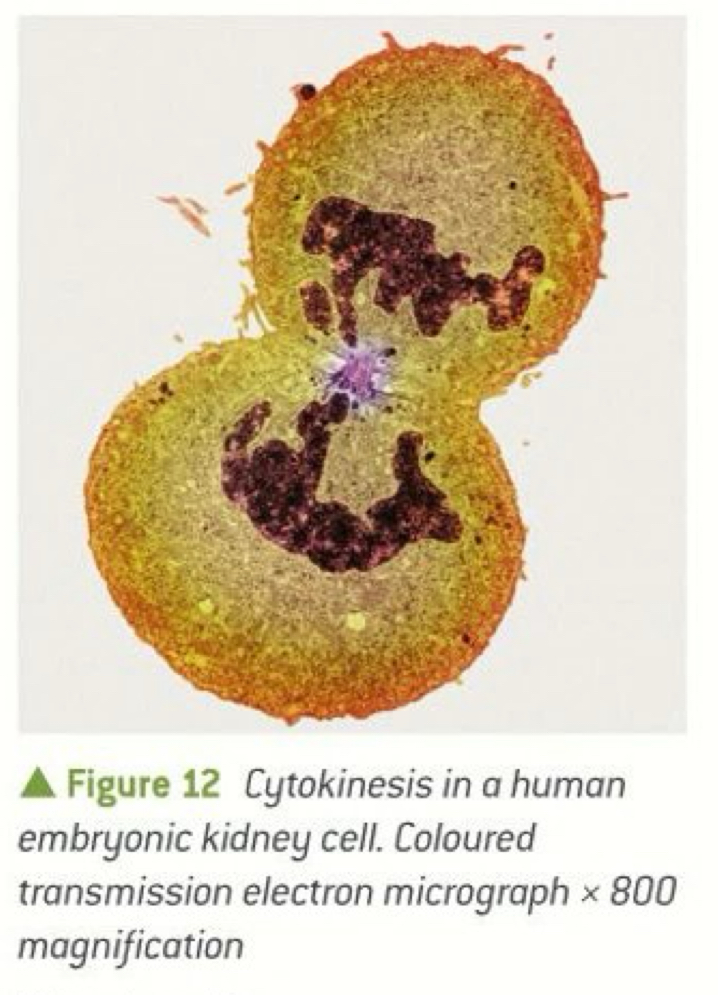
What is cytokinesis
The physical separation of the parent cell into genetically identical daughter cells
What happens during cytokinesis in animals
A cleavage furrow (folded membrane) forms and separates the daughter cells
Cell surface membrane is pulled inwards by the cytoskeleton until it is close enough to fuse around the middle
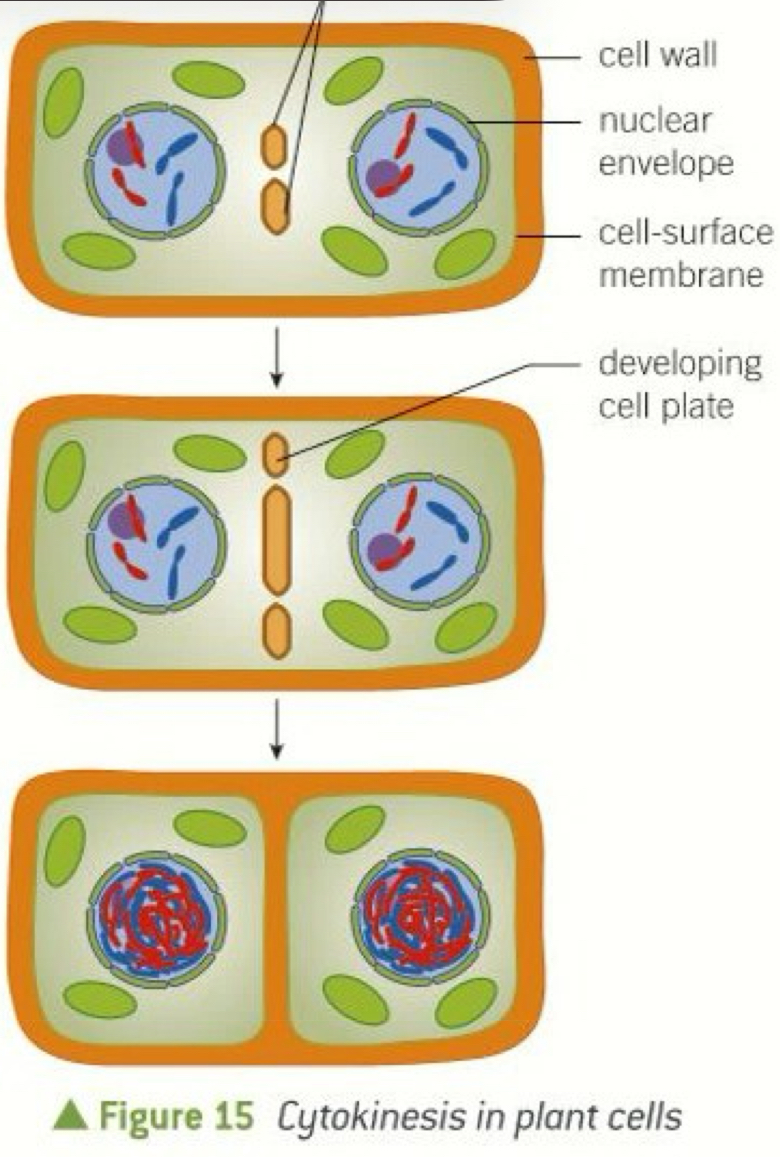
What happens in cytokinesis in plants
Cell plate forms at the site of the metaphase plate
Vesicles from the Golgi apparatus begin to assemble in the same place as where the metaphase plate was formed
Vesicles fuse with each other and with the cell surface membrane, dividing the cell into 2
New cell walls are produced in sections along the cell plate
Separates the new daughter cells
What is a specialised cell
Cells that are differentiated to carry out very specific functions
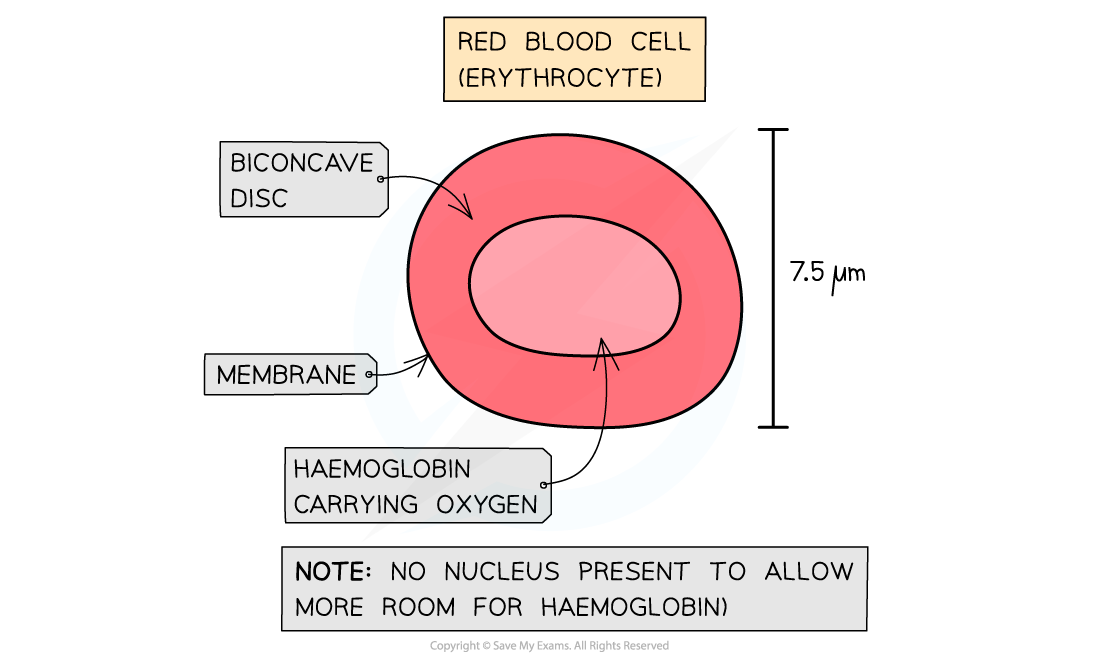
What is an erythrocyte/red blood cell (function, location, adaptations)
Function:
Transport oxygen around the body
Location:
Produced in Bone marrow
Circulate in bloodstream
Adaptations:
Flattened, Biconcave shape - increases surface area to volume ratio
Not many organelles + no nuclei to make space for haemoglobin
High amounts of haemoglobin in the cytoplasm
Flexible to squeeze through narrow capillaries due to elastic membrane
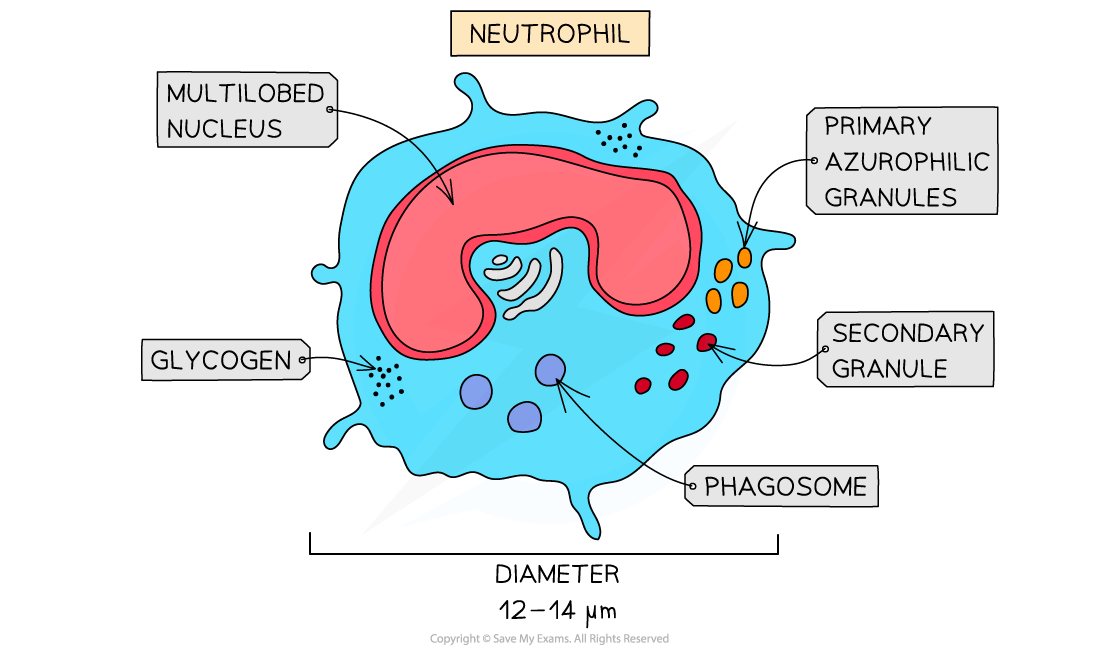
What is a neutrophils cell (function, location, adaptations)
Function:
Destroy pathogens by phagocytosis and the secretion of enzymes
Location:
Produced in Bone marrow
Circulate in bloodstream
Adaptations:
Multi lobed nucleus - makes it easier to squeeze through small gaps and get to the site of infection
Flexible shape allows them to squeeze through cell junctions in the capillary wall
Also allows for pseudopodia: cytoplasmic projections that engulf microorganisms
Granular cytoplasm contains many lysosomes that contain enzyme used to attack pathogens
What is a sperm cell/spermatozoa (function, location, adaptations)
Function:
Reproduction - fuse with egg and initiate the development of an embryo and pass on fathers gene
Location:
Produced in testes
Adaptation:
Head contains a nucleus with half the normal number of chromosomes (haploid nucleus)
Head contains acrosome’s that can break down the outer layer of an egg cell so that the haploid nucleus can enter to fuse with the egg’s nucleus
Mid-piece is packed with mitochondria to release energy for tail movement
Tail rotates - propelling the sperm cell forwards and allowing it to move towards the egg
What is a root hair cell (function, location, adaptations)
Function:
Absorption of water and mineral ions from soil
Location:
Surface of plant roots
Adaptations:
Has root hair to increase surface area of water uptake by osmosis is greater - can absorb more water and ions
Thinner cell walls for shorter diffusion
Permanent vacuole contains cell sap - more concentrated than soil water, maintaining a water potential gradient
Mitochondria for active transport of mineral ions
No chloroplasts as they’re underground
What is a palisade cell (function, location, adaptations)
Function:
Carry out photosynthesis to produce glucose and oxygen
Location:
Palisade mesophyll layer
Adaptations:
Large number of chloroplasts present in the cytoplasm to maximise the absorption of light for photosynthesis
The tall and thin shape allows light to penetrate deeper before encountering another cell wall + for many cells to be densely packed together
Large vacuole to maintain turgid pressure
What is a Guard cell (function, location, adaptations)
Function:
Control the opening of the stomata to regulate water loss and gas exchange
Location:
Plant’s epidermis
Adaptations:
Inner cell walls are thicker (those facing the air outside the leaf) while the outer cell walls are thinner
The difference in the thickness of the cell walls allows the cell to bend when turgid
Cytoplasm has a high density of chloroplasts and mitochondria
May play a role in the opening of the stomata
What are Ciliated Epithelium (function, location, adaptations)
Function:
Moving substances across the surface of a tissue
Location:
Respiratory and female reproductive systems
Adaptations:
Made up of cilia - beat in a coordinated way to shift material along the surface of the epithelium tissue
Mitochondria to provide energy for movement
Goblet cells secrete mucus which helps to trap dust, dirt and microorganisms - preventing them from causing infection
What is squamous epithelium cells (function, location, adaptations)
Function:
Provide a surface covering or outer layer
Present when rapid diffusions across a surface is essential
Location:
Variety of organs + structures - blood vessels and alveoli
Adaptations:
Single layer of flattened cells on a basement membrane
forms a thin cross-section which reduces the distance that substances have to move to pass through - shortens the diffusion pathway
Permeable, allowing for the easy diffusion of gases
What is Phloem tissue (function, location, adaptations)
Function:
Translocation of organic solutes (e.g. sucrose)
Location:
Vascular bundles
Adaptations:
Sieve tube elements with perforated sieve plates.
Companion cells with many mitochondria for active loading.
Plasmodesmata link companion cells to sieve tubes.
What is Xylem tissue (function, location, adaptations)
Function:
Transport water and mineral ions
Provide structural support
Location:
Vascular bundles
Adaptations:
Dead cells forming continuous tubes with no end walls.
Lignified walls for strength and waterproofing.
Pits allow lateral movement of water.
What is Muscle tissue (function, location, adaptations)
Function:
Contraction to cause movement
Location:
Skeletal muscles
Heart
Walls of organs
Adaptations:
Long fibres containing actin and myosin
Many mitochondria to supply ATP
Can shorten and relax
What is cartilage tissue (function, location, adaptations)
Function:
Provides flexible support and reduces friction at joints
Location:
Joints
Trachea
Ear
 Note
Note  Flashcards (94)