Chapter 6: Cost Estimation
 Call Kai
 Learn
Learn Practice Test
 Spaced Repetition
 Match
Match Flashcards
 Knowt Play
1/130

There's no tags or description
Looks like no tags are added yet.
Name | Mastery | Learn | Test | Matching | Spaced | Call with Kai |
|---|
No analytics yet
Send a link to your students to track their progress
131 Terms
READ.
An acceptable plant design must present a process that is capable of operating under conditions which will yield a profit.
Capital must be allocated for direct plant expenses, such as those for raw materials, labor, and equipment.
Besides direct expenses, many other indirect expenses are incurred, and these must be included if a complete analysis of the total cost is to be obtained.
READ.
An acceptable plant design must present a process that is capable of operating under conditions which will yield a profit.
Capital must be allocated for direct plant expenses, such as those for raw materials, labor, and equipment.
Besides direct expenses, many other indirect expenses are incurred, and these must be included if a complete analysis of the total cost is to be obtained.
Raw materials
Labor
Equipment
Enumerate three examples of direct plant expenses.
Administrative salaries
Product-distribution costs
Costs for interplant communications
Enumerate three examples of indirect plant expenses.
Capital investment
It is required for any industrial process.
Fixed-capital investment (for physical equipment and facilities)
Working capital (for salaries, stock and storage of raw materials and products, and others requiring a direct cash outlay)
The total investment for any process consists of two (2):
READ.
In an analysis of costs in industrial processes, capital-investment costs, manufacturing costs, and general expenses including income taxes must be taken into consideration.
READ.
In an analysis of costs in industrial processes, capital-investment costs, manufacturing costs, and general expenses including income taxes must be taken into consideration.
Capital sink
CASH FLOW FOR INDUSTRIAL OPERATIONS. Determine what is being asked below.
It is an investment or asset that consumes a large amount of money without generating a significant financial return.
Tree-growth concept
CASH FLOW FOR INDUSTRIAL OPERATIONS. Determine what is being asked below.
It depicts a trunk output to start the particular industrial operation designated as the total capital investment.
Total capital investment
CASH FLOW FOR INDUSTRIAL OPERATIONS. Determine what is being asked below.'
This includes all the funds necessary to get the project underway, encompassing the regular manufacturing fixed capital investment and the working capital investment along with the investment required for all necessary auxiliaries and non-manufacturing facilities.
Lump sum
CASH FLOW FOR INDUSTRIAL OPERATIONS. Determine what is being asked below.
The cash flow for the capital investments can usually be considered as in a ____.
Gross profits
CASH FLOW FOR INDUSTRIAL OPERATIONS. Determine what is being asked below.
The difference between the income and operating costs represents ___ before depreciation or income-tax charges.
True
CASH FLOW FOR INDUSTRIAL OPERATIONS. Determine what is being asked below.
TRUE OR FALSE. Depreciation must be recognized as a cost before income-tax charges are made and before net profits are reported to the stockholders.
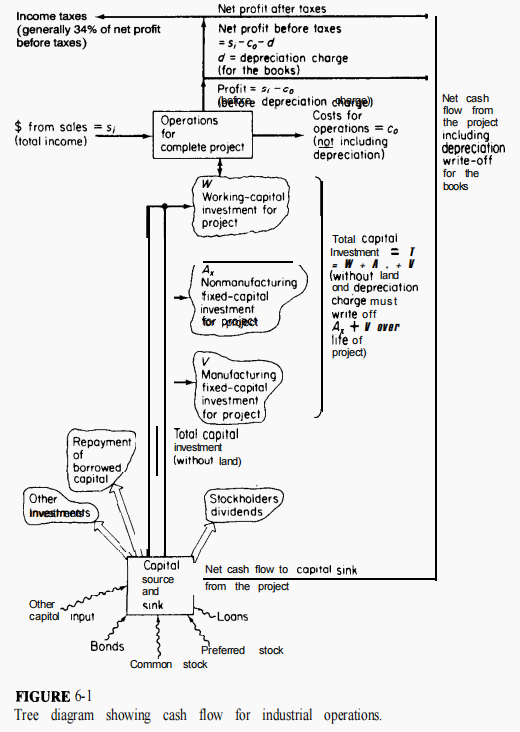
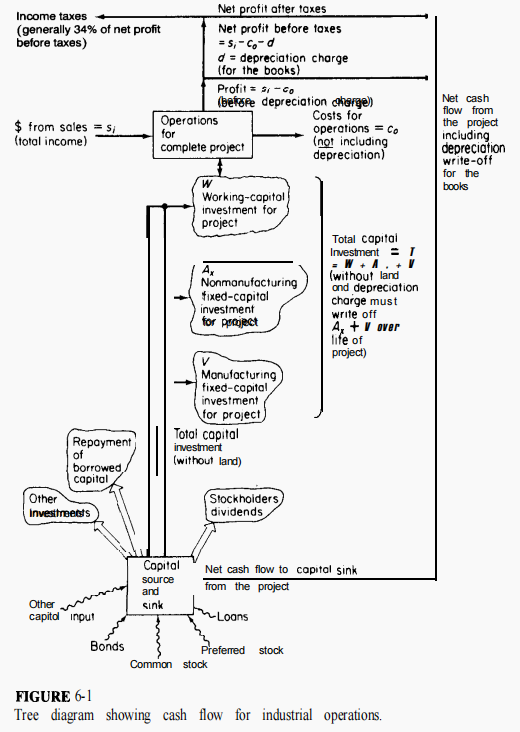
FAMILIARIZE. Tree diagram showing cash flow for industrial operations.
FAMILIARIZE. Tree diagram showing cash flow for industrial operations.
Cumulative cash position
CASH FLOW FOR INDUSTRIAL OPERATIONS. Determine what is being asked below.
It is the total sum of all cash inflows and outflows for a business over a specific period.
True
CASH FLOW FOR INDUSTRIAL OPERATIONS. Determine what is being asked below.
TRUE OR FALSE. In a cumulative cash position, the time value of money is neglected.
Estimated life period of the project
CASH FLOW FOR INDUSTRIAL OPERATIONS. Determine what is being asked below.
The time period chosen for a cumulative cash position is ____.
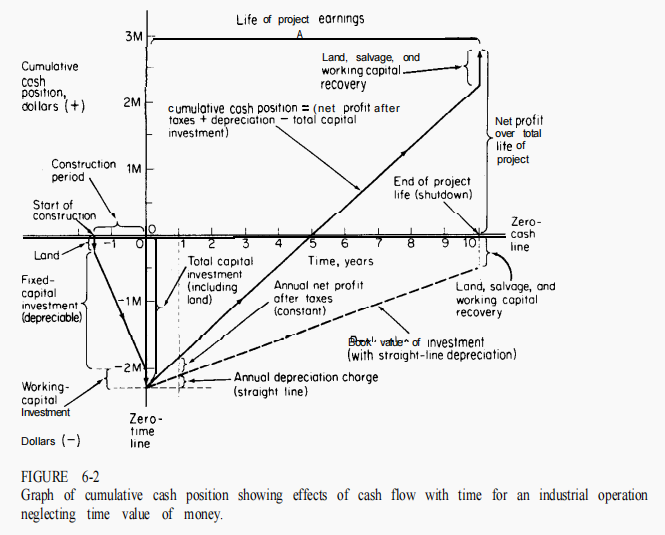
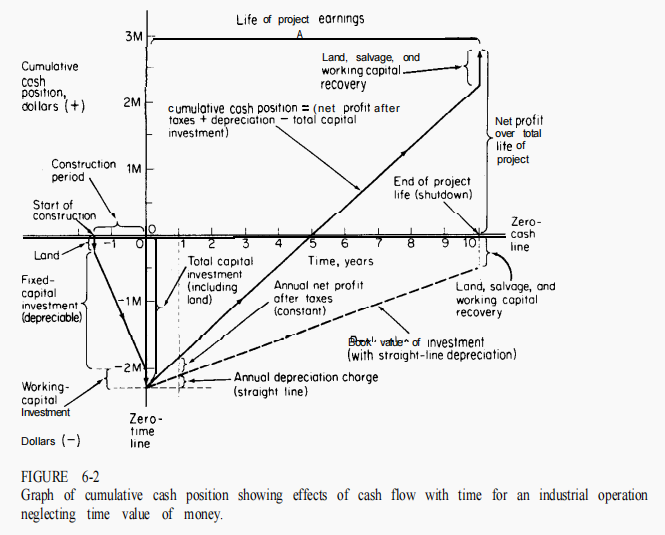
FAMILIARIZE. Graph of cumulative cash position showing effects of cash flow with time for an industrial operation neglecting time value of money.
FAMILIARIZE. Graph of cumulative cash position showing effects of cash flow with time for an industrial operation neglecting time value of money.
Zero point
(ADDITIONAL: The total capital investment at the zero point in time includes land value, fixed-capital and auxiliaries’ investment, and working capital.)
CASH FLOW FOR INDUSTRIAL OPERATIONS. Determine what is being asked below.
In a graph of cumulative cash position, this point represents that time at which the plant has been completely constructed and is ready for operation.
True
(ADDITIONAL: However, profits in the ideal situation come in from the operation as soon as time is positive.)
CASH FLOW FOR INDUSTRIAL OPERATIONS. Determine what is being asked below.
TRUE OR FALSE. In the zero-time line, the cash position is negative by an amount equivalent to the total capital investment at zero time.
READ.
Under cumulative cash position,
Cash flow to the company, in the form of net profits after taxes and depreciation charges, starts to accumulate and gradually pays off the full capital investment.
After the full capital investment is paid off, profits will accumulate on the positive side of the cumulative cash position until the end of the project life at which the project theoretically is shut down and the operation ceases.
READ.
Under cumulative cash position,
Cash flow to the company, in the form of net profits after taxes and depreciation charges, starts to accumulate and gradually pays off the full capital investment.
After the full capital investment is paid off, profits will accumulate on the positive side of the cumulative cash position until the end of the project life at which the project theoretically is shut down and the operation ceases.
Net profit over the total life of the project or cash flow into the company’s capital sink
CASH FLOW FOR INDUSTRIAL OPERATIONS. Determine what is being asked below.
The final result of the cumulative cash position is ___.
READ.
Under factors affecting investment and production costs,
If the chemical engineer bases the cost of the raw materials for the process on regular market prices, the result may be that the process is uneconomical.
If the engineer had based the estimate on the actual prices the company would have to pay for the raw materials, the economic picture might have been altered completely.
READ.
Under factors affecting investment and production costs,
If the chemical engineer bases the cost of the raw materials for the process on regular market prices, the result may be that the process is uneconomical.
If the engineer had based the estimate on the actual prices the company would have to pay for the raw materials, the economic picture might have been altered completely.
Sources of equipment
Price fluctuations
Company policies
Operating time and rate of production
Governmental policies
FACTORS AFFECTING INVESTMENT AND PRODUCTION COSTS. Determine what is being asked below.
Enumerate the five (5) factors affecting investment and production costs.
Equipment
FACTORS AFFECTING INVESTMENT AND PRODUCTION COSTS. Determine what is being asked below.
It is one of the major costs involved in any chemical process.
READ.
Under sources of equipment,
In many cases, standard types of tanks, reactors, or other equipment are used, and a substantial reduction in cost can be made by employing idle equipment or by purchasing secondhand equipment.
If new equipment must be bought, several independent quotations should be obtained from different manufacturers.
READ.
Under sources of equipment,
In many cases, standard types of tanks, reactors, or other equipment are used, and a substantial reduction in cost can be made by employing idle equipment or by purchasing secondhand equipment.
If new equipment must be bought, several independent quotations should be obtained from different manufacturers.
Monthly Labor Review
(ADDITIONAL: This is published by the U.S. Bureau of Labor Statistics, and it gives up-to-date information on present prices and wages for different types of industries.)
FACTORS AFFECTING INVESTMENT AND PRODUCTION COSTS. Determine what is being asked below.
It is one of the most complete sources of information on existing price conditions.
READ.
Under price fluctuations,
In our modern economic society, prices may vary widely from one period to another, and this factor must be considered when the costs for an industrial process are determined.
The chemical engineer must keep up-to-date on price and wage fluctuations.
READ.
Under price fluctuations,
In our modern economic society, prices may vary widely from one period to another, and this factor must be considered when the costs for an industrial process are determined.
The chemical engineer must keep up-to-date on price and wage fluctuations.
READ.
Under company policies,
Policies of individual companies have a direct effect on costs.
Accounting procedures and methods for determining depreciation costs vary among different companies.
The company policies with reference to labor unions should be considered, because these will affect overtime labor charges and the type of work the operators or other employees can do.
READ.
Under company policies,
Policies of individual companies have a direct effect on costs.
Accounting procedures and methods for determining depreciation costs vary among different companies.
The company policies with reference to labor unions should be considered, because these will affect overtime labor charges and the type of work the operators or other employees can do.
Labor union policies
(ADDITIONAL: Labor union policies are sets of rules and goals designed to protect workers’ rights and improve their collective bargaining power. They typically focus on securing higher wages, safer working conditions, and better benefits for all members.)
FACTORS AFFECTING INVESTMENT AND PRODUCTION COSTS. Determine what is being asked below.
These should be considered because these will affect overtime labor charges and the type of work the operators or other employees can do.
True
FACTORS AFFECTING INVESTMENT AND PRODUCTION COSTS. Determine what is being asked below.
TRUE OR FALSE. The ideal plant should operate under a time schedule which gives the maximum production rate while maintaining economic operating methods.
True
(ADDITIONAL: This is because the fixed costs are utilized to the fullest extent.)
FACTORS AFFECTING INVESTMENT AND PRODUCTION COSTS. Determine what is being asked below.
TRUE OR FALSE. If the ideal plant is operating under a time schedule which gives the maximum production rate, then the total cost per unit of production is kept near a minimum.
True
(ADDITIONAL: This ideal method of operation is based on the assumption that the sales demand is sufficient to absorb all the material produced.)
FACTORS AFFECTING INVESTMENT AND PRODUCTION COSTS. Determine what is being asked below.
TRUE OR FALSE. If the production capacity of the process is greater than the sales demand, the operation can be carried on at reduced capacity or periodically at full capacity.
Break-even point
FACTORS AFFECTING INVESTMENT AND PRODUCTION COSTS. Determine what is being asked below.
It refers to the point where the total product cost equals the total income.
READ.
Under operating time and rate of production,
One of the factors that has an important effect on the costs is the fraction of the total available time during which the process is in operation.
When equipment stands idle for an extended period of time, the labor costs are usually low; however, other costs, such as those for maintenance, protection, and depreciation, continue even though the equipment is not in active use.
READ.
Under operating time and rate of production,
One of the factors that has an important effect on the costs is the fraction of the total available time during which the process is in operation.
When equipment stands idle for an extended period of time, the labor costs are usually low; however, other costs, such as those for maintenance, protection, and depreciation, continue even though the equipment is not in active use.
READ.
Under operating time and rate of production,
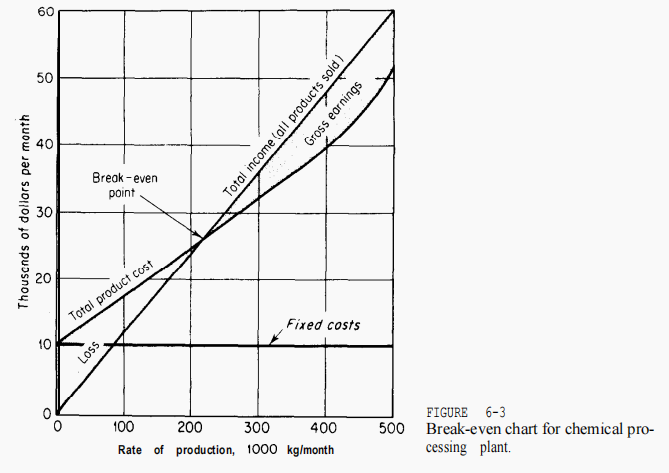
Figure 6-3 gives a graphical analysis of the effect on costs and profits when the rate of production varies.
The fixed costs remain constant and the total product cost increases as the rate of production increases.
Under the conditions shown in the figure, an ideal production rate for this chemical processing plant would be approximately 450,000 kg/month, because this represents the point of maximum net earnings.
READ.
Under operating time and rate of production,
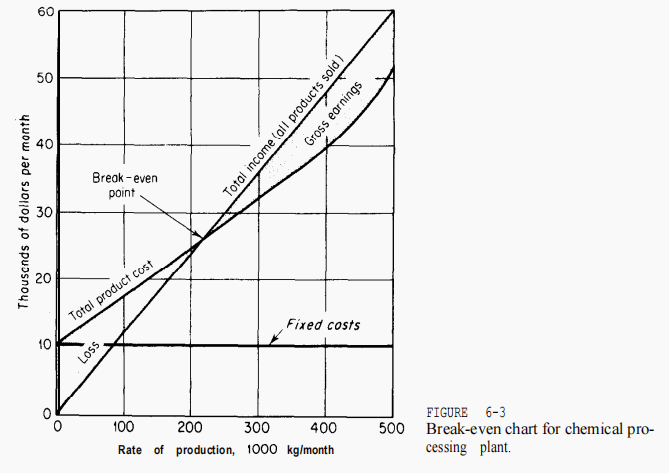
Figure 6-3 gives a graphical analysis of the effect on costs and profits when the rate of production varies.
The fixed costs remain constant and the total product cost increases as the rate of production increases.
Under the conditions shown in the figure, an ideal production rate for this chemical processing plant would be approximately 450,000 kg/month, because this represents the point of maximum net earnings.
READ.
Under governmental policies,
The national government has many regulations and restrictions which have a direct effect on industrial costs.
Some examples of these are import and export tariff regulations, restrictions on permissible depreciation rates, income-tax rules, and environmental regulations.
READ.
Under governmental policies,
The national government has many regulations and restrictions which have a direct effect on industrial costs.
Some examples of these are import and export tariff regulations, restrictions on permissible depreciation rates, income-tax rules, and environmental regulations.
READ.
Under capital investments,
Before an industrial plant can be put into operation, a large sum of money must be supplied to purchase and install the necessary machinery and equipment.
Land and service facilities must be obtained, and the plant must be erected complete with all piping, controls, and services.
In addition, it is necessary to have money available for the payment of expenses involved in the plant operation.
READ.
Under capital investments,
Before an industrial plant can be put into operation, a large sum of money must be supplied to purchase and install the necessary machinery and equipment.
Land and service facilities must be obtained, and the plant must be erected complete with all piping, controls, and services.
In addition, it is necessary to have money available for the payment of expenses involved in the plant operation.
Fixed-capital investment
CAPITAL INVESTMENTS. Determine what is being asked below.
It is the capital needed to supply the necessary manufacturing and plant facilities.
Working capital
CAPITAL INVESTMENTS. Determine what is being asked below.
It is the capital necessary for the operation of the plant.
Total capital investment
CAPITAL INVESTMENTS. Determine what is being asked below.
It is the sum of the fixed-capital investment and the working capital.
Manufacturing fixed-capital investment
Nonmanufacturing fixed-capital investment
CAPITAL INVESTMENTS. Determine what is being asked below.
Enumerate the two (2) categories of fixed-capital investment.
Manufacturing fixed-capital investment
CAPITAL INVESTMENTS. Determine what is being asked below.
It represents the capital necessary for the installed process equipment with all auxiliaries that are needed for complete process operation.
Manufacturing fixed-capital investment
CAPITAL INVESTMENTS. Determine what is being asked below.
Expenses for piping, instruments, insulation, foundations, and site preparation are typical examples of costs included in this capital investment.
Nonmanufacturing fixed-capital investment
CAPITAL INVESTMENTS. Determine what is being asked below.
It refers to the fixed capital required for construction overhead and for all plant components that are not directly related to the process operation.
Nonmanufacturing fixed-capital investment
CAPITAL INVESTMENTS. Determine what is being asked below.
This capital investment includes plant components such as the land, processing buildings, administrative, and other offices, warehouses, laboratories, transportation, shipping, and receiving facilities, utility and waste-disposal facilities, shops, and other permanent parts of the plant.
Construction overhead cost
CAPITAL INVESTMENTS. Determine what is being asked below.
It consists of field-office and supervision expenses, home-office expenses, engineering expenses, miscellaneous construction costs, contractor’s fees, and contingencies.
True
(EXPLANATION: The costs for building shared facilities are split between the production areas and the administrative areas.)
CAPITAL INVESTMENTS. Determine what is being asked below.
TRUE OR FALSE. In some cases, construction overhead is proportioned between manufacturing and nonmanufacturing fixed-capital investment.
Raw materials and supplies carried in stock
Finished products in stock and semifinished products
Accounts receivable
Cash kept on hand for monthly payment of operating expenses
Accounts payable
Taxes payable
CAPITAL INVESTMENTS. Determine what is being asked below.
The working capital for an industrial plant consists of the total amount of money invested in (6):
1-month supply
CAPITAL INVESTMENTS. Determine what is being asked below.
The raw materials inventory included in working capital usually amounts to a ___ supply of the raw materials valued at delivered prices.
10% to 20%
(ADDITIONAL: This percentage may increase to as much as 50% or more for companies producing products of seasonal demand because of the large inventories which must be maintained for appreciable periods of time.)
CAPITAL INVESTMENTS. Determine what is being asked below.
The ratio of working capital to total capital investment varies with different companies, but most chemical plants use an initial working capital amounting to ___ to ___ percent of the total capital investment.
READ.
Under estimation of capital investment,
Of the many factors which contribute to poor estimates of capital investments, the most significant one is usually traceable to sizable omissions of equipment, services, or auxiliary facilities rather than to gross errors in costing.
READ.
Under estimation of capital investment,
Of the many factors which contribute to poor estimates of capital investments, the most significant one is usually traceable to sizable omissions of equipment, services, or auxiliary facilities rather than to gross errors in costing.
Order-of-magnitude estimate (ratio estimate)
Study estimate (factored estimate)
Preliminary estimate (budget authorization estimate, scope estimate)
Definitive estimate (project control estimate)
Detailed estimate (contractor’s estimate)
ESTIMATION OF CAPITAL INVESTMENT. Determine what is being asked below.
Enumerate the five (5) categories or types of capital cost estimates.
Order-of-magnitude estimate (ratio estimate)
ESTIMATION OF CAPITAL INVESTMENT. Determine what is being asked below.
It is based on similar previous cost data and has a probable accuracy of estimate over ± 30%.
Study estimate (factored estimate)
ESTIMATION OF CAPITAL INVESTMENT. Determine what is being asked below.
It is based on knowledge of major items of equipment and has a probable accuracy of estimate up to ±30%
Preliminary estimate (budget authorization estimate, scope estimate)
ESTIMATION OF CAPITAL INVESTMENT. Determine what is being asked below.
It is based on sufficient data to permit the estimate to be budgeted and has a probable accuracy of estimate within ±20%.
Definitive estimate (project control estimate)
ESTIMATION OF CAPITAL INVESTMENT. Determine what is being asked below.
It is based on almost complete data but before completion of drawings and specifications and has a probable accuracy of estimate within ±10%.
Detailed estimate (contractor’s estimate)
ESTIMATION OF CAPITAL INVESTMENT. Determine what is being asked below.
It is based on complete engineering drawings, specifications, and site surveys and has a probable accuracy of estimate within ±5%.
False
(EXPLANATION: It is more likely that the actual cost will be greater than the estimated cost.)
ESTIMATION OF CAPITAL INVESTMENT. Determine what is being asked below.
TRUE OR FALSE. There is a large probability that the actual cost will be less than the estimated cost where information is incomplete or in time of rising-cost trends.
Predesign cost estimates (includes order-of-magnitude, study, and preliminary estimates)
ESTIMATION OF CAPITAL INVESTMENT. Determine what is being asked below.
These require much less detail than firm estimates.
READ.
Under estimation of capital investment,
The predesign cost estimates are extremely important for determining if a proposed project should be given further consideration and to compare alternative designs.
The distinction between predesign and firm estimates gradually disappears as more and more detail is included.
READ.
Under estimation of capital investment,
The predesign cost estimates are extremely important for determining if a proposed project should be given further consideration and to compare alternative designs.
The distinction between predesign and firm estimates gradually disappears as more and more detail is included.
Variance
ESTIMATION OF CAPITAL INVESTMENT. Determine what is being asked below.
Predesign estimates may be used to provide a basis for requesting and obtaining a capital appropriation from company management. Later estimates, made during the progress of the job, may indicate that the project will cost more or less than the amount appropriated. Management is then asked to approve a ____ which may be positive or negative.
Cost index
COST INDEXES. Determine what is being asked below.
It is merely an index value for a given point in time showing the cost at that time relative to a certain base time.
READ.
Under cost indexes,
Cost indexes can be used to give a general estimate, but no index can take into account all factors, such as special technological advancements or local conditions.
READ.
Under cost indexes,
Cost indexes can be used to give a general estimate, but no index can take into account all factors, such as special technological advancements or local conditions.
less than 10 years
COST INDEXES. Determine what is being asked below.
The common indexes permit fairly accurate estimates if the time period involved is ___.
Marshall and Swift equipment cost index
Engineering News-Record construction index
Nelson-Farrar refinery construction index
Chemical engineering plant cost index
COST INDEXES. Determine what is being asked below.
Enumerate the four (4) common cost indexes.
All-industry equipment index
Process-industry equipment index
COST INDEXES. Determine what is being asked below.
Enumerate the two (2) categories of Marshall and Swift (formerly known as Marshall and Stevens) equipment indexes.
All-industry equipment index
COST INDEXES. Determine what is being asked below.
It is the arithmetic average of individual indexes for 47 different types of industrial, commercial, and housing equipment.
Process-industry equipment index
COST INDEXES. Determine what is being asked below.
It is a weighted average of eight of these, with the weighting based on the total product value of the various process industries.
Marshall and Swift indexes
COST INDEXES. Determine what is being asked below.
This cost index is based on an index value of 100 for the year 1926, taking into consideration the cost of machinery and major equipment plus costs for installation, fixtures, tools, office furniture, and other minor equipment.
Engineering News-Record Construction Cost Index
COST INDEXES. Determine what is being asked below.
This index shows the variation in labor rates and materials costs for industrial construction.
Nelson-Farrar construction index
COST INDEXES. Determine what is being asked below.
Its basis is the construction costs in the petroleum industry.
Chemical engineering plant cost index
COST INDEXES. Determine what is being asked below.
Its basis is the construction costs for chemical plants.
Chemicals (48)
Petroleum (22)
Paper (10)
Rubber (8)
Paint (5)
Glass (3)
Cement (2)
Clay products (2)
COST INDEXES. Determine what is being asked below.
The percentages used for the weighting in the process-industry equipment index are (8):
Engineering News-Record Construction Cost Index
COST INDEXES. Determine what is being asked below.
This index employs a composite cost for 2500 lb of structural steel, 1088 fbm of lumber, 2256 lb of concrete, and 200 h of common labor.
Nelson-Farrar refinery construction cost index
COST INDEXES. Determine what is being asked below.
The total index percentages in this cost index are weighted as follows: skilled labor (30), common labor (30), iron and steel (20), building materials (8), and miscellaneous equipment (12).
Equipment, machinery, and supports (61)
Erection and installation labor (22)
Engineering and supervision (10)
Buildings, materials, and labor (7)
COST INDEXES. Determine what is being asked below.
Enumerate the four (4) major components of the Chemical Engineering Plant Cost Index.
Fabricated equipment (37)
Pipes, valves, fittings (20)
Process machinery (14)
Structural supports, insulation, paint (10)
Instrument and controls (7)
Pumps and compressors (7)
Electrical equipment (5)
COST INDEXES. Determine what is being asked below.
The major component of the Chemical Engineering Plant Cost Index, equipment, is further subdivided and weighted as follows (7):
READ.
Under cost indexes,
Unfortunately, all cost indexes are rather artificial; two indexes covering the same types of projects may give results that differ considerably.
The most that any index can hope to do is to reflect average changes.
READ.
Under cost indexes,
Unfortunately, all cost indexes are rather artificial; two indexes covering the same types of projects may give results that differ considerably.
The most that any index can hope to do is to reflect average changes.
READ.
Under cost indexes,
For use with process equipment estimates and chemical-plant investment estimates, the Marshall and Swift equipment cost indexes and the Chemical Engineering plant cost index are recommended.
The Engineering News-Record construction index, relative with time, has increased much more rapidly because it does include a productivity improvement factor.
The Nelson-Farrar refinery construction index has shown a very large increase with time and should be used with caution and only for refinery construction.
READ.
Under cost indexes,
For use with process equipment estimates and chemical-plant investment estimates, the Marshall and Swift equipment cost indexes and the Chemical Engineering plant cost index are recommended.
The Engineering News-Record construction index, relative with time, has increased much more rapidly because it does include a productivity improvement factor.
The Nelson-Farrar refinery construction index has shown a very large increase with time and should be used with caution and only for refinery construction.
Capital investment
COST FACTORS IN CAPITAL INVESTMENT. Determine what is being asked below.
It is the total amount of money needed to supply the necessary plant and manufacturing facilities plus the amount of money required as working capital for operation of the facilities.
Grass-roots plant
COST FACTORS IN CAPITAL INVESTMENT. Determine what is being asked below.
It is defined as a complete plant erected on a new site.
All costs of land
Site development
Battery-limit facilities
Auxiliary facilities
COST FACTORS IN CAPITAL INVESTMENT. Determine what is being asked below.
In grass-roots plants, investment includes (4):
Battery limit
COST FACTORS IN CAPITAL INVESTMENT. Determine what is being asked below.
It is a geographical boundary defining the coverage of a specific project.
READ.
Under cost factors in capital investment,
Battery limits encompass the manufacturing area of a proposed plant or addition, including all process equipment but excluding provision of storage, utilities, administrative buildings, or auxiliary facilities unless so specified.
Normally, this excludes site preparation and therefore, may be applied to the extension of an existing plant.
READ.
Under cost factors in capital investment,
Battery limits encompass the manufacturing area of a proposed plant or addition, including all process equipment but excluding provision of storage, utilities, administrative buildings, or auxiliary facilities unless so specified.
Normally, this excludes site preparation and therefore, may be applied to the extension of an existing plant.
Purchased equipment
COST FACTORS IN CAPITAL INVESTMENT. Determine what is being asked below.
It is the basis of several predesign methods for estimating capital investment.
Sources of equipment prices
Methods of adjusting equipment prices for capacity
Methods of estimating auxiliary process equipment
COST FACTORS IN CAPITAL INVESTMENT. Determine what is being asked below.
These three (3) factors are essential to the estimator in making reliable cost estimates.
Processing equipment
Raw-materials handling and storage equipment
Finished products handling and storage equipment
COST FACTORS IN CAPITAL INVESTMENT. Determine what is being asked below.
The various types of equipment can often be divided conveniently into (3):
Insulation
Ducts
COST FACTORS IN CAPITAL INVESTMENT. Determine what is being asked below.
Give two (2) examples of auxiliary equipment and materials.
Obtain firm bids from fabricators or suppliers
(ADDITIONAL: Often, fabricators can supply quick estimates which will be very close to the bid price but will not involve too much time.)
COST FACTORS IN CAPITAL INVESTMENT. Determine what is being asked below.
It is the most accurate method for determining process equipment costs.
Cost values from the file of past purchase orders
(ADDITIONAL: When used for pricing new equipment, purchase-order prices must be corrected to the current cost index.)
COST FACTORS IN CAPITAL INVESTMENT. Determine what is being asked below.
Second best method, in terms of reliability, for determining process equipment cost is ___.
Six-tenths-factor (a logarithmic relationship)
COST FACTORS IN CAPITAL INVESTMENT. Determine what is being asked below.
This rule is sued to estimate the cost of a piece of equipment when no cost data are available for the particular size of operational capacity involved.
Log-log plot
COST FACTORS IN CAPITAL INVESTMENT. Determine what is being asked below.
The attached equation indicates that a ____ of capacity vs equipment cost for a given type of equipment should be a straight line with a slope equal to 0.6.

READ.
Under estimating equipment costs by scaling,
In general, the cost-capacity concept should not be used beyond a tenfold range of capacity.
Care must be taken to make certain the two pieces of equipment are similar with regard to type of construction, materials of construction, temperature and pressure operating range, and other pertinent variables.
READ.
Under estimating equipment costs by scaling,
In general, the cost-capacity concept should not be used beyond a tenfold range of capacity.
Care must be taken to make certain the two pieces of equipment are similar with regard to type of construction, materials of construction, temperature and pressure operating range, and other pertinent variables.
Weight
COST FACTORS IN CAPITAL INVESTMENT. Determine what is being asked below.
Purchased-equipment costs for vessels, tanks, and process-and materials-handling equipment can often be estimated on what basis?
READ.
Under estimating equipment costs by scaling,
The fact that a wide variety of types of equipment have about the same cost per unit weight is quite useful, particularly when other cost data are not available.
Generally, the cost data generated by this method are sufficiently reliable to permit order-of-magnitude estimates.
READ.
Under estimating equipment costs by scaling,
The fact that a wide variety of types of equipment have about the same cost per unit weight is quite useful, particularly when other cost data are not available.
Generally, the cost data generated by this method are sufficiently reliable to permit order-of-magnitude estimates.
READ.
Under purchased-equipment installation,
The installation of equipment involves costs for labor, foundations, supports, platforms, construction expenses, and other factors directly related to the erection of purchased equipment.
Installation labor cost as a function of equipment size shows wide variations when scaled from previous installation estimates.
READ.
Under purchased-equipment installation,
The installation of equipment involves costs for labor, foundations, supports, platforms, construction expenses, and other factors directly related to the erection of purchased equipment.
Installation labor cost as a function of equipment size shows wide variations when scaled from previous installation estimates.
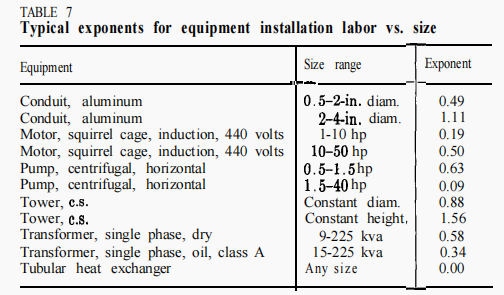
Tubular heat exchangers are set with cranes and hoists, which, when adequately sized for the task, recognize no appreciable difference in size of weight of the equipment.
COST FACTORS IN CAPITAL INVESTMENT. Determine what is being asked below.
In Table 7, tubular heat exchangers appear to have zero exponents, implying that direct labor cost is independent of size. Why?
65% to 80%
COST FACTORS IN CAPITAL INVESTMENT. Determine what is being asked below.
Analyses of the total installed costs of equipment in a number of typical chemical plants indicate that the cost of the purchased equipment varies from ___ to ___ percent of the installed cost depending upon the complexity of the equipment and the type of plant in which the equipment is installed.
25% to 55%
COST FACTORS IN CAPITAL INVESTMENT. Determine what is being asked below.
Installation costs for equipment are estimated to vary from ___ to ___ percent from the purchased-equipment cost.
8% to 9%
COST FACTORS IN CAPITAL INVESTMENT. Determine what is being asked below.
The total cost for the labor and materials required for insulating equipment and piping in ordinary chemical plants is approximately ___ to ___ percent of the purchased-equipment cost.
Explore top notes

