Population, Species Interactions and Food Webs
 Studied by 0 people
 Call with Kai
 Learn
Learn Practice Test
 Spaced Repetition
 Match
Match Flashcards
 Knowt Play
1/44

There's no tags or description
Looks like no tags are added yet.
Name | Mastery | Learn | Test | Matching | Spaced | Call with Kai |
|---|
No analytics yet
Send a link to your students to track their progress
45 Terms
Population
A group of individuals of one species under investigation. It's a group of sexually interbreeding individuals
Population Dynamics
Dynamics are affected by the births, deaths, immigration and emigration of a population as well as its age structure and survivorship curves.
For spatial dynamics, species abundances can increase or decrease due to range expansion or contraction, whereas temporal dynamics include models such as age structure (e.g., population pyramids)
Species
A group of interbreeding natural populations, which are reproductively isolated from other such groups
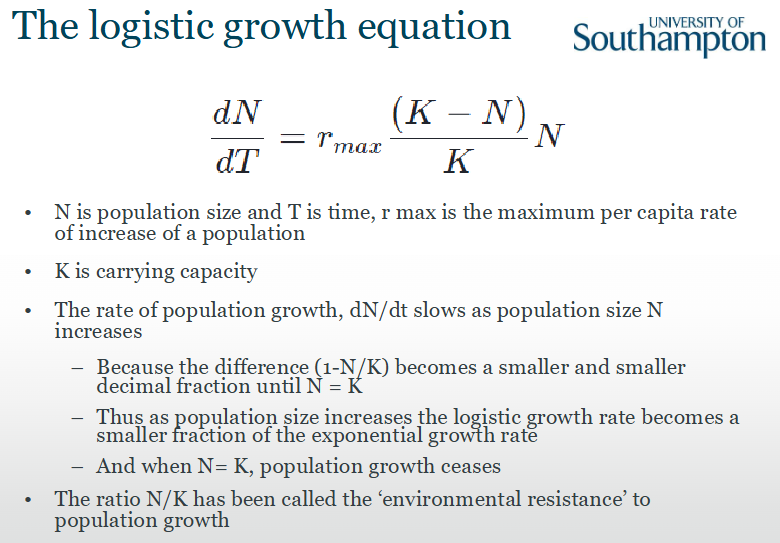
Logistic Growth
As resources are depleted, population growth rate slows and eventually stops. The environment limits population growth by changing birth and death rates
Logistic Growth Equation
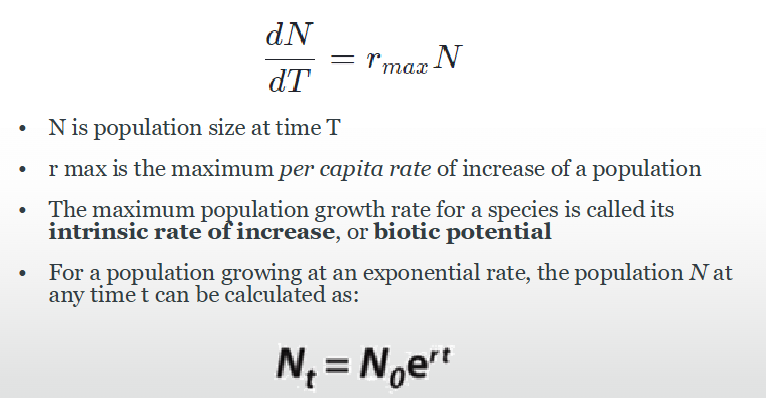
Exponential Growth
The growth in populations without distinct breeding seasons and continuous population growth
Exponential Growth Equation
Geometric Growth
Describes the growth of populations with a pulsed reproduction
rMax
Also called biotic potential, is defined as the maximum
reproductive capacity of an organism under optimum environmental
conditions
What is rMax (biotic potential) affected by
It’s affected by the reproductive capacity or an organism which is affected by :
– The age at which an organism can first reproduce
– The number of offspring produced each time an organism reproduces
– The frequency of the reproductive cycle/the total number of times an organism reproduces during its life
Carrying capacity (K)
The maximum population size of a species that can be sustained in a particular area at that time
Metapopulations
A group of spatially separated populations of the same species that interact with each other through processes like migration, dispersal, and colonisation
Metapopulation Dynamics
Rather than a single population, you have a population of populations linked by colonization. Individual local populations go extinct, but can be re-colonized by individuals from other local populations in the metapopulation
Metapopulation dynamics example
Sand Lizards (Lacerta agilis) in heathland in Dorset. They occur in fragmented habitats connected by limited migration and are characterised by extinction and recolonisation: populations are transient
Intra-specific competition
Competition between individuals of the same species
Intra-specific competition example
Spiders are common, arthropod generalist predators in most natural and managed terrestrial ecosystems. Thus, the relationship of spider cannibalism to food limitation, competition, and population regulation can also be seen as a form of intraspecific competition. Cannibalism is not only the reduction in the intensity of exploitative competition through elimination of a competitor (often seen in Wolf Spiders), but also for resources such as web sites or the web itself. The most documented example of territoriality in spiders is that of the web spider Agelenopsis aperta (Agelenidae), which reduces exploitative competition for prey by defending an area in excess of the web.
Inter-specific competition
Competition between individuals of different species
Inter-specific competition example
The invasive ant Myrmica rubra, is a high-quality seed-disperser in its native range that interacts with myrmecochores (ant-dispersed plants) and the high-quality seed disperser Aphaenogaster sp. in its invaded range. Out of the two functionally similar mutualist ant species, M. rubra was better at discovering and dispersing seeds, but Aphaenogaster sp. was dominantly aggressive over M. rubra. Interspecific interactions dampened seed dispersal relative to dispersal by the better disperser. Despite the native ant dispersing fewer seeds, its dominance over the subordinate (invasive) ant has the potential to allow for some level of biotic resistance against the effects of M. rubra on plant communities when these species coexist.
Interference competition
The direct action of competitor's seeking the same resource and so interfering with each other's uninterrupted access to and use of that resource. In this case the resource need only be effectively limited (e.g. gulls feeding on a rubbish tip)
Interference competition example
Interference competition between arctic and red foxes for good quality dens and hunting grounds at southern edge of range in Sweden. The arctic fox in mainland Europe is endangered, while the red fox is increasing its range in the north. High quality dens were inhabited by reproducing arctic foxes more often when no red foxes bred in the vicinity.
Furthermore, in 2/3 of cases, when arctic foxes did reproduce near red foxes, juveniles were killed by red foxes. We also found that breeding arctic foxes occupied dens at higher altitudes than red foxes did meaning the red fox might thus be excluding the arctic fox from breeding in low altitude habitat, which is most important in years when food abundance is limited and competition is most fierce.
This is interspecific interference competition.
Exploitation competition
Where competitors do not actually meet and directly restrict each other's use of the resource but they do occupy the resource separately (e.g. at different times) and so affect the total amount of resource available. In this case, the resource must be inadequate to provide for all (e.g. Kestrals & Barn owls hunting for small mammals)
Exploitation competition examples
Shiny cowbird Molothrus bonariensis is a non specific S. American brood parasite. Found to scramble compete for food with young host chicks, it is fed at a higher proportion than its host nestmates when it is reared in nests of a smaller-bodied host, the house wren, Troglodytes aedon.
The signal exaggeration hypothesis states that cowbird chicks have visual and/or acoustic begging signals that elicit preferential feeding. The size-advantage hypothesis states that hosts preferentially feed large chicks and/or that larger chicks outcompete host chicks in a scramble competition for food.
This is interspecific exploitation competition.
True Predators
Are predators that during their life time will kill many prey individuals. Includes most carnivores but also seed eaters, carnivorous plants and plankton feeders
Predator and prey cycles example
Populations tracking populations, a classic example of Canada lynx tracking its primary prey the snowshoe hare. These sub-lethal predator effects have been shown to be mediated by physiological stress of the hares. Elevated predator-induced glucocorticoid (stress hormone) concentrations in individual dams caused a decline in their reproductive output measured both by number and quality of offspring. Thus, evidence that any stressor, not just predation, which increases glucocorticoid concentrations will result in a decrease in reproductive output.
Parasitoids
All insects where eggs laid in the bodies of other animals. Accounts for approx 10% of world species
Parasitoid example
Ichneumons and Braconids (parasitic wasps) are primarily parasitoids of dozens of different caterpillars (such as armyworms, cabbage looper, fall webworm, tent caterpillars, tomato fruitworm, redhumped caterpillar).
Grazers and Browsers
Grazers feed on grasses, herbs, seaweed and browsers feed on woody plants. Includes the large vertebrate herbivores e.g. deer, cattle and also invertebrate terrestrial and marine animals e.g. molluscs
Parasites
These consume only part of their prey. However, only one or a few prey are affected by each parasite
Parasite example
The fish tongue parasite Cymothoa exigua is a crustacean that lives in the mouth of Spotted Rose Snapper fish (Lutjanus guttatus). It feeds on blood from the artery under the tongue and on food fragments. Eventually replaces fish’s own tongue. It appears that the parasite does not cause any other damage to the host fish. This is the only known case of a parasite functionally replacing a host organ.
Keystone Species
A species that helps hold the system together
Keystone species example
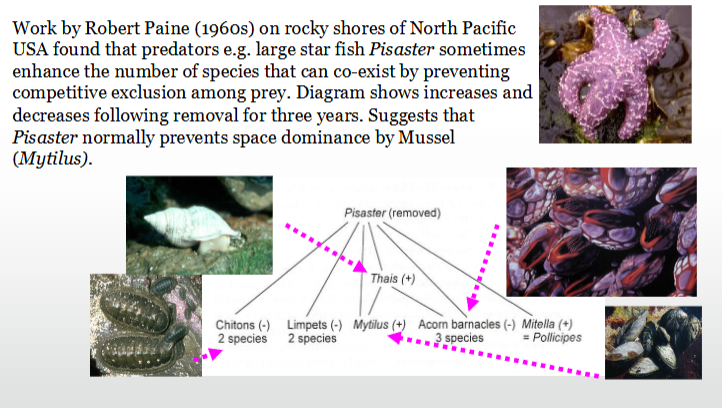
The Pisaster Star fish is a keystone predator that feeds on mussels. It controls the mussel population and prevents it over-dominating the shores of NW USA. This maintains diversity of other marine life e.g. limpets, barnacles, chitons. Other species, such as Whelk, could be seen as “lesser” predators. The dog whelk Nucella (Thais) lapillus also feeds on the mussel Mytilus edulis on rocky shores of
New England. When it mounts a mussel it tries to drill a hole in the shell. However the mussels can fight back and respond by attaching byssal threads to the snail. This traps them and exposes them to crab predation.
What are the 5 main types of keystone species
-Keystone predators
-Keystone food suppliers
-Keystone ecological engineers
-Keystone diseases
-Keystone pollinators
Keystone predator example
Sharks have a major role in maintaining the ocean ecosystem and also serving as an indicator of the ocean health. They control the populations of prey species by eliminating the weak and sick animals ensuring the species diversity, play an important role in the conservation of coral reefs and frequent multiple coastal and pelagic ecosystems that are at continued risk from exploitation by pelagic longline fisheries, unfortunately putting them in danger of decline due to overfishing, anthropogenic activities and demand for shark fins.
Keystone food supplier example
Fig trees (Ficus sp.) are mature fig trees in tropical forests that provide birds and
mammals with steady supply of food. This food is famine food which is not nutrient rich but enough to tide them over. However, figs are still a keystone species as they are vital, although only form a small part of overall diet, as they maintain the populations of species in times of hardship.
Keystone ecological engineer example
The European Beaver is a keystone species as it creates wetland habitats through the felling of trees and creation of log dams. These provide habitats for many other species e.g. fish, invertebrates, aquatic plants. Dams also improve water quality via water filtration, allow land to hold more water and create diverse wetland habitats.
Keystone disease example
The Dutch Elm Disease is a microscopic fungus (Ceratocystis ulmi) that attacks
the tree’s vascular system as spreads through the xylem to the root after which the tree quickly dies. It is thought to be an invasive species from Asia as Asian species are resistant. Affects European and N. American elms badly. Identified in 1920s by a team of Dutch phytopathologists and is carried by Elm beetle Scolytus scolytus and S. multistriatus. This is a keystone disease as it removes a keystone species: Elm trees. This causes habitat loss, biodiversity reduction and landscape alteration.
Keystone pollinators example
Bats of the family Pteropodidae (the flying foxes) are important in the pacific islands, especially the genus Pteropus in particular, as the main or only pollinator
and seed disperser of tropical trees. This includes commercially important species e.g. mahogany, ebony.
Flagship Species
Species that attract human interest and thus resources for the conservation of their whole biological community
Flagship species example
In Kalimantan, foundations for orangutans (especially those orphaned, displaced by forest fires/logging or confiscated from animal traders) started with centres to rehabilitate rescued orangs but then ‘worked outwards’ to champion the protection of surrounding forest and then orangutan forest habitat more generally. The orangutan’s human-likeness assures its integration into human ethical and moral frames and this galvanises concerned individuals to care for and rehabilitate orangutans into their ‘natural’ setting. More recently, the orangutan appeared as an issue animal in Greenpeace's 2010 ‘Give me a break’ campaign targeting the oil palm sector
Food Web
A system of interlocking and interdependent food chains
Food web example
Introduced large herbivores have partly filled ecological gaps formed in the late Pleistocene, when many of the Earth's megafauna were driven extinct. The first documented predation of juvenile feral donkeys Equus africanus asinus by cougars Puma concolor in the Mojave and Sonoran Deserts of North America (in the Death Valley National Park) was investigated, with cougar predation corresponding with differences in feral donkey behaviour and its associated effects on desert wetlands.
Donkeys were primarily diurnal at wetlands with cougar predation, thereby avoiding cougars. However, donkeys were active throughout the day and night at sites without predation. Cougar predation appears to rewire an ancient food web, with diverse implications for modern ecosystems as predation can control herbivore populations through direct killing, preventing herbivory and trampling of fauna. The results suggest that protecting apex predators could have important implications for the ecological effects of introduced megafauna.
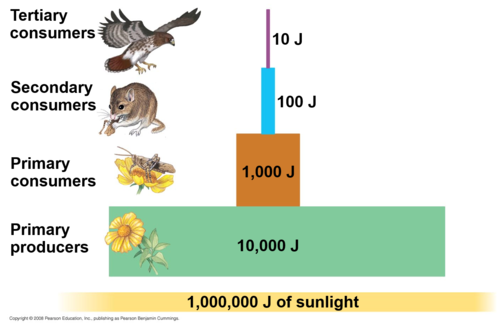
Trophic Pyramids
Is the basic structure of interaction in all biological communities characterized by the manner in which food energy is passed from one trophic level to the next along the food chain. Loss of efficiency at each level is usually due to respiration and energy being transferred into forms not available for next trophic level (other lost in faeces, bone etc).
Typically only 10% is transferred into biomass at the next tropic level.
Mutualism
Reciprocally positive interactions between pairs of species
Mutualism example
A keystone mutualism among a hummingbird–mistletoe–marsupial in the temperate forests of Patagonia promotes ecological resistance to an invasive pollinator, the buff-tailed bumblebee Bombus terrestris. Invasive bumblebee reduced the strength and interaction niche of the five central pollinator species while increasing its own strength and interaction niche, suggesting a replacement of interactions. It was found that the keystone mutualism promoted resistance to B. terrestris invasion by reducing its negative impacts on central species.
In spring and summer, the hummingbird pollinates nearly 20% of the endemic woody genera in this region. The nectar produced by the mistletoe is the only nectar resource for the hummingbird during winter, and the hummingbird is the almost exclusive pollinator of the mistletoe, which allows it to achieve full reproductive success. In addition, the marsupial disperses seeds of more than 16 fleshy-fruited species, including large fruits not dispersed by the native birds and is the only seed disperser of the mistletoe. By indirectly increasing species diversity, this keystone mutualism may increase community resistance to the impacts of non-native bumblebees by promoting interaction rewiring of native pollinators.
Facilitation
An interaction in which the presence of one species alters the environment in a way that enhances growth, survival or reproduction of a second, neighbouring species. Can be mutualistic, antagonistic or commensal
 Note
Note  Flashcards (53)