Lecture #7: Stuttering Neurological perspectives
 Call Kai
 Learn
Learn Practice Test
 Spaced Repetition
 Match
Match Flashcards
 Knowt Play
1/12

There's no tags or description
Looks like no tags are added yet.
Name | Mastery | Learn | Test | Matching | Spaced | Call with Kai |
|---|
No analytics yet
Send a link to your students to track their progress
13 Terms
Brain Structure of People who stutter (5)
AWS do not show expected asymmetries of having a larger right than left prefrontal lobe and larger right than left occipital lobe. Their right and left prefrontal and occipital lobe were more similar in size. This is important because frontal lobe is important for executive function
AWS have less white matter density (overall)(meaning information is not being carried the same way and speed as PWNS). Less density in structures such as cerebellum which is important for motor coordination and may explain why there are motor differences. PWS have greater white density in the right hemisphere. PWNS show assymetry because they have atypical lateralization in the left hemisphere, but in PWS there is more symmetry due to greater right hemisphere activation. This shows that PWS are compensating using the right hemisphere.
AWS have extra gyri in the superior bank of the Sylvian fissure (region involved in speech and language processing, is where broca’s and wernickes is). NOTE: More is not always good, can get in the way
In PWNS, they have larger left planum temporale (PT)→ indicator of left hemisphere specialization for language and apart of wernicke’s area. AWS have a larger Right PT, meaning right and left PT EQUAL IN SIZE. expected assymetry isn’t there.
Corpus callosum differences… More on next card
Corpus Callosum
→ AWS have a larger Corpus callosum (facilitates communication between hemispheres) than PWNS.
More isn’t always good
→ AWS had more white matter in the rostrum of the corpus callosum.
Rostrum of the CC connects prefrontal and motor areas. The largest region of CC was the rostrum
In other words PWS, have a larger Rostrum which faciliates the right and left hemispheres of their brains communicating about motor, communication, and control planning.
A LARGER Corpus callosum means greater INTERFERENCE between the right and left hemispheres of the brain, especially in the frontal and motor regions of the brain. a larger CC means your right brain is trying to chat with your left brain while you are trying to do a task that is supposed to be lateralized in the left brain.
simply put:
larger CC and specifically larger Rostrum region of CC (connects prefrontal and motor areas) is observed in PWS, and this is not good because it leads to excess communication of right hemisphere to left hemisphere about motor, communication and planning. This leads to INTERFERENCE because your right hemisphere is constantly trying to chat with your left hemisphere why you are trying to do a task that is supposed to be lateralized in the left hemisphere. so:
larger cc + Rostrum→ excess right hemisphere communication to left→ interference for left lateralized tasks..
→ CWS had a slightly smaller CC size and white matter density in CWS compared to other groups (TD, spontaneous recovery kids).
This tells us the experience of stuttering changes the structure of the brain by making the CC larger, and CC being larger creates interference
As SLPS, tells us that we should be treating them b4 these changes happen in the brain because brains are less plastic when you are older so it will be difficult to change it bacl.
Summary: Brain structure of people who sutter
If you stutter, display atypical structured in your brain:
Atypical brain anatomy gyrification, lobes, gray matter, white matter, and Planum temporale, and CC
some appear when you start stuttering, some changes happen bc of length of time you stuttered (aka CC)
Deficits in left hemisphere (due to less white matter there) leads to right hemipshere compensation (bc of higher white matter in right hemisphere of brain)
Brain Function (7)
Activity during speech-language Processing
Activity during moments of stuttering and fluent speech
Activity before and after treatment
Activity during imagined stuttering
Sex Differences in Activity
Compensatory brain activity
Auditory Processing
Activity during speech-language processing
When asked to look at face of a stranger who asked a question, AWS had Lower activity in the Left IFG (broca’s area region: speech production) and Anterior medial prefrontal Cortex (amPFC) hemisphere (important for speech-language processing) compated to fluent adults.
tells us that just looking at the face of a stranger changes the way the brain functions in the regions involved in speech.
During this task, AWS with more SEVERE stuttering showed higher activation in the amygdala and hippocampus (they control emotional processing)
in other words, AWS are showing lower activity in speech productions of the brain but higher activity in emotion centers of the brain, just by looking at the face of a stranger without talking.
When AWS presented with high and low imagery sentences (no speaking involved), AWS had greater alpha power (aka less activity) in the posterior left hemisphere
PWNS shower greater alpha power (aka less activity) int the posterior right hemisphere
Overall, showed that AWS displayed less activity in the LEFT HEMISPHERE during language processing, even with no overt speech, just silently reading sentences.
Activity during moments of stuttering and fluent speech
study looked at activity in both solo and choral (reading in sync with someone else) reading.
During moments of stuttering (during solo reading), the right hemisphere motor cortex controlling the lips and the supplementary motor areas (SMA-motor planning) were OVERACTIVATED in AWS. → maybe this is why PWS have a lot of tension from this motor overactivation
HOWEVER, the motor regions were not ovreactivated during Choral speech (aka led to fluent speech). tells us that when reading with someone else, motor regions are not activated and PWS gain fluency. also tells us that overactivation of motor areas ONLY occur during moments of stuttering.
Additionally, regions involved in auditory processing (temporal regions of brai ,specifically MTG and STG) were DEACTIVATED during moments of stuttering. MTG and STG, involved in processing speech; wernickes is here). this is atypical, PWNS activate these regions when speaking.
FLUENT SPEECH is correlated with activation of the superior temporal gyrus (STG)
the middle temporal gyrus and STG were deactivated during moments of stuttering
In summary, In summary, stuttering is associated with atypical activity in the motor regions (overactivation) and temporal regions (deactivation) of the brain. Imagine how hard it would be to change this if you were stuttering for so much of your life. can use strategies, but a lot of effort to change this.
Activity during before and after treatment
Before treatment: AWS activated the bilteral inferior frontal gyrus (IFG) and right precentral gyrus (motor cortex), which are areas involved in speech motor control. activated more motor areas, even during silent reading when motor execution not needed.
During oral reading task: AWS showed higher levels and more regions of activation of motor regions overall, primarily in the right hemisphere
AWS also showed higher activation in the temporal and parietal regions, right opercolum, anterior cingulate gyris, and insula: Overall, AWS just showed more activation in the right hemisphere**
not sure if you have to know that long list of brain regions, but basically PWS will activate some regions of the brain more than PWNS and that activation is typically in the right hemisphere.
IMMEDIATELY AFTER treatment: right hemisphere activation was basically gone (decreased) and AWS activated the left hemisphere IFG and precentral gyrus'; so now seeing assymetrical activation aka left lateralization of speech motor areas present in fluent people. shows how therapy can be effective and normalize activity/make changes in the brain.
ONE year AFTER treatment: some relapse/right hemisphere activation coming back, but most activation was left lateralized except for the right MTG (middle temporal gyrus) and bilateral Middle frontal gyrus (MTG, attention and memory).
majority of PWS relapse after 2-3 years after treatment and start stuttering again; tells us brain likes to go back to baseline aka these patterns of overactivation of the right hemisphere, especailly if have been stuttering for a long time (decades)
During Oral reading task, regions for motor control were activated bilaterally and similar to controls, the left motor regions showed greater activation one year post treatment. ALSO, AWS showed OVERACTIVATION in both right and left hemispheres (but this time also in left so improvement there)
Basically, before treatment, AWS activated more regions in the right hemisphere. After treatment, right hemisphere activation decreases and left hemisphere activation increases. Two years after therapy, again AWS showed greater activation in right hemisphere similar to before therapy. some lasting effects in left still there tho.
Imagined Stuttering
During solo and choral reading, AWS were asked to imagine they were stuttering.
Imagined stuttering produced activation similar to actual moments of stuttering.
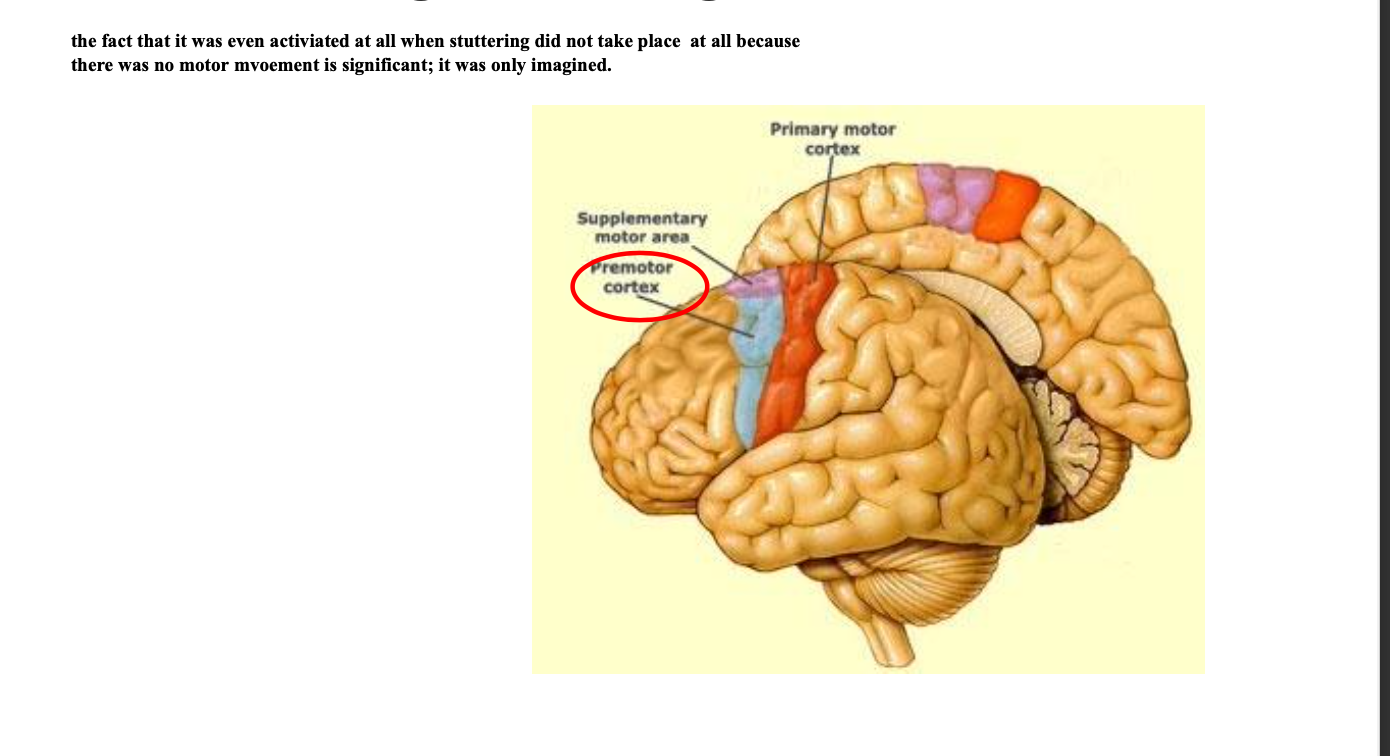
During overt stuttering the superior lateral premotor cortex (SLPrM) was strongly activated but it was only weakly activated when stuttering was imagined. the fact that it was even activated at all when stuttering did not take place/there was no motor movement is significant.
in general, most areas of the brain activated during overt stutterig were also activated during imagined stuttering
food for thought: what if you asked your client to imagine if they were fluent?if client only looked at their fluent speech (aka one study editing videos of them and only keeping fluent part) the results showed that the client became more fluent, so maybe it is about visualizing fluency, it may help client, who knows needs more research but worth a try as a clinician
Sex differences in activity
During moments of stuttering, females showed bilateral activation while males showed more right hemisphere activation
bilateral activation allows you to compensate more for deficits in either hemisphere of the brain; PWS already primarity activate right hemisphere but males are even more right dominant during speech and language processing when left hemipshere should be dominant. We know that generally, males are less likely to recover than females. girls having bilateral activation of the brain gives them opportunties for compensation for left hemisphere deficits that males don’t have
In both sexes, the Anterior Insula was correlated with moments of stuttering (involved in speech planning and production)
During FLUENT speech (choral reading) females AWS also showed more bilateral activation compared to male AWS who showed right hemisphere lateralization.
Fluent speech was correlated with Activation of the inferior frontal gyrus (IFG), MTG, and STD areas for auditory processing and speech planning production. this tells is that having more bilateral activation good for brain bc easier to compensate.
Compensatory Brain activities
Only PWS activate the right frontal opercolum (RFO)→ right hemisphere homologue of broca’s area.
***the RFO is the compensatory mechanism for fluent speech ONLY found in people
who stutter, people who don’t stutter don’t need this compensatory activation because they are fluent;
so within PWS, those who show less or no activation in RFO have more severe stuttering
because have less compensatory mechanisms.
damage to RFO has also been linked to articulatory disorders. remember, it is a homologue of broca’s after all.
Auditory Processing
Studies brain activity under delayed auditory feedback (DAF and Non-altered Feedback (NAF)
in general, you become less fluent if in noisey environment, but that is for FLUENT people, those who STUTTER are actually more fluent;
for people who stutter, that delayed auditory feedback (delay in hearing yourself) makes you a lot more fluent. This is another way to help you distinguish
between PWS and PWNS.
If you don’t stutter and hear a delay, you have more activation in the right temporal region of the brain aka stg and Mtg
Brain Function: Summary
Fluent speech: associated with activation of the regions involved in auditory processing (STG and MTG).
During moments of stuttering: AWS were observed to overactivate regions of the motor cortex (associated with speech production) in the right hemisphere and deactivate auditory regions.
Increased motor activity even when speech is not required and during moments of stuttering
Increased right hemisphere compensatory activation (related to the motor system and compensation-RFO)
Shift to “normalized” pattern after therapy
Overall, people who stutter show right
hemisphere dominance for speech-
language processing.
• Sex differences: Female AWS show more
bilateral activation than male AWS during
speech and language processing.
Other conditions that decrease/amerliorate stuttering
These things help you distinguish between PWS and PWNS. Recall that choral reading also helped pinpoint PWS.
Masking noise:
aka like white noise, helps decrease stuttering in PWS. in video, showed an immediate effect when sound was turned on and off in headphones.
can also use this to see if someone stutters, if they become a lot more fluent when they hear
this noise, then they are probably a PWS
temporal lobe is activated because you are listening to something else, so
while people who don’t stutter become less fluent, PWS become more fluent
Paced Speech:
pacing speech one syllable at a time to a metronome; this is another way to induce fluency in clients; may not be treatment but both masking noice and paced speech
can help client see that they can be fluent.

