15- Nutrient Cycles
 Studied by 2 people
 Call Kai
 Learn
Learn Practice Test
 Spaced Repetition
 Match
Match Flashcards
 Knowt Play
1/41

There's no tags or description
Looks like no tags are added yet.
Name | Mastery | Learn | Test | Matching | Spaced | Call with Kai |
|---|
No analytics yet
Send a link to your students to track their progress
42 Terms
What are some facts about nutrient cycles?
Elements in organisms are constantly being recycled between biotic and abiotic pahes
Nutrients cycles between biotic and abiotic components of ecosystems within which they exist as organic and inorganic compounds
What are organic compounds?
tend to be found inside organisms (living or dead) and are large, complex molecules that all contain the element carbon
What are inorganic compound?
consist of simple, small molecules and tend to be found in the abiotic phase
What are the features of nutrient cycles?
Nutrients in a simple, inorganic form are taken up by producers
Producers use nutrients to synthesise more complex organic molecules
Then passed along food chains as producers and animals are eaten by consumers
When these die, decomposed by saprobionts and nutrients are returned to original inorganic form to complete the cycle
Which biological molecules contain nitrogen?
nucleic acids DNA and RNA
proteins and their monomers (amino acids)
ATP/ ADP
Tell me about nitrogen
Makes up 80% of earth’s atmosphere
Scarce resource for living organisms
Nitrogen gas is inert/ unreactive, so not available to most living organisms when in gaseous state
Why will lack of nitrogen lead to stunted growth?
Organisms is unable to make proteins which are needed for growth
What is the order of the nitrogen cycle?
Nitrogen fixation
Nitrification
Decomposition and Ammonification
Denitrification
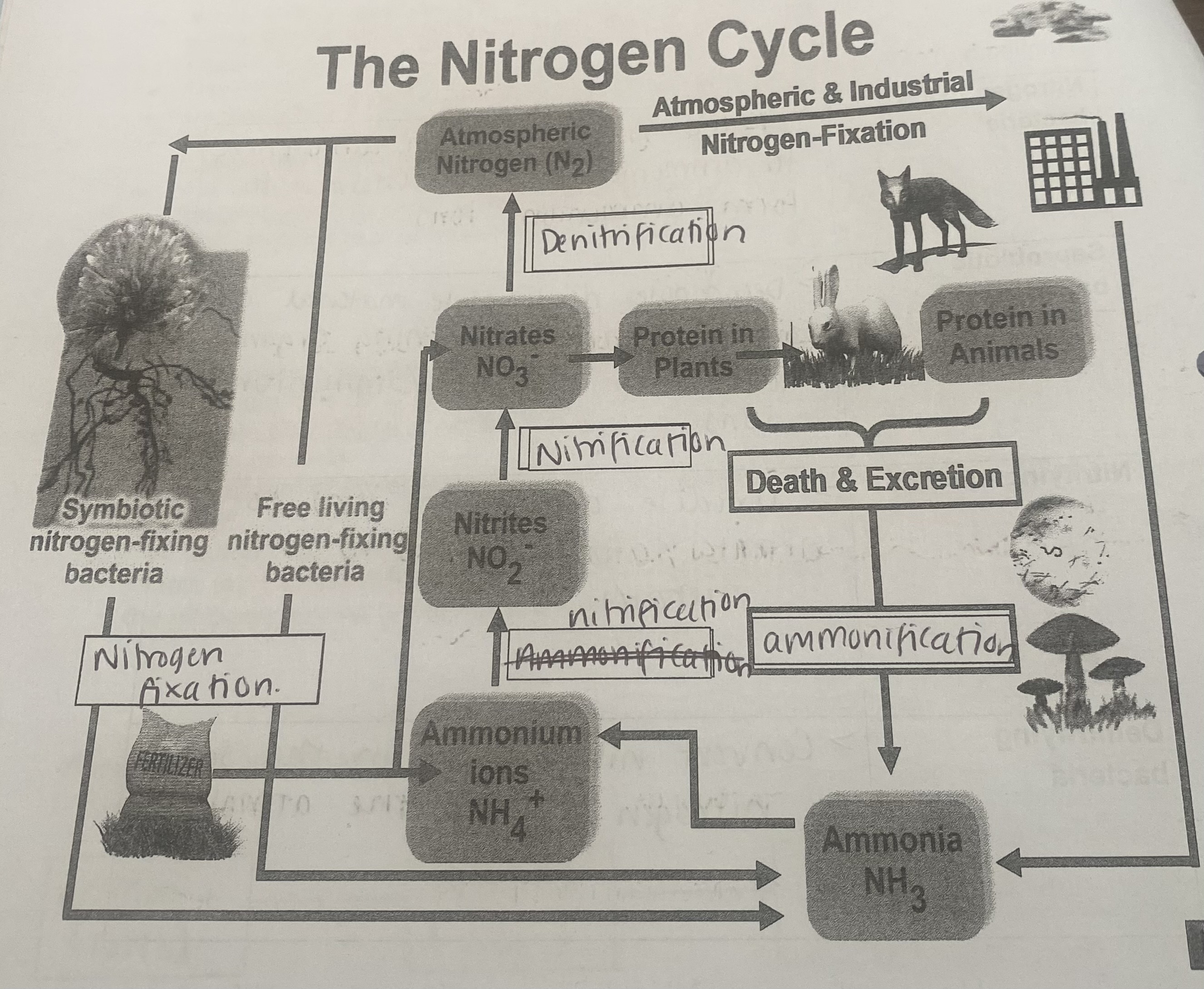
Describe nitrogen fixation
carried out by nitrogen fixing bacteria
convert nitrogen gas into ammonia/ ammonium ions
some bacteria live in swelling on roots (nodules) of plants called legumes
bacterium receives water and sugars from plant and in return supplies plant with ammonia
ammonia can be used to make proteins and other nitrogen containing compounds
some ammonia ends up in soil
free living nitrogen fixing bacteria in soil- ammonia they produce dissolves in water in soil to form ammonium ions
plants take up nitrogen from soil to form nitrates by active transport- this is how most nitrogen returns to biotic phase
Describe nitrogen flow through food webs
inorganic nitrogen taken up by plants is largely in the form of nitrates
used to synthesise molecules like proteins or DNA
moves into other organisms when eat plants, and digest and absorb the organic compounds
What type of organisms will consume nitrogen in living plant material?
herbivores
primary consumers
omnivores
What type of organisms will consume nitrogen in dead plant and animal material?
saprobionts
decomposers
What type of organisms will consume nitrogen in living animals?
carnivores
secondary consumers
tertiary consumers
omnivores
Describe Nitrification
carried out by nitrifying bacteria which convert ammonium ions into nitrates
2 stages each carried out by different nitrifying bacteria
oxidation of ammonium ions to nitrite ions by nitrifying bacteria
oxidation of nitrites to nitrates by nitrifying bacteria
plants take up nitrates through roots by active transport, returning nitrogen to biotic phase
Describe Decomposition and ammonification (saprobiotic nutrition)
when organisms die, excrete urea or egest faeces, saprobiotic microogranisms convert organic nitrogen in these organic compounds into ammonium ions
returns nitrogen to abiotic phase
saprobionts secrete enzymes in detritus so nitrogen-containing compounds are digested externally
this is extracellular digestion
products of digestion are absorbed by saprobionts but some ions/ molecules are released into the environment
Describe Denitrification
loss of nitrates from soil under anaerobic conditions
nitrates converted to nitrogen gas
aerating soil will reduce this process
What does nitrogen fixing bacteria do?
reduce nitrogen gas in atmosphere to ammonia which dissolves to form ammonium ions
What does saprobiotic bacteria do?
decompose dead/ waste material and convert nitrogen-containing organic matter into ammonia/ ammonium ions
What does nitrifying bacteria do?
oxidise ammonium ions to nitrites, and nitrites to nitrates
What does denitrifying bacteria do?
convert nitrate ions in soil to nitrogen gas in the atmosphere
Explain the nitrogen cycle (paragraph)
Nitrogen in atmosphere can be converted into ammonium ions in soil by nitrogen fixing bacteria.
These bacteria can either be free living in soil or live in root nodules of plants called legumes.
Ammonium is converted firstly to nitrite and then nitrate by other soil bacteria called nitrifying bacteria.
This process uses oxygen so is oxidation.
The nitrate can be taken up by plant roots by active transport which goes against a conc gradient so uses energy in the form of ATP.
Respiration is used to release this energy/ make ATP.
The plants use nitrates to build nitrogen containing compounds like DNA, proteins, amino acids, RNA etc, so increasing their yield.
These nitrogen-containing organic compounds are passed to animals when plants are eaten by herbivores/ omnivores/ consumers.
When plants and animals die, bacteria called saprobionts break down nitrogen containing organic compounds.
These are hydrolysis reactions, using extracellular enzymes and the small molecules produced are absorbed.
The waste product of this process is ammonia/ ammonium which can be converted into nitrate by nitrification and taken up by plants.
What are the features of nitrogen fixing bacteria?
converts nitrogen gas to ammonia
can be found in soil
can be found in root nodules
What are the features of nitrifying bacteria?
converts ammonia to nitrates
can be found in soil
What are the features of denitrifying bacteria?
converts nitrates to nitrogen gas
works in anaerobic conditions
can be found in soil
What are the features of saprobiotic bacteria?
breaks down proteins in dead material
can be found in soil
Give 2 sources of Ammonia in the soil (2 marks)
from nitrogen-fixing bacteria converting nitrogen gas to ammonia
breakdown of proteins in dead material by saprobiotic bacteria leads to the release of ammonia
What biological molecules is phosphorus found in?
phospholipids
nucleic acids (DNA/ RNA)
ATP/ ADP
NADPH
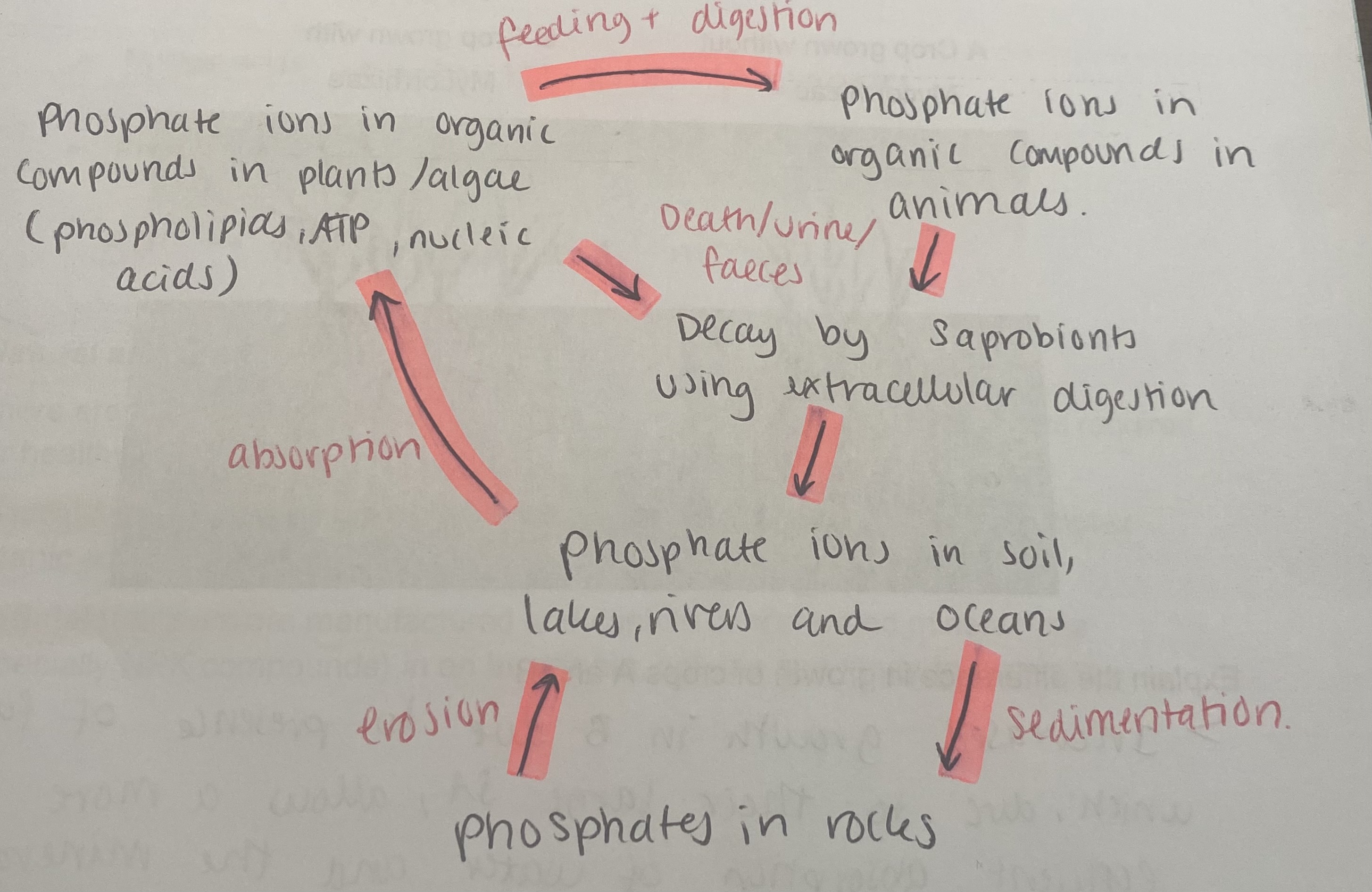
Describe the phosphorus cycle
Saprobionts decompose dead animals/ plants/ algae/ waste materials using extracellular digestion.
Saprobionts absorb products of digestion and release phosphate ions into soils, lakes etc. where they dissolve (stored mainly in sedimentary rock).
Some phosphate ions are absorbed by plants and are used to form organic biological molecules used in growth (phospholipids, ATP, nucleic acids etc).
Phosphate ions passed to animals that feed on plants. Phosphate-containing organic compounds are digested then absorbed and assimilated.
Some dissolved phosphates in oceans can form rocks by sedimentation.
Phosphate in sedimentary rocks only return to cycle if geological upheavel and erosion occurs
What is mycorrhizae?
Fungi that grow in association with plant roots and improve plant’s uptake of water and inorganic ions
example of a mutualistic relationship between 2 species in which they both benefit nutritionally
Explain how mycorrhizae works?
Fungus colonises host plant’s roots.
Grow in and around roots, producing large system of threads or hyphae.
Provides fungus with carbohydrates from plant (e.g. glucose and sucrose).
In return plant gains benefits of fungal hyphae’s greater ability to absorb water and minerals due to large SA of thread like hyphae.
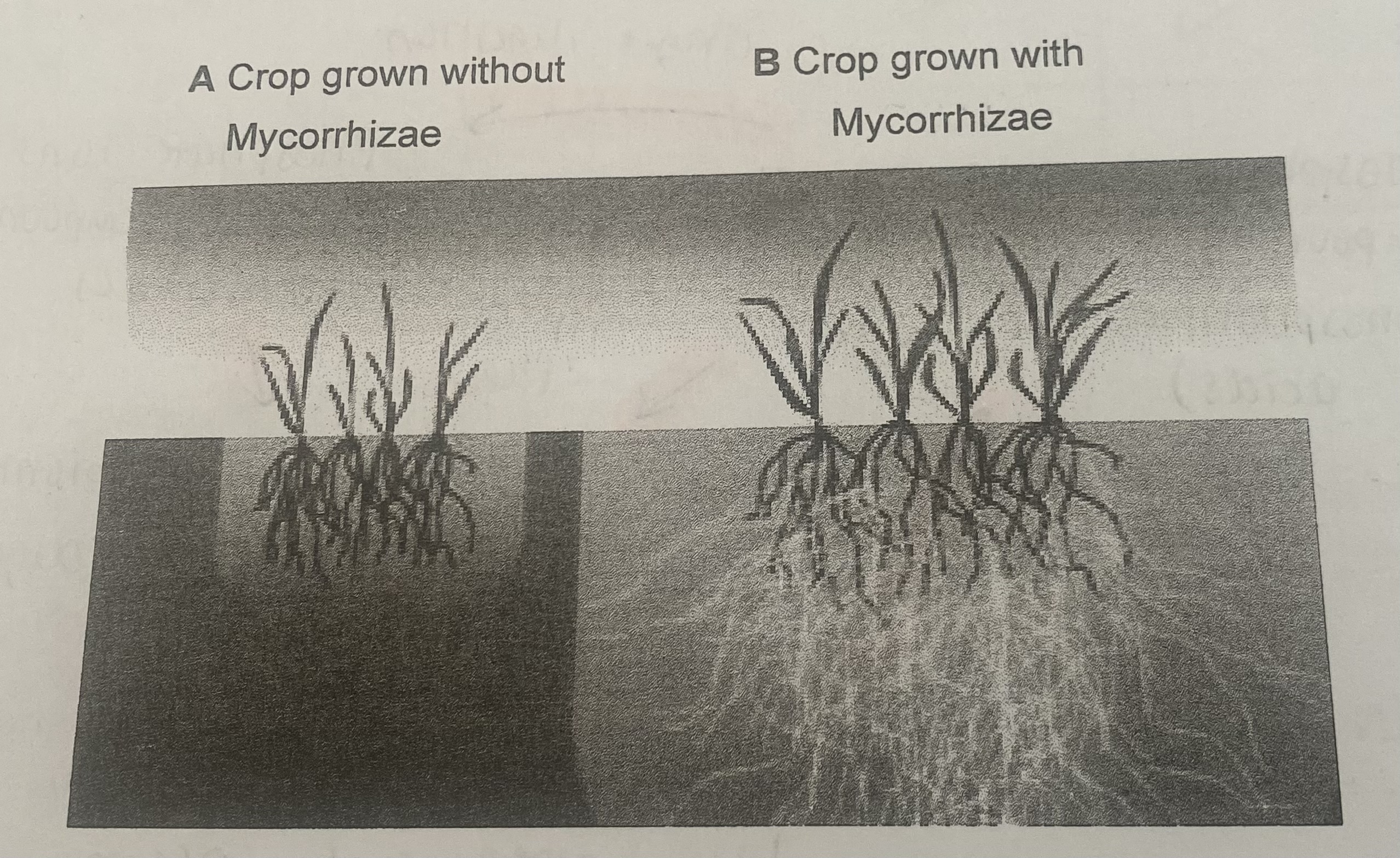
Explain the difference in growth of crops A and B (2 marks)
Increased growth in B due to presence of fungus which, due to their large SA, allow more efficient absorption of water and the minerals that are essential for growth (and are often limiting factors in plant growth)
Why do we need fertilisers?
Nitrates and phosphates are 2 very important mineral ions (often limiting factors in plant growth)
Intensive food production results in nitrates and phosphates continually being lost from soil
Feeding livestock depletes nitrates and phosphates
Plants not left to decompose so minerals not recycled- necessary farmers use fertilisers to replace lost mineral ions and maintain crop productivity
What ions are needed to produce proteins?
nitrates
What ions are needed to produce nucleic acids?
nitrates
phosphates
What ions are needed to produce phospholipids?
phosphates
What ions are needed to produce ATP?
phosphates
nitrates
What are natural fertilisers?
consist of organic plant or animal matter, containing complex organic compounds e.g. urea which releases mineral ions as it decays
What are artificial fertilisers?
manufactured and contain concentrated mineral ions in an inorganic, soluble and ready to use form
What widespread environmental impacts can using fertilisers have?
reduced species diversity
leaching
eutrophication
Describe leaching
excess ions can be washed out of soil by rain
leached ions then find way into streams
causes eutrophication
Describe eutrophication
in most lakes/ rivers, there is naturally very little nitrate= nitrate is a limiting factor for plant growth
once nitrate leaches into water course, ceases to be a limiting factor and plants/ algae grow exponentially resulting in:
an algal bloom occurs (rapid algal growth)
dense layer of algae forms on surface, absorbing light and preventing it penetrating lower depths so plants below cannot photosynthesise and die
increased competition between algae results in algal death
when algae die, decomposed by bacteria and other saprobiotic organisms, whose population suddenly increase
increase in aerobic respiration by bacteria uses up oxygen
dissolved oxygen in water become depleted, causing many invertebrates and fish to die
Explain how pollution of a river with sewage can also cause eutrophication (3 marks)
The organic material in sewage is fed upon by bacteria, which will respire aerobically, using up the oxygen in the river. If detergents are present, these contain phosphates which will encourage algal growth.
 Note
Note  Flashcards (78)