Exam 1
 Studied by 0 people
 Call with Kai
 Learn
Learn Practice Test
 Spaced Repetition
 Match
Match Flashcards
 Knowt Play
1/297

There's no tags or description
Looks like no tags are added yet.
Name | Mastery | Learn | Test | Matching | Spaced | Call with Kai |
|---|
No analytics yet
Send a link to your students to track their progress
298 Terms
Define microbe
a living creature (typically microscopic) that metabolize food, grows, and reproduces
What are exceptions to the definition of a microbe?
large bacteria and fungi (can be seen w/o microscope)
virus (noncellular/nonliving)
Define En. microbio
the study of microbial fate and activity in air, water, and soil AND the resulting impact on human health and welfare
What are Madsen’s core concepts for EM?
Must understand evolution, thermodynamics, habitat diversity, ecology, and physiology
Microb'e’s prime directive = survival, maintenance, energy generation, and growth
Genomes are a record of past and present habitat diversity
Advancement depends on many different methods converging on an answer
EM is rapidly changing
What are examples of microbes?
bacteria, archaea, fungi, protists
What are microbes able to eat and breathe?
things other than organic carbon (sugar) and oxygen
Why is it important that microbes can eat and breathe things besides sugar and oxygen?
makes them critical to cycling of compounds that are able to be oxidized or reduced in water
leaves a huge mark on the chemistry of the planet
What are examples of what microbes provide for humans?
Beneficial
agriculture, energy, food, pharmaceuticals
Negative
diseases, parasites, food spoilage, molds
How do microbes know what to do?
because of their genes code for them to do certain things: make enzymes, produce energy, and grow
What are the unique traits of microbes?
small size
ubiquitous distribution (found everywhere)
high metabolic activity (move a lot)
physiological responsiveness
genetic malleability
potentially rapid population growth
nutritional and enzymatic diversity
How might microbe counts differ between soil and extreme environments?
Soil has 100s to 1000s of different microbe species
Extreme en. can have as little as a few different species
What are the new 3 domains proposed by Carl Woese?
Bacteria
Archaea
Eukarya
What is Winogradsky column?
a method suggesting microbial communities develop along a gradient of oxygen avaliability
What are Koch’s Postulates?
To determine relationship between microbe and disease
remove organisms from complex communities and isolate key processes
propagate in pure culture
reintroduce isolate into healthy organism
re-isolate key bacteria in pure culture
obtain reproducible results
What is the main difference between prokaryotes and eukaryotes?
prokaryotes lack a cell membrane and nucleus
eukaryotes have a cell membrane and a defined nucleus
what are the main characteristics of eukaryotes?
complex
contain a nucleus and membrane-bound organelles
common components: mito and ER
can be single or multi-celled
wide range of organisms: animals, plants, fungi, protists, and most algae
what are the main characteristics about prokaryotes?
small, simple
cells surrounded by plasma membrane (no nucleus or membrane-bound organelles)
common pomponents: peptidogylcan and cytochrome
DNA is contained in a nucleoid
Two distinct groups: Bacteria and Archaea
Why is the term prokaryotes problematic?
It lumps bacteria and archaea because they both lack a nucleus and other organelles
HOWEVER they are genetically distinct
Why is it beneficial for prokaryotes to have their DNA in nucleoids?
It allows them to replicate very easily which allows them to adapt to new environments quicker
Allows for binary fission for quick replication
The DNA is more hardy outside of the organism
What is cell morphology?
it is a reference for the shape of a cell
Why is the shape of a cell important?
it dictates how that cell with grow, reproduce, obtain nutrients, and move
shape needs to be maintained to function properly
What are the 4 different types of bacteria cell morphology?
Coccus
Bacillus
Curved Rods
Pleomorphic
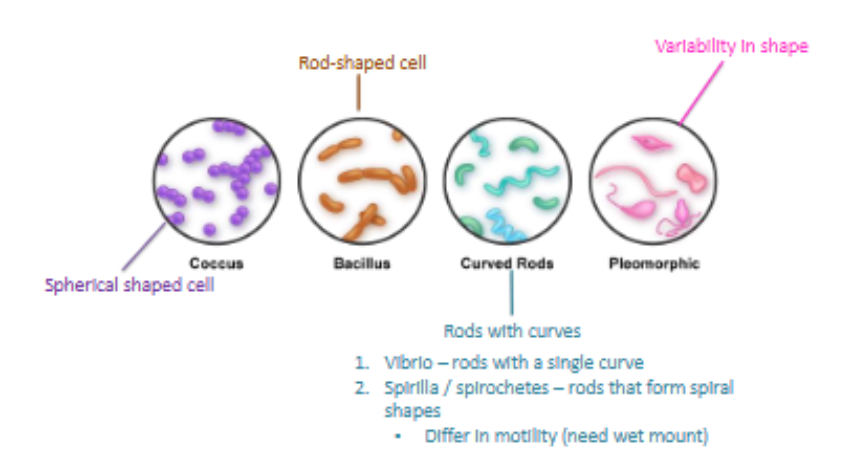
What is coccus?
a bacteria cell morphology that is spherical shaped cells
What is Bacillus?
a bacteria cell morphology that are rod-shaped cells
What are curved rods?
a bacteria cell morphology that rods with curve
two types
vibrio-rods with a single curve
spirilla/spirochetes - rods that form spiral shapes
What is pleomorphic?
a bacteria cell morphology that have a variability in shape
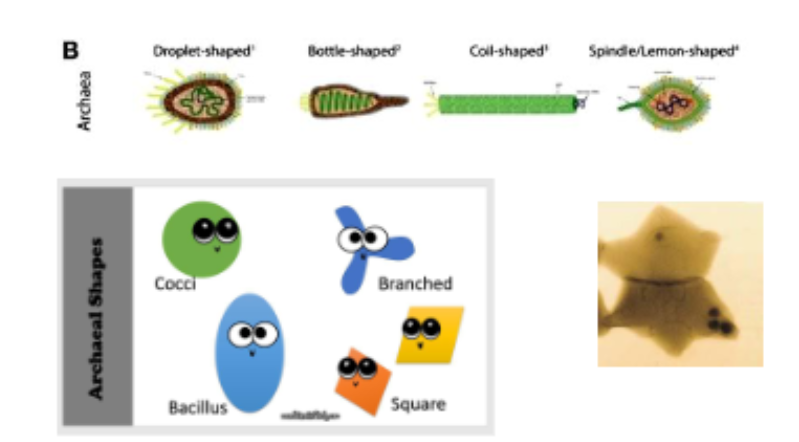
What are the cell morphology for Archaea?
Droplet-shaped
Bottle-shaped
Coil-shaped
Spindle/Lemon-shaped
Square
Branched
Star
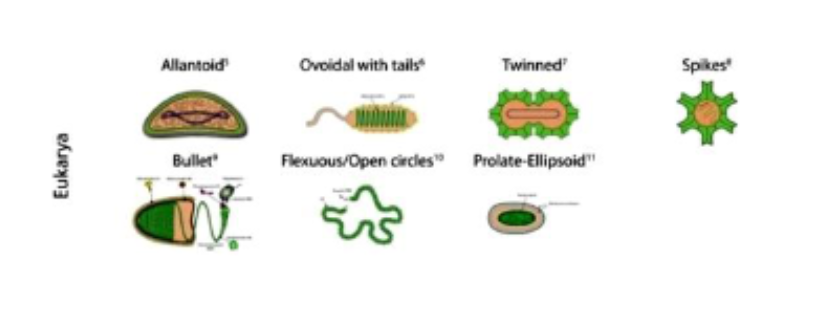
What are eukaryote cell morphology?
allantoid
ovoidal with tails
twinned
spikes
bullet
flexuous/open circle
prolate ellipsoid
What is a cell wall and why is it important?
a wall made of sugars and amino acids which forms an outer mesh around the membrane
also has peptidoglycan and murein
important because it provides protection, a site of attack for antibiotics, receptor sites for drugs/viruses, and strucutre
provides distinction among different types of bacteria
how are the cell walls of bacteria and archaea different?
bacteria have peptidoglycan
archaea use proteins or pseudomurein
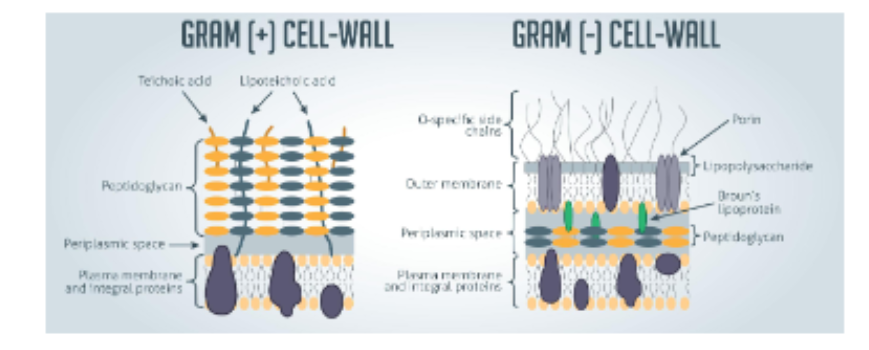
What are the 2 different bacterial cell walls?
Gram positive: surrounded by a single think peptidoglycan cell wall (purPle)
Gram negative: thinner peptidoglycan cell wall with an outer membrane containing lipopolysaccharides (piNk)
What is the gram staining procedure?
crystal violet - turns everything blue
iodine - makes the blue adhere to the cells more
alcohol - washes away blue from gram neg walls
safranin - dyes gram neg walls pinkish
What color with gram neg and gram pos be after staining?
gram neg = pinkish/purple
gram pos = blue/dark purple
What are the key differences between gram pos and gram neg bacteria?
gram neg
more environmental
tend to be aerobic
more diverse
in the ground/water
gram pos
tend to be anaerobic
in the air like dust/skin cell particles
What are characteristics of archaea cell walls?
semi-rigid structures that surround the cell
HOWEVER many don’t have cell walls and they are very diverse
What are characteristics of eukaryote cell walls?
mostly for plants and fungi
made of cellulose (with lots of carbon), hemicellulose, pectin, proteins, biogenic silica, calcium carbonate, agar, carrageenan, and chitin
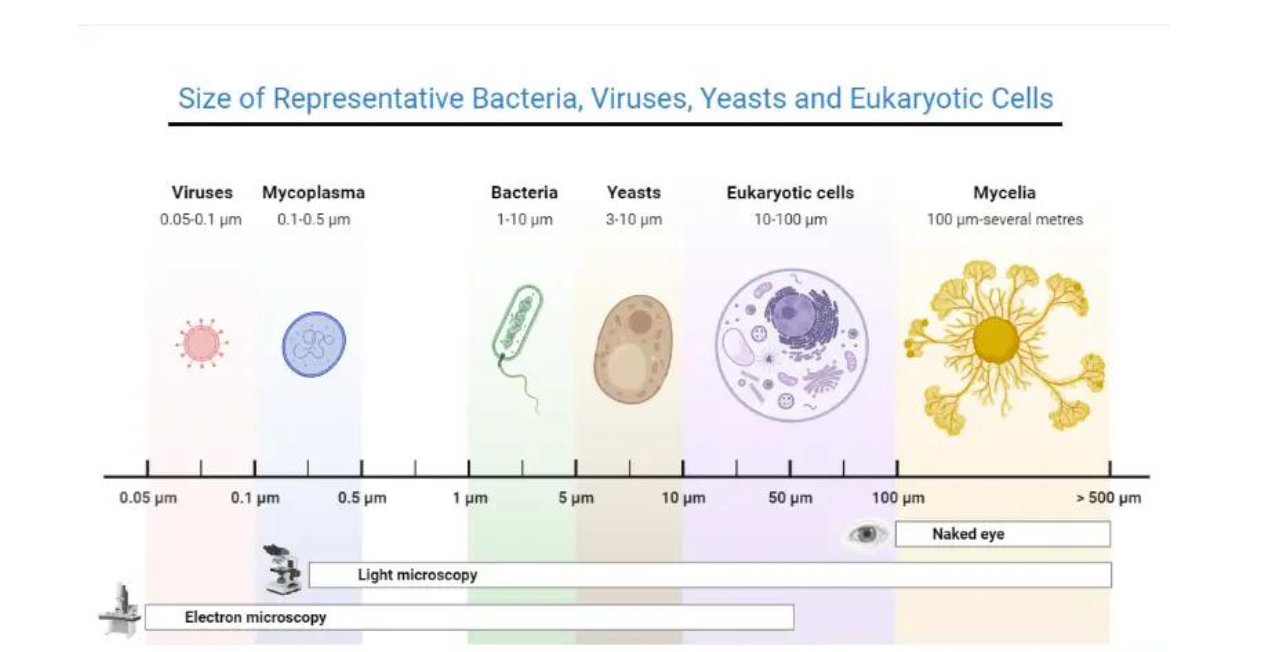
What is the order of size from smallest to largest for general microbes?
viruses, mycoplasma, bacteria, yeasts, eukaryotic cells, mycelia
How are microbes able to grow?
nutrients and key molecules are transported across their membrane so being small is beneficial
Why is being small beneficial for microbial growth?
Smaller cells have a higher surface area-to-volume ratio, which improves nutrient uptake and waste removal.
What does the surface area of a cell represent in terms of function?
It represents the area available for transporting nutrients and waste across the membrane.
What does the volume of a cell represent in terms of function?
It represents the internal space that must be supported with nutrients and energy.
What is the SA:VOL ratio of a cell with a surface area of 12.56 µm² and volume of 4.19 µm³?
2.99 — indicating a high SA:VOL ratio.
What happens to the SA:VOL ratio as a cell gets larger?
The SA:VOL ratio decreases, making nutrient transport less efficient
How does a high SA:VOL ratio benefit a cell?
It allows faster nutrient intake, waste removal, and replication.
What cellular response occurs when nutrients are limited?
Cells shrink to increase their SA:VOL ratio.
What cellular response occurs when nutrients are abundant?
Cells expand, decreasing their SA:VOL ratio.
What challenges do large cells face due to low SA:VOL ratio?
Difficulty in transporting enough nutrients to support growth and reproduction
What is one potential advantage of larger cell size despite lower SA:VOL?
Larger cells may store more resources or perform specialized functions
What four components are found in all cells?
Cytoplasm, DNA, Ribosomes, Cell Membrane
What is cytoplasm?
A gel-like fluid filling the cell and providing an aqueous environment for chemical reactions
What is cytoplasm mostly composed of?
Water, salts, and proteins.
What is DNA?
The genetic material containing instructions for the cell’s traits and functions.
Where is DNA located in bacteria and archaea?
In the nucleoid (not membrane-bound).
Where is DNA located in eukaryotes?
Inside a membrane-bound nucleus.
What is a genome?
The complete set of genes in an organism.
What is the function of ribosomes?
Protein synthesis.
What are ribosomes made of?
RNA and proteins.
Where are ribosomes found in bacteria and archaea?
Floating freely in the cytoplasm
Where are ribosomes found in eukaryotes?
On the endoplasmic reticulum and in the cytoplasm.
What is a sedimentation value (Svedberg unit, S)?
A measure of how fast a particle (such as a ribosome) sediments in a centrifuge, reflecting its size, shape, and density rather than its mass alone
What is the sedimentation value of bacterial/archaeal ribosomes?
70S
What is the sedimentation value of eukaryotic ribosomes?
80S
What is the plasma membrane?
A boundary separating the cell interior from the environment.
What are the three major functions of the plasma membrane?
Permeability barrier, protein anchor, energy conservation.
What does “energy conservation” mean in membrane function?
The membrane helps generate and maintain energy gradients
What cellular processes involve the membrane?
Phospholipid/protein synthesis, nucleoid division, flagella base, waste removal, endospore formation.
What makes eukaryotic cells more complex?
Membrane-bound organelles (mitochondria, ER, Golgi, etc.)
Why do eukaryotes have multiple membranes?
Each organelle has its own membrane for specialized functions.
What percentage of a cell is water?
70–90%
What are the four major monomer groups and their respective macromolecules?
Sugars-Polysaccharides
fatty acids-Lipids
nucleotides-Nucleic acids
amino acids-Proteins
What are informational macromolecules?
Nucleic acids and proteins (their sequence carries information).
What are non-informational macromolecules?
Polysaccharides and lipids (repetitive sequences, no informational role).
What model describes membrane structure?
The fluid-mosaic model: accounts for movement of various components within the membrane itself
What is the membrane primarily composed of?
A phospholipid bilayer.
What are the two regions of a phospholipid?
Hydrophilic polar head (phosphate group)
hydrophobic fatty acid tails.
Connected by glycerol linkage
Why do phospholipids form bilayers?
Hydrophobic tails avoid water; hydrophilic heads face water.
What strengthens eukaryotic membranes?
Steroids (e.g., cholesterol).
What strengthens bacterial membranes?
Hopanoids (sterol-like molecules).
What are integral proteins?
Proteins embedded within the membrane.
What are peripheral proteins?
Proteins attached to the membrane surface via lipid tails.
What percentage of membrane-associated proteins are integral?
About 70–80%.
What is the protein:phospholipid ratio in bacteria?
~2.5:1
What is the protein:phospholipid ratio in eukaryotic plasma membranes?
~1:1
What is the protein:phospholipid ratio in mitochondrial membranes?
~2.5:1 (similar to bacteria)
What does the mitochondrial protein:phospholipid ratio suggest?
Evidence for bacterial ancestry (endosymbiotic theory).
What are the two types of nucleic acids?
DNA (deoxyribonucleic acid) and RNA (ribonucleic acid).
What are nucleic acids made of?
Polymers called polynucleotides, which are chains of nucleotide monomers
What is a nucleotide composed of?
A phosphate group, a nitrogenous base, and a pentose sugar.
What is a nucleoside?
A nitrogenous base attached to a sugar, without a phosphate group
What are three cellular roles of nucleotides besides building nucleic acids?
Energy carriers (ATP/GTP), signaling molecules (cAMP/cGMP), and enzyme cofactors.
What is the sugar in RNA?
Ribose, which has an –OH group on the 2' carbon.
What is the sugar in DNA?
Deoxyribose, which has an –H (no oxygen) on the 2' carbon
What are the two categories of nitrogenous bases?
Purines and pyrimidines.
Which bases are purines?
Adenine (A) and guanine (G).
Which bases are pyrimidines?
Cytosine (C), thymine (T), and uracil (U).
What type of bond holds complementary bases together?
Hydrogen bonds.
What is the nucleotide form of adenosine in RNA?
Adenylate (AMP).
What is the nucleotide form of deoxyadenosine in DNA?
Deoxyadenylate (dAMP)
What does “NMP,” “NDP,” and “NTP” stand for?
Nucleoside monophosphate, diphosphate, and triphosphate. (N could be A, G, U, or C, include d if for DNA)
 Note
Note  Flashcards (76)