ch 19 – modulation of movement by cerebellum (motor control)

0.0(0)
studied byStudied by 0 people
0.0(0)
full-widthCall Kai
learnLearn
examPractice Test
spaced repetitionSpaced Repetition
heart puzzleMatch
flashcardsFlashcards
GameKnowt Play
Card Sorting

1/24

encourage image

There's no tags or description

Looks like no tags are added yet.

Study Analytics
Name
Mastery
Learn
Test
Matching
Spaced

No study sessions yet.

25 Terms

1
New cards

upper

cerebellum modifies the activity of _____ motor neurons

2
New cards

laminated cortex and nucleu

two main gray matter structures:

3
New cards

laminated cortex

  • surface of gray matter

4
New cards

nuclei

  • deep in white matter

  • neurons are the main source of output of the cerebellum

5
New cards

detect and correct the error between intended and actual movements

primary function of cerebellum:

6
New cards

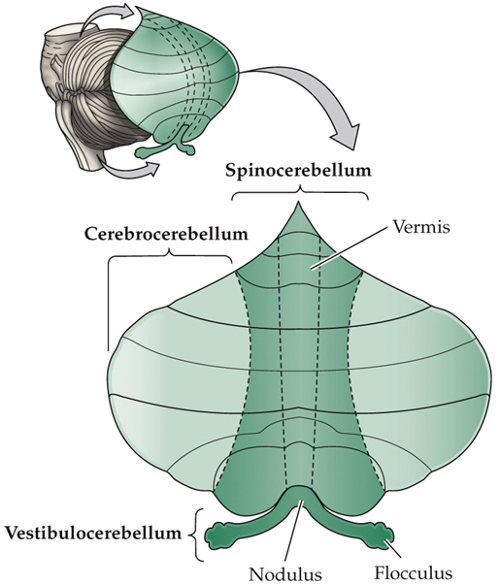
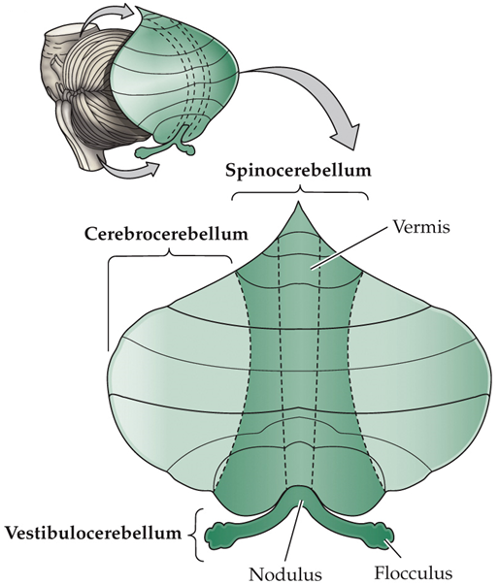
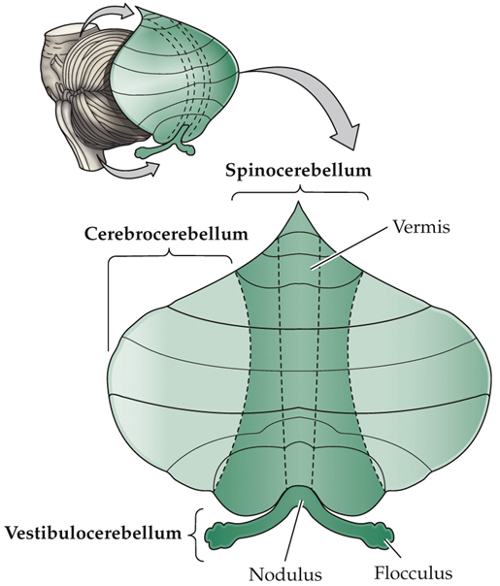
3 parts of the cerebellum

  • cerebrocerebellum

  • spinocerebellum

  • vestibulocerebellum

<ul><li><p>cerebrocerebellum</p></li><li><p>spinocerebellum</p></li><li><p>vestibulocerebellum</p></li></ul><p></p>
7
New cards

cerebrocerebellum

  • lateral hemispheres

  • largest in humans

  • receives input from cerebral cortex

  • controls highly skilled movements + speech
<ul><li><p>lateral hemispheres</p></li><li><p>largest in humans</p></li><li><p>receives input from cerebral cortex</p></li><li><p>controls highly skilled movements + speech</p></li></ul><p></p>
8
New cards

spinocerebellum

  • middle section

  • receives input from the spinal cord

  • vermis (center) → movements of proximal muscles

  • lateral areas → movements of distal muscles

<ul><li><p>middle section</p></li><li><p>receives input from the spinal cord</p></li><li><p>vermis (center) → movements of proximal muscles</p></li><li><p>lateral areas → movements of distal muscles</p></li></ul><p></p>
9
New cards

vestibulocerebellum

  • receives inputs from brainstem

  • vestibulo-ocular reflex (VOR) → involuntary movement of the eyes when the head is moving

  • posture

  • equilibrium

<ul><li><p>receives inputs from brainstem</p></li><li><p>vestibulo-ocular reflex (VOR) → involuntary movement of the eyes when the head is moving</p></li><li><p>posture</p></li><li><p>equilibrium</p></li></ul><p></p>
10
New cards

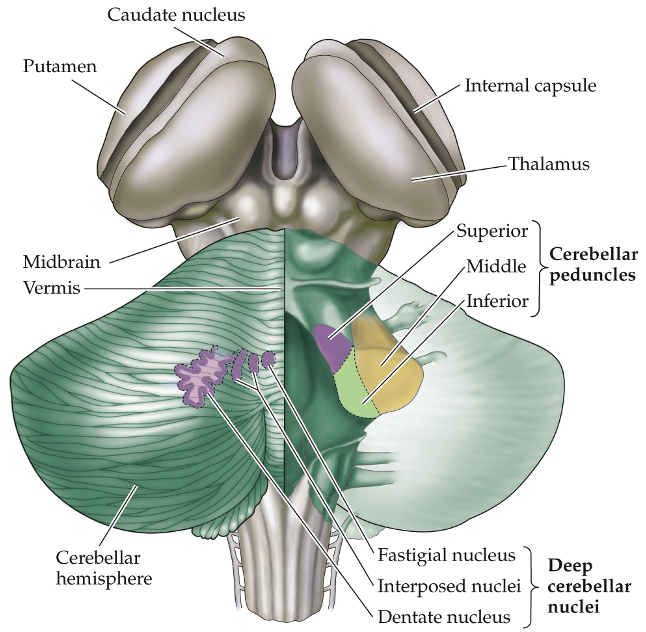
deep cerebellar nucleu

  • send outputs (efferents) to the thalamus, which projects to the motor cortex

    • cerebellum → thalamus → cortex

<ul><li><p>send outputs (efferents) to the thalamus, which projects to the motor cortex</p><ul><li><p>cerebellum → thalamus → cortex</p></li></ul></li></ul><p></p>
11
New cards

input projections TO the cerebellum

  • cerebral cortex axons project → pontine nuclei (brainstem) on the same side → pontine nuclei axons cross the midline → cerebellum

  • receives sensory info about body position and movement
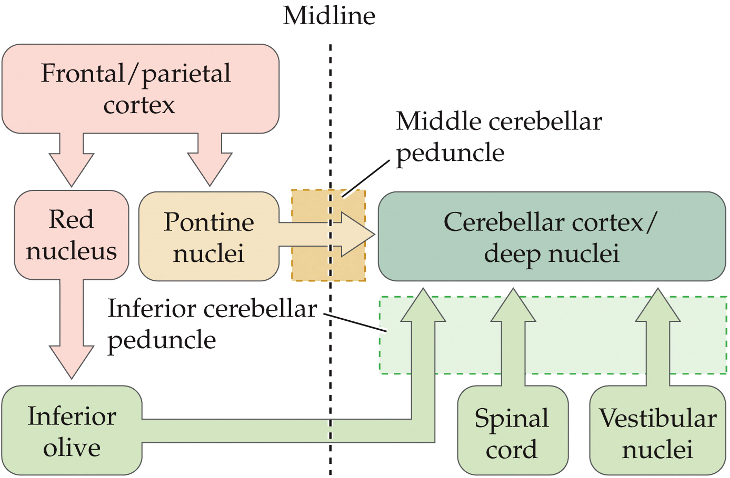
<ul><li><p>cerebral cortex axons project → pontine nuclei (brainstem) on the same side → pontine nuclei axons cross the midline → cerebellum</p></li><li><p>receives sensory info about body position and movement</p></li></ul><p></p>
12
New cards

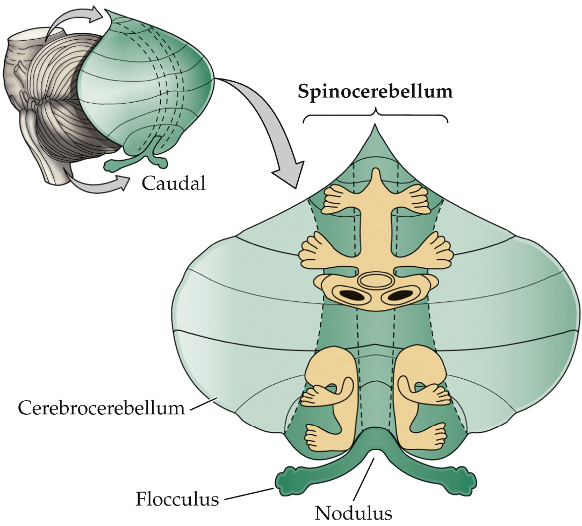
spinocerebellar maps

  • spinocerebellum contains topographic maps for sensory inputs

  • fractured = areas of the body appear several times

  • inputs are ipsilateral

    • brain inputs are contralateral

<ul><li><p>spinocerebellum contains topographic maps for sensory inputs</p></li><li><p>fractured = areas of the body appear several times</p></li><li><p>inputs are ipsilateral </p><ul><li><p>brain inputs are contralateral</p></li></ul></li></ul><p></p>
13
New cards

output projections FROM the cerebellum

  • cerebellar cortex neurons → deep cerebellar nuclei → axons cross to other side of cerebral cortex

  • cerebral cortex neurons control contralateral musculature

  • each cerebellar hemisphere controls ipsilateral musculature

<ul><li><p>cerebellar cortex neurons → deep cerebellar nuclei → axons cross to other side of cerebral cortex</p></li><li><p>cerebral cortex neurons control contralateral musculature</p></li><li><p>each cerebellar hemisphere controls ipsilateral musculature</p></li></ul><p></p>
14
New cards

fastigial nuclei

  • neurons (deep cerebellar) send projections to brainstem

  • control medial tracts in spinal cord that regulate axial and proximal limb muscles
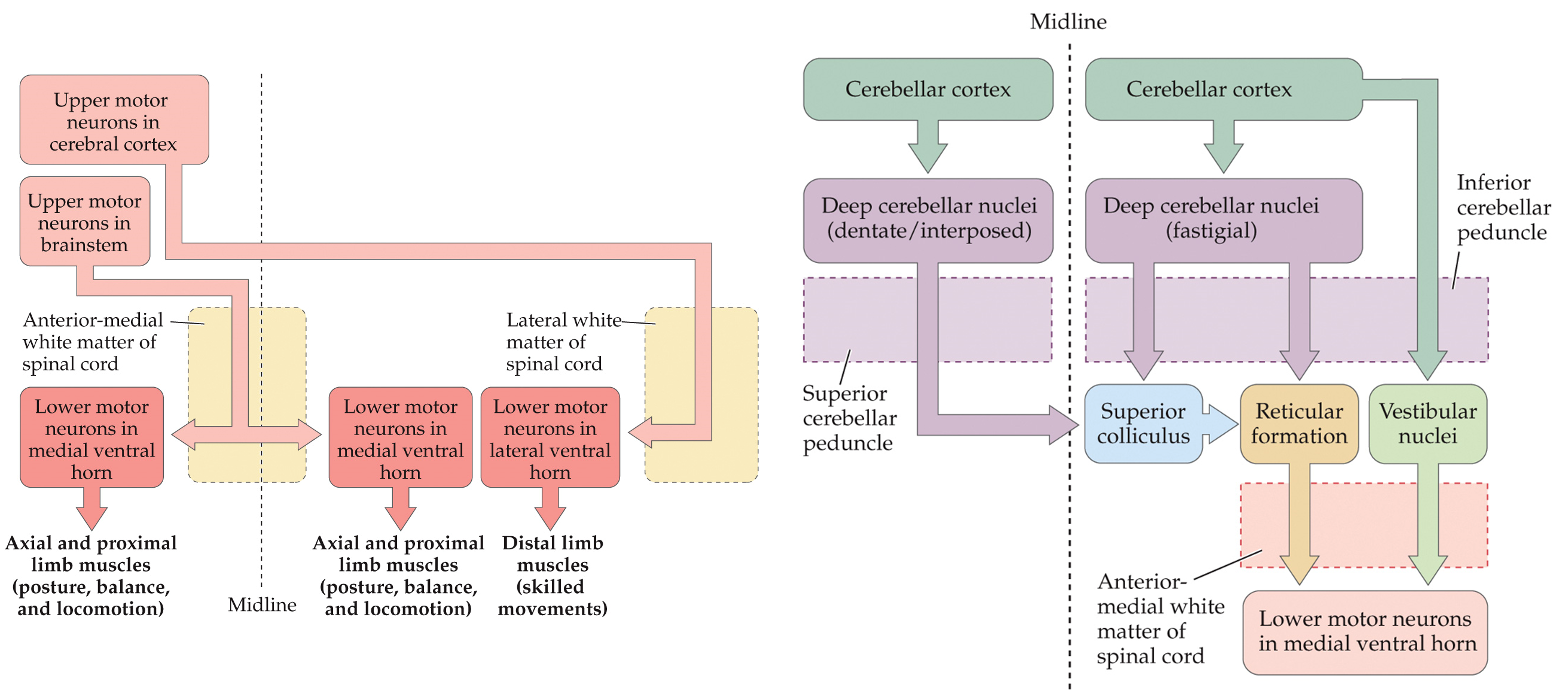
<ul><li><p>neurons (deep cerebellar) send projections to brainstem</p></li><li><p>control medial tracts in spinal cord that regulate axial and proximal limb muscles</p></li></ul><p></p>
15
New cards

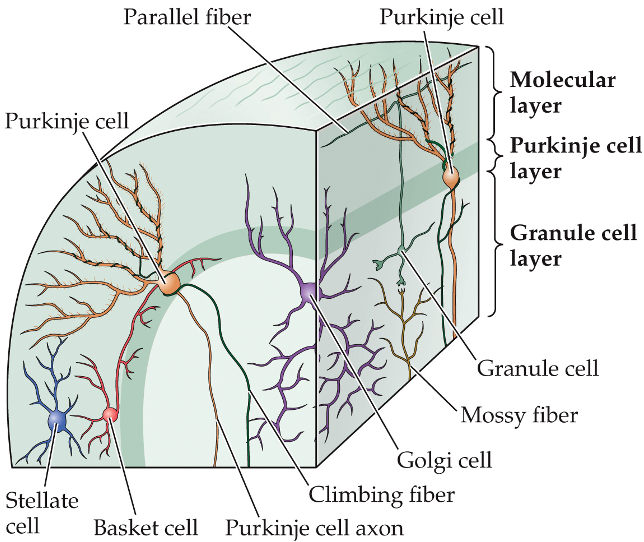
purkinje cells

inputs to the cerebellum target _______ _____

16
New cards

cerebellum circuit

cortex → pontine nuclei (brainstem) → cerebellum (contralateral)

17
New cards

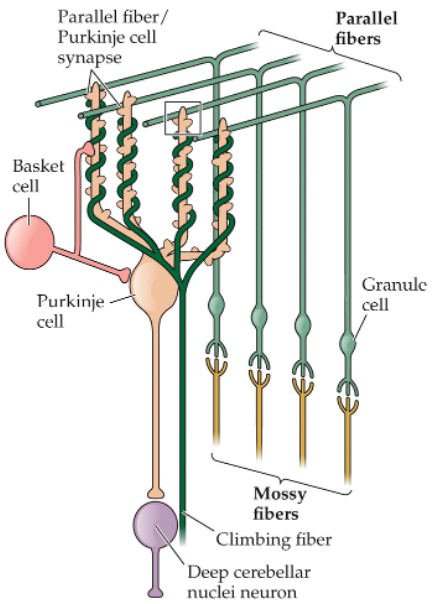
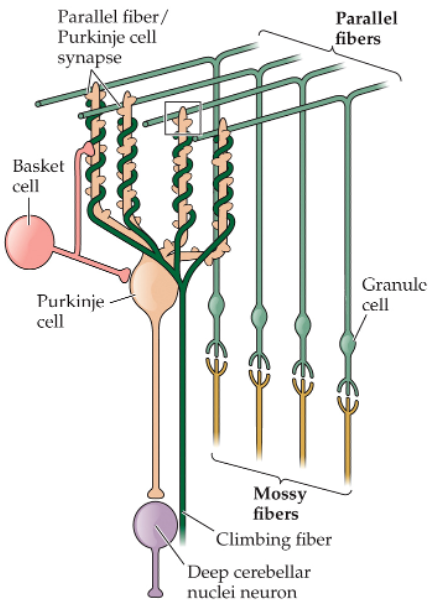
mossy fibers

  • axons of pontine nuclei

  • connect to granule cells

18
New cards

granule cells

  • connected to mossy fibers

  • send parallel fibers to Purkinje cells = T branches

    • via excitatory synapses

  • 50 billion

<ul><li><p>connected to mossy fibers</p></li><li><p>send parallel fibers to Purkinje cells = T branches</p><ul><li><p>via excitatory synapses</p></li></ul></li><li><p>50 billion</p></li></ul><p></p>
19
New cards

parallel fibers

  • at right angles to the plane of purkinje dendrites

  • connects many Purkinje cells

    • each Purkinje cell receives inputs from around 200,000

  • granule cells = wires - connecting to - Purkinje cells = poles

    • minimum contacts between wires

    • maximum number of contacts

    • spreading of information

<ul><li><p>at right angles to the plane of purkinje dendrites</p></li><li><p>connects many Purkinje cells</p><ul><li><p>each Purkinje cell receives inputs from around 200,000</p></li></ul></li><li><p>granule cells = wires - connecting to - Purkinje cells = poles</p><ul><li><p>minimum contacts between wires</p></li><li><p>maximum number of contacts</p></li><li><p>spreading of information</p></li></ul></li></ul><p></p>
20
New cards

climbing fibers

  • connect Purkinje cell dendrites (wrapping around them) to form numerous connections

  • when fired, causes a Purkinje cell to fire

  • funneling of information

<ul><li><p>connect Purkinje cell dendrites (wrapping around them) to form numerous connections</p></li><li><p>when fired, causes a Purkinje cell to fire</p></li><li><p>funneling of information</p></li></ul><p></p>
21
New cards

deep cerebellar nuclei neurons

  • receive excitatory inputs from mossy fibers and climbing fibers

  • Purkinje cells are GABAergic → modulate excitation via inhibition

    • Purkinje cells form a cortical inhibitory loop = can correct errors and modify movements

<ul><li><p>receive excitatory inputs from mossy fibers and climbing fibers</p></li><li><p>Purkinje cells are GABAergic → modulate excitation via inhibition</p><ul><li><p>Purkinje cells form a cortical inhibitory loop = can correct errors and modify movements</p></li></ul></li></ul><p></p>
22
New cards

motor learning model

  • modulated by cerebellum

  • Purkinje cells compare climbing fiber input and parallel fiber input

    • if inputs arrive at the same time: depression of synapse with parallel fiber

      • via LTD = endocytosis of AMPAR

    • next time: similar input will have the Purkinje cells fire less → less inhibition from cerebellar loop → brain motor program controlled by that Purkinje cell will be more activated
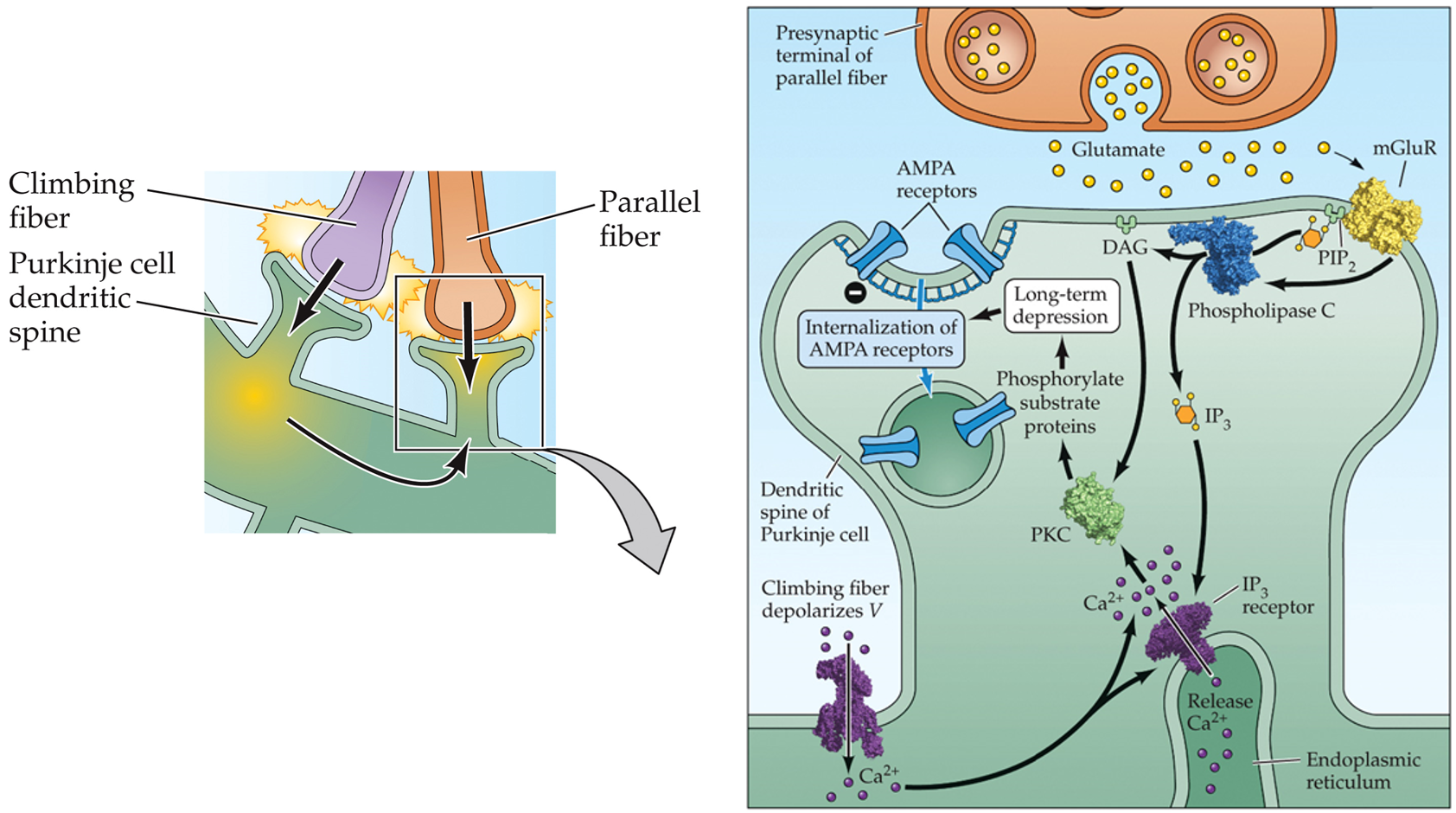
<ul><li><p>modulated by cerebellum</p></li><li><p>Purkinje cells compare climbing fiber input and parallel fiber input</p><ul><li><p>if inputs arrive at the same time: depression of synapse with parallel fiber</p><ul><li><p>via LTD = endocytosis of AMPAR</p></li></ul></li><li><p>next time: similar input will have the Purkinje cells fire less → less inhibition from cerebellar loop → brain motor program controlled by that Purkinje cell will be more activated</p></li></ul></li></ul><p></p>
23
New cards

movement control

  • during movements, pattern of cerebellar activity in Purkinje cells and deep nuclei neurons changes continuously
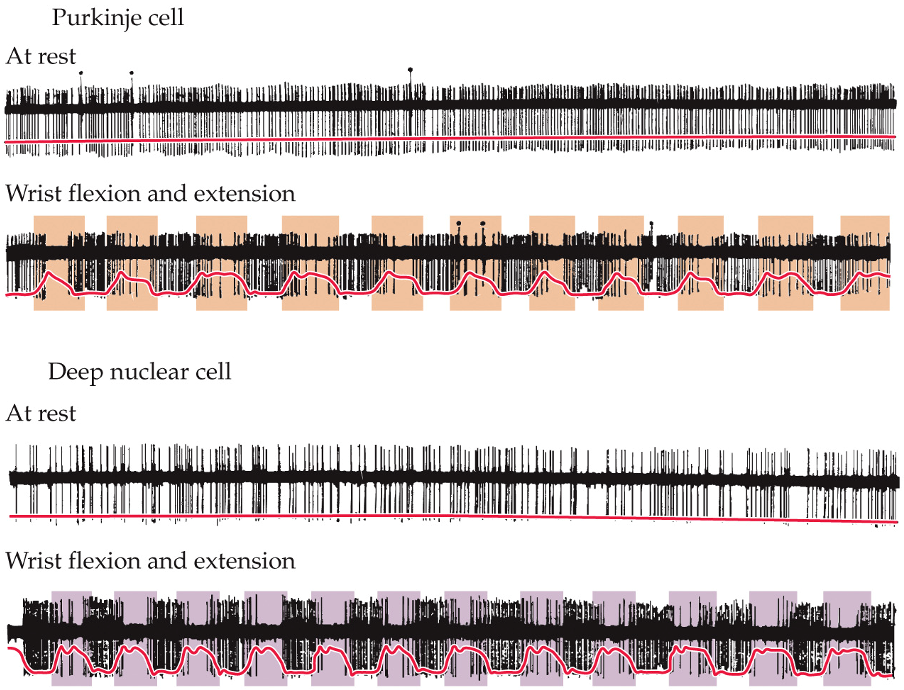
<ul><li><p>during movements, pattern of cerebellar activity in Purkinje cells and deep nuclei neurons changes continuously</p></li></ul><p></p>
24
New cards

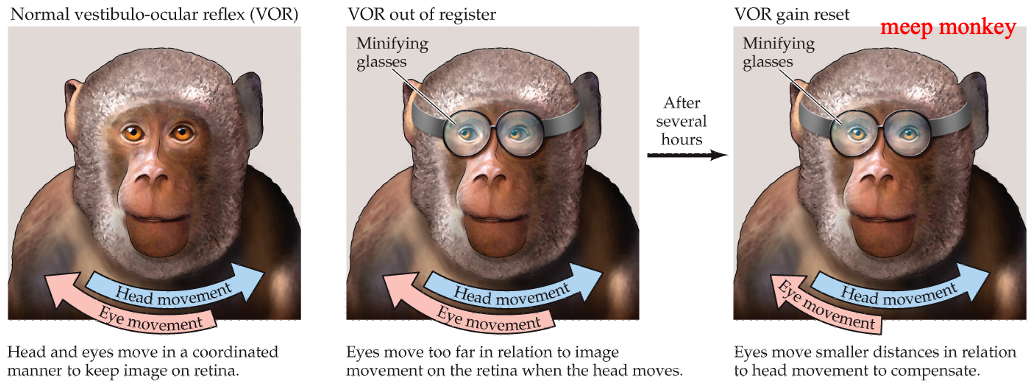
vestibulo-ocular reflex

  • when the head turns, the eyes move in the opposite direction to keep a stable image in the retina

  • if there is damage to the cerebellum, VOR can’t adapt to new conditions → cerebellar ataxia

  • minifying glasses:

    • glasses alter the size of the visual image

    • healthy cerebellum adapts VOR to compensate

    • damaged cerebellum prevents this adaptation
<ul><li><p>when the head turns, the eyes move in the opposite direction to keep a stable image in the retina</p></li><li><p>if there is damage to the cerebellum, VOR can’t adapt to new conditions → cerebellar ataxia</p></li><li><p>minifying glasses:</p><ul><li><p>glasses alter the size of the visual image</p></li><li><p>healthy cerebellum adapts VOR to compensate</p></li><li><p>damaged cerebellum prevents this adaptation</p></li></ul></li></ul><p></p>
25
New cards

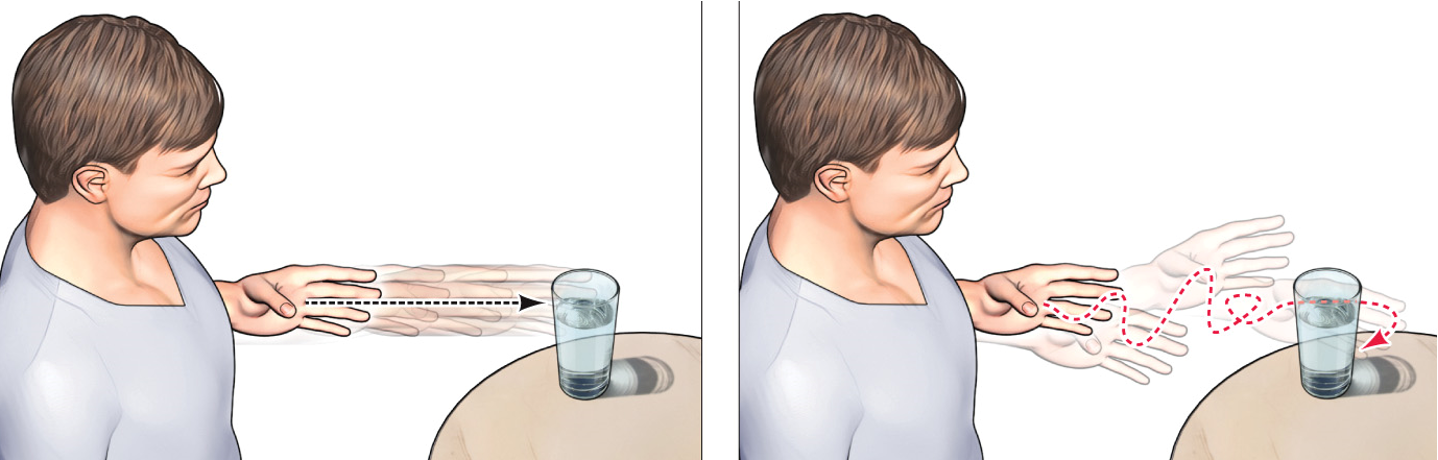
appendicular ataxia

  • irregular movements that typically overshoot or undershoot the visual target

  • require frequency corrective movements
<ul><li><p>irregular movements that typically overshoot or undershoot the visual target</p></li><li><p>require frequency corrective movements</p></li></ul><p></p>