APLang Rhetorical Terms (Ms. Moser)
 Studied by 0 people
 Call with Kai
 Learn
Learn Practice Test
 Spaced Repetition
 Match
Match Flashcards
 Knowt Play
1/40

There's no tags or description
Looks like no tags are added yet.
Name | Mastery | Learn | Test | Matching | Spaced | Call with Kai |
|---|
No study sessions yet.
41 Terms
alliteration
Repetition of the same sound beginning several words or syllables in sequence.
(ex. Let us go forth to lead the land we love ...)
allusion
Brief reference to a person, event, or place (real or fictitious) or to a work of art.
(ex. Let both sides unite to heed in all corners of the earth the command of Isaiah ...)
anaphora
Repetition of a word or phrase at the beginning of successive phrases, clauses, or lines.
(ex. ... not as a call to bear arms, though arms we need — not as a call to battle, though embattled we are ...)
antimetabole
Repetition of words in reverse order.
(ex. Ask not what your country can do for you — ask what you can do for your country.)
antithesis
Opposition, or contrast, of ideas or words in a parallel construction.
(ex. We shall... support any friend, oppose any foe...)
archaic diction
Old-fashioned or outdated choice of words.
(ex. beliefs for which our forebears fought)
asyndeton
Omission of conjunctions between coordinate phrases, clauses, or words.
(ex. We shall pay any price, bear any burden, meet any hardship, support any friend, oppose any foe to assure the survival and the success of liberty.)
cumulative sentence
Sentence that completes the main idea at the beginning of the sentence and then builds and adds on.
(ex. But neither can two great and powerful groups of nations take comfort from our present course — both sides overburdened by the cost of modern weapons, both rightly alarmed by the steady spread of the deadly atom, yet both racing to alter that uncertain balance of terror that stays the hand of mankind's final war.)
hortative sentence
Sentence that exhorts, urges, entreats, implores, or calls to action.
(ex. Let both sides explore what problems unite us instead of belaboring those problems which divide us.)
imperative sentence
Sentence used to command or enjoin.
(ex. My fellow citizens of the world: ask not what America will do for you, but what together we can do for the freedom of man.)
inversion
Inverted order of words in a sentence (variation of the subject-verb-
object order).
(ex. United there is little we cannot do in a host of cooperative ventures. Divided there is little we can do ...)
juxtaposition
Placement of two things closely together to emphasize similarities or differences.
(ex. We are the heirs of that first revolution. Let the word go forth... that the torch has been passed to a new generation of Americans —born in this century...)
metaphor
Figure of speech that compares two things without using like or as.
(ex. And if a beachhead of cooperation may push back the jungle of suspicion...)
oxymoron
Paradoxical juxtaposition of words that seem to contradict one another.
(ex. But this peaceful revolution...)
parallelism
Similarity of structure in a pair or series of related words, phrases,
or clauses.
(ex. Let both sides explore.... Let both sides, for the first time, formulate serious and precise proposals. Let both sides seek to invoke.... Let both sides unite to heed...)
periodic sentence
Sentence whose main clause is withheld until the end.
(ex. To that world assembly of sovereign states, the United Nations, our last best hope in an age where the instruments of war have far outpaced the instruments of peace, we renew our pledge of support...)
personification
Attribution of a lifelike quality to an inanimate object or an idea.
(ex. with history the final judge of our deeds)
rhetorical question
Figure of speech in the form of a question posed for rhetorical effect rather than for the purpose of getting an answer.
(ex. Will you join in that historic effort?)
synedoche
Figure of speech that uses a part to represent the whole.
(ex. In your hands, my fellow citizens, more than mine, will rest the final success or failure of our course.)
zeugma
Use of two different words in a grammatically similar way that produces different, often incongruous, meanings.
(ex. Now the trumpet summons us again — not as a call to bear arms, though arms we need — not as a call to battle, though embattled we are —but a call to bear the burden ...)
audience
The listener, viewer, or reader of a text. Most texts are likely to have multiple audiences.
(ex. Gehrig's audience was his teammates and fans in the stadium that day, but it was also the teams he played against, the fans listening on the radio, and posterity — us.)
concession
An acknowledgment that an opposing argument may be true or reasonable. In a strong argument, a concession is usually accompanied by a refutation challenging the validity of the opposing argument.
(ex. Lou Gehrig concedes what some of his listeners may think — that his bad break is a cause for discouragement or despair.)
connotation
Meanings or associations that readers have with a word beyond its dictionary definition, or denotation. Connotations are usually positive or negative, and they can greatly affect the author's tone. Consider the connotations of the words below, all of which mean "overweight."
(ex. That cat is plump. That cat is fat. That cat is obese.)
context
The circumstances, atmosphere, attitudes, and events surrounding a text.
(ex. The context for Lou Gehrig's speech is the recent announcement of his illness and his subsequent retirement, but also the poignant contrast between his potent career and his debilitating disease.)
counterargument
An opposing argument to the one a writer is putting forward.
Rather than ignoring a counterargument, a strong writer will usually address it through the process of concession and refutation.
(ex. Some of Lou Gehrig's listeners might have argued that his bad break was a cause for discouragement or despair.)
ethos
Greek for "character." Speakers appeal to ethos to demonstrate that they are credible and trustworthy to speak on a given topic. Ethos is established by both who you are and what you say.
(ex. Lou Gehrig brings the ethos of being a legendary athlete to his speech, yet in it he establishes a different kind of ethos — that of a regular guy and a good sport who shares the audience's love of baseball and family. And like them, he has known good luck and bad breaks.)
logos
Greek for "embodied thought." Speakers appeal to logos, or reason, by offering clear, rational ideas and using specific details, examples, facts, statistics, or expert testimony to back them up.
(ex. Gehrig starts with the thesis that he is "the luckiest man on the face of the earth" and supports it with two points: (1) the love and kindness he's received in his seventeen years of playing baseball, and (2) a list of great people who have been his friends, family, and teammates.)
occasion
The time and place a speech is given or a piece is written.
(ex. In the case of Gehrig's speech, the occasion is Lou Gehrig Appreciation Day. More specifically, his moment comes at home plate between games of a doubleheader.)
pathos
Greek for "suffering" or "experience. Speakers appeal to pathos to emotionally motivate their audience. More specific appeals to pathos might play on the audience's values, desires, and hopes, on the one hand, or fears and prejudices, on the other.
(ex. The most striking appeal to pathos is the poignant contrast between Gehrig's horrible diagnosis and his public display of courage.)
persona
Greek for "mask." The face or character that a speaker shows to his or her audience.
(ex. Lou Gehrig is a famous baseball hero, but in his speech he presents himself as a common man who is modest and thankful for the opportunities he's had.)
polemic
Greek for "hostile." An aggressive argument that tries to establish the superiority of one opinion over all others. Polemics generally do not concede that opposing opinions have any merit.
propaganda
The spread of ideas and information to further a cause. In its negative sense, propaganda is the use of rumors, lies, disinformation, and scare tactics in order to damage or promote a cause.
purpose
The goal the speaker wants to achieve.
(ex. One of Gehrig's chief purposes in delivering his Farewell Address is to thank his fans and his teammates, but he also wants to demonstrate that he remains positive: he emphasizes his past luck and present optimism and downplays his illness.)
refutation
A denial of the validity of an opposing argument. In order to sound reasonable, refutations often follow a concession that acknowledges that an opposing argument may be true or reasonable.
(ex. Lou Gehrig refutes that his bad break is a cause for discouragement by saying that he has "an awful lot to live for!")
rhetoric
As Aristotle defined the term, "the faculty of observing in any given case the available means of persuasion." In other words, it is the art of finding ways to persuade an audience.
rhetorical appeals
Rhetorical techniques used to persuade an audience by emphasizing what they find most important or compelling. The three major appeals are to ethos (character), logos (reason), and pathos (emotion).
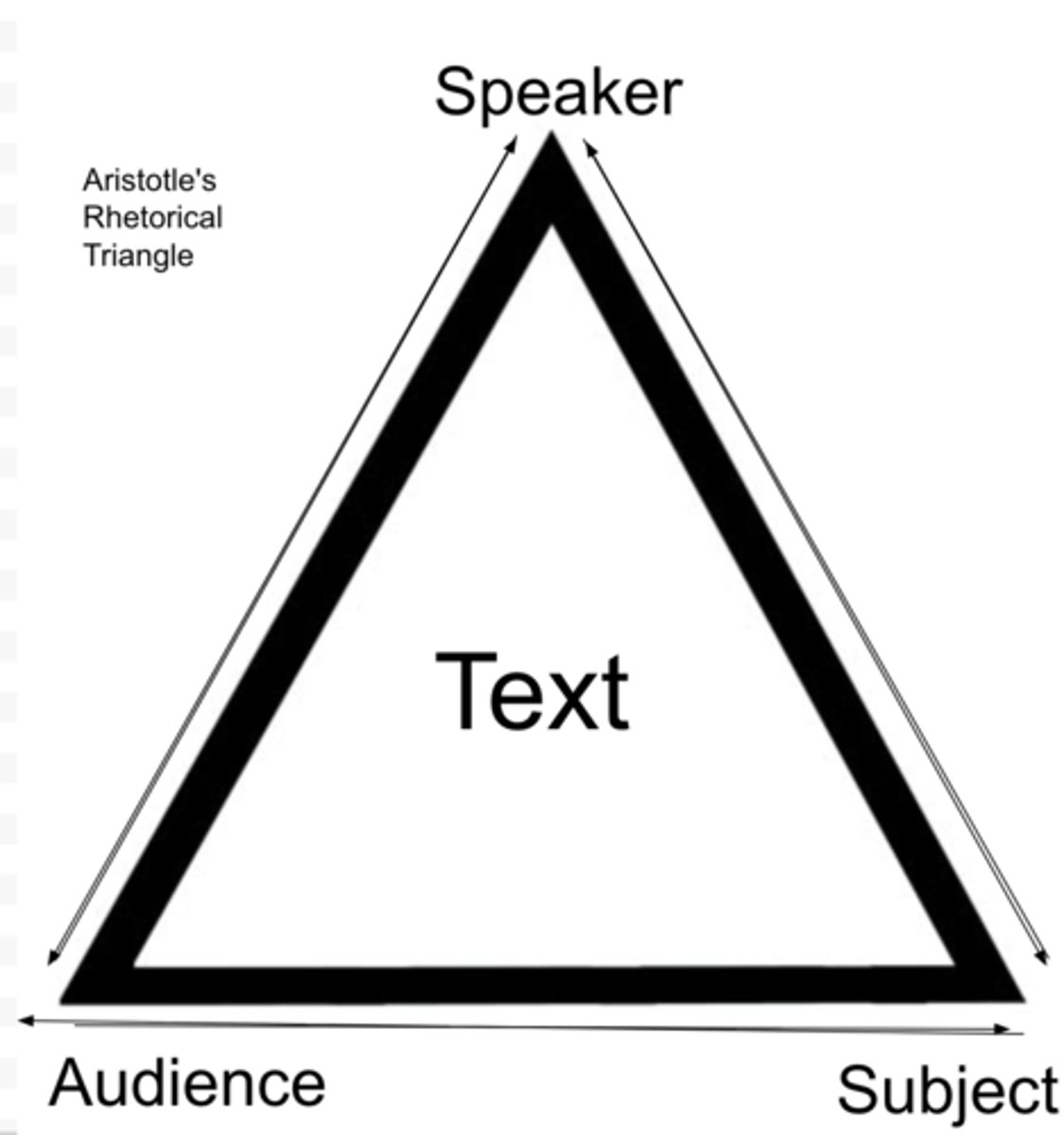
rhetorical triangle (Aristotelian triangle)
A diagram that illustrates the interrelationship among the speaker, audience, and subject in determining a text.
SOAPS
A mnemonic device that stands for Subject, Occasion, Audience, Purpose, and Speaker. It is a handy way to remember the various elements that make up the rhetorical situation.
speaker
The person or group who creates a text. This might be a politician who delivers a speech, a commentator who writes an article, an artist who draws a political cartoon, or even a company that commissions an advertisement.
(ex. In his Farewell Address, the speaker is not just Lou Gehrig, but baseball hero and ALS victim Lou Gehrig, a common man who is modest and thankful for the opportunities he's had.)
subject
The topic of a text. What the text is about.
(ex. Lou Gehrig's subject in his speech is his illness, but it is also a catalog of all the lucky breaks that preceded his diagnosis.)
text
While this term generally means the written word, in the humanities it has come to mean any cultural product that can be "read" — meaning not just consumed and comprehended, but investigated. This includes fiction, nonfiction, poetry, political cartoons, fine art, photography, performances, fashion, cultural trends, and much more.
 Note
Note  Flashcards (109)