Lecture 5 - Synapses and Chemical Neurotransmission
 Studied by 0 people
 Call Kai
 Learn
Learn Practice Test
 Spaced Repetition
 Match
Match Flashcards
 Knowt Play
1/179

There's no tags or description
Looks like no tags are added yet.
Name | Mastery | Learn | Test | Matching | Spaced | Call with Kai |
|---|
No study sessions yet.
180 Terms
Where is the neurotransmitter synthesised and stored in a neuron?
In the neuron and stored in vesicles in the presynaptic terminal
What event initiates neurotransmitter release at the synapse?
An action potential invades the presynaptic terminal
What does depolarisation of the presynaptic terminal cause?
It causes the opening of voltage-gated Ca²⁺ channels
What happens after voltage-gated Ca²⁺ channels open?
Ca²⁺ flows into the presynaptic terminal
How does Ca²⁺ trigger neurotransmitter release?
Ca²⁺ causes vesicles to fuse with the presynaptic membrane
How is the neurotransmitter released into the synaptic cleft?
Via exocytosis from the fused vesicles
Once released, where does the neurotransmitter go?
It binds to receptor molecules in the postsynaptic membrane
What happens when neurotransmitters bind to postsynaptic receptors?
Postsynaptic channels open or close
What is the effect of postsynaptic channel opening or closing?
It generates a postsynaptic current, causing an excitatory or inhibitory postsynaptic potential that changes the cell's excitability
What happens to the vesicle membrane after neurotransmitter release?
It is retrieved from the plasma membrane for reuse
What do voltage-gated Na⁺ and K⁺ channels do?
They conduct nerve impulses down the axon of a neurone
What is the role of ligand-gated channels, e.g., acetylcholine receptors?
They communicate nerve impulses between different neurones
What is the function of gap junctions in neurones?
They are important for synchronising signals and transferring nutritional metabolites
How is a Na⁺ channel structured?
It has four subunits fused into one polypeptide
How is a K⁺ channel structured?
It has four separate subunits that come together
What is the ball and chain model related to?
Signal inactivation of voltage-gated ion channels
What is the inactivation domain in the ball and chain model?
A “ball” attached to the channel by a flexible chain
What happens when the channel depolarises?
The channel opens and a negatively charged binding site is created for the positively charged ball
How does the ball inactivate the channel?
The ball moves into the binding site and blocks the channel, stopping ion flow
What is the structure of an acetylcholine ligand-gated channel receptor?
It is a pentamer (made of five subunits)
What happens when a ligand binds to a ligand-gated channel receptor?
It causes a structural change that allows the pore to open
Give examples of ligand-gated ion channels activated by extracellular neurotransmitters
Channels activated by glutamate and acetylcholine
How can ligand-gated channels be activated intracellularly?
By second messengers such as Ca²⁺, cAMP, or cGMP
What factors cause gap junctions to close?
Low calcium, low pH, changes in membrane potentials, and phosphorylation
How long are gap junctions typically open once formed?
For seconds to minutes
What is the main function of gap junctions?
They link the cytosol of one cell to another
What can move across gap junctions?
Inorganic molecules and small ions
Give examples of events where gap junctions help synchronise activity.
Heart pumping and labour contractions
How many distinct molecular mechanisms do cell surface receptors use to receive signals?
Four
What are the four types of cell surface receptors?
1) Ligand-gated ion channels
2) Receptors with intrinsic guanylyl cyclase activity
3) Receptors with intrinsic or associated tyrosine kinase activity
4) G-protein-coupled receptors (GPCRs)
What are G-protein-coupled receptors linked to?
Opening/closing of ion channels, modulation of adenylyl cyclase, and phosphoinositide-specific phospholipase C activities
What are neurotransmitters?
Chemicals transferred across a neuronal synapse to either promote or inhibit a signal
Give an example of a small molecule neurotransmitter
Acetylcholine
Name some amino acid neurotransmitters
Glutamate, aspartate, GABA, glycine
Give an example of a purine neurotransmitter
ATP
What are biogenic amines?
Neurotransmitters derived from amino acids, including catecholamines, indoleamine, and imidazoleamine
Which neurotransmitters are catecholamines?
Dopamine, adrenaline, noradrenaline
Which neurotransmitter is an indoleamine?
Serotonin
Which neurotransmitter is an imidazoleamine?
Histamine
Give examples of peptide neurotransmitters
Methionine enkephalin and Substance P
What is the amino acid sequence of Substance P?
Arg-Pro-Lys-Pro-Gln-Gln-Phe-Phe-Gly-Leu-Met
What is the structure of acetylcholine?
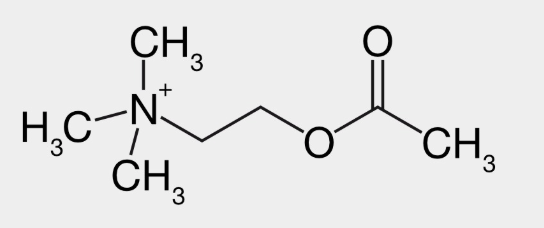
What type of neurotransmitter is acetylcholine?
Predominantly excitatory, especially at skeletal muscles, but can be excitatory or inhibitory at other sites in the CNS and PNS
Where do cholinergic pathways typically begin and end?
They begin in the basal forebrain complex (BFC) and end in the PNS
What is acetylcholine’s role in the cortex?
It is important for cortical stimulation, including regulation of sleep
How many types of acetylcholine receptors are there?
Two
What type of receptor is a nicotinic acetylcholine receptor?
A ligand-gated ion channel that gives a fast response
What type of receptor is a muscarinic acetylcholine receptor?
A G-protein-coupled (metabotropic) receptor that acts much slower
Where are nicotinic receptors located?
Most parasympathetic targets and all autonomic ganglion cells
What is the response of nicotinic receptors?
Relatively fast postsynaptic response
Where are M1 receptors located?
Smooth muscle and glands of the gut
What is the response of M1 receptors?
Smooth muscle contraction
Increased glandular secretion
Relatively slow response
Where are M2 receptors located?
Smooth and cardiac muscle of the cardiovascular system
What is the response of M2 receptors?
Smooth muscle contraction and inotropic effect on cardiac muscle
Where are M3 receptors located?
Smooth muscles and glands of all targets
What is the response of M2 receptors?
Smooth muscle contraction and glandular secretion
What is the structure of adrenaline?
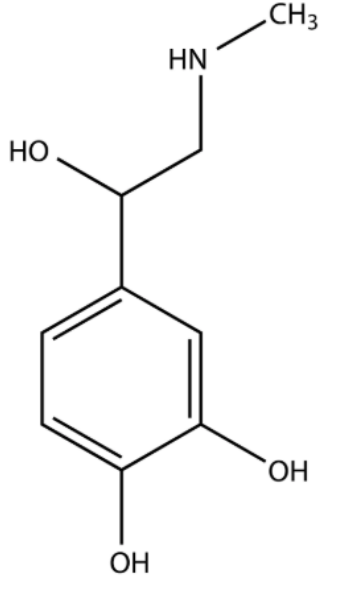
What is the structure of noradrenaline?
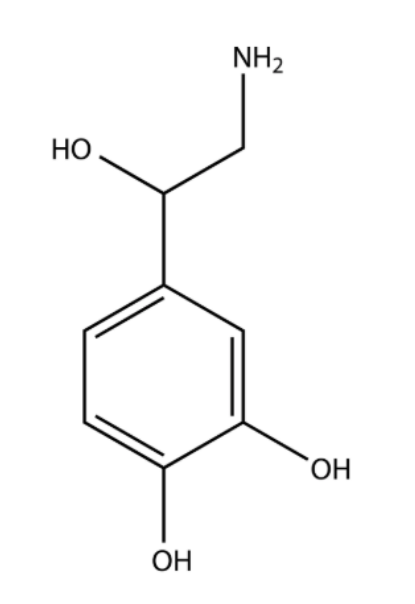
What is the structure of dopamine?
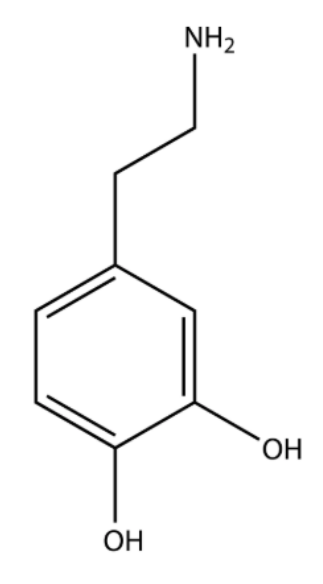
What are catecholamines?
Neurotransmitters that contain a catechol group (benzene ring with two hydroxyl groups) and an amine group
Which nervous system do catecholamines mainly affect?
The sympathetic nervous system
Which neurons synthesise catecholamines?
Adrenergic neurones
What amino acid are catecholamines derived from?
Tyrosine
Why is tyrosine hydroxylase (TH) important?
It is the rate-limiting enzyme in the synthesis of all catecholamine
What happens if tyrosine hydroxylase is absent in embryos?
Incompatible with life
What are examples of catecholamines?
Adrenaline, noradrenaline and dopamine
Where is dopamine mainly located?
Mainly in the brain, with a few peripheral locations
Is dopamine excitatory or inhibitory?
Primarily an excitatory neurotransmitter
What transporter is unique to dopaminergic neurons?
Dopamine transporter (DAT)
Where do major dopaminergic neuron circuits originate?
The substantia nigra
What are the key functions of dopamine?
Motivation and reward, memory, and voluntary movement
How many types of dopamine receptors are there?
D1a, D1b, D2, D3, D4
What intracellular signalling pathway do dopamine receptors use?
Adenylyl (adenyl) cyclase via G-proteins
What is the effect of D1 receptors on adenylyl cyclase?
Stimulate adenylyl cyclase
What is the effect of D2 receptors on adenylyl cyclase?
Inhibit adenylyl cyclase
What can stimulation of dopamine receptors change?
Enzyme activity and gene expression
Are noradrenaline and adrenaline excitatory or inhibitory?
Both are generally excitatory neurotransmitters, but adrenaline is present at lower levels
Where are noradrenaline and adrenaline mostly synthesised?
Sympathetic ganglion cells located near the spinal cord or abdomen
What role does noradrenaline play in the autonomic nervous system?
It is a major neurotransmitter that helps coordinate motor behaviour
What are the functions of noradrenaline in the brain?
Regulates attention, arousal, memory, and the sleep–wake cycle
What are the functions of noradrenaline in the body?
Boosts cardiovascular function and prepares muscles for activity
Where do noradrenergic neurones originate?
The locus coeruleus
What physiological response are noradrenaline and adrenaline involved in?
Fight-or-flight responses
Where is adrenaline used as a neurotransmitter in the brain?
Neurones in the medulla oblongata
How many types of adrenergic receptors are there?
Nine types of adrenergic receptors
Can dopamine activate adrenergic receptors?
Yes, dopamine can activate certain adrenergic receptors at higher doses
What are the α1 adrenergic receptor subtypes?
α1A, α1B, α1D
Which G-protein is associated with α1 receptors?
Gq
What is the main signalling pathway of α1 receptors?
Increased phospholipase C → increased IP₃ and DAG → increased Ca²⁺
What are the effects of α1 receptor activation?
Smooth muscle contraction, including vasoconstriction and pupil dilation
What are the α2 adrenergic receptor subtypes?
α2A, α2B, α2C
What is the G-protein associated with α2 receptors?
Gi
What is the main signalling pathway of α2 receptors?
Decreased adenylyl cyclase → decreased cAMP
What are the main effects of α2 receptor activation?
Inhibition of neurotransmitter release (autoreceptors) and vasoconstriction
What is the β1 adrenergic receptor subtype?
β1
What is the G-protein associated with β receptors?
Gs
What is the main signalling pathway of β1 receptors?
Increased adenylyl cyclase → increased cAMP
What are the main effects of β1 receptor activation?
Increased heart rate and increased contractility
What is the β2 adrenergic receptor subtype?
β2
What is the main signalling pathway of β2 receptors?
Increased adenylyl cyclase → increased cAMP
 Note
Note  Flashcards (20)