Unit 5- AP Government- Political Participation
 Call Kai
 Learn
Learn Practice Test
 Spaced Repetition
 Match
Match Flashcards
1/66

There's no tags or description
Looks like no tags are added yet.
Name | Mastery | Learn | Test | Matching | Spaced | Call with Kai | Chat |
|---|
No analytics yet
Send a link to your students to track their progress
67 Terms
Linkage institutions
Institutions that connect citizens to government. The mass media, interest groups, political parties and elections are the main linkage institutions.
3 Indirect linkage institutions
parties, interest groups, media
Goal of Parties
win elections
Tasks of linkage institutions
pick policymakers, run/coordinate campaigns, give cues to voters, articulate policies, coordinate policymaking
Party Identification
self-proclaimed preference for one party, influences voter choice
Ticket Splitting
voting for both parties on a ballot
Straight Ticket Voting
voting one party on a ballot
Divided Government
different party in Congress compared to the President
Likely Republican voters
higher income/affluence, college grads, older voters, protestants, suburban areas, smaller cities, southeast
Likely Democratic Voters
lower income, lower education, women , younger voters, Catholics (changing), Jews, Asians, African Americans, large cities, northeast and west coast
National Convention
Prepare, every four years, write party platform, nominate candidates for Pres and VPres
Officeholders
those who identify with party and hold elective/appointed offices in all three branches and levels of government
Reasons for 2 Party system
historical, force of tradition, electoral system ,american ideological consensus
Splinter parties
offshoots of a major party
Consequences of the 2 party system
Moderation of political conflict, winner take all system, proportional representation problems
Interest Group
organization of people with similar policy goals that tries to influence the political process to achieve those goals
What do interest groups try to influence?
Policy at every branch and every level of government
Iron triangles
composed of key interest groups interested in a particular policy, the government agency in charge of administering the policy, and the members of congressional committees/subcommittees handling the policy
Arrangement of Iron triangle
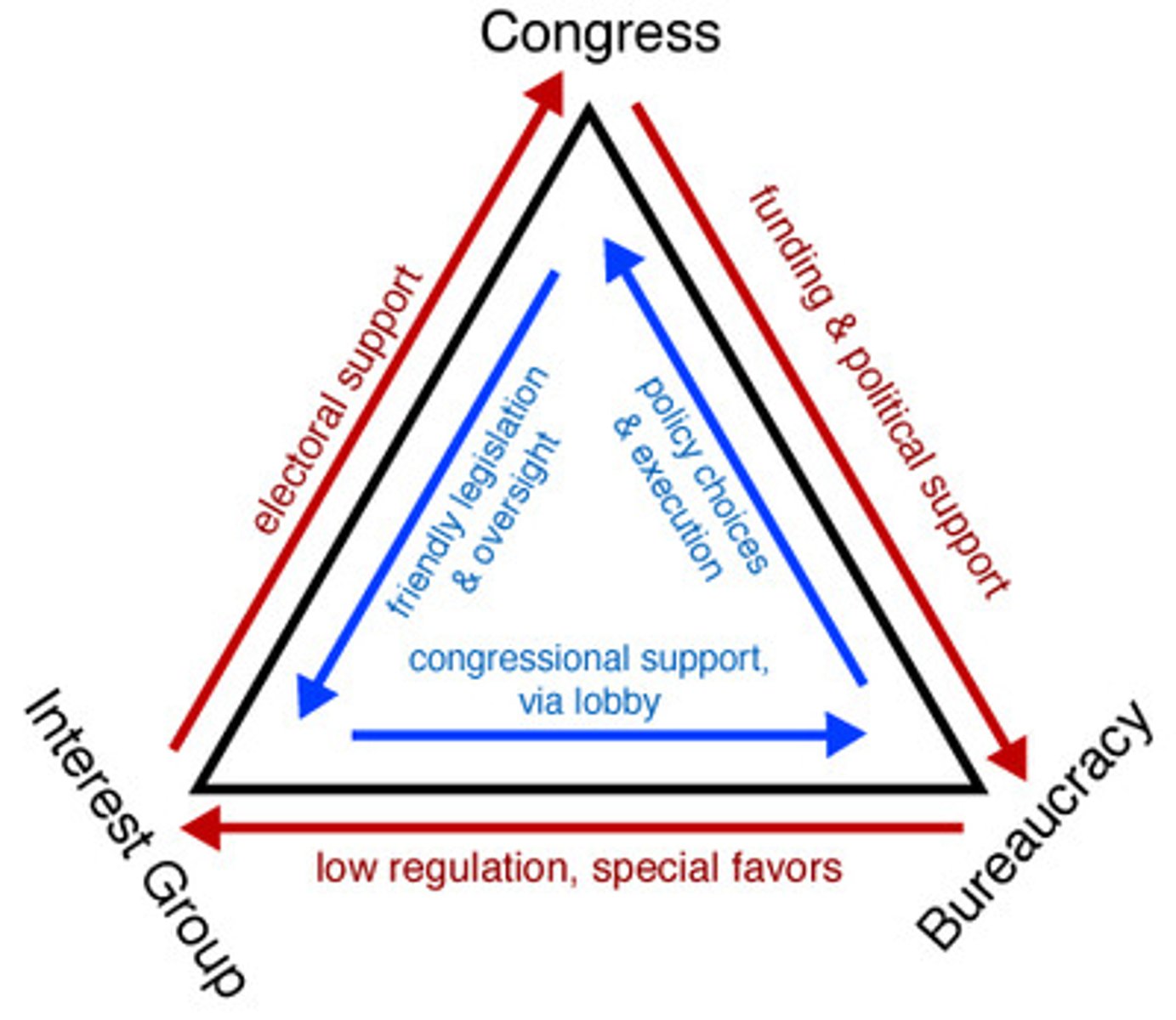
Factors that influence success of interest groups
size, intensity, financial resources
Free-rider problem
when potential members decide not to join, but sit back and let others do the work from which they will still benefit
Single issue group
has narrow interest, dislikes compromise, and single-mindedly pursues its goal at the expense of other goals
Interest group goal
to shape policy
Strategies of interest group to reach goal
lobbying, electioneering, litigation, appeal to public for widespread support
Lobbying
interest groups that directly influence
Lobbyist
political persuaders who are reps of organized groups
How do lobbyists help congresspeople
source of info, help with political strategy, formulate campaign strategy, source of ideas and innovation
Political Action Committees (PACs)
provide a means for groups to participate in electioneering
Amicus curiae briefs
"Friend of the court"; written arguments submitted to the courts in support of one side of a case
4 main policy areas
economic issues, environmental issues, equality issues, interest of all consumers issues
Economic groups
concerned with wages, prices and profits
Labor groups
union workers in a specific group
Business groups
support the right to work laws
Right to work laws (what Mississippi has)
outlaw union membership as condition of employment
Equality interests
equal rights for women and minority groups
The only guarantee for equal protection of women in constitution
19th Amendment
Public interest lobbies
represent groups that champion causes or ideas in the public interest
Madison's solution to problem in Federalist 10
create an open system in which many groups would be able to participate; groups with opposing interests would counterbalance each other
Mass media
reaches out and profoundly influence not only the elites but the masses
Investigative journalism
use of detective like reporting methods to unearth scandals
Federal Communications Commission
regulates the use of airwaves
Narrowcasting
stations target narrow audiences; bias
Political Activists
depend heavily on the media to get their ideas placed on the government agenda
Media
key linkage institution between people and policymakers
Watchdog function
helps keep government small; expose scandals and intrigues people
Media functions
gate keeper, agenda setter, scorekeeper, watchdog
Citizens United v. FEC
A landmark Supreme Court case that ruled that laws restricting independent political expenditures by corporations and unions violate the First Amendment. Resulted in the rise of Superpacs.
Superpac
An independent political action committee that can raise unlimited amounts of money to advocate for or against political candidates.
primary election
A preliminary election held to select a party's candidate for the general election by winning a majority of delegates at he convention. Also allows registered party members to vote for their preferred candidate.
Who sets rules for primary elections
State legislatures and political parties, determining the process and regulations for selecting candidates.
McCain Feingold
A law that sought to ban soft money in elections; regulates campaign finance by restricting the amount individuals and organizations can contribute to political campaigns and establishing rules for political advertising.
Federal Election Campaign Act
A law passed in 1971 that regulates campaign financing for federal elections, requiring candidates to disclose their campaign contributions and expenditures while setting limits on individual contributions.
FEC
The Federal Election Commission (FEC) is an independent regulatory agency responsible for enforcing federal campaign finance laws, overseeing the public funding of elections, and ensuring transparency in campaign contributions.
battleground state
A state where both major political parties have similar levels of support among voters, making it a key focus during elections due to its potential to swing either way.
pluralism
A political theory advocating that multiple groups should coexist and compete for power, ensuring diverse interests are represented in the political process.
hyperpluralism
A theory criticizing pluralism by suggesting that too many competing groups lead to political paralysis and diminished governance, as a wide array of interests can overwhelm the policymaking process.
horserace politics
describes the way the media focuses on the competitive aspects of elections, emphasizing polling results and candidates' standings rather than policy issues or substantive debates.
winner-take-all system
A voting system in which the candidate who receives the most votes in a constituency wins the election, and all other candidates receive no representation. This system often leads to a two-party dominance. Example: The electoral college
Voter turnout
refers to the percentage of eligible voters who participate in an election, indicating the level of public engagement and interest in the electoral process.
Who is most likely to turnout in election
are typically older, more educated, and wealthier individuals, as they have higher levels of engagement and awareness of the electoral process.
party line voting
the practice of voting exclusively for candidates of one political party during an election, often influenced by party loyalty.
retrospective voting
refers to the practice where voters make their electoral choices based on the past performance of a candidate or party, assessing their previous actions and outcomes before making a decision.
prospective voting
is the practice where voters make their electoral choices based on the expected future performance or policies of a candidate or party, rather than their past actions.
rational choice voting
is a theory suggesting that voters make decisions by comparing the expected utility of different candidates and choosing the one they believe will maximize their well-being based on personal interests.
elitism theory
is a political theory that posits a society is divided between a minority of elites who hold power and influence, and the majority of the populace who have limited influence over political decisions.
political efficacy
is the belief that one’s participation in politics can influence political processes and outcomes, affecting their trust in government and civic engagement.
structural barrier
refers to obstacles that prevent individuals or groups, particularly marginalized communities, from participating in the political process, such as laws, policies, or institutional practices. Examples: voter registration and voter ID laws.