Week 5 BIO 130 Readings
 Call Kai
 Learn
Learn Practice Test
 Spaced Repetition
 Match
Match Flashcards
 Knowt Play
1/17

There's no tags or description
Looks like no tags are added yet.
Name | Mastery | Learn | Test | Matching | Spaced | Call with Kai |
|---|
No analytics yet
Send a link to your students to track their progress
18 Terms
Tissues
Cooperative assemblies of various cell types that work together to carry out a unified function
Extracellular matrix
The material that cells secrete around themselves that gives supportive tissues like bone or wood their strength
Cell wall
ECM of plant cells
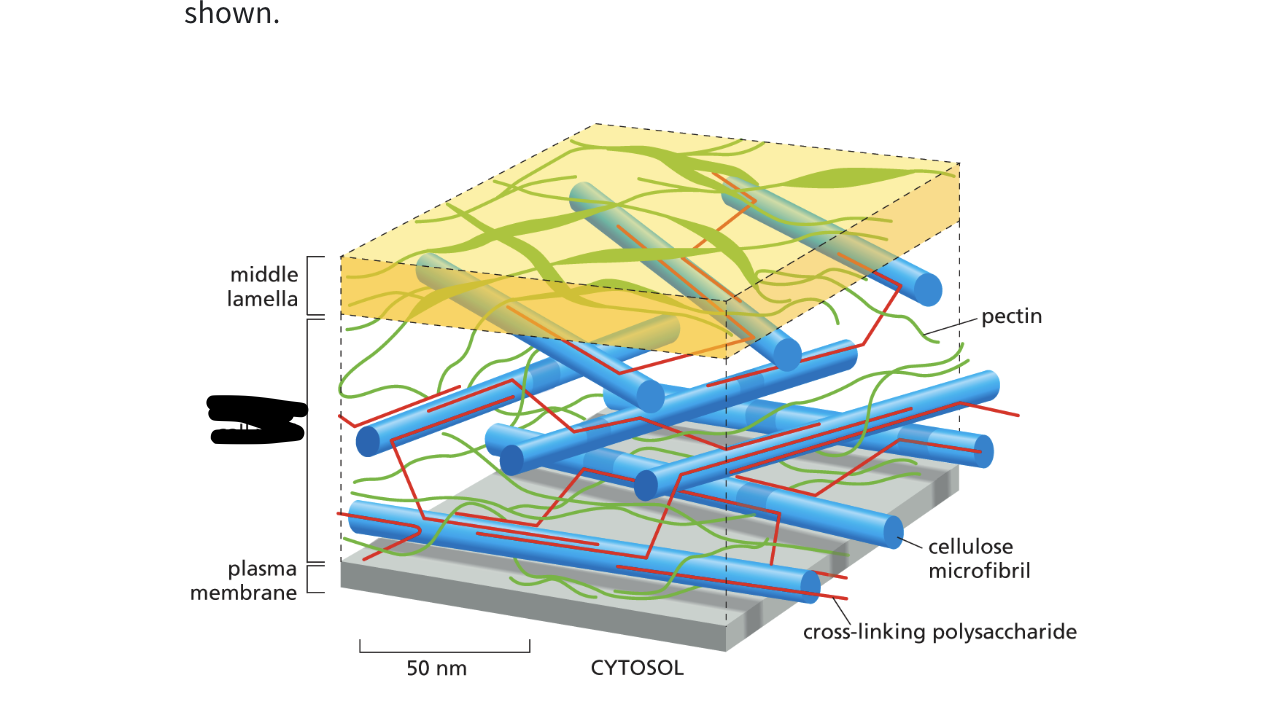
Plant cells themselves will synthesize, secrete and control this structure that forms a box aorund cells
helps to imobilize, protect and enclose cells
Can be thick like in wood or thin and flexible like a leaf
Important as cells without cell walls are easily ruptured, as they lack the strong intermediate filament cytoskeleton that helps animal cells hold their shape
Doesn,t have to be rigid - ex. lettuce leaves are rigid due to osmotic swelling
Primary cell walls
formed in newly made plant cells
only 200 nm thick
Can slowly expand to accomodate cell growth
Turgor pressure
The driving force for cell growth
Develops as a result of an osmotic imbalance between the interior of the plant and its surroundings
Secondary cell wall
produced when a cell stops growing and the wall does not need to expand
done by thickening the primary one or adding new layers with different composition under the old ones
When cells are specialized they produce specialized forms fo these walls
ex. waxy and waterproff ones for the surface of epidermal cells of leaves, hard and thick woody walls for those of the xylem
Cellulose microfibrils
Long fibers of the polysaccharide cellulose that are used to provide tensile strength along the stress lines of the plant cell wall
Interwomen with other polysaccharides and some structural proteins that are bonedeted to form a complex structure
Can resist compression and tension
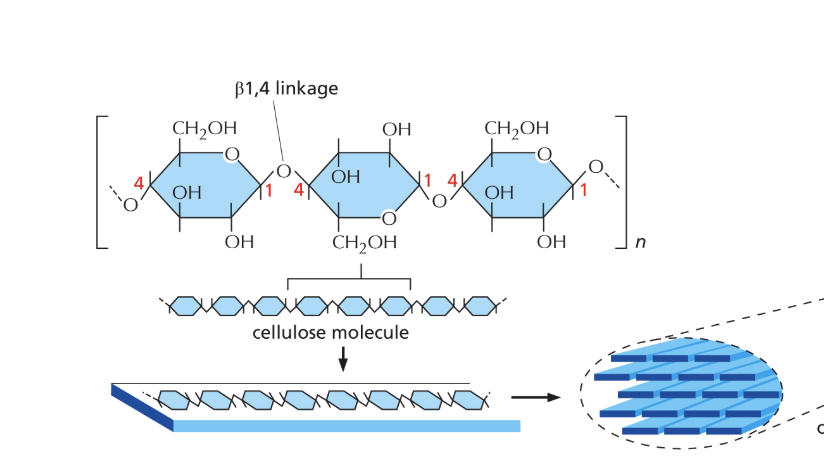
Cellulose molecules are long and unbranched chains of glucose with each unit inverted with respect to each other and connected by a beta-1,4-glycosidic linnkage
this repeates hundres of times to create a cellulose moleulce
18 of these are held together by hydrogen bonds to make this polymer
Cellulose microfibrils and growth
Orientiation of these determiens how a cell grows due to their rigidity
If they are arrangeld like a corset cell will grow more upwards in length rather than in girth
controlling the way it makes it’s wall allows a cell to control its shape
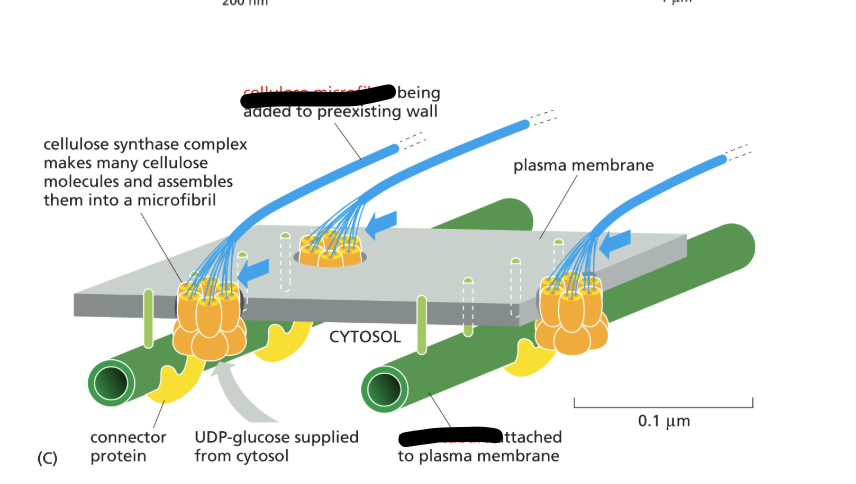
Cellulose synthase complexes
Produce cellulose
embeded in the outer surface of the cell as integeral membrane proteins that are made up of six enzyme trimers, acts as an enzyme complex to make cellulose
transport activated glucose monomers in the form of UDP-gluclose from the cytosol across the plasma mrembrane and incorporat them into a growing cellulsoe chain at the points of membrane attachment which then assemble to form a cellulose microfibril
distal ends of microfibrils are integrated into cell wall and elongation pushes these complexes along the plane 9blue arrows)
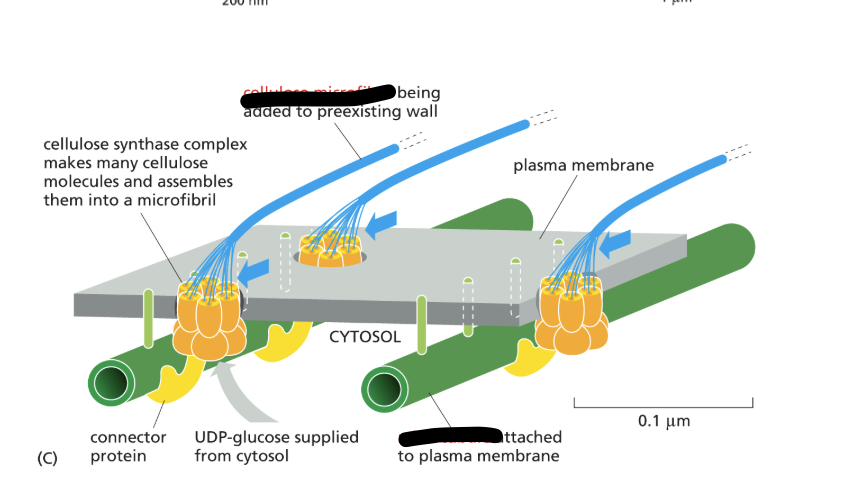
Microtubule
Guides cellulose synthase complexes and alligns with the growing cellulose microfibrils outside of the cell
act as tracks taht direct the moevment of this enzyme complex, indireclty shapingthe plant cell and its tissues
.attached to plasma membrane by transmembrane proteins
Connective tissues
Cells in which the extracellular matrix is abundant and carries the mechanical load themselves
Many cells are classed under this tissue for example
the dermis of the skin
bone
cartilage
jelly in the interior of the eye
Bulk of the tissue is occupied by the extracellular matrix in which the cells are scattered in
Tensile sterngth of ecm provided by fibrous proteins that are mainly collagens
Specific character of tissues is attributed to the type and quanity of collagen it contains as well as the other molecules in between in various propotions
Elastin for example is a rubbery proteins in artieries that helps to make the vessels resilient and allows them to withstand blood pulsing through them
Collagens
Family of proteins
mammals have over 40 genes that code for various kinds of these proteins that support the strucuture and function of tissues
Chief protein in skin, tendon and bone
Make up 25% of the protein mass of a mammal- more than any other protein
Characteristic feature = long and stiff triple stranded helical strucutre where 3 polypeptide chains of these monomers are wonund around each other in a rope like super helix
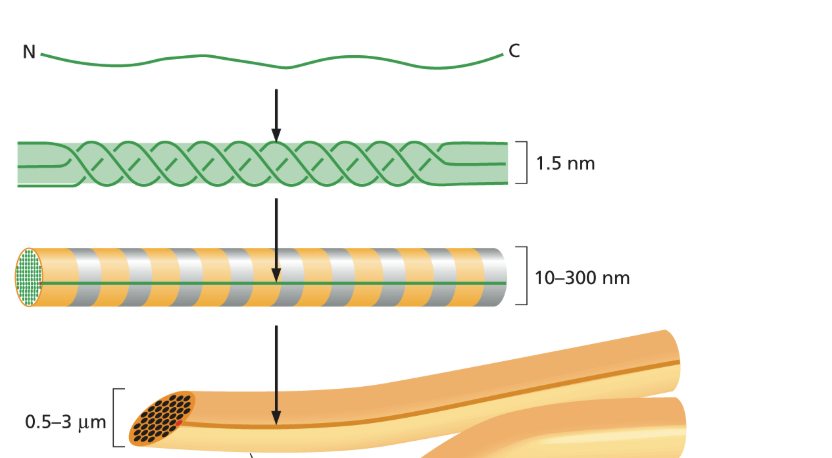
Type 1 collagen
most abundant form, makes up 90% of bodies collagen
Collagen fibrils
Thin cables 10-300 nm in diameter and many micrometers long
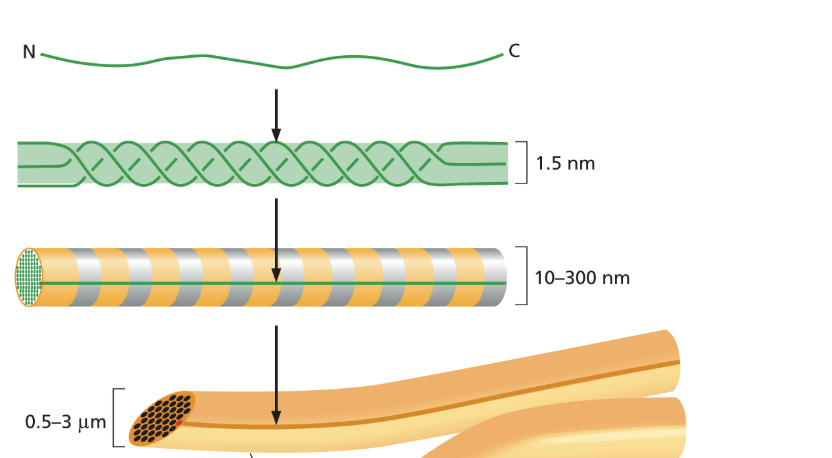
Collagen fibers
Thick asosociations of collagen fibrils that are 0.5 to 3 micromeeters in diameter
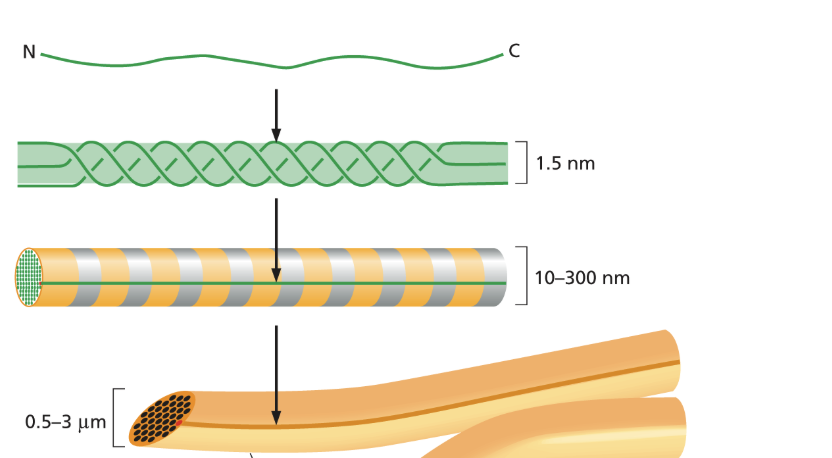
Osteoblasts
Cells in the ecm of the bone tha make collagen
Produce most of the other macromolecules of the matrix
molecules synthesized intracellularly and form huge cohesive agregartes outside of the cell
Fibroblasts
Cells in the connective tissue that make collagen
Produce most of the other macromolecules of the matrix
molecules synthesized intracellularly and form huge cohesive agregartes outside of the cell
Dr. Matt Buechler studies these!
Procollagen
As mature collagens are designed to form huge aggreates inside of a osteo/fibroblast this could cause a cell to become chocked with its own products
Therefore osteo/fibroplasts secrete this preliminary form of collagen that has additional peptide extensions at the end to obstrucutre the premature assembly into collagen fibrils

