4th Industrial, Emerging Technologies, Multiplatform Application, Web and Mobile Development Frameworks
 Studied by 67 people
 Call Kai
 Learn
Learn Practice Test
 Spaced Repetition
 Match
Match Flashcards
 Knowt Play
1/102

There's no tags or description
Looks like no tags are added yet.
Name | Mastery | Learn | Test | Matching | Spaced | Call with Kai |
|---|
No analytics yet
Send a link to your students to track their progress
103 Terms
The ongoing transformation of manufacturing and related industries through the integration of advanced technologies.
Industry 4.0 (a.k.a. Industrial Revolution 4.0)
Connecting physical devices to the internet for real-time data collection and communication.
Internet of Things
Enabling machines to learn from data and make autonomous decisions.
Artificial Intelligence (AI) and Machine Learning (ML)
Utilizing vast amounts of data to gain insights and optimize processes.
Big Data and Analytics
Large datasets are collected and analyzed to identify ________, ________, and ___________ for improvement
patterns, trends, and opportunities
Blending the physical and digital worlds for automated control and interaction.
Cyber-physical Systems (CPS)
______________________ are integrated with digital systems, allowing for automated control and real-time decision-making.
Physical machines
Mechanization powered by water and steam engines.
First Industrial Revolution
When is the First Industrial Revolution?
1760-1840
Mass production with assembly lines and electricity.
Second Industrial Revolution
When is the Second Industrial Revolution?
1870-1914
Computers and automation in manufacturing and business processes.
Third Industrial Revolution
When is the Third Industrial Revolution?
1960-present
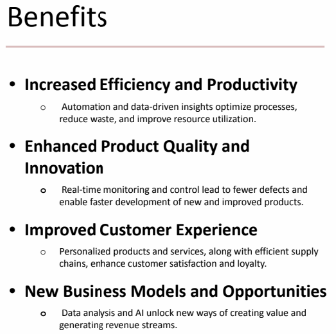
Benefits of Industry 4.0
1.) Increased efficiency
2.) Enhanced product quality and Innovation
3.) Improved customer experience
4.) New business models and opportunities.
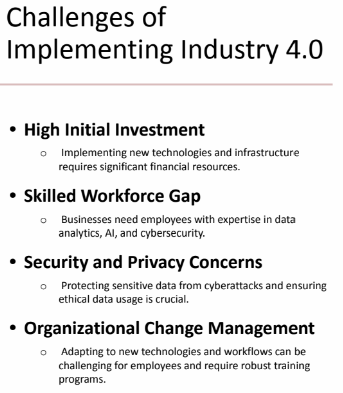
Challenges of Implementing Industry 4.0
1.) High initial investment
2.) Skilled workforce gap
3.) Security and privacy concerns
4.) Organizational change management.
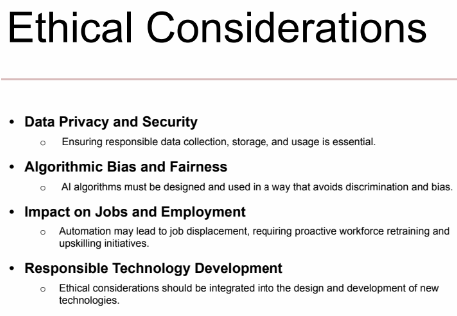
Ethical Considerations
1.) Data privacy and security
2.) Algorithmic bias and fairness
3.) Impact on jobs and employment
4.) Responsible technology development.
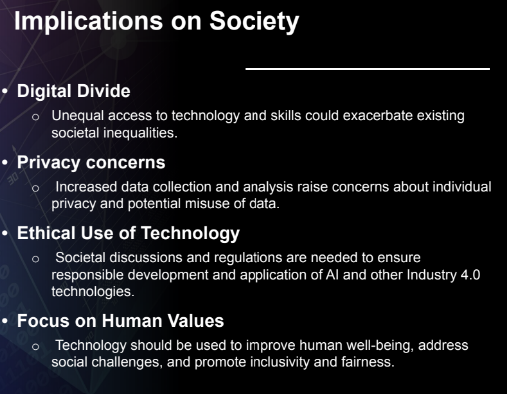
Implications on Society
1.) Digital divide
2.) Privacy concerns
3.) Ethical use of technology
4.) Focus on human values.
It is a new technology, but it may also refer to the continuing development of an existing technology
Emerging Technology
Technologies that are currently developing, or that are expected to be available within the next five to ten years, and is usually reserved for technologies that are creating, or are expected to create, significant social or economic effects.
Emerging Technology
Examples of emerging technologies? (based on PPT)
Electronic Medical Record (EMR) system
Autonomous Cars
Virtual Reality
Internet of Things
Ambient Intelligence
An enabling technology that allows physician practices to pursue more powerful quality improvement programs than is possible with paper-based records. However, achieving quality improvement through this technology use is neither low-cost nor easy.
Electronic Medial Record (EMR) System
A vehicle capable of sensing its environment and operating without human involvement.
Autonomous Cars
a simulated 3D environment that enables users to explore and interact with a virtual surrounding in a way that approximates reality, as it is perceived through the users' senses.
Virtual Reality
Describes the network of physical objects—“things”—that are embedded with sensors, software, and other technologies for the purpose of connecting and exchanging data with other devices and systems over the internet.
Internet of Things
an emerging discipline that brings intelligence to our everyday environments and makes those environments sensitive to us. In addition, this research builds upon advances in sensors and sensor networks, pervasive computing, and artificial intelligence.
Ambient Intelligence
A general term covering the development methods, programming languages, and tools to support them that may be used in the development of software.
Software Development Technologies
A cloud computing platform which provides the mix of services such as IaaS, PaaS and SaaS which helps in cloud infrastructure, Platform, and Software.
Amazon Web Services (AWS)
It refers to a large volume of both structured and unstructured data.
Big Data
Is a framework to handle and process this large volume of Big data. It also allows clustering multiple computers to analyze massive datasets in parallel more quickly.
Hadoop
is the study of data to extract meaningful insights for business. It is a multidisciplinary approach that combines principles and practices from the fields of mathematics, statistics, artificial intelligence, and computer engineering to analyze large amounts of data.
Data science
is a structural framework for dynamic web apps. It lets you use HTML as your template language and lets you extend HTML's syntax to express your application's components clearly and succinctly.
AngularJS
AngularJS's data binding and dependency injection __________ much of the code you would otherwise have to write.
Eliminate
Apps/websites developed with Angular
Google
Gmail
Microsoft Xbox
Forbes
Paypal
Upwork
Weather.com
Is a cross-platform runtime environment which is designed for developing Networking & Server Side applications.
Node Js
What trending field within the realm of IT involves creating applications specifically tailored for the Android operating system?
Android App Development
Is a framework which provides an alternative to the ASP.NET Web Forms to create web applications
ASP.NET MVC
Developer have huge benefit in creating the web pages in ___ framework, because it makes the development easier by splitting the application.
MVC framework
Is an open-source model—view—view model framework for building user JavaScript interfaces and single-page applications.
Vue.js
is a vast field that involves designing, engineering, and validating hardware products.
Hardware development technology
The hardware product development lifecycle can be divided into seven phases:
Requirement or ideation
Design
Manufacturing
Testing
Distribution
Use and Maintenance
Disposal
is an open-source microcontroller board based on the Microchip ATmega328P microcontroller and developed by Arduino.cc and initially released in 2010.
Arduino Uno
Contains on-board power supply, USB port to communicate with PC, and an Atmel microcontroller chip.
Microcontroller board
a tiny computer about the size of a credit-card, the board features a processor, RAM and typical hardware ports you find with most computers.
RASPBERRY Pl
Arduino Vs Raspberry Pl
is a simple computer that can run one program at a time, over and over again. It is very easy to use.
Arduino or Micro-controller
Arduino Vs Raspberry Pl
is a general-purpose computer(Mini PC), usually with a Linux operating system, and the ability to run multiple programs. It is more complicated to use than an Arduino
Raspberry Pi
Arduino Vs Raspberry Pl
is best used for simple repetitive tasks: opening and closing a garage door, reading the outside temperature and reporting it to Twitter, driving a simple robot.
Arduino
Arduino Vs Raspberry Pl
is best used when you need a full-fledged computer: driving a more complicated robot, performing multiple tasks, doing intense calculations (as for Bitcoin or encryption)
Raspberry Pi
is the practice of developing software products or services for multiple platforms or software environments.
Engineers and developers use various methods to accommodate different operating systems or environments for one application or product.
Cross-platform development
Steers clear from the complexity of creating a sustainable product that spans multiple platforms and instead focuses on generating a competent design that stays close to the target platform-Android, iOS, etc.
Native Application
Platform frameworks seek to generate an app that reaches out to as many followers of your brand as possible by covering a wide number of end devices during the programming and creation process.
Cross-Platform
The Benefits of Cross Platform App Development:
Code Reusability
Cost Effectiveness
Consistency in UI Components
Easy Hosting
Cloud Integration
Fewer Technical Barriers
Shorter Time to Market
Top 5 Cross-Platform App Frameworks:
Xamarin
React Native
Flutter
Ionic
Node.js
Xamarin
Was launched in 2011 as an independent cross-app development framework but was later acquired by Microsoft in 2016, thus lending it more credibility than before.
Pros of Xamarin
Xamarin app development uses C# for coding, meaning that it works seamlessly on an array of platforms (including Android and iOS).
Xamarin has a strong community of over 60,000 contributors from more than 3,700 companies.
Share more than 75% of your code across platforms, for "write once, run anywhere" ease.
A single tech stack for faster development
Cons of Xamarin
Compared to native applications, Xamarin applications are larger in size and require more space.
Xamarin apps might face compatibility issues during the integration of third-party libraries.
Xamarin is not recommended for apps that demand heavy graphics because each platform has a different method for visually laying out screens a ux/ui rich application is advised to be implemented natively
React Native
It improves the speed of development but also increases the duration of the debugging process, especially on Android.
Flutter
open source and free cross-platform framework for creating native interfaces for Android as well as iOS. It is a cross-platform app framework maintained by Google, the very same organization that develops the Android Native Framework.
One of the most remarkable and popular cross-platform app frameworks, based on AngularJS.
It allows developers to use a combination of top programming languages i.e., HTML5, JavaScript, and CSS and Cordova wrapper to access native platform controllers.
Ionic
The fact that Ionic gives a __________ feel to the apps is what makes it a favorite of developers. It helps develop cross-platform apps and allows them to perform perfectly on various platforms.
native-like feel
Ionic is based on a _______________ framework designed specifically for mobile operating systems. It provides numerous Ul components for developing robust applications.
SAAS Ul framework
It is an open-source environment that supports the development of server-side and scalable networking apps. It’s cross-platform apps are inherently highly efficient and responsive.
Node.js
Node.js is an incredible framework for developing cross-platform apps. Essentially, Node.Js is a JavaScript runtime framework built on the ________________.
Chrome V8 JavaScript engine
This framework is capable of handling several concurrent connections together. It also comes loaded with a rich library of numerous JavaScript modules that help in simplifying the development of web applications.
node.js
A platform can refer to computer or processor architecture. For example, the x86 and x86-64 CPUs constitute the most common computer architectures
Hardware Platform
A ____________ platform is a set of compatible hardware on which software applications can be run.
hardware
The word "__________" has been extremely useful in IT to refer to the specific structures within which software programs will run.
platform
Related components of hardware platform
The processor or, in the case of high-performance systems, several processors. Some of the processors may provide only limited programmability, as is the case for many video accelerators.
The set of I/O devices provided by the platform
The bus interface
The software development environment
What are the types of Hardware Platforms?
Arduino
Netduino
NET Gadgeteer
Rasberry PI
Types of Software Platform:
Operating Systems
Computing Platforms
Database
Platforms
Application
Mobile
Web
API
Provide the basic services required to use hardware
Operating System
Platforms built on top of operating systems that provide computing functionality in areas such as cloud computing and virtualization.
Computing Platforms
Cloud platforms for deploying and managing various types of database such as relational, NoSQL and in-memory databases
Database
Scalable storage of objects and files including APIs and value added services such as resilient storage that is backed up in multiple locations.
Platforms
a class of software that is primarily designed to be used by people are environments and toolkits for developing and deploying.
Application
platform include mobile operating systems and environments for building mobile apps. They also include cloud platforms for building mobile back ends that provide services to mobile apps.
Mobile
Provide services that are useful to websites and web based software as a service such as web servers, web application servers, content delivery networks and edge computing.
Web
Cloud platform for deploying APIs that are typically built around an API gateway that performs function such as load balancing, latency reduction and rate limiting.
API
It is a platform for developing software applications where it serves as the foundation for software developers.
It is also similar to an Application Programming Interface (API); technically, each of these consists Of an API.
Framework
API only provides access to the ______________ elements, while the Frameworks serve as the basis for programming
Framework-supported elements
A grid that makes it easy to organize your website’s design elements.
Defined font styles and sizing depending on their function (different typography for headings vs paragraph, etc.,)
Websites components pre-constructed, such as side panels, buttons and navigation bars.
Front-end frameworks
It is the website server side.
It stores and arrange data, as well as ensuring that everything works fine on the website’s client side.
It’s the part you can’t see and interact on the website
It is the portion of the software that doesn’t come into direct user contact
Back-end Frameworks
Front-end VS Back-end
Focus
Visuals, User Interaction
Front-end
Front-end VS Back-end
Focus
Functionality, Data
Back-end
Front-end VS Back-end
Skills
Html, CSS, JavaScript, UX
Front-end
Front-end VS Back-end
Skills
Programming Languages, Databases, Servers
Back-end
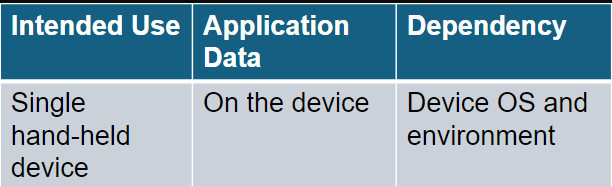
Native Applications
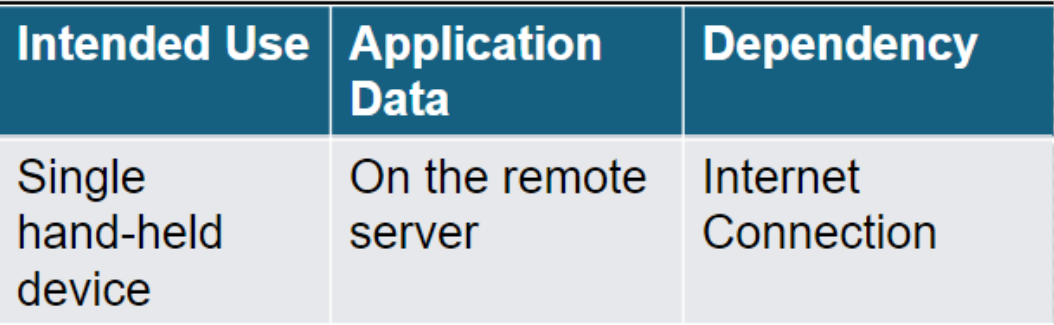
Web Application
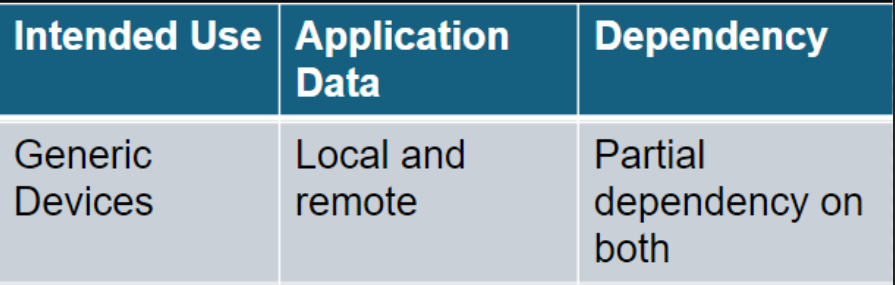
Hybrid Application
Pros of Mobile Application
Convenience
Easy Communication with Customers
Offline Usage
Enhanced User Experience
Cons of Mobile Application
Development Complexity
Cost: Distribution Costs
Updates and Support
Apps that can be open on a user's device via web browser. It is custom designed websites that are built to look and be used as native apps, though they are not stored on a user's device.
Web Application
Pros of Web Applications
Web based applications are easier to handle and thus can execute on most any OS platform.
Even if without the approval of any app stores, the developers can still offer the application
Fast development cycles using CSS, HTML and JavaScript.
Cons of Web Applications
Slower Performance: web apps often operate at a slower speed compared to applications hosted on local servers. This limitation can impact user experience, especially for resource-intensive tasks.
Dependency on Internet Connection: web apps rely entirely on an Internet connection. If the internet is unavailable, users cannot access the app. A reliable connection is essential for browsing the website and running the app.
Browser Dependency: web apps are closely tied to the web browser. While this provides benefits like cross-platform compatibility, any issues with the website (such as unresponsiveness) directly affect the app’s functionality.
Limited Functionality: Web apps may not leverage device-specific features as effectively as native apps. They lack access to certain hardware capabilities, limiting their functionality.
Security Concerns: Since web apps run in a browser, there is no quality control system like app stores. Users are not guaranteed the same level of safety and security as native apps.
Increased App Size: Web apps tend to have larger file sizes due to their direct link to the browser. A large app can be considerably slower than a native desktop application.
Applications that are installed just like any other app on a device.
Hybrid Applications
Hybrid apps are deployed in a native container using a __________ object. This object displays web content when the app is used thanks to the use of web technologies (CSS, JavaScript, HTML, HTML5).
WebView Mobile object
Pros of Hybrid Applications
Has the best functionality and user-friendliness The developers doesn't have platform limitation,
meaning they can build hybrid apps that works on multiple platforms
Great options for developers who create intensive apps (e.g games).
Cons of Hybrid Application
It is better to make them native in the case of very complicated applications
Requires much time and effort in developing to make it feel and look good for a native user.
If it doesn't work properly, app stores may refuse the hybrid application.
Acts as a bridge between different software components, enabling them to communicate and exchange data.Facilitatess efficient software development by allowing programmers to access pre-built functionality without writing complex code.
API
Working of APIs
Client: The user or customer initiates a request via the API.
API: Acts as the communication medium between the client and the server.
Server (Backend): Accepts the request, processes it, and provides a response.
 Note
Note  Flashcards (78)