Western Europe: Historical, Geographical, and Cultural Overview for Students
 Studied by 0 people
 Call with Kai
 Learn
Learn Practice Test
 Spaced Repetition
 Match
Match Flashcards
 Knowt Play
1/47

There's no tags or description
Looks like no tags are added yet.
Name | Mastery | Learn | Test | Matching | Spaced | Call with Kai |
|---|
No study sessions yet.
48 Terms
What is cultural diffusion?
The process by which people adopt the practices of their neighbors.
What was the Renaissance?
The revival of art, literature, and learning that took place in Europe during the 14th, 15th, and 16th centuries.
When did farming spread into Europe?
Around 5400 BC.
What major civilizations influenced Western Europe before AD 500?
Greek and Roman civilizations.
What significant period began around 1400 in Western Europe?
The Renaissance, characterized by the rediscovery of ancient Greek and Roman knowledge.
What was the impact of the Renaissance on European states?
It enabled powerful states to explore and colonize other parts of the world.
What was the Industrial Revolution?
The shift from human power to machine power.
What technological advancements characterized the Industrial Revolution?
Machines powered by water, steam, and fuel.
Where did industrialization begin?
In England, then spread to Western Europe during the 1800s.
What happened in the mid-1900s?
Workers and women gained the right to vote.
What political and economic organization was formed in Western Europe?
The European Union.
What is the summit?
The highest point of a mountain or similar elevation.
What geographical feature runs through Austria, Italy, Switzerland, Germany, and France?
The Alps.
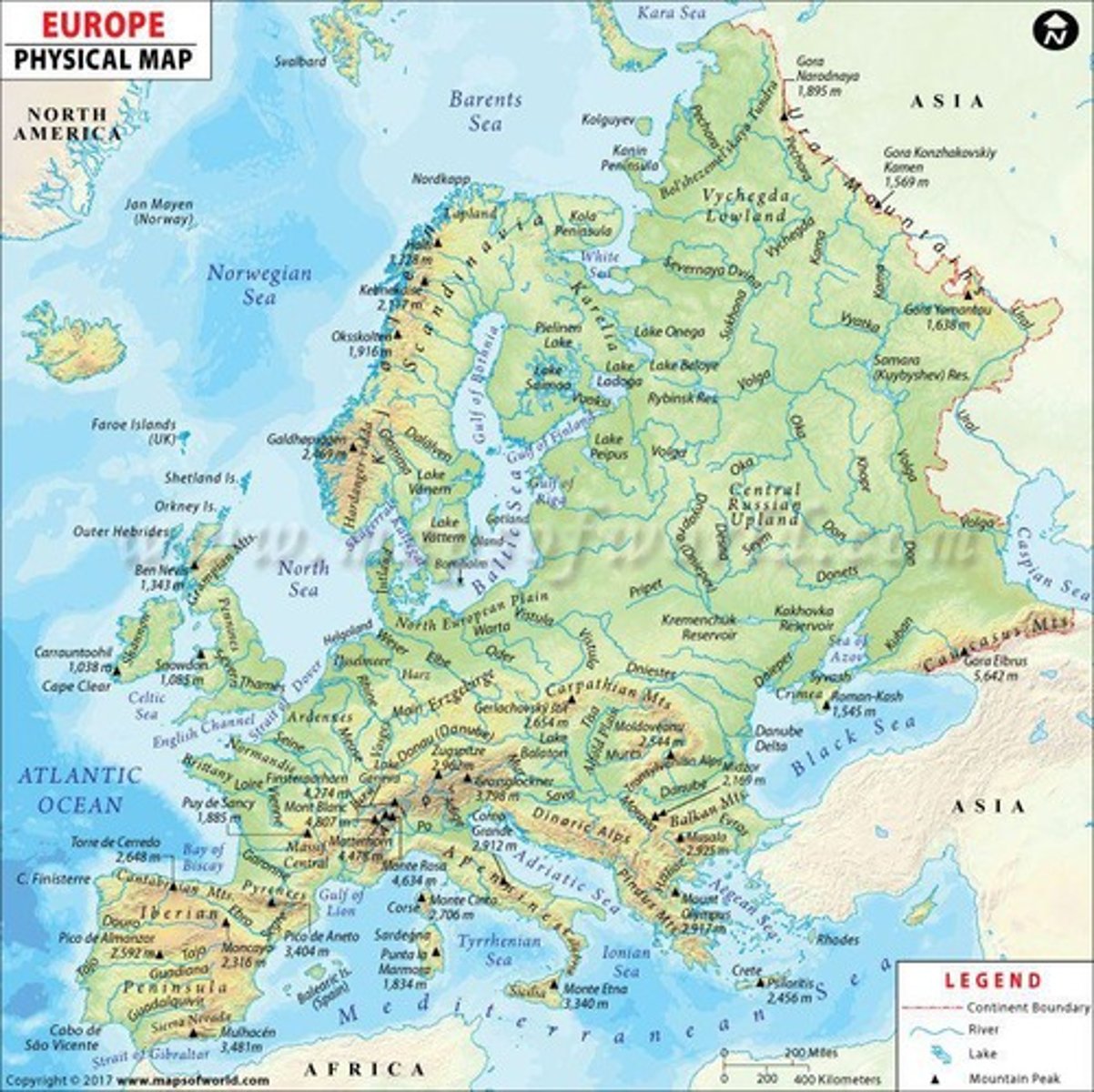
What is the climate type that covers much of Western Europe?
Marine West Coast.
What current carries tropical waters towards Europe?
North Atlantic Drift.
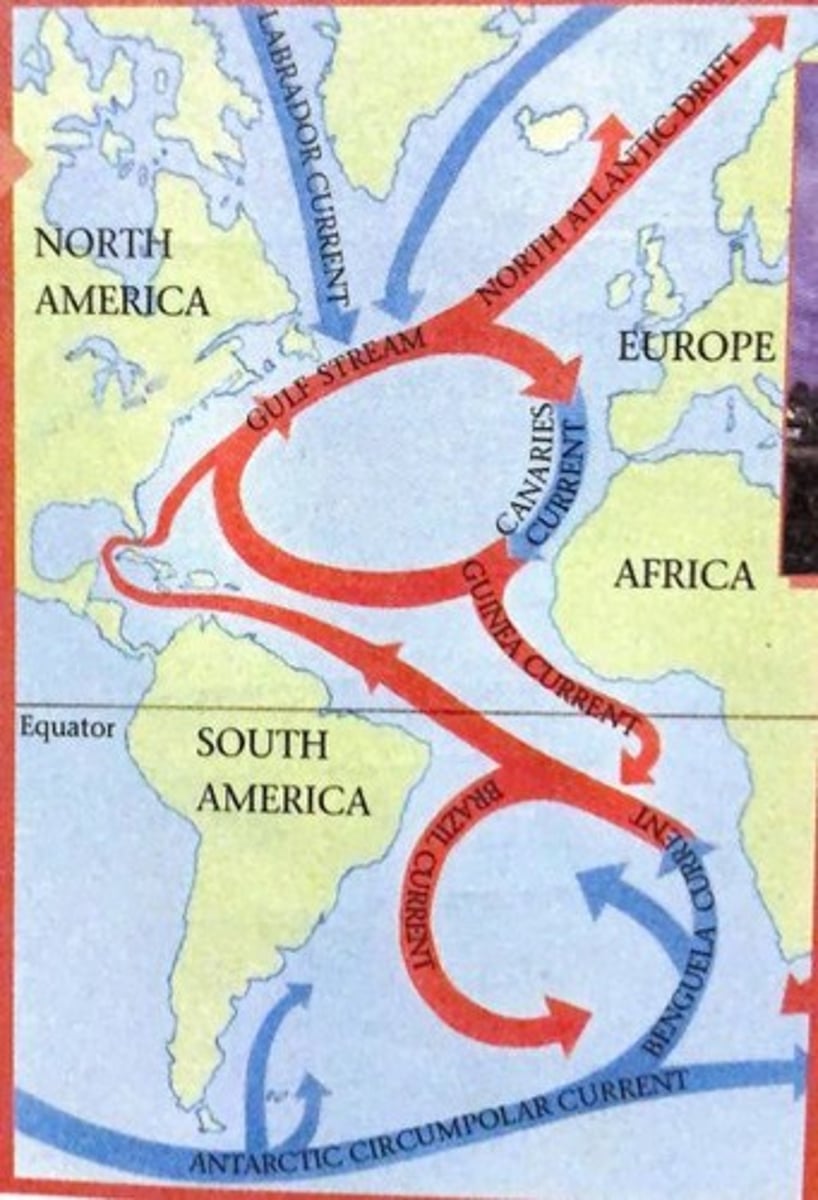
What are prevailing westerlies?
Constant flow of air from West to East in the temperate zones of Earth.
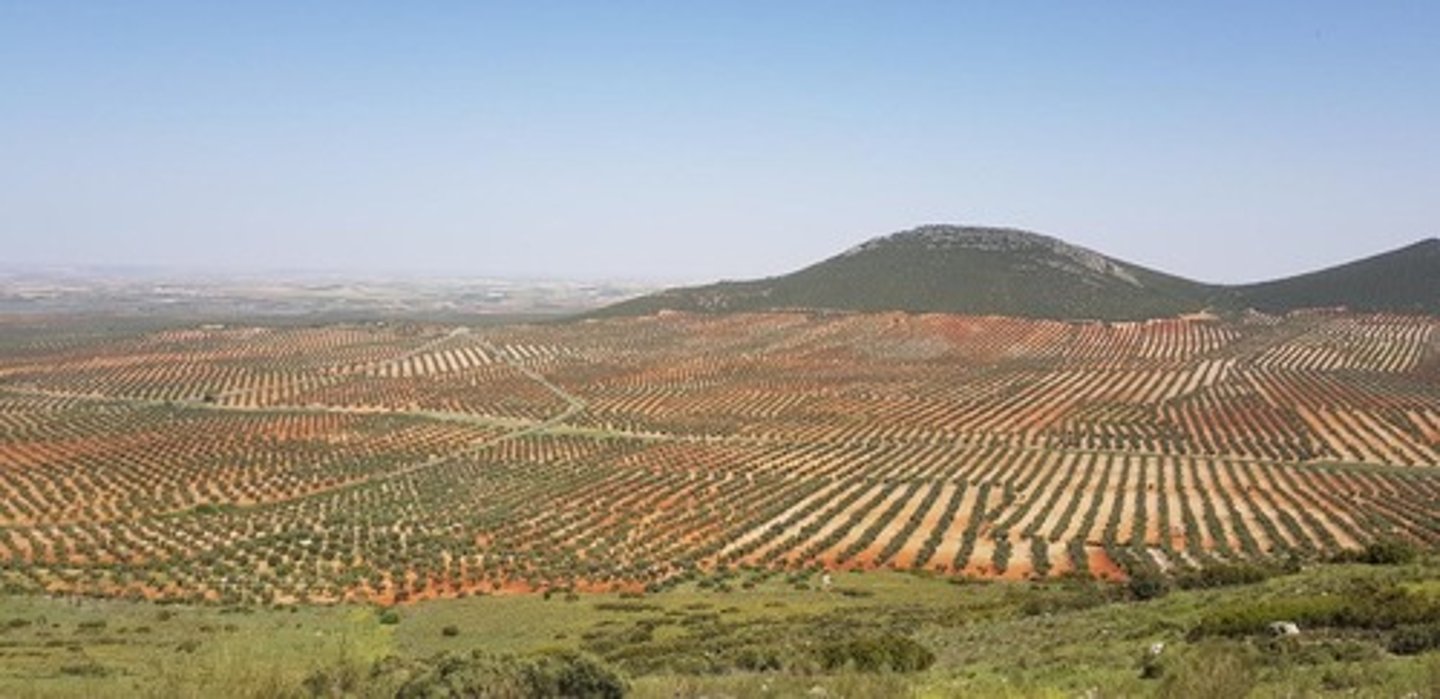
What type of climate encourages olive cultivation in Southern Europe?
Mediterranean Climate.
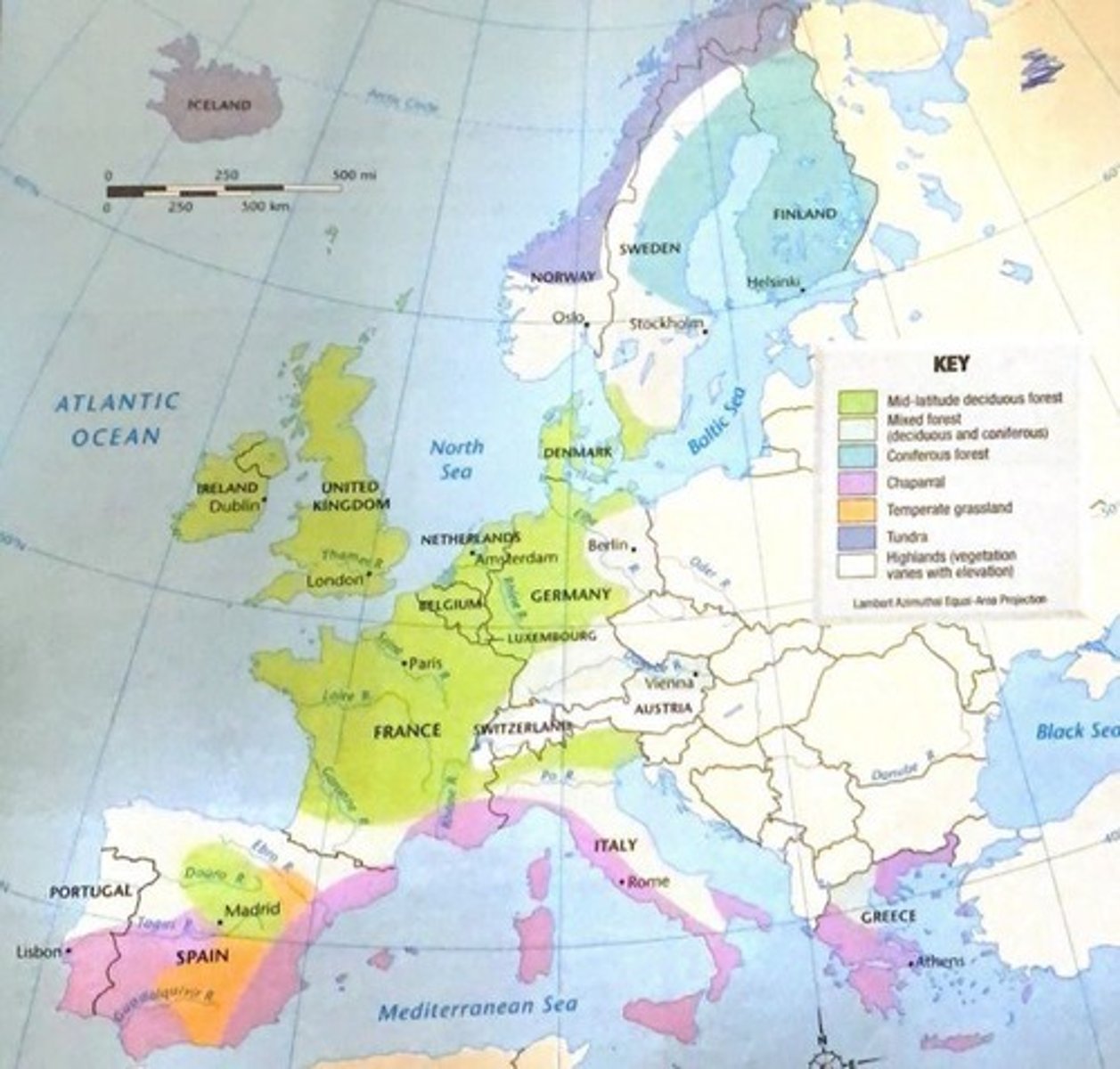
What ecosystem extends over much of Western Europe?
Mid-latitude deciduous forest.
What is reforestation?
The process of planting trees to restore forested areas.
How does elevation affect ecosystems?
Altitude affects vegetation and animal life, with fewer plants and animals living above the tree line.
What type of vegetation is found at 50 degrees North in Western Europe?
Deciduous forests.
What type of forest covers much of the land bordering the Mediterranean Sea?
Chaparral.
What is the significance of wetlands in southern Spain?
They support diverse ecosystems including pine forests and sand dunes.
What is the population density of Western Europe?
Western Europe is densely populated despite its small area.
What architectural features are common in Western European cities?
Soaring cathedrals that served as religious, social, and cultural centers.
What has encouraged migration to Western Europe?
Strong economics in Western European nations have attracted people from around the world.
How does migration affect European cultures?
Migration introduces new traditions, languages, and religions to European cultures.
What are the major languages spoken in the United Kingdom?
English, Gaelic, Welsh, and Irish.
To what group of languages does English belong?
English belongs to the Germanic group of languages.
What languages do Gaelic, Welsh, and Irish belong to?
They belong to the Celtic group of languages.
What ethnic conflict exists in Spain related to language?
Minorities in northern Spain speak Basque and in the southeast speak Catalan, leading to desires for independence.
What is the euro?
The euro is the currency used by member nations of the European Union.
What transformation did the Industrial Revolution bring to Western Europe?
It transformed Western Europe from an agricultural society to an industrial society.
What are the dominant economic activities in Western Europe?
Manufacturing and trade.
What is the significance of the European Union?
It began as a common market for mutual economic benefit and expanded to include a single currency, the euro.
Why is a single currency beneficial for EU members?
It allows for easier trade among member nations.
Where are Western Europe's coal resources located?
Coal resources are primarily located in industrialized countries like Germany and the United Kingdom.
What is compulsory education?
Education that is required by law for children to attend for a certain number of years.
What age range is compulsory education in Finland?
Children from 7 to 16 years old must attend school.
What role does the French national government play in education?
It controls the curriculum and sets high standards for French students.
What is the dropout rate like in Italy?
Many Italian students drop out of school early, with a relatively low university attendance rate.
What is the literacy rate in Finland?
Finland has a literacy rate of 100%.
What percentage of students in Finland attend tertiary education?
85% of students in Finland attend tertiary education.
What is the significance of the University of Bologna?
It is possibly the world's only university and is over 900 years old.
What is the education expenditure as a percentage of GNP in the United Kingdom?
4.4%.
What is the primary school students per teacher ratio in France?
19 students per teacher.
How do primary school enrollment rates compare across Finland, France, Italy, and the UK?
All four countries have 100% enrollment in primary school.
What generalization can be made about education in Western Europe and the United States?
Both regions provide free primary and secondary education to children.
 Note
Note  Flashcards (26)