BIOL 1020 - Lecture 11 + 12: Membrane Dynamics
 Studied by 0 people
 Call with Kai
 Learn
Learn Practice Test
 Spaced Repetition
 Match
Match Flashcards
 Knowt Play
1/32

There's no tags or description
Looks like no tags are added yet.
Name | Mastery | Learn | Test | Matching | Spaced | Call with Kai |
|---|
No study sessions yet.
33 Terms
Explain the fluid mosaic model of the cell membrane
Phospholipid bilayer
Hydrophilic phosphate heads face outward; hydrophobic fatty acid tails face inward.
Amphipathic → spontaneously form bilayers in water.
Other lipids add diversity.
Fluidity
Membrane has oil-like fluid consistency at normal body temperatures
Phospholipids & proteins float, held by hydrophobic interactions.
Cholesterol and lipids regulates fluidity (prevents freezing & overheating) (cis and trans bonds, as well unsaturated fats)
Cytoskeleton (cortical microfilaments) supports shape.
Mosaic nature
Components: proteins, cholesterol, carbohydrates.
Proteins:
Integral (span membrane; hydrophobic α-helices; may form hydrophilic channels).
Peripheral (bound to surface).
Functions: adhesion, communication, signaling, recognition (glycoproteins), transport (channels/pumps), enzymes.
Selective permeability
Controls entry/exit of nutrients, wastes, and products via the composition of the plasma membrane
Nonpolar molecules cross easily; polar/charged/large molecules need proteins.
Transport types:
Passive (diffusion, channels e.g., aquaporins).
Active (energy to move against gradient).
Bulk transport (exocytosis, endocytosis).
Transport proteins are highly specific (e.g., glucose channels exclude fructose).
What are the two main types of proteins suspended in the membrane?
Integral membrane proteins: penetrate the hydrophobic interior of the lipid bilayer
Transmembrane proteins go all the way through
other proteins only go partially through (eg. integrins)
Peripheral proteins: associated with only a single side of the membrane
List the general functions of transmembrane proteins
Transport: selectively allow substances through the membrane
Enzymatic activity: assists in reactions that occur around the plasma membrane
Signal Transduction: proteins have a binding site that accepts specific chemical substances (eg. hormones)
Cell-cell recognition: glycoproteins and glycolipids can be specific in different cell types, serve as ID tags
Intercellular joining: hook together to join adjacent cells
Attachment to the cytoskeleton/ECM: non covalent bonds to microfilaments, which maintains cell shape and stablizes the position of membrane proteins
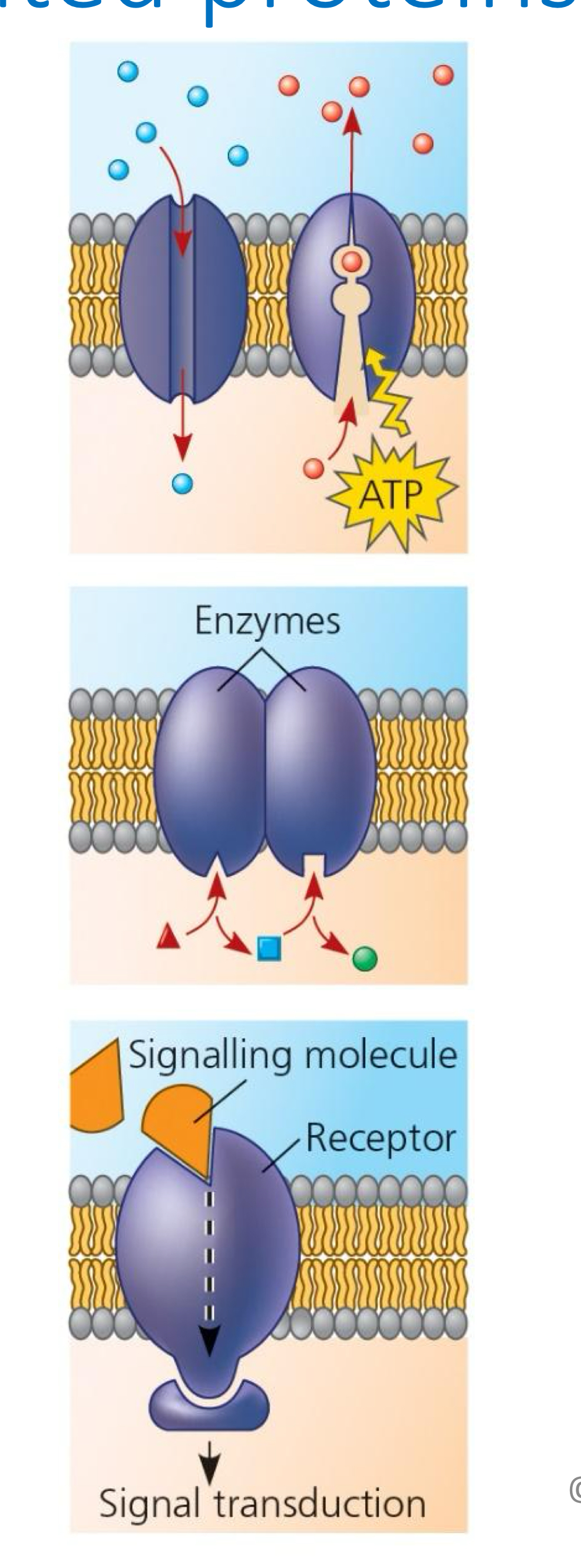
Describe the basic properties of transmembrane proteins that allow them to reside in the lipid bilayer
Amphipathic nature – they have both hydrophobic and hydrophilic regions.
Hydrophobic regions – usually α-helices (or sometimes β-barrels) with nonpolar R-groups that interact with the fatty acid tails in the bilayer’s hydrophobic core.
Hydrophilic regions – portions of the protein that extend into the cytoplasm and extracellular fluid, exposed to water.
What is diffusion?
the movement of particles of any substance to evenly spread out within a space
movement of each individual molecule/particle is random
movement of a population of molecules/particles can be directional
in the absence of other forces, a substance will diffuse from where it is more concentrated to where it is less concentrate
What is passive transport?
allows substances to pass through channel proteins without the use of energy
Describe simple diffusion
movement from higher concentration too lower concentrations, straight through the lipid bilayer
passive
Describe simple diffusion through a channel
movement from higher to lower concentrations through the pore of a membrane channel protein
passive
Describe Facilitated diffusion
movement from higher to lower concentrations via a membrane carrier protein (facilitative transporter)
still passive since high to low
Describe active transport
movement from low to high concentrations via a protein transporter
requires energy (active) which often comes from ATP hydrolysis
Define a semipermeable membrane
A semipermeable membrane is a barrier that allows certain substances to pass through while restricting others.
Typically, it lets small, nonpolar molecules (like O₂, CO₂) and sometimes water pass freely.
It blocks or regulates larger, polar, or charged molecules unless special transport proteins are present.
This property is key for maintaining homeostasis, as it controls what enters and leaves the cell.
Describe osmosis
the diffusion of water across its concentration gradient
the selectively permeable membrane has pores that are too small for sugar but large enough for water
some water moleculees wiil cluster around the solute, making it unavailable.
the left over water not bound to sugar is free water concentration → this is what diffuses
since the sugar is too large to cross the membrane by diffusion, it is termed a nonpenetrating solute
aquaporins
Compare and contrast osmolarity and tonicity
osmolarity: osmotic concentration of a solution, thee number of osmoles per liter of solution
Compounds will split into their ions — eg. 5 mM glucose + 6 mM NaCl = 17 mOsm (6 Na+, 6 Cl-, 5 glucose)
tonicity: the ability of the surrounding solution to gain or lose water within the cell
depends on solute concentration that cannot cross the membrane relative to what is inside the cell
What are hypotonic, isotonic, and hypertonic solutions
Isotonic = same; no net movement of free water across the plasma membrane
water will move in and out
Hypertonic = more; concentration of solutes is greater outside of the cell
water will leave the cell
Hypotonic = less; concentration of solutes is greater inside the cell
water will enter the cell
Describe the effects hypotonic, isotonic, and hypertonic solutions in plant and animal cell
Animals:
Hypotonic - lysed (water enters, cell swells)
Isotonic - normal (water enters and leaves)
Hypertonic - shrivelled (water leaves the cell)
Plants:
Hypotonic - turgid (normal) (H2O enters, cell has turgor pressure)
Isotonic - flaccid (no net movement of water, cell lacks turgor)
Hypertonic - plasmolyzed (water leaves the cell, irrevesible)
What is osmoregulation
occurs in some animal cells
controls solute and water concentration
Compare and contrast simple and facilitated diffusion
Similarities (both are passive transport):
Move molecules down their concentration gradient (high → low).
No energy (ATP) required.
Aim to reach equilibrium across the membrane.
Simple diffusion:
Molecules pass directly through the lipid bilayer.
Works for small, nonpolar molecules (O₂, CO₂, steroids, lipids).
Rate depends only on the concentration gradient and membrane permeability.
No transport proteins involved.
Facilitated diffusion:
Molecules move via specific transport proteins (channel or carrier).
Used for polar, charged, or larger molecules (glucose, ions, amino acids).
Rate can be faster but saturates if all transport proteins are occupied.
Proteins are selective for the molecules they transport.
Explain secondary active transport
Secondary active transport (also called cotransport) uses the energy stored in an electrochemical gradient created by primary active transport to move another molecule against its concentration gradient.
How it works:
Primary active transport (like the Na⁺/K⁺ pump) uses ATP to create a gradient.
Secondary active transport proteins harness that gradient.
One molecule moves down its gradient (providing energy), while another moves against its gradient.
Types:
Symport: Both molecules move in the same direction (e.g., Na⁺-glucose symporter).
Antiport: Molecules move in opposite directions (e.g., Na⁺-Ca²⁺ exchanger).
Remember that R-groups of alpha helices radiate out from the helix, so what parts of the integral membrane protein alpha helices interact with the phospholipid tails?
a. hydrophillic R groups
b. charged R groups
c. hydrophobic R groups
d. peptide backbone atoms
c. hydrophobic R groups
Integral membrane proteins span the lipid bilayer with α-helices.
The R-groups project outward from the helix.
Since the interior of the membrane is hydrophobic (fatty acid tails), the R-groups that face the tails must also be hydrophobic (nonpolar).
Hydrophilic or charged R-groups instead face aqueous environments (cytoplasm/extracellular space) or line channels/pores inside the protein.
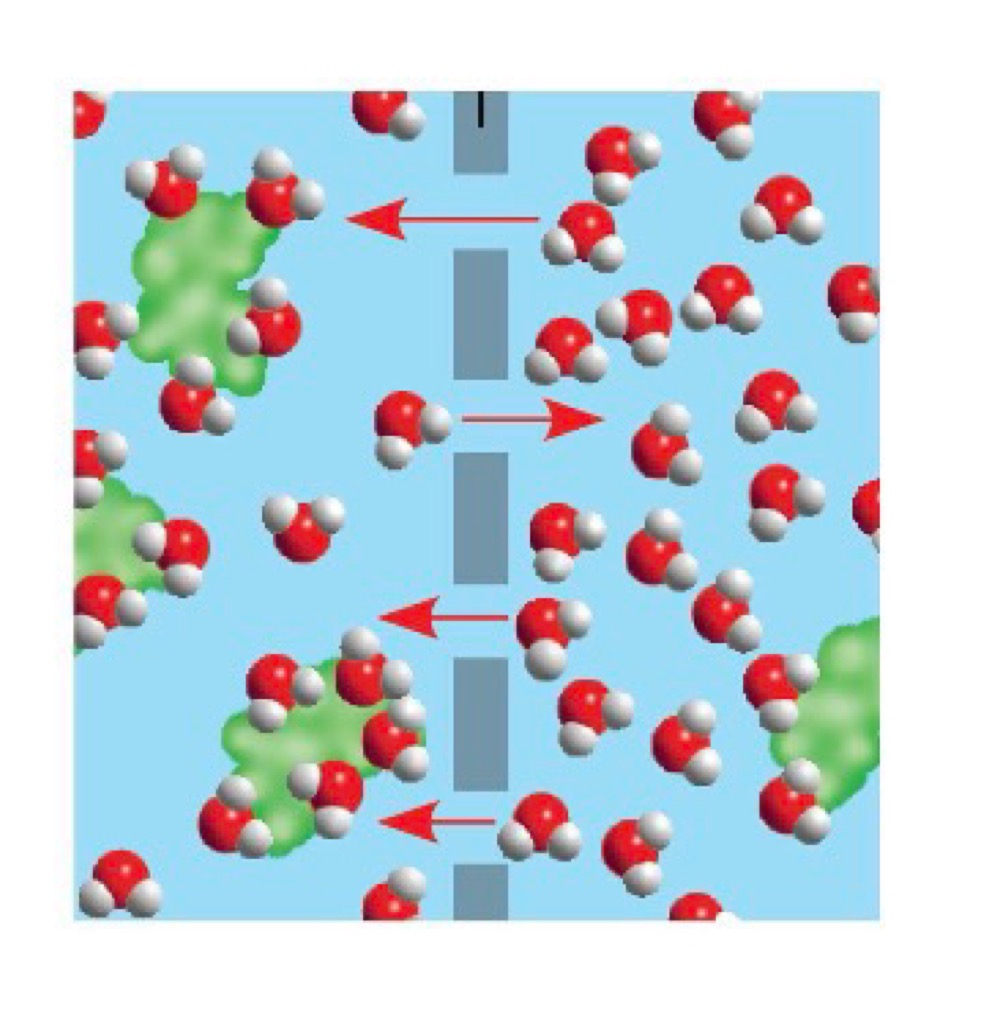
Which direction will water move across the semipermeable membrane
a. left to right
b. right to left
c. water will not move
b. right to left
water will move from a high concentration of free water to a lower concentration
What of the following factors would tend to increase membrane fluidity
a. a greater proportion of unsaturated phospholipids
b. a greater proportion of saturated phospholipids
c. a lower temperature
d. a relatively high protein content in the membrane
a. a greater proportion of unsaturated phospholipids
What kind of protein do not carry out membrane transport
A. Integral proteins
B. Peripheral proteins
C. Proton pumps
D. Channel proteins
E. Carrier proteins
B. Peripheral proteins
A plant cell that is in an isotonic solution will be:
A. Turgid
B. Flaccid
C. Plasmolyzed
b. flaccid
A heffalump’s blood is isotonic and isosmootic at 185 mM NaCl to RBC. If you place the RBC into a solution containing 160mM NaCl, what would happeen to the cell?
a. the cell would plasmolyse
b. the cell would shrink
c. the cell would lyse
d. the cell would become turgid
c. the cell would lyse
Which best describes the fluid mosaic model of plasma membrane?
a. polar heads face inwarrds and nonpolar tails face outwards
b. The phospholipids move around but membrane proteins are flued in place
c. The Plasma membrane is stiff and rigid
d. All membrane components are constantly moving and rearranging within the membrane
d. All membrane components are constantly moving and rearranging within the membrane
Which of the following factors would tend to increase membrane fluidity
a. a lower temperature
b. a relatively high protein count
c. a greater proportion of unsaturated phospholipids
d. a greater proportion of saturated phospholipids
c. a greater proportion of unsaturated phospholipids
Which is not a function of plasma membrane bound proteins
a. signal transduction
b. transport
c. cell-cell recognition
d. RNA transcription and translation
e. attachment to the cytoskeleton and extracellular matrix
d. RNA transcription and translation
The structure of membrane proteins usually consists of
a. polar beta sheets
b. polar alpha helice
c. non polar beta sheets
d. non polar alpha helices
d. non polar alpha helices
Molecules of water are diffused through the plasma membrane via an aquaporin. This is an example off
a. facilitated diffusion through a carrier protein
b. active transport
c. simple diffusion
d. facilitated diffusion through a channel protein
d. facilitated diffusion through a channel protein
Cholesterol helps to maintain membrane fluidity by
a. packing phospholipids more closely together at cooler temperatures
b. doing nothing, cholesterol is not essential in the plasma membrane
c. restricting the movement of phospholipids at higher temperatures
d. Increasing protein content
c. restricting the movement of phospholipids at higher temperatures
In what way do the membranes of a eukaryotic cell vary
a. only certain membranes are constructed from amphipathic molecules
b. certain proteins are unique to each membrane
c. only certain membranes of the cell are selectively permeable
d. phospholipids are only found in certain membranes
b. certain proteins are unique to each membrane
According to the fluid mosaic model of membrane structure, proteins of the membranes are mostly
a. spread in a continuous layer over the inner and outer surfaces of the membrane
b. randomly oriented in the membrane, with no fixed inside outside polarity
c. embedded in a lipid bilayer
d. confined to the hydrophobic interior of the membrane
c. embedded in a lipid bilayer
Which of the following processes includes all the others
a. passive transport
b. osmosis
c. diffusion of a solute across a membrane
d. transport of an ion down its electrochemical gradient
a. passive transport
 Note
Note  Flashcards (86)