Sophmore Swim
 Studied by 0 people
 Call Kai
 Learn
Learn Practice Test
 Spaced Repetition
 Match
Match Flashcards
 Knowt Play
1/11

There's no tags or description
Looks like no tags are added yet.
Name | Mastery | Learn | Test | Matching | Spaced | Call with Kai |
|---|
No analytics yet
Send a link to your students to track their progress
12 Terms
3 Basic Objectives
Safety-RULE #1 AROUND WATER IS SAVE YOURSELF FIRST
Fitness-How to use swimming to improve fitness
Fun-Having fun while improving your swim stroke and becoming more efficient in the water.
Pool Rules
No running
No hanging on the lane lines
No food gum or drink
No shoes on deck
Proper bathing attire only (1 piece suits and no cotton t shirts)
No diving in the shallow water
Never any phones on deck- never!
No touching the basketball hoop, rim, net.
Apply Levers to swimming
The farther your arms are forward the longer your lever is. Often compared to a teeter totter as a way to see the balance we are looking for in the water. A balanced swimmer swims on the surface of the water.
Front Crawl/ Freestyle
Head down so you see the bottom of pool, breathe to side
Balanced body position- finding the center of buoyancy. Often compared to teeter totter or a first class lever as a way to see the balance we are looking for in the water. A balanced swimmer swims on the surface of the water.
Arms, always one arm out in front, arms recover and get ready for the next workload, out of the water.
Flutter kick on the surface of the water with mostly straight legs.
Full length of pool
What is a Shepards Crook?
a required piece of equipment for all publicly attended facilities and is the easiest most effective device for making an “extension assist” 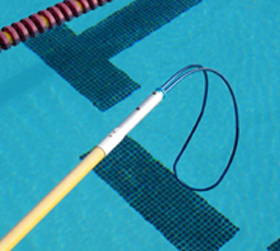
How to use a shepards crook
Lower the rounded end into the water
Push/press it into the victim’s gut
Put weight on back foot
Pull victim in slowly, hand over hand
Safety while practicing and testing.
How to use a ring bouy (required for all public facilities)
Step on the float end of the rope with your non-dominant foot out front.
Have excess looped rope in an open non-dominant hand.
Throw a buoy underhand, like horseshoes for accuracy.
Throw a buoy past the victim.
Use rope to pull the victim to the side, slowly, hand over hand.
How to do backstroke (a competition Stroke)
Balanced body position- finding the center of buoyancy. Often compared to teeter totter or a first class lever as a way to see the balance we are looking for in the water. A balanced swimmer swims on the surface of the water.
Chin up, ears in water
Arms, hand enters pinky in, thumb out
Kicking the water out of the pool, upward motion is the propulsion of the kick
Full length of pool
Elementary Backstroke (least amount of “work” needed, recovery stroke)
Balanced body position- finding the center of buoyancy. Often compared to teeter totter or a first class lever as a way to see the balance we are looking for in the water. A balanced swimmer swims on the surface of the water.
Arms- in water recovery for this stroke
Kick-knees together, heals back, turn out toes, snap heals around and back together in a snapping motion
Glide-minimum of 5 second glide insures proper timing of pull and kick
Full length of pool
Red Cross 5 Skills to Save Your Life in Water
1. Step or jump into the water over your head.
2. Return to the surface and float or tread water for one minute.
3. Turn around in a full circle and find an exit.
4. Swim 25 yards to the exit without stopping.
5. Exit from the water. If in a pool, be able to exit without using the ladder.
Progressive Overload
is the gradual increase of stress placed upon the body during exercise training.
Rule of Progression
Gradually adding more stress in one of the 3 areas of time, frequency, or intensity.
 Note
Note  Flashcards (44)