Urban Heat Islands Module: Review Sheet Key Concepts
 Studied by 0 people
 Call Kai
 Learn
Learn Practice Test
 Spaced Repetition
 Match
Match Flashcards
 Knowt Play
1/30

Earn XP
Description and Tags
These flashcards cover key vocabulary and concepts related to Urban Heat Islands, their causes, and effects.
Name | Mastery | Learn | Test | Matching | Spaced | Call with Kai |
|---|
No analytics yet
Send a link to your students to track their progress
31 Terms
Urban Heat Island (UHI)
The relative warmth of a city compared to surrounding rural areas, caused by heat-absorbing surfaces, reduced vegetation, and human activities.
Albedo
A measure of reflectivity (0.0 to 1.0); higher albedo means more sunlight is reflected and less is absorbed.
Urban Tree Canopy
The layer of leaves, branches, and stems covering the ground when viewed from above, which can reduce heat island effects.
Thermodynamics Energy
The potential to perform work or effect physical change, including forms like thermal, radiative, kinetic, chemical, and electrical energy.
Heat
The transfer of thermal energy between objects, flowing from hotter to cooler objects.
Transpiration
Water movement through a plant and its evaporation from leaves, stems, and flowers.
Evaporative Cooling
A process where evaporation from a surface absorbs heat, cooling the object.
Conduction
Heat movement through direct contact.
Convection
Heat transfer via fluid movement, such as air or water.
Radiation
Heat transfer via electromagnetic waves.
Redlining
A historical discriminatory practice denying financial services to minority neighborhoods.
Equilibrium
When energy in equals energy out, resulting in a constant temperature.
Xylem
Tubes in wood that carry water upward from the roots.
Stomata
Small holes in leaves where water vapor exits and CO₂ enters.
Key structures
Roots (absorbs water with dissolved nutrients
Xylem (tubes carrying water upward)
Stomata (small holes in leaves where water evaporates and CO2 enters)
A parking lot has an albedo of 0.10 and a white roof has an albedo of 0.65. Which surface will have a higher equilibrium temperature on a sunny day, and why?
The parking lot will have a higher equilibrium temperature
The parking lot has a low albedo (0.10) meaning it absorbs about
90% of incoming solar radiation and reflects very littleThe white roof has a high albedo (0.65) meaning it reflects about
65% of sunlight and absorbs much less energySince temperature increases when energy absorption exceeds energy
loss, the parking lot absorbs far more solar energy causing it to heat up to a
higher equilibrium
Draw or describe an energy diagram showing how transpiration cools a tree's leaves. Include the energy transfers and phase change involved.
Incoming energy
· Sunlight strikes leaves → leaves absorb solar radiation→ leaf temperature rises
Cooling process
· Water inside the tree moves from roots → trunk → leaves
· Water evaporates from leaf pores (stomata)
· Phase change: liquid water → water vapor
Energy transfer
· Evaporation requires energy called latent heat of vaporization
· That energy is taken from the leaf’s thermal energy
· Removing heat lowers leaf temperatures and cools surrounding air
· Sunlight→ absorbed by leaf→ water evaporates→ heat energy removed→ leaf and air cools
Urban heat islands can exist without climate change, but how does climate change worsen the heat island problem?
· UHI occur because cities contain heat absorbing materials like asphalt and concrete and have fewer plants
Climate change worsens UHIs by
· Increasing baseline global temperatures
· Making heat waves more frequent and intense
· Increasing nighttime temperatures which reduces cooling periods
· Increasing drought stress, reducing plant cooling effects
· These factors make already warm urban areas even hotter and more dangerous
1. Why do trees reduce urban temperatures more effectively than their low albedo (0.15–0.18) would suggest?
· Trees have a relatively low albedo (they absorb sunlight), but they still cool cities effectively because
Transpiration cooling
· Trees release water vapor, removing heat through evaporation
Shade
· Tree canopies block solar radiation from reaching buildings, pavement, and people
Reduced surface heat storage
· Shaded surfaces absorb and store less heat, lowering overall temps
· Because trees cool both through shade and evaporation, their cooling impact is much greater than albedo alone would predict
1. Explain the connection between historical redlining and present-day urban heat distribution. What type of human-environment interaction is involved when cities now plant trees in these areas?
connection:
· Redlining was a discriminatory housing policy that restricted investment in certain neighborhoods, often minority communities
· These neighborhoods received fewer trees, parks, green spaces
· Overtime, they developed more pavement and dense infrastructure
· Today these areas tend to have higher temperatures and stronger urban heat island effects
Type of human-environmental interaction:
· This is an example of human modification of the environment
· Modern tree planting programs represent efforts to restore environmental balance and reduce heat inequities caused by past human life
1. An object at high temperature emits more thermal radiation than the same object at low temperature. How does this principle help explain why surfaces reach a stable equilibrium temperature in sunlight?
· An object in sunlight absorbs solar radiation and also emits thermal (infrared) radiation
· When the object is cool, it absorbs more energy than it emits → temperature rises
· As temperature increases, thermal radiation emission increases
· Eventually the rate of energy emitted equals the rate of energy absorbed
· At this point, the object reaches equilibrium temperature, where temperature remains stable because energy gains and losses are balanced
Name one effect that urban heat islands have on local weather patterns
- increase thunderstorm formation
- reduce nighttime cooling
-alter wind patterns
- increase air pollution formation (like ozone)
Name a specific adaptation strategy that cities can use to reduce the urban heat island effect.
cities can plant more trees and expand greenspaces
-installing green roofs, using reflective cool roofing materials, using light colored pavement
. Briefly describe how historical redlining relates to present-day urban heat distribution
Historical redlining prevented investment in certain neighborhoods, especially minority communities. These areas received fewer parks and trees and had more pavement and dense development. As a result, they now tend to be hotter and experience stronger urban heat island effects compared to formerly wealthier, greener neighborhoods
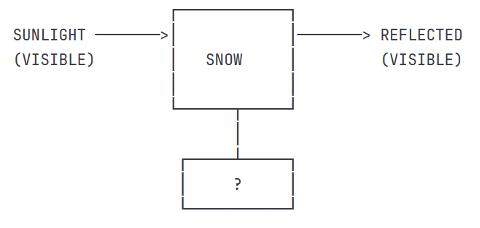
Consider the energy diagram at right.
What text should replace the question mark?
Emitted infrared (thermal) radiation
- Snow received visible sunlight
- Snow reflects some visible light (high albedo)
- Snow also absorbs some energy and then releases it as infrared heat radiation
Consider the following situation described in everyday language. Create an energy diagram that shows this process.
A CUP OF HOT COFFEE IS COOLING DOWN.
Energy source
- hot coffee contains thermal energy
Energy transfers
-heat moves from coffee to surrounding air by:
- conduction( through cup)
- Convection (warm air rising)
- this evaporation removes heat (latent heat loss), helping cool the coffee
Hot coffee (thermal energy) heat loss to air (convection+conduction+radiation) evaporation of water (liquidgas) removes additional heat coffee temperature decreases
. Rewrite this everyday description using the scientific terms from class:
"The black asphalt road gets really hot in the sun, much hotter than the white concrete sidewalk next to it."
The black asphalt road has a lower albedo than the white concrete sidewalk, so it absorbs a greater proportion of incoming solar radiation. Because it absorbs more energy and reflects less sunlight, the asphalt reaches a higher equilibrium temperature than the concrete surface
Explain how transpiration cools the air around a tree. Make sure to include where the cooling effect occurs, what phase change is involved, and how the heat is carried away from the tree.
- Transpiration cools the air around the leaves and the canopy of a tree
- Water absorbed by the roots travels through the xylem to the leaves
- At the leaves, water exists through stomata and undergoes a phase change from liquid water to water vapor
- This evaporation requires energy known as latent heat of vaporization, which is taken from the leaf and surrounding air.
- As heat energy is removed, the leaf temperature decreases, and cooler air is released into the surrounding environment, helping reduce local air temperatures
Xylem are...
tubes in wood that carry water upward from roots
Trees have a low albedo similar to asphalt, yet they cool urban areas more effectively than asphalt. true or false
true
Which of these is NOT a cause of urban heat islands?
A. heat-absorbing properties of building materials
B. Transpiration from urban vegetation
C. reduced ventilation from building configuration
D. heat emissions from air conditioning and industry
B. Transpiration from urban vegetation
 Note
Note  Flashcards (31)