Chapter 7: Microbiology Exam 1
 Studied by 0 people
 Call with Kai
 Learn
Learn Practice Test
 Spaced Repetition
 Match
Match Flashcards
 Knowt Play
1/104

There's no tags or description
Looks like no tags are added yet.
Name | Mastery | Learn | Test | Matching | Spaced | Call with Kai |
|---|
No study sessions yet.
105 Terms
What is matter? What % of matter makes up cells
Matter takes up space and mass
cells are 70% water
97% of cell weight is organic compounds, proteins being most prevalent
96% of cell is composed of 6 elements: Carbon, Hydrogen, Oxygen, Phosphorus, Sulfur, Nitrogen
What are trace elements
Trace elements are required by an organism in only minute quantities such as iron in humans.
How long have microbes been on Earth and how do they make changes to the ecosystem?
Microbes have been on earth for 3.5 billion years and they change the ecosystem by changing the (4)
atmosphere
Freshwater/marine systems
Development of rich soils
All nutrient cycles are possible due to microbes
What is nitrogen fixation?
The reduction of N2 to organic nitrogen. Humans are dependent on this system, it takes N2 gas, reduces it into an organic molecules that all organisms can use
What 2 macromolecules have N in it , which is why organic N is useful
Dna and proteins
_____ naturally produced organic nitrogen is of prokaryotic origin
ALL
What are the 3 types of nutrition categorization of prokaryotes
Those that acquire carbon (Autotroph and heterotroph )
Those that need an energy source (phototrophs, chemotrophs)
Electron Source (lithographs, organotrophs)
What are autotrophs and heterotrophs
Auto: use CO2 as source for carbon, energy acquired from other sources (sun)
Hetero: use variety of carbon sources, energy is acquired from organic molecules
What are the two energy sources definition
Phototrophs
Chemotrophs
Phototrophs: gets energy from light
Chemotrophs: obtains energy from oxidation of chemical compounds
What is the Electron source definition in Prokaryotes
Lithotrophs are reduced inorganic substances such as H2O
Organotrophs: obtain electrons from organic compounds such as sugar
What are chemoorganotrophs and chemolitotrophs
Chemoorganotrophs: comes from organic molecules
Chemilithotrophs: comes from inorganic molecules
Why are nutritional types important
they add on greater diversity of metabolic processes
They can live in different locations then eukaryotes
What are the 7 microbial interaction types
Mutualism
Cooperation
Commensalism
Amensalism
Predation
Parasitism
Competition
What type of benefit occurs in Mutualism
both benefit
It is a coevolutionary process that is more dependent
What type of benefit occurs with cooperation
Both benefit but it is luck by association
What type of benefit happens in predation?
One organism benefits which is the prey and one organism doesn’t benefit which is the prey that died
What type of interaction type or benefit occurs with parasitism
One organism benefits and the other organism does not benefit
What type of interaction type or benefit occurs with competition
Negative, negative relationship
Even the winner has to waste energy to get what it needs. They lost something in the process even if they win they can not get back.
One outcompetes the other for sites resources
What happens during commensalism and amensalim what type of relationship
Commensalism: where one species benefits from the other without affecting it, neither harming or helping it
Ammensalism: one species inhibits, harms or destroys the other, while the other organism remains unaffected and receives no benefit
If a species is +, and another relationship is - and another relationship is 0 what does this all mean
+= more likely to successfully reproduce hence having a fitness benefit
0= more likely to have no effect on fitness
-= more likely to be at a fitness cost, and is less likely to reproduce
+/+ relationship
Mutualism and Cooperation
One + one neutral
Commensalism
One - one neutral
Amensalism
-/-
competition
+/-
Predation
Parasitism
How to tell apart paradise and predation
In predation one predator eats its prey and removes it from the population
In parasitism , the parasite does not want to killl the host because it needs the host as a “home”
When something is intraspecifci what does that mean
It means that two organisms of the same species interact in competition
If something in interspecific what does this mean
It invovles all interaction types
When something is ectosymbiont what does that mean
This means that one organism is located on the surface of another organism (on top of one)
What is symbiosis
Symbiosis is an association of two or more different species of organisms
What does it mean when something is symbiont
When something is symbiont this means that the organism that has a specific relationship with another that can be characterized as mutualism, parasitism, commensalism or Amensalism.
What is an endosymbiont
Endosymbiont is an organism located within another organisms (inside)
What is the definition of mutualism
Mutualism is a symbiotic relationship between 2 or more species where parties benefit (+/+)
what is tube worm bacterial relationships?
Tube worm bacterial relationships exist thousands of meters below ocean surface. Giant tube worms provide a home and raw chemicals to internal bacteria, which in return gives food to the worm by chemical energy
When something is cooperation type of relationship, what does that mean
when something is considered cooperation, when its interaction is not species to species dependent for fitness. Therefore, each person is unique due to environmental factors.
What is the difference between mutualism and cooperation
Mutualism is a mandatory partnership where both species are so dependent on each other that they cannot survive alone. Cooperation is an optional relationship where both sides benefit from working together but are perfectly capable of surviving independently.
What is commensalism
A symbiotic relationship where one part benefits while the other is not affected because of proximity
How does spatial proximity affect commensalism
Spatial proximity can involve modification of environment by one organism, making it more suited for another organism
What are two examples w microorganisms where spatial proximity is important
Microbial succession during spoilage of milk. Fermenting bacteria promote growth of acid tolerant species
Formation of Biofilms: initial colonizer helps other microorganisms attach
Genus Streptomyces is what type of relationship behavior
Amensalism, in which one species is harmed and another is neutral.
What is an example of Amensalism?
Some microbes produce many antibiotics, and inactive complaints, that can sometimes have off target effects. But humans do not know if it can also provide a benefit which is why it is hard to study/show this relationship
Definition the relationship of predation
+ / -
Relationship between predator and prey. The predator survives by killling and eating prey. Predators are always higher in the trophic level than their prey
Define the relationship of parasitism
+ / - relationship
A symbiotic relationship in which one organism the parasite benefits, while the host is harmed. Parasites however, often live exclusively on or in the host organisms, so they make small damage to not kill the host
Talk about the steps of the zombie ant (4)
Fungi spores fall from the canopy/leaves in a rainforest and falls on the floor onto an ant
The fungi is able to break into the exoskeleton of the ant and the spores each teh chitin of the exoskeleton. The fungi buries itself in the nervous tissue of the ant
The fungi hijacks the nervous system of teh ant, making them “antisocial”. It then forces the ant to climb trees and do a death grip
During the death grip, the fungi starves the ant to death. The death grip forces the ant to go and bite the underside of the leaf to kill it. Then the fungi eats the ant, and falls over again to attack more ants
Interspecifc vs intra specific in relationships
Interspeciic has all types of relationships/interaction types (multitask, cooperation, commensalim, ammenlsim, predation, parasite, etc)
Intraspecific since its species to species specific, and the two organisms need the same resources to some variety, it only has competition interactions.
If there is more overlap between individual niches what happens
Stronger the interactions types
What is the definition of symbiosis
The relationship in which 2 different organisms live together, often interdependent, (paradigm, mutualism, commensalism, Amensalism, etc)
In intraspecific competition such as male zebras fight to defend territory and ensure breeding privileges, the ______ are identical
Niches
What is a niche
A nice is a “role” an organism plays within its environment, including how it gets foods, where it lives, and how it interacts with other species
What happens in interspecific competition? (Diff animals) there are also two outcomes define these
This occurs when 2 different organisms try to acquire or use the same resources. There are two possible outcomes of competition
1) occurs when 2 organisms niches overlap
2) Long term competition can be a stimulus for natural selection/evolution
What is resource partitioning ?
Species reduce competition by reducing overlap in fundamental niches.
this requires natural selection and evolution to reduce competition
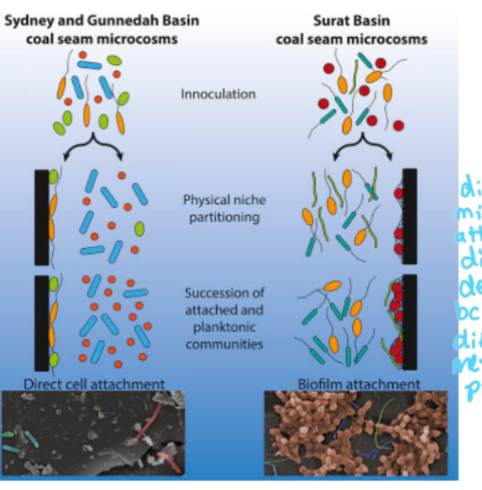
Explain this and why it’s important
This si important bc it shows resource partionining in which diff micrbonbes attach at diff depths of teh ocean because of different metabolic processes.
Species reduce competition by reducing….
Overlap in fundamental niches
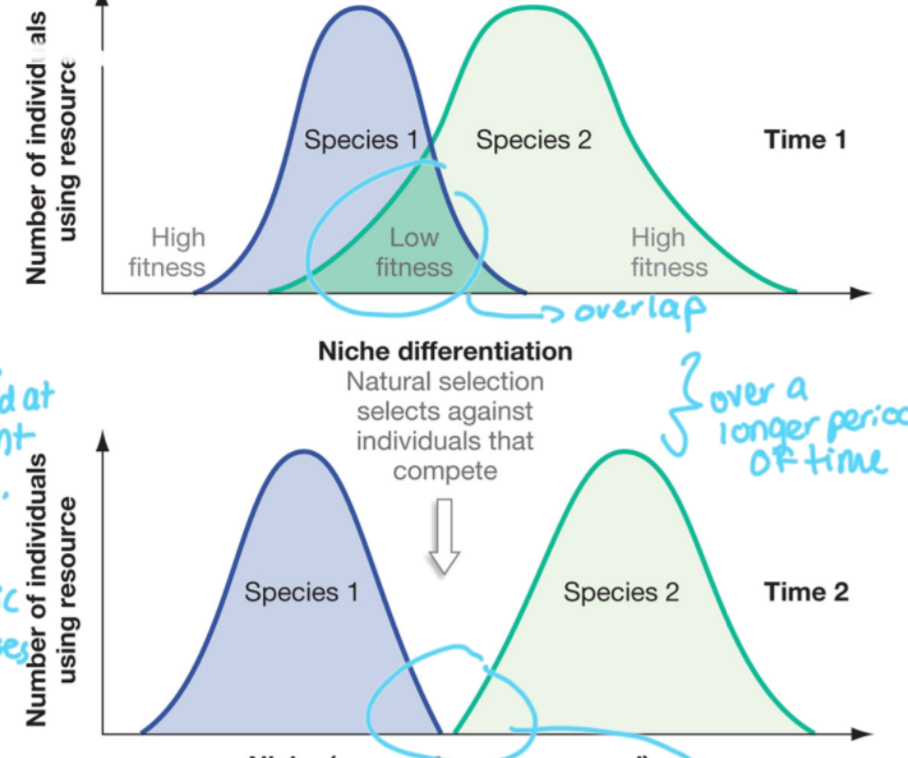
Explain these two graphs
In teh first graph the niches tend to overlap therefore there is more competition between two species.
In the second graph overtime w natural selection, and evolution, a niche differentiation occurs, and natural selection selects against individuals that compete, and there is less competition.
Overall this is called resource partitioning
What is competitive exclusion? Explain the two aspects of it (principle and explanation )
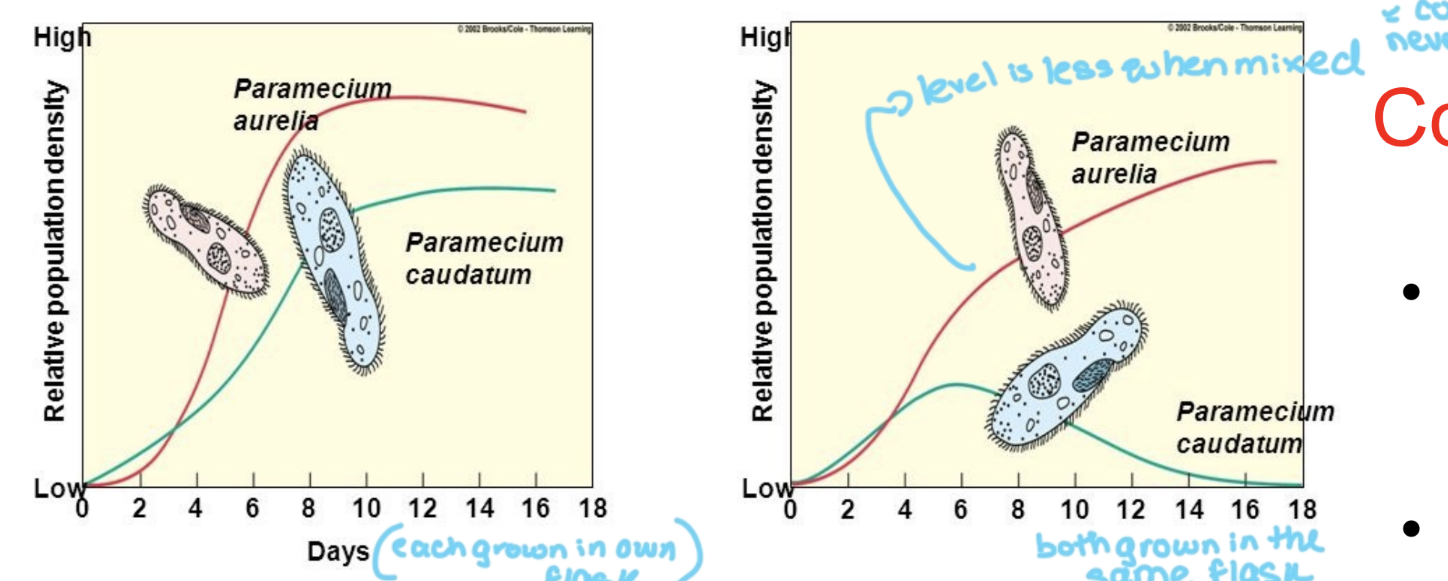
Competitive exclusion occurs when 2 organisms try to acquire or use the same resources, and one species is extinct locally.
principle: one organism dominates
Explanation: if the fundamental niches overlap fully, one species will go to extinction.
This happens when there is no way to seperate the niches over a long period of time. NS and evolution will drive these species into extinction
give an example of the competitive exclusion pricniple.
in one grpah each bacterium is grown in its own flask, and thee is signficant population growth for both. however, when both of these bacfteria are grown in the same flask, one speciies goes completely extinct, and the compeititor never reaches full population densiry either. thi shows that once niches overlap, one speciies will go extinct locally in that area
what is the “true” definition of coevolution
one has to generate adaptation to every advantage that others might have
“ in reference to an evolutionary system, continuing adaptation is needed in order for a species to maintain its relative fitness amongst the systems it is coevolving with
How is the fungal farming ants a complex interaction example?
these farmer ants cultivate a fungal garden (A). it is a predator/prey/mutualistic interaction.
there is a parasite (B) on the fungal garden that can eats this fungus (A) produced by the ant
therefore, the ant promotes the grown of another fungi (C) to inhibit the growth of the parasite (B) that kills the other fungi(A)
but there is another parasite (D) that prevents the grown of that protective fungal (C)
in this. the ant and parasite are always in competition
what is biofilm?
biofilm is when certain bacteria attatch to a substrate, adhere to a surface, secrete a slimy coat, which makes a comfortable enviornment for other microbes
Prokaryotes mainly Eubacteria, can adhere to solid surfaces to form a slimy, slippper coat called the
biofilm
how does the glycocalyx become biofilm?
The glycocalyx acts as the initial glue that allows individual bacteria to anchor themselves firmly to a surface. Once attached, the bacteria multiply and secrete massive amounts of this sugary material to build a shared, protective "city" called a biofilm.
why are biofilms studied (2)
they are very complex and permanently attach communities of prokaryotic organisms
they can cause environmental problems or chronic bacterial infections in humans
How do biofilms form? (4 steps)
1) Attachment: the process begins when individual microbes lightly stick to a surface
Growth: the microbes then release a “sticky glue” made of sugars, DNA, and proteins called EPS to build a protective cover around themselves
Maturation: the biofilm grows into a complex, organized community where diff species work tg and communicate
Detachment: parts of the biofilm breaks off to travel and to start the cycle again on a new surface
why is biofilm important in medicine
these structures are a major problem in medicine because they are very resistant and difficult to treat with standard methods.
bacteria can be found in medical devices such as sub venous catheters, hip implants, mouth, and they are difficult to treat/penetrate.
what is common life example of biofilm
Dental plaque in the mouth is a perfect example of a biofilm in daily life.
Are biofilms exhibiting heterogenity, complexity, and are a dynamic of community compositon of microorganisms
yes
What is quorum sensing? (3)
Quroum Sensing is cell to cell communication mediated by small signaling molecules.
it couples cell density and intracellular communication to transcription regulation between prokaryotic species
all different types of microbes are able to send signals to each other, and the three domains (Archea, Eubacteria, and Protists) can communicate and make each other stronger
what plays an essential role in regulation of genes whose products are needed for the establishment of virulence, symbiosis, biofilm production, and morphological differentiation in wide range of bacteria
Quorum Sensing
How do most bacterial and archeal cells reproduce?
most by binary fission some reproduce via budding
microbes reproduce asexually, mitosis, binary fission
what are the three phases of bacterial binay fission
period of growth
chromosome/DNA replication and partitoning
Cytokinesis
differen structures that prokaryotes have that animals dont that make it very difficult to seperate is known as the
cell wall
what is septation
formation of cross wall between 2 daughter cells during cytokinesis
what is the FtsZ gene and what does it do
these genes are responible for splitting cell walls apart and are important for binary fission
what are the four steps for cytokinesis (4)
selection of site for septum
assembly of z ring w protein FtSz
assembly fo cell wall synthesizing machinery
constriction of cell and septum formation
the protein FtsZ does what?
this protein forms the Z ring. The z ring is then linked to the plasma membrane. the proteins make sure that these genes are accumulated at the center of the cell. The cell wall synthesizing machinery becomes assembled, and the constriction of the z ring results in the cell divison.
the cell walls built underneath the plasma membrane is what helps it seperate
Bacterial Growth Curves : what are they and why are they important
Bacterial growth curves refers to the population growth rather than the growth of individual cells. It is plotted as a logarithm of cell number (y) vs time (x)
What are the 5 phases of a bacterial growth curve and what does each mean
lag phase
exponential phase:
stationary phase: this is the carrying capacity of the curve. there is no division and the population remains the same
death phase or longterm stationary phase: after the bacteria reaches its carrying capacity it can iethe grow in curves or go into a death phase.
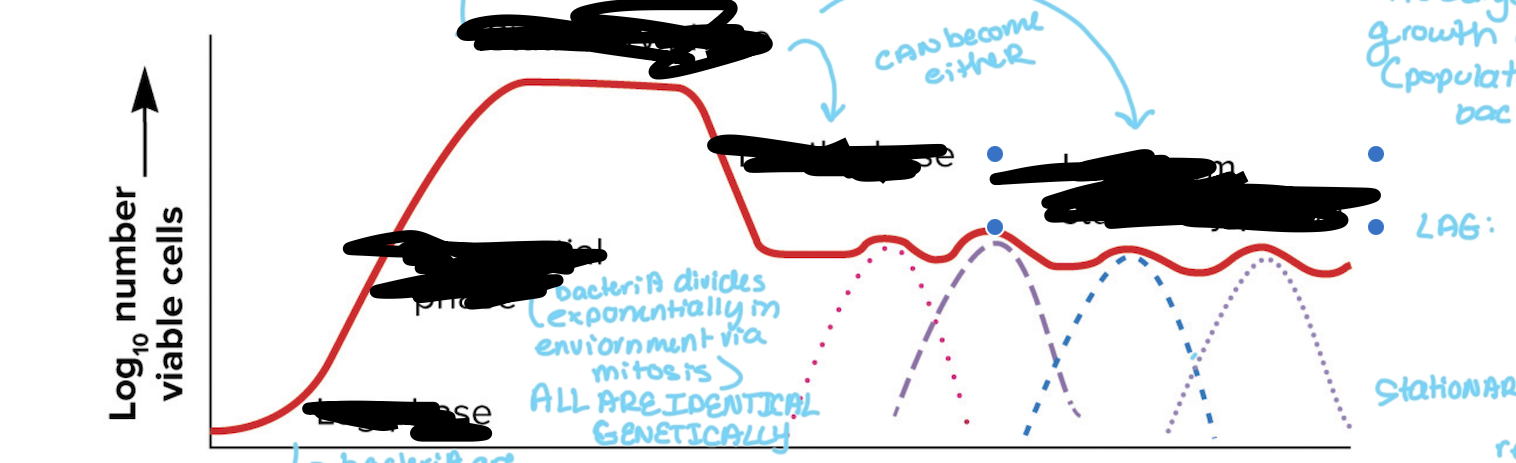
Label this image
A: lag phase
B: exponential phase
C: stationary phase
d death phase
e long term stationary phase
what happens during the lag phase
this is when the bacteria duplicates DNA, and the bacteria is gaining resources to do DNA synthesizes. the cell is synthesizing new components
what happens during the exponential phase
bacteria divides exponentially in environment via mitosis. all are identical genetically. this is aka the log phase. the rate of growth and division is constant and maximal. nutrient availability is not limiting, and the population is most uniform in terms of chemical and physical properties
what happens during the stationary phase
there is a closed system population growth eventually ceases. the total number of viable cells remain constant. active cells stop reproducing, or reproductive rate is balanced by death rate. population can stop dividing but can remain metabolically active.
this is the carrying capacity of the curve. there is no division and the population remains the same
what are some possible reasoning for the stationary phase were growht does not change
nutrient limitation
limited o2 availability
toxic waste accumulation
critical population density is reached
what occurs during the death phase
# of viable cells declines exponentially
cells are dying at a constant rate
detrimental to environmental changes such as nutrient deprivation
buildup of toxic wastes cause irreparable harm to cells
what happens during the long term stationary phase
there is a process marked by waves of genetically distinct variants
bacterial population continually evolves
naturla selection occurs
it does NOT occur for all populations
What is generation doubling time
the amount of time required for a population to doubel in size.
these vary based on species and enviornmental conditions
in binary fission how many are prodcued final
2
what is the equation for calculation population size over time
Nf= (Ni)2^n
In the equation Nf= (Ni) 2^n
what does the Nf stand for
What does Ni stand for
what does n stand for
whar does 2^n stand for
nf stands for total number of cells in a population
Ni stands for the starting number of cells
exponent n denotes generation time
2^n is the number of cells in that generation (every generation doubles)
What are some environmental nonbiotic factors that can affect growth rates ( exceptions ofc the extremophiles Archeans) (6)? Why does this happen?
temperature
o2 concentration
pH
osmotic pressure
barometric pressure
radiation
this happens bc microbes are small and single celled, so they are exposed to various different enviornmetnal factors all the time.
most bacterial speaking, eubacterial organissms need what type of environemtnal conditions
moderate
can microbes regulate their internal temp
NO THEY CAN NOT
how do microbes regulate their internal temepratures
they contain enzymes that have functionally optimal temp ranges, and the baceria exhibits distint growth temperatures due to this optimal temepraute of these enzymes. All bacteria cells are optimized for certain temeprature’s, outside of the “normal”
what are some adaptation of thermophiles (2).
1) stabilized protein/enzyme structure that increases the number of H bonds
2) membrane is stabilized by more saturated, MW lipids and ether linkages
why is oxygen so important in so many aspects
oxygen in majority is the final electron acceptor for electron transport chains.
does oxygen concentration vary in microbes
yes, growth in the presence of oxygen does vary because it depends on each microbes metabolic processes, electron transport chains and terminal electron acceptor used.
For example, anaerobic microbes do not need o2 to grow, but aerobic microbes grow in the presence of oxygen.
obligate aerobe
obligate anaerobe
facultative anaerobes
aerotolerant anaerobes
obligate aerobe: needs oxygen to grow
obligate anaerobe: will kill if oxygen is present.
facultative anaerobes: do not need oxygen but grow better with oxygen
aerotolerant anaerobes: growth with or without oxygen
what is pH and why is it important with microbe
pH is the measure of relative aciditty of a solution. if pH is outside the normal range it can effect both enzymes and proteins, which prevents microbial growth.
how can microbes change the pH of their habitat?
producing waste products
what are acidophiles?
acidophiles actively pump out H
usually fungi and archea
growth optimum is between pH 0 and 5.5
what are neutrophiles?
mostly bacteria
the exhange K for H+
their optimum growth is between 5.5 and 8
 Note
Note  Flashcards (48)