(not mine) Long-Term Memory: Encoding, Retrieval, and Consolidation Strategies in Psychology
 Studied by 0 people
 Call Kai
 Learn
Learn Practice Test
 Spaced Repetition
 Match
Match Flashcards
 Knowt Play
1/69

There's no tags or description
Looks like no tags are added yet.
Name | Mastery | Learn | Test | Matching | Spaced | Call with Kai |
|---|
No analytics yet
Send a link to your students to track their progress
70 Terms
What is the process of acquiring information and transferring it into long-term memory (LTM)?
Encoding
What is the process of transferring information from long-term memory to working memory?
Retrieval
What type of rehearsal involves research without considering meaning?
Maintenance rehearsal
What type of rehearsal involves considering meaning and making connections to other information?
Elaborative rehearsal
Who proposed the Levels of Processing Theory?
Fergus Craik & Robert Lockhart
What is shallow processing?
Little attention to meaning, focusing on physical features of words.
What is deep processing?
Close attention to meaning and relating items, leading to better memory.
What type of question leads to shallow processing according to Craik & Tulving's study?
Questions about physical features of a word.
What type of question leads to deeper processing in Craik & Tulving's study?
Questions about rhyming.
What type of question leads to the deepest processing?
Fill-in-the-blanks questions.
What technique did Gordon Bower & David Winzenz test to enhance memory?
Visual imagery through paired-associate learning.
What is the self-reference effect?
Memory is better when relating a word to oneself.
What did T. B. Rogers' experiment demonstrate about self-reference?
Participants remembered words better if they rated them as describing themselves.
What is the generation effect?
Generating material rather than passively receiving it enhances learning and retention.
What did Norman Slameka & Peter Graf's study compare?
The effectiveness of reading pairs of related words versus generating the second word.
What is a retrieval cue?
A word or stimulus that helps a person remember information stored in memory.
What did Gordon Bower's tree study demonstrate about organizing information?
Organized presentation leads to better memory recall compared to random presentation.
What did John Bransford & Marcia Johnson find about presenting associated pictures?
Presenting a picture before reading a confusing paragraph improves memory recall.
How does linking words to survival value affect memory according to James Nairne?
It creates stronger memories compared to tasks that do not involve survival value.
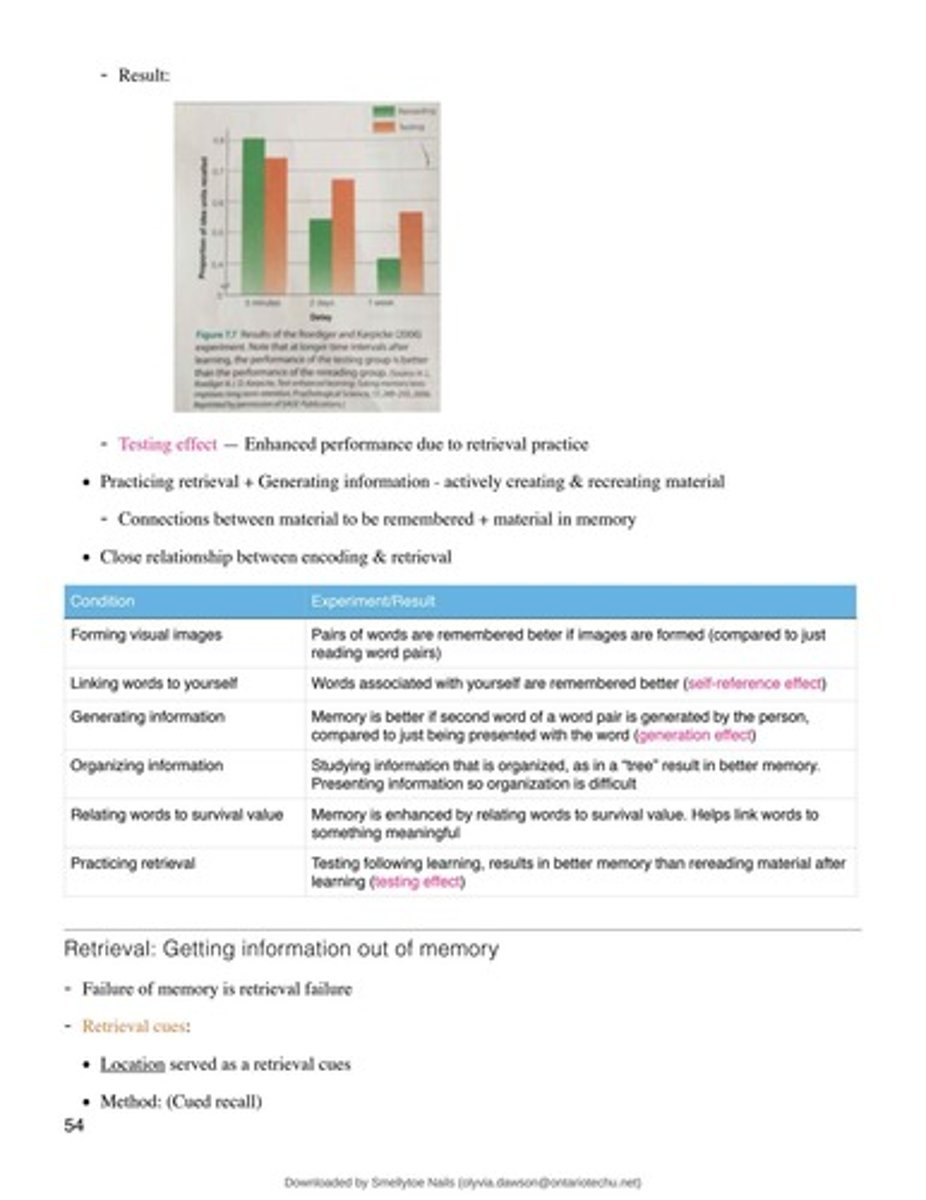
What is the testing effect?
Enhanced performance due to retrieval practice.
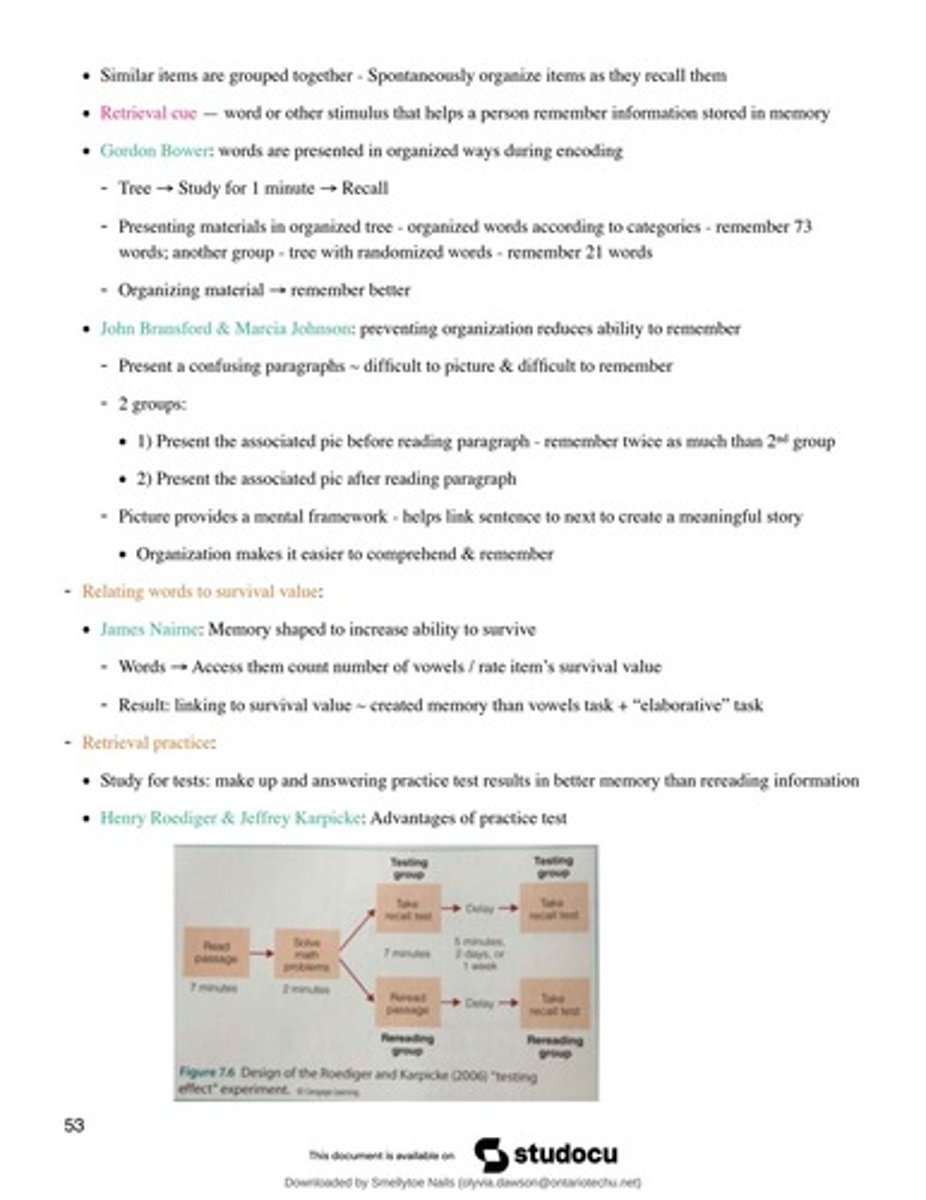
What did Henry Roediger & Jeffrey Karpicke's experiment reveal about testing?
Practice tests lead to better memory retention than rereading information.
What is the relationship between encoding and retrieval?
There is a close relationship; effective encoding enhances retrieval.
What is the impact of organizing information on memory?
Studying organized information results in better memory recall.
How does generating information impact memory?
Memory is improved when individuals actively create and recreate material, enhancing connections between new and existing knowledge.
What is the self-reference effect in memory?
Words associated with oneself are remembered better than those that are not.
How does organizing information affect memory retention?
Studying organized information, such as in a tree structure, results in better memory compared to disorganized presentation.
What role does survival value play in memory retention?
Memory is enhanced when words are related to survival value, linking them to meaningful contexts.
What is retrieval failure?
Failure of memory occurs when information cannot be accessed, often due to ineffective retrieval cues.
What are retrieval cues?
Stimuli that aid in recalling information from memory, which can include location or specific prompts.
What is the difference between free recall and cued recall?
Free recall involves recalling stimuli without prompts, while cued recall provides retrieval cues to assist memory.
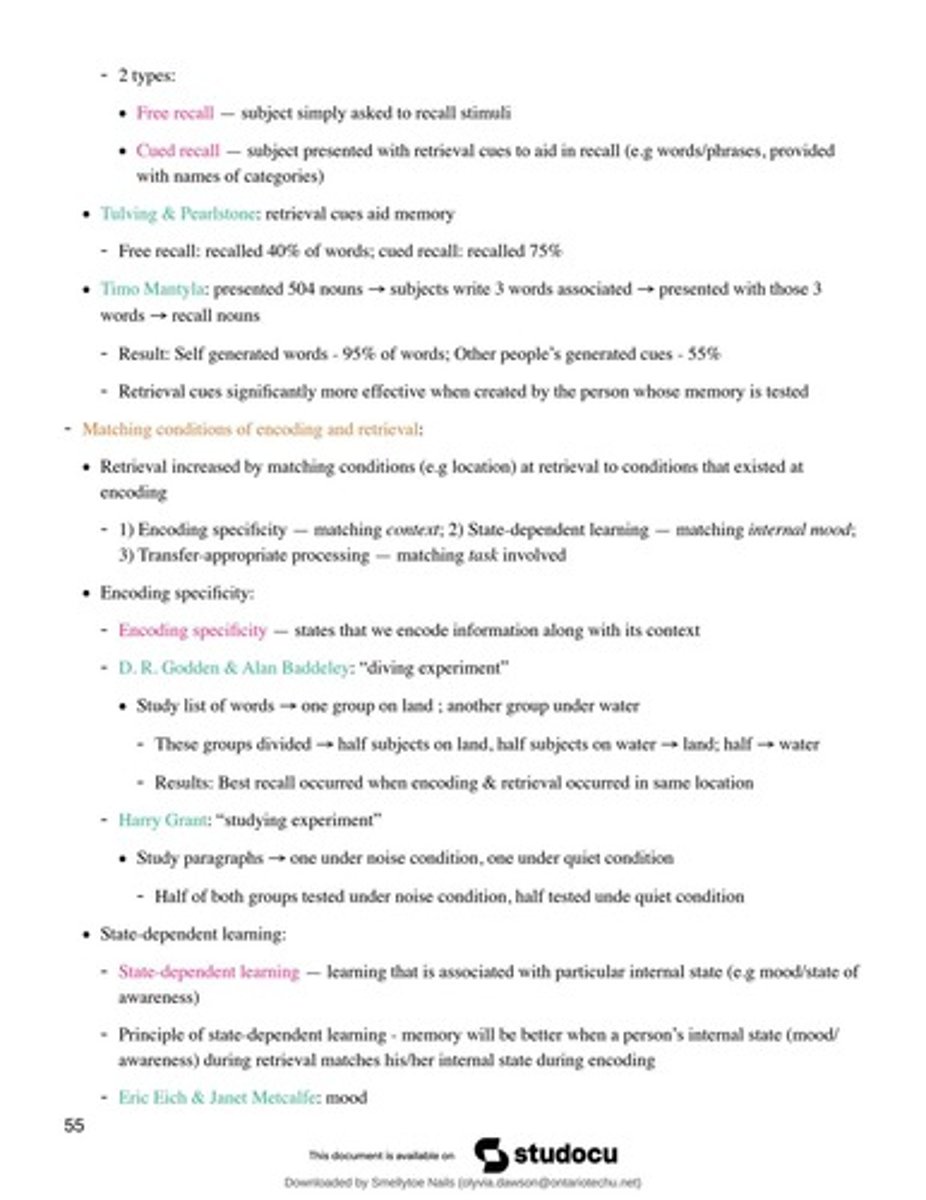
What did Tulving & Pearlstone's study reveal about retrieval cues?
Their study showed that cued recall resulted in significantly better memory performance (75% recalled) compared to free recall (40% recalled).
What is encoding specificity?
The principle that memory is enhanced when the context at retrieval matches the context during encoding.
What was the result of Godden & Baddeley's diving experiment?
Best recall occurred when participants were tested in the same location where they studied the words.
What is state-dependent learning?
Memory is better when a person's internal state during retrieval matches their internal state during encoding.
How did Eich & Metcalfe demonstrate state-dependent learning?
Subjects recalled words better when their mood during retrieval matched their mood during encoding.
What is transfer-appropriate processing?
Memory performance is better when the cognitive tasks involved in encoding and retrieval match.
What did Donald Morris's study reveal about matching cognitive tasks?
Subjects performed better on retrieval tasks when the type of processing during encoding matched the retrieval task.
What is the relationship between deeper processing and retrieval?
Deeper processing at encoding does not always guarantee better retrieval performance.
What is the role of consolidation in memory?
Consolidation refers to the process of stabilizing a memory trace after initial acquisition.
What is the process of consolidation in memory?
The process that transforms new memories from a fragile state, which can be disrupted, to a more permanent state, which is resistant to disruption.
What are the two mechanisms of memory consolidation?
Synaptic consolidation and systems consolidation.
What is synaptic consolidation?
A process that takes place over minutes or hours, involving structural changes at synapses.
What is systems consolidation?
A process that occurs over months or years, involving the gradual reorganization of neural circuits within the brain.
Who proposed that learning and memory are represented in the brain by physiological changes at synapses?
Donald Hebb.
What is long-term potentiation (LTP)?
A process that enhances the firing of neurons after repeated stimulation, strengthening synaptic transmission.
What role does the hippocampus play in memory consolidation?
It coordinates activity across different cortical areas and helps bind together representations of memory.
What is retrograde amnesia?
Loss of memory for events that occurred before an injury, which can extend back minutes, hours, or years.
What is graded amnesia?
A type of retrograde amnesia that is most severe for events that happened just before the injury and less severe for earlier events.
What is anterograde amnesia?
Amnesia for events that occur after an injury, resulting in the inability to form new memories.
What happens to the connections between the hippocampus and cortex as time passes after memory formation?
The connections weaken and eventually vanish, while connections between cortical areas are formed and strengthened.
What did George Muller and Alfons Pilzecker's study on memory reveal about immediate vs. delayed recall?
The delay group remembered 48% of the first list, while the immediate group remembered 28%.
What is the standard model of consolidation?
Incoming information activates multiple areas in the cortex, which communicate with the hippocampus to coordinate memory activity.
What is the role of reactivation in memory consolidation?
The hippocampus replays neural activity associated with memory, helping to form direct connections between various cortical areas.
What role does the hippocampus play in memory retrieval?
The hippocampus is involved in the retrieval of episodic memories, even if they originated long ago.
What did Asaf Gilboa's research reveal about the hippocampus?
Gilboa found that the hippocampus was activated during the retrieval of both recent and remote episodic memories.
What are the three types of responses when recalling stimuli?
1) Remember (R) - recalling the original presentation; 2) Know (K) - familiarity without specific recollection; 3) Don't - no memory of the stimuli.
How do R and K responses relate to types of memory?
R responses are associated with episodic memory, while K responses are linked to semantic memory.
What happens to episodic memory over time?
Episodic memory tends to lose its character over time, with a decrease in R responses.
How does sleep affect memory consolidation?
Sleep enhances memory consolidation by eliminating environmental stimuli that might interfere with the process.
What did Steffan Gais discover about sleep and memory retention?
Gais found that students who slept shortly after studying retained much more material than those who stayed awake.
What is reconsolidation in memory?
Reconsolidation is the process where a retrieved memory becomes fragile and needs to be consolidated again.
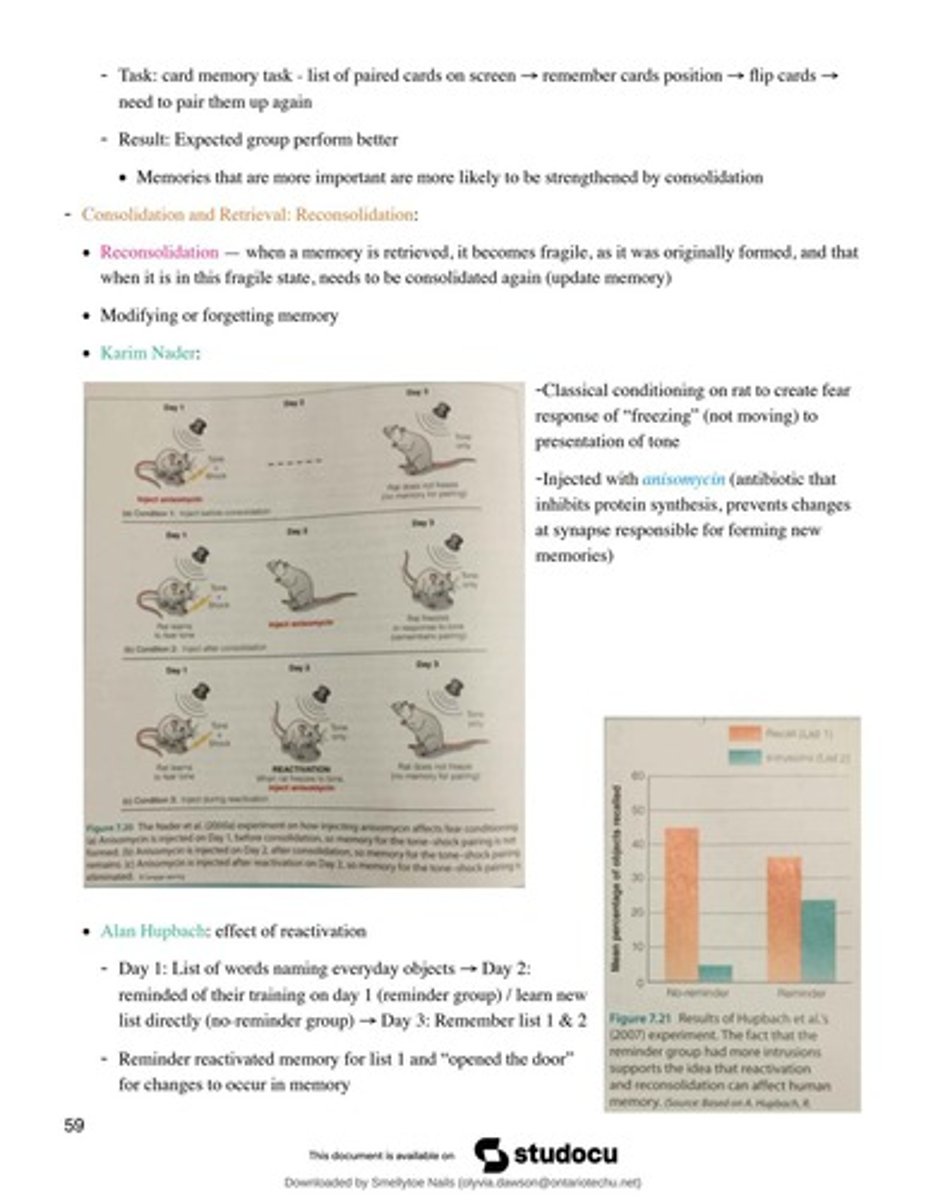
How does the timing of anisomycin injections affect memory in rats?
Injecting anisomycin before consolidation prevents memory formation, while injecting it after consolidation preserves memory.
What effect does reactivation have on memory according to Alan Hupbach's research?
Reactivation can open the door for changes to occur in memory, as seen in the increased intrusions in the reminder group.
What is posttraumatic stress disorder (PTSD) and how is it related to memory?
PTSD occurs when individuals experience flashbacks of a traumatic event, often accompanied by anxiety and physical symptoms.
How can reactivation and reconsolidation help alleviate PTSD symptoms?
Administering propranolol during reactivation can reduce physiological responses associated with traumatic memories.
What are effective studying strategies for enhancing memory?
Effective strategies include elaboration, generation and testing, organization, taking breaks, and avoiding ineffective methods like highlighting.
What is the generation effect in studying?
The generation effect refers to the enhanced ability to remember information when actively involved in generating it.
What is the spacing effect in studying?
The spacing effect suggests that shorter, distributed study sessions are more effective for memory retention than cramming.
What is a common misconception about rereading material?
Rereading can create an illusion of learning, leading to familiarity without deep understanding of the material.
What is the familiarity effect in studying?
The familiarity effect occurs when repeated exposure to material makes it seem easier to recall, but does not enhance actual understanding.
 Note
Note  Flashcards (94)