Forensic Psychology
 Studied by 0 people
 Call with Kai
 Learn
Learn Practice Test
 Spaced Repetition
 Match
Match Flashcards
 Knowt Play
1/58

There's no tags or description
Looks like no tags are added yet.
Name | Mastery | Learn | Test | Matching | Spaced | Call with Kai |
|---|
No analytics yet
Send a link to your students to track their progress
59 Terms
Culture
What is a crime in one place may not be judged as such in another
E.g. multiple wives = bigamy in UK (crime) but permitted in Muslim cultures
History
Crime in one era may not be in another
E.g. homosexuality decriminalised, teachers used to be able to hit pupils
Age
A factor that determines whether an individual can be prosecuted by setting a legal limit
Special circumstances
A factor that may reduce responsibility for criminal actions. Eg murder and self defence
Official Statistics
Government records of total number of crimes reported to police and recorded
Victim Surveys
Record peoples experience of crime over specific period
50,000
Number of randomly selected households to answer The Crime Survey for England and Wales
Offender Surveys
Individuals volunteering details of the number and types of crime they have committed
Self-report indicators of repeat offending
Trends in prevalence of drugs and alcohol
Offender Profiling
Investigative tool used when solving crimes
Aims to narrow field of enquiry and list of likely suspects
Compiling profile by careful scrutiny of crime scene and analysis of evidence, generates hypothesis on characteristics of offender
top-down approach
Developed from in-depth interviews of 36 sexually motivated serial killers
Match what is known about crime and offender to pre-existing template, murderers and rapists classified into organised and disorganised
Organised
Planned crime in advance
Victim targeted and offender may have 'type'
High degree of control and precision
Intelligent, skilled and professional, socially and sexually competant
Disorganised
Little evidence of planning
Spontaneous spur of the moment, impulsive, little control
Lower than average IQ, unskilled or unemployed, sexual dysfunction, live alone
36
Number of serial killers interviews to make the top down approach
The Bottom-Up Approach
Generates picture of offender through systematic analysis of evidence (data driven)
Investigative Psychology
Apply statistical procedures alongside psychological theory to analysis of crime scene evidence
Geographical Profiling
Location of linked crimes to make inference about likely home or operational base of offender (crime mapping)
Marauder
Someone who commits crime close to where they live
Commuter
Someone travels to commit crime
Rachel Nickell
British case study where profiling did but work
Arthur Shawcross
American serial killer who returned to the scene of the crime
Adrian Babb
American rapist who abused elderly ladies in tower blocks
John Duffy
British case study where profiling worked. He is known as the railway rapist
Lombroso
suggested criminials were genetic throwbacks, subspecies who were biologically different
Atavistic
Physiological markers of criminals.
Narrow, sloping brow and strong prominant jaw, high cheekbones and facial asymmetry, dark skin and extra toes/fingers/nipples
Murderers = bloodshot eyes, curly hair and long ears
Sexual deviants = glinting eyes, swollen and fleshy lips and projecting ears
Gall
Developed phrenology
MAOA
a gene that appears to play an important role in preventing antisocial behavior in humans
Diathesis-Stress Model
If genetics play a role it is likely also effected by environment, criminal behaviour may come about through both genetic predisposition and biological/psychological trigger
Neural
May be brain differences, evidence found association with reduced emotional responses, lack of empathy, characterises many convicted criminals
prefrontal cortex (PFC)
Raine using brain-imaging to show link between reduced activity in prefrontal cortex (part that regulates emotional behaviour) and criminal behaviour.
Amygdala
A limbic system structure involved in memory and emotion, particularly fear and aggression. Less active in criminals as found by Raine
Raine
Conducted research into the brains of serial killers using PET scans
Eysenck
proposed behaviour represented along 2 dimensions: 1. introversion/extraversion (E) and neuroticism/stability (N), form variety of personality characteristics/traits, later added psychoticism (P)
Criminal personality
Neurotic-extravert
Also score highly on psychoticism (cold, unemotional)
Level of Moral Reasoning
Kohlberg proposed people's decisions and judgements on issues of right and wrong can be summarised in a stage theory of moral development
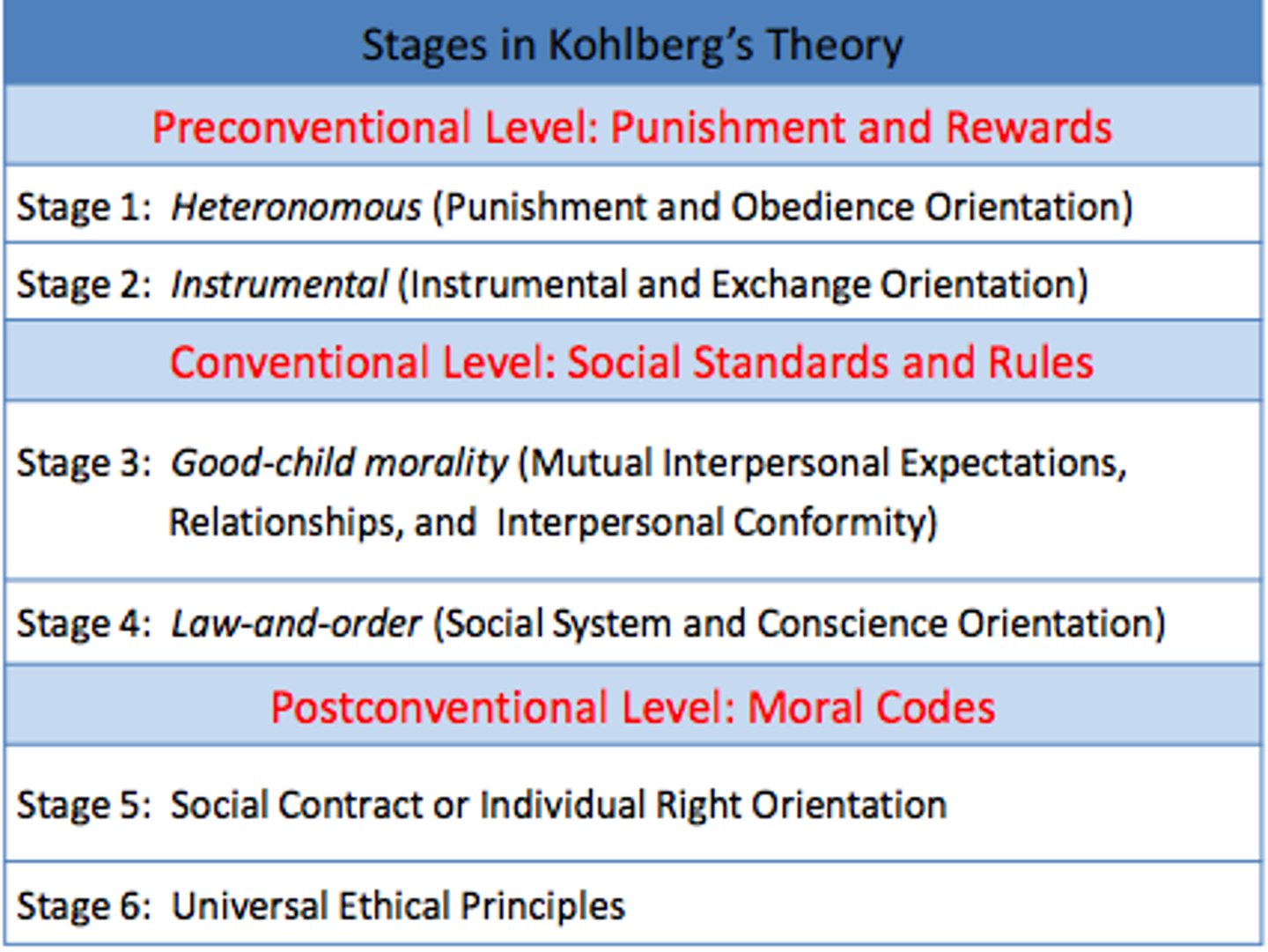
Kohlberg's
Developed levels of moral reasoning
Heinz Dilemma
Used to measure kohlbergs levels of moral reasoning
Cognitive Distortions
Errors or biases in information processing system characterised by faulty thinking, criminals interpret other people's behaviour and justify their own actions
Hostile Attribution Bias
Misinterpretting actions of others, misread non-aggressive cues triggering violent disproportionate response
Minimalisation
Attempt to deny or downplay seriousness of an offence, especially common with sexual offenders
Differential Association Theory
Proposes individuals learn values, attitudes etc. for criminal behaviour through interaction with different people
Sutherland
developed differential association theory
Pro-Criminal Attitudes
Exposed to values of groups towards crime. If these outweighs anti criminal attitudes = offending
Differential association theory proposes possibility to mathematically predict if frequency, intensity and duration of exposure is known
Superego
part of the personality that acts as a moral center
Weak Superego
Same-sex parent absent during phallic stage, child cannot internalise a fully-formed superego as no opportunity for identification
Deviant Superego
Internalised superego which is immoral or has deviant values
Over-Harsh Superego
Individual is crippled by guilt and anxiety, unconsciously drives individual to perform criminal acts in order to satisfy superego's need for punishment
Maternal Deprivation Theory
44 thieves study, affectionless psychopathy 12/14 with prolonged separation
Deterrence
Unpleasant prison experience designed to put off individuals offending
Works on 2 levels: general (broad message to members of society crime isn't tolerated) and individual (recidivism, punishment)
Incapacitation
Offender taken out of society for protection of public
Depends upon severity of offence and nature of offender
Retribution
Revenge for crime by making offender suffer
Level of suffering proportional to seriousness of crime
Rehabilitation
Reform offender, rejoin society, prison should provide opportunities to develop
recidivism
Refers to reoffending, 57% of UK offenders will reoffend within a year of release
Token Economy
Based on operant conditioning, reinforce desirable behaviour with token that can be exchanged for reward
Cognitive Behaviour Treatment
Novaco suggests cognitive factors trigger emotional arousal, precedes aggressive acts, becoming angry is reinforced by individuals feeling of control (behaviourism
Anger Management
1. Cognitive preparation
2. Skill acquisition
3. Application practise
Cognitive Preparation
Requires offender to reflect on past experience and consider typical patterns of anger, learns to identify triggers and if irrational this is made clear
Skill Acquisition
Offenders introduced to range of techniques and skills to help deal with anger-provoking situation more rationally, techniques cognitive, behavioural or physiological
Application Practise
Given opportunity to practise skills within carefully monitored environment, role play between offender and therapist of past triggering situation, successful > positive reinforcement
Restorative Justice
Managed collaboration between offender and victim based on healing and empowerment
Supervised meeting organised between both with experienced mediator
Victim shows how it affected them and offender sees consequences of their actions
 Note
Note  Flashcards (76)