Chapter 5: Surface water transport
 Studied by 0 people
 Call with Kai
 Learn
Learn Practice Test
 Spaced Repetition
 Match
Match Flashcards
 Knowt Play
1/22

There's no tags or description
Looks like no tags are added yet.
Name | Mastery | Learn | Test | Matching | Spaced | Call with Kai |
|---|
No study sessions yet.
23 Terms
What is the equation for solving for Cs (solid phase concentration)
Cs=KD*Cw
What is the equation for solving for KD (Partition coefficient)
KD=fOC*KOC
What does fs represent?
Fraction Sorbed (fraction of contaminant associated with the solid phase)
What does Cs represent?
Solid phase concentration
What does Cw represent?
Aqueous phase concentration
What does αsettling represent?
First order rate constant for removal by settling
What does αdilute represent?
First order rate constant for removal by dilution/flow of river or stream
What does αdecay represent?
First order rate constant for removal by decay of radioactive isotope
What does αdegrad represent?
First order rate constant for removal by degradation
What rate constant(s) for removal would you expect to find in a lake?
αsettling, αdilution, αdegrad, and αdecay if the contaminant is a radioactive isotope
What rate constant(s) for removal would you expect to find in a river/stream?
αsettling, αdegrad, and αdecay if the contaminant is a radioactive isotope (NOTE: NO FLOW/DILUTE)
When would you want to model a lake with multiple homogenous compartments?
during seasonal thermal stratification
What model can we simplify a lake to
Homogenous compartment(s)
What model can we simplify a river/stream to
open channel
what two types of dispersion are dominant when it comes to surface water
Turbulence and advective heterogeneities
What does Ex represent?
Dispersion coefficient
What does u* represent?
mean water velocity
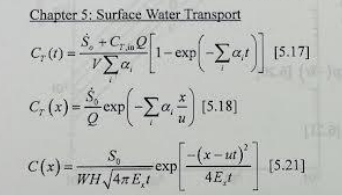
Which of these equations is solely for use with rivers/streams (advection only)
5.18
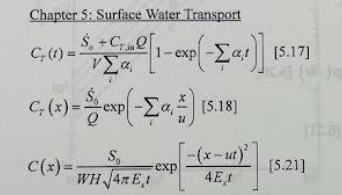
Which of these equations is solely for use with lakes? (one compartment)
5.17
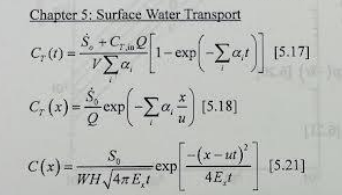
Which of these equations is solely for use with rivers/streams (advection and dispersion)
5.21
what does t* represent?
time at which maximum concentration occurs
 Note
Note  Flashcards (66)