The Role of the Unconscious & Structure of Personality
 Studied by 0 people
 Call Kai
 Learn
Learn Practice Test
 Spaced Repetition
 Match
Match Flashcards
 Knowt Play
1/11

Earn XP
Description and Tags
Name | Mastery | Learn | Test | Matching | Spaced | Call with Kai |
|---|
No analytics yet
Send a link to your students to track their progress
12 Terms
What are the key assumptions of the psychodynamic approach?
Experiences in early childhood play a key role in making us the person that we are later in life
- e.g. if someone wasn’t breastfed or was breastfed for too long they may be 'stuck' in the oral phase → causing later behaviour such as smoking, biting nails, sarcasm
All behaviour is a result of our unconscious thoughts, feelings, personality traits
It’s instincts or drives that motivate our behaviour, this means we’re driven to go through the psychosexual stages
Who laid down the foundation of psychodynamic thinking in psychology?
Sigmund Freud; he discussed the notion of the unconscious.
Freud’s theories revolve around 3 central ideas:
1. That the personality has a discernible structure (recognisable/noticeable patterns)
2. It’s constructed by the passage through the psychosexual stages
3. The unconscious conflicts of this process are mediated by psychological processes - defence mechanisms
What may happen if someone is conflicted due to dysfunctional parental behaviour?
They may exhibit defence mechanism behaviour.
They may be in denial as to their unhappy childhood and claim that their upbringing was perfect
What did Freud use to explain the different levels of consciousness?
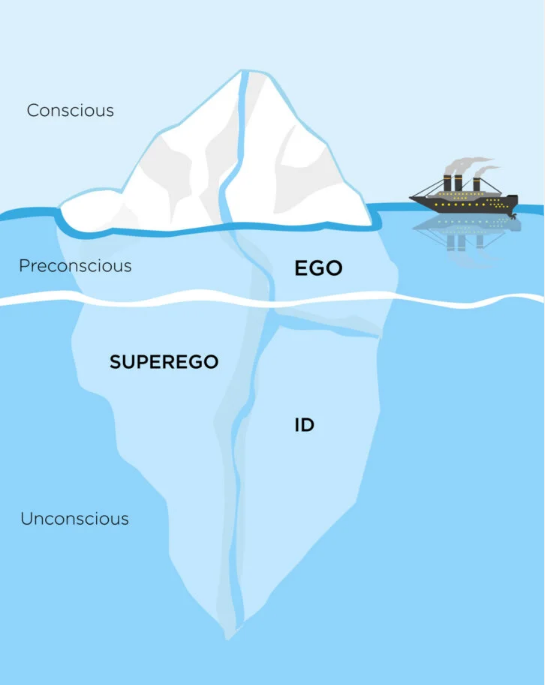
The metaphor/analogy of an iceberg.
What is the iceberg analogy?
The Conscious
The small amount of mental activity we know about and are aware of (e.g. thoughts, perceptions)
The ‘tip of the iceberg’
The Preconscious
Contains thoughts and memories not currently in conscious awareness but we can access if desired
Sits just below the surface of the conscious mind, where dreams and ‘Freudian slips’ lurk
The Unconscious
Thoughts, feelings and behaviour that we’re unaware of (e.g. instincts, deeply buried painful memories, unacceptable urges, childhood conflicts that we’ve repressed)
Most of our mind is made up of the unconscious - it has a significant influence on our behaviour and personality (e.g. causes anxiety, shape emotions, influence decisions)
What are ‘Freudian slips’?
They reveal secret feelings.
E.g. ‘I loathe my husband’ - when the intended phrase was ‘I loathe my husband’
What is said appears to be accidental but it expresses the person’s true, repressed feelings
What do dreams reveal?
Secret fears/desires.
E.g. Dreams of flying = the wish to break free from limitations, to be free
E.g. Dreams of being naked in public = anxiety about others accepting you
What are the 3 parts (tripartite) of personality described by Freud?
Id
Ego
Superego
How do the Id, Ego and Superego interact in personality?
They are not separate entities but work together within the personality, often in conflict.
Individuals may be more dominated by one part (e.g. the Id), but the Ego and Superego still function and work harder to override/control the Id
What is the Id?
Present from birth - Freud described babies as being ‘bundles of Id’.
Important in early life to ensure survival, which is why an infant will cry until their needs are met
Instinctive (innate/natural) part of our personality and operates according to the pleasure principle
Seeks only self-indulgent/selfish pleasure and instant gratification (satisfaction) of its needs - Like a spoilt child e.g. 'I want it 'now!'
What is the Ego?
Develops around the age of two.
Operates according to the reality principles
The mediator between the two other parts of the personality
Reduce the conflict between the demands of the Id and the superego - manages this by employing ‘defence mechanisms’
Develops in response to control by others, usually one's parents, during the anal stage of development
E.g. The id must sometimes be 'tamed' as its wild impulses could lead to trouble whereas the Superego must sometimes be ignored if it is likely to lead to punitive (punishment) self-blame or excessive guilt
What is the Superego?
Develops around the age of five (end of the phallic stage)
Operates according to the morality principle, like a disapproving teacher or parent - 'Why would anyone want that? It’s wrong and it means that you are weak and sinful to want it!'
Can also show approval (though this is rarer than disapproval) e.g. ‘You did very well resisting that temptation, what a good person you are!'
Punishes the ego for wrongdoing (through guilt)
Represents an internalised sense of right and wrong - the conscience, morality, ethics, judgemental aspects of the self
It represents the moral standards of one's same-sex parent and the specific type of discipline instilled in one's childhood
 Note
Note  Flashcards (131)