ECO 202 Module 4: Economic Efficiency, Government Price Setting, and Taxes
 Studied by 0 people
 Call with Kai
 Learn
Learn Practice Test
 Spaced Repetition
 Match
Match Flashcards
 Knowt Play
1/17

There's no tags or description
Looks like no tags are added yet.
Name | Mastery | Learn | Test | Matching | Spaced | Call with Kai |
|---|
No analytics yet
Send a link to your students to track their progress
18 Terms
surplus
someting that remains above what is used or needed
refers to the benefit that people derive from engaging in market transactions
consumer surplus
the difference between the highest price a consumer is willing to pay for a good or service and the actual price the consumer pays
the area below the demand curve and above market price
related to marginal benefit - the additional benefit to a consumer from consuming one more unit of a good or service

producer surplus
the difference between the lowest price a firm would be willing to accept for a good or service and the price it actually receives
the area above the supply curve and below market price
the lowest price a firm would accept is the marginal cost of producing the good or service
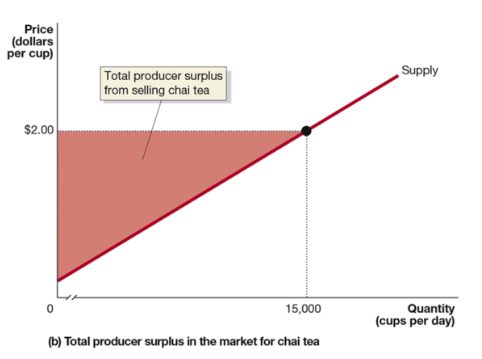
what do consumer and producer surplus measure?
consumer surplus measures the net benefit to consumers from participating in a market rather than the total benefit
consumer surplus in a market is equal to the total benefit received by consumers minus the total amount they must pay to buy the good or service
producer surplus measures the net benefit received by producers from participating in a market
producer surplus in a market is equal to the total amount firms receive from consumers minus the cost of providing the good or service
efficiency in competitive markets
1) a market is efficient id all trades take place where the marginal benefit excees the marginal cost, and no other trades take place
2) a market is efficient if it maximizes the sum of consumer surplus and producer surplus (the total net benefit to consumers and firms), known as the economic surplus, which is maximized at competitive equilibrium quantity
deadweight loss
reduction in economic surplus resulting from a market not being in competitive equilibrium, the amount of inefficiency in a market
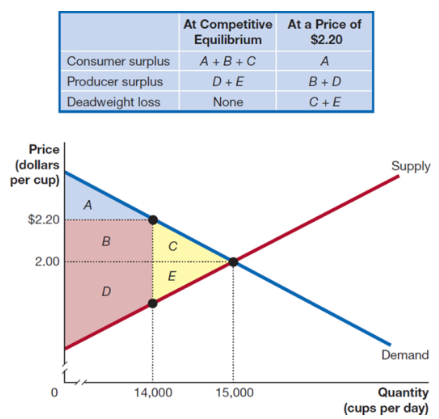
economic efficiency
market outcome in which the marginal benefit to consumers of the last unit produced is equal to its marginal cost of production and in which the sum of consumer surplus and producer surplus is at maximum
price ceiling
a legally determined maximum price that sellers may charge
ex) rent controls
price floor
a legally determined minimum price that sellers may receive
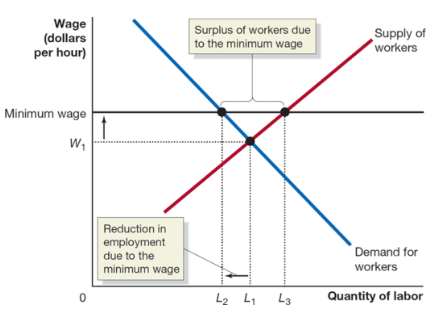
ex) minimum wage
effects of price floor
surplus is transferred from consumers to producers
firms may produce excess products (surplus)
ex) minumum wage raises incomes, but may result in fewer jobs
effects of price ceiling
surplus is transferred from producers to consumers
results in a shortage
ex) rent ceiling, rent decreases, but there is too much demand for the supply of apartments, resulting in a shortage
illegal markets
markets in which buying and selling take place at prices that violate government price regulations
results of government price controls
some people win (renters with lower rents, or landlords who can exploit the shortage of housing to illegally raise rents
some people lose (law-abiding landlords, and renters unable to find apartments
there is a loss of economic efficiency (fewer apartments rented results in deadweight loss)
per-unit taxes
taxes assessed as a particular dollar amount on the sale of a good or service
equilibrium price is $6/pack and 4 billion packs sold/year
a $1/pack tax will shift the supply curve left/up by $1
the price needs to be exactly $1 higher to convince firms to still sell 4 billion packs, because the firms marginal costs effectively increased by $1/unit
new equilibrium price is $6.90 with a quantitty of 37 billion packs/year. consumers pay $6.90 but after paying the $1 tax, producers are left with $5.90
the government will receive tax revenue equal to the green box. some producer and some consumer surplus will become tax revenue and some will become deadweight loss

excess burden
the deadweight loss from a tax
tax efficiency
a tax is efficient if it imposes a small excess burden relative to the tax revenus it raises
tax incidence
the actual division of the burden of a tax betweeen buyers and sellers in a market
does NOT depend on who has the legal obligation to pay for the tax
determined by the relative slopes of the demand and supply curves
a steep demand curve means that buyers do not change how much they want to buy when the price changes, resulting in them taking on much of the burden of the tax
a shallow demand curve means that buyers change how much they buy a lot when the price changes. then they could not be forced to accept as much of the burden of the tax
equilibirum condition
in equilibrium, quantity demanded is equal to quantity supplied. we can use the equilibirum condition to solve for price
ex) Qd = 4,750,000 - 1,000P
Qs = -1,000,000 +1,300P
4,750,000 - 1,000P = -1,000,000 + 1,300P
P = 2,500
 Note
Note  Flashcards (165)