Biology Test 2
 Call Kai
 Learn
Learn Practice Test
 Spaced Repetition
 Match
Match Flashcards
 Knowt Play
1/164

There's no tags or description
Looks like no tags are added yet.
Name | Mastery | Learn | Test | Matching | Spaced | Call with Kai | Chat |
|---|
No analytics yet
Send a link to your students to track their progress
165 Terms
What is an example of something multicellular?
What about two examples of unicellular?
-Humans (us) are multicellular
-Bacteria and amoebas are unicellular
What is the shape of animal cells?
They have no definitive shape.
What is mitosis?
Splitting
What are the three parts of cell theory?
1) All living things are made up of cells
2) Cells are the smallest working units of all living things
3) All cells come from preexisting cells through cell division
What are the smallest things alive?
Cells
Where do all cells come from?
The Universal Common Ancestor (UCA)
How big are cells?
Very small, 30 microns-ish
What is the surface area of a cell? What is the volume?
Surface area is the membrane. Volume is the interior.
Why do cells want higher surface area?
Higher surface area allows more movement across the cell.
What should the surface area to volume ratio be?
As high as possible.
Why do cells remain microscopic?
To maximize their surface area to volume ratio.
What shape are bacteria, typically?
Rod shaped.
How many chromosome do bacteria have? What about humans?
Bacteria have one chromosome. Humans have 23.
What is the significance of the fact that watermelon have 1000s of chromosomes whereas humans only have 23?
There is none. The amount of chromosomes does not relate to intelligence or complexity.
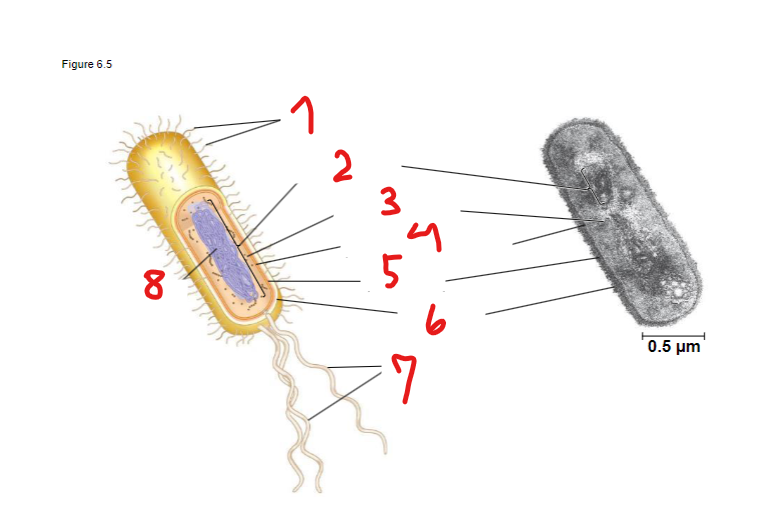
What is the 2? What does it do?
2 is the nucleoid. It is the region where the chromosome is and it cannot be located. It functions much like the nucleus in eukaryotic cells.
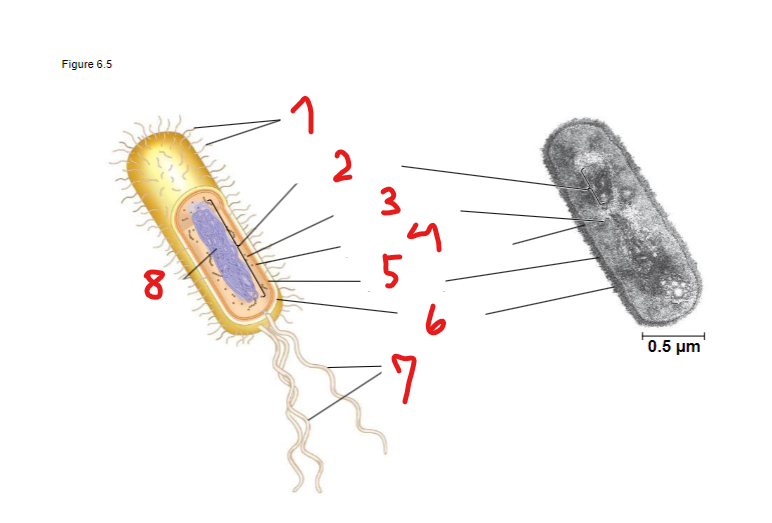
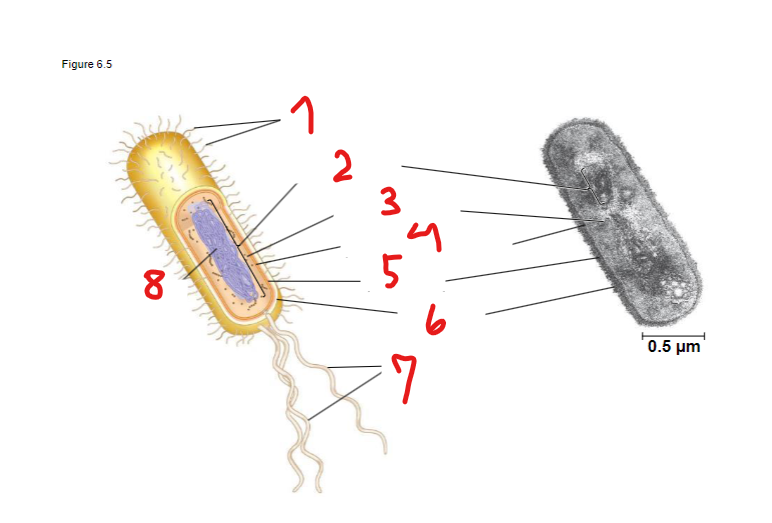
What is 6? What does it do?
6 is the capsule. It helps bacteria hide from the immune system, and other cells don’t have it.
How does the immune system identify cells?
It touches them to identify them. Bacteria hides from this sense of touch.
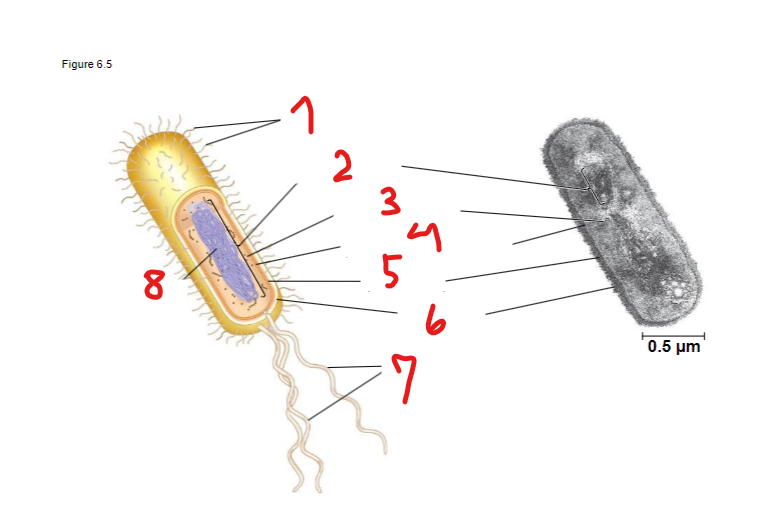
What is 7? What does it do?
7 is flagella. Bacteria move using flagella.
What do the flagella interact with to move?
Motor proteins.
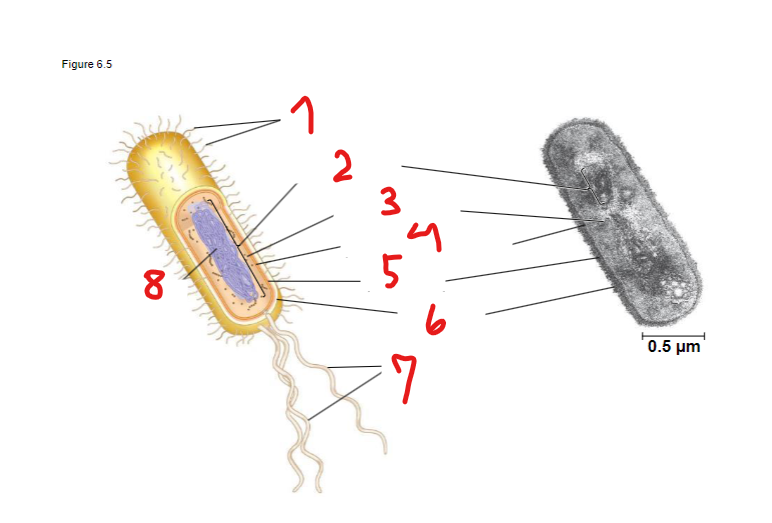
What is 1? What does it do?
Fimbriae. They enable the bacteria to bind to specific receptor structures and thereby to colonise specific surfaces
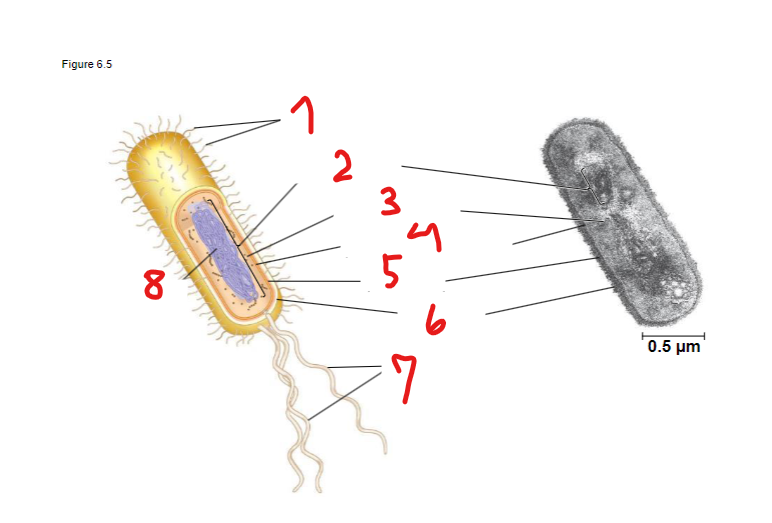
What is three? What does it do?
Ribsomes. They synthesize all cellular proteins.
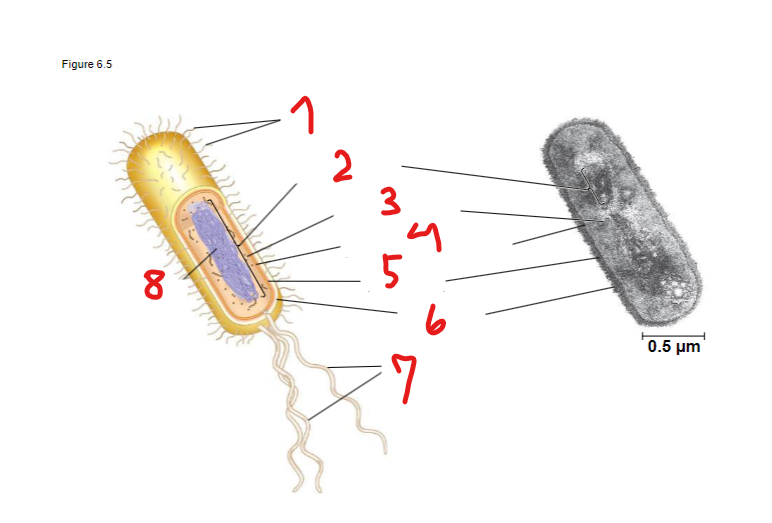
What is four? What does it do?
Plasma membrane. It does transport, biosynthesis, and energy transduction.
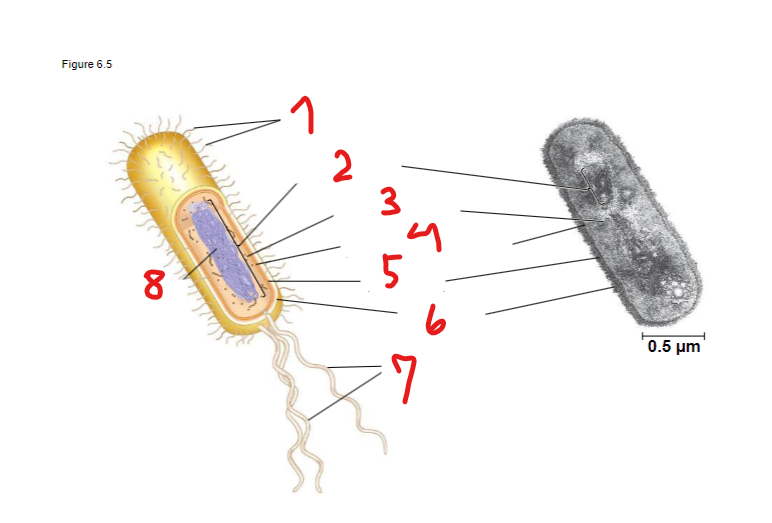
What is five? What does it do?
Cell wall. It forms a rigid structure of uniform thickness around the cell and is responsible for the characteristic shape of the cell.
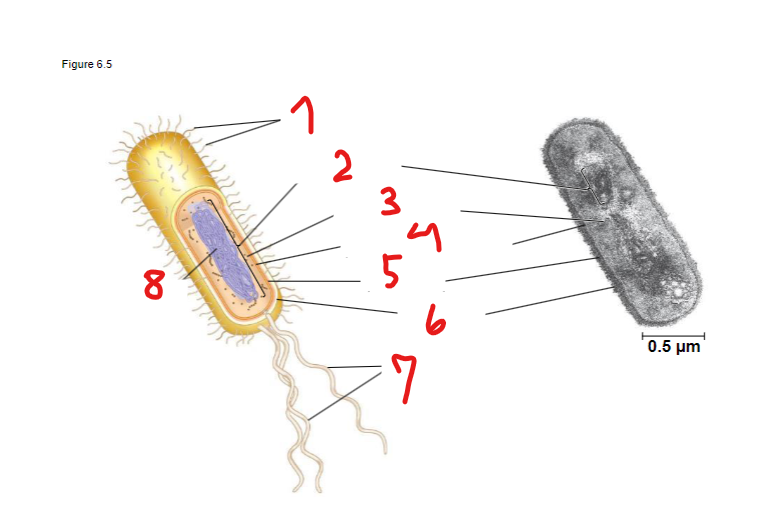
What is eight? What does it do?
Bacterial Chromosome. A circular molecule of DNA that functions as a self-replicating genetic element
Do animal cells have a cell wall? Why or why not?
Animals do not have a cell wall. Humans have a skeleton that holds us up. We also actively move, so a cell wall would not be ideal.
What are two unique characteristics of eukaryotic cells? (animal and plant)
-Have a nucleus and organelles are all separate
What two things do plant cells have that animals don’t? (besides wall)
Chloroplasts and vacuole
What does the nuclear membrane do?
Limits what goes in and out of the nucleus.
Where are the chromosomes located?
In the nucleus.
Why are mutations not normally felt?
95% of DNA is junk DNA.
Where is the nucleus typically located?
Near the center of the cell.
What do pores do in the nucleus?
They are how the nucleus controls what is moving in and out through.
What can the nucleus be likened to?
The brain of the cell. It controls the things inside the cell.
What shape does the mitochondria have?
Jelly bean shape
What does the mitochondria do?
Converts glucose and oxygen to ATP
What is ATP?
An energy rich molecule
What is the mitochondria responsible for?
Processing food.
Which type of cell is made of around 40% mitochondria?
Muscle cell
Give a basic explanation of how ATP is used for energy.
One of the phosphate groups of ATP is broken off releasing energy in the bond making ADP.
What can ATP be considered?
Energy currency to be spent when needed.
What are the two types of ribosomes?
Free and bound ribosomes.
Which ribosomes are in the liquid filling?
What is this liquid filling called?
Free ribosomes
Cytoplasm
Which ribosomes are attatched to the endoplasmic reticulum?
Bound ribosomes
What do ribosomes do?
Manufacture proteins through dehydration synthesis of amino acids, creating peptides and proteins. Also used to make antibiotics.
Where do ribosomes recieve instructions from?
The nucleus, in the form of DNA
What is the first level of protein structure?
The amino acid order
What do chloroplasts do?
Synthesize food through photosynthesis
What are stacked within the chloroplast? What do these stacks form?
Thylakoids are stacked to form the granum.
What does the endoplasmic reticulum do?
Protein folding occurs there. It transports proteins while the ribosomes make them. Shaping of the proteins happens in here.
It also stores calcium? Kinda random 🤔
Why is it called rough ER?
Bound ribosomes are stuck there and produce rough ER
What does smooth ER do?
It continues to transport the protein.
What are lysosomes?
Transport vesicles
What do lysosomes contain?
Digestive enzymes (hydrolytic enzymes)
What type of cells are lysosomes found in?
Eukaryotic animal cells
What are vacuoles?
Storage sacs
What is phagocytosis?
Digestion, digestive enzymes, melds with food vacuole. Cells engulf a food particle.
What is autophagy?
Take out and digest damaged organelles.
Why is the process in the endoplasmic reticulum important?
The shape of proteins is critical.
Why can a vesicle blend into the golgi apparatus?
It’s made of the same stuff
What are the two golgi sides?
Trans/Shipping face and Cis/receiving face
What is the process from nucleus to outside the cell for a protein?
The nucleus sends ribosomes to the endoplasmic reticulum which enter through the rough ER and then the smooth ER. The protein is then pinched off into a transport vesicle and is absorbed by the golgi apparatus. It goes through the GA and is pinched off again into a transport vesicle. This is then sent outside.
What do lysosomes help do?
Get rid of damaged organelles or digest food.
What does the nuclear envelope do?
Pores provide access for the mRNA
Rough ER (More complicated description)
Bound ribosomes secrete glycoproteins, it distributes transport vesicles, provides the membrane for the cell.
Smooth ER (more complicated explanation)
Lipid synthesis, carbohydrate metabolism, detoxifies drugs and poisons, stores calcium ions.
Where are vacuoles derived from?
The ER and Golgi app.
Where are vacuoles typically?
Central and in plant cells.
What do central vacuoles do?
They store waste. Can also store pigments.
What can vacuoles do in plants?
They can swell and take up to 90% of the cell.
What happens to cells/paramecium in fresh water and salt water?
Cells absorb water in fresh water and lose water in salt water.
Paramecium in fresh water has a durable but flexible membrane allowing it to swell. The cell wall prevent is from breaking.
What is lyse?
Cells hydrolysis. Blow up because of too much water.
What does a contractile vacuole do?
When it gets too full, it squeezes water out of the cell by contracting.
What is the cytoskeleton?
A structure that helps cells maintain their shape and internal organization
What is another work for microfilaments and what are there properties?
Actin filaments. They are flexible and stretchy. Shaped in a double spiral type thing?
What do micro/actin filaments do?
Tension bearing, prevent ripping apart.
Also amoebid movement, psuedopods extend. They help chromosomes move.
What is one way microfilaments help movement?
The myosin head acts as a ratchet on a gear to contract muscles. This pulls apart the actin filament.
What is the shape of intermediate filament?
Cables made of proteins.
What do intermediate filaments do?
Maintain cell shape, anchor the nucleus, form the nuclear lamina.
What shape are microtubules?
Hollow tubes
What do microtubules do?
Prevent the cell from being crushed. Component of cilia and flagella. Chromosome and organelle movement.
How do proteins move using microtubules?
Microtubules have motor proteins attached to the vesicle. Proteins can walk along tubules toards the golgi app. Like a tram system.
In animal cells, what is the organization of microtubules?
Centrioles are a collection of microtubules and these make up centrosomes.
What are cilia and flagella made of?
A series of microtubules
How do the tubules cause movement? (cillia and flagella)
Moving back and forth
How do you distinguish cilia from flagella?
Cilia are smaller and have lots. Flagella are longer and limited in number.
What are the two strokes of a cilia?
The power stroke and recovery stroke.
What is plasmodesmata?
In plants. Holes that allow chemical signals and water to pass through
What is the extrascellular matrix?
In animals, a large network of proteins and other molecules that surround, support, and give structure to cells and tissues in the body.
What allow the extracellular matrix to stick together?
collagen, fibronectin, integrins, a proteoglycan
What is a gap junction?
Like a plasmodesmata in plants, but in animals. Provide direct cell-to-cell communication by allowing the passage of signaling molecules, ions, and electrical currents.
What is a tight junction?
Two proteins stick together to be waterproof. Prevent fluid from destroying the cell.
What is a desmosome?
Intermediate filament of cytoskeleton of cells stickign together. Welds stick together. Plants dont need this because of the cell wall.
What is the cell membrane made of?
A phospholipid bilayer with two sides.
What makes a phospholipid unique?
Hydrophilic head and hydrophobic tail.
How do unsaturated hydrocarbon tails act?
They allow the membrane to be fluid and prvent packing.
How do saturated hydrocarbon tails act?
They make the membrane viscous and allow phospholipids to pack together.
How does cholesterol affect the membrane in animals?
Reduces fluidity at moderate temps but prevents solidification at low temps. It’s embedded inside the membrane.
What are the two constituents of the fluid mosaic model?
Embedded proteins and ?????
If someone has the second bit in their notes pls let me know I have no idea.
What makes the fluid mosaic model adaptible? Why is it the fluid mosaic model of the cell membrane?
Proteins can float which makes it flexible.
What do proteins on the outside of the cell (in the FMM) do?
Hold the cell together.