LECTURE 1: SEMANTICS
 Studied by 36 people
 Call Kai
 Learn
Learn Practice Test
 Spaced Repetition
 Match
Match Flashcards
 Knowt Play
1/26

Earn XP
Description and Tags
by Vzu Nguyen
Name | Mastery | Learn | Test | Matching | Spaced | Call with Kai |
|---|
No analytics yet
Send a link to your students to track their progress
27 Terms
What is semantics?
Semantics is the study of the meaning of words, phrases, and sentences. (………… meaning)
Semantics focuses on what the words c……………….m ………., not what an individual speaker might want them to mean on a particular occasion (pragmatics, not semantics).
Example:
Where’s the cheeseburger? (What does cheeseburger refer to here?)
Over there, by the window
Question: "Where’s the cheeseburger?"
Here, the keyword is cheeseburger. Semantics looks at what that word means in general (lexical meaning): a sandwich with a beef patty and cheese inside a bun.Answer: "Over there, by the window."
This response shows that in this situation, cheeseburger is being used to refer to a particular physical object (a specific cheeseburger someone is pointing to or thinking about).
So, the example is demonstrating how semantics works:
Semantics → The word cheeseburger conventionally means a food item made of bread, meat, and cheese.
Pragmatics (not in your text, but related) → In this context, it refers to a specific cheeseburger sitting by the window.
🔑 Takeaway: The example shows the difference between the lexical meaning of a word ("cheeseburger" = a type of food) and its reference in a real-life situation (that specific cheeseburger by the window).
lexical, conventionally mean
Conceptual meaning vs. Associative meaning
(Fill in the blank from the left column to the right one)
Conceptual meaning | Associative meaning |
Conceptual meaning covers those basic, e……… c…………. of meaning that are conveyed by the l……. use of a word. It is the type of meaning that dictionaries are d……… t…. d………... E.g. Conceptual meaning: "needle": thin, sharp, steel instrument | Associative meaning: a…………. or c………… attached to a word. Eg: “needle”: pain, illness, blood, drugs, thread, knitting Those associations d…… from one person to another. E.g: Associative meaning: associations or connotations attached to a word. "needle": pain, illness, blood, drugs, thread, knitting Those associations differ from one person to another. |
essential components, literal, designed to describe, associations, connotations, differ
Semantic features (nét nghĩa)
A semantic feature is a c………….. of the concept associated with a lexical item.
Semantic features can be treated as the basic elements involved in d…………… the meaning of each word in a language from every other word.
Semantic features are usually presented as a matter of o…………., paired positive (+) and negative (-) features, denoting the presence or absence of the particular feature in the meaning of the word.
component, differentiating, opposition
Componental analysis
"Componential analysis is an attempt to give a s………….. a…………. of words in terms of semantic features or components (Katz Fodor, 1963). It consists in determining the b…………… c…………. constituting the semantic content, or sense, of a word. Brinton (2010, p 166)”
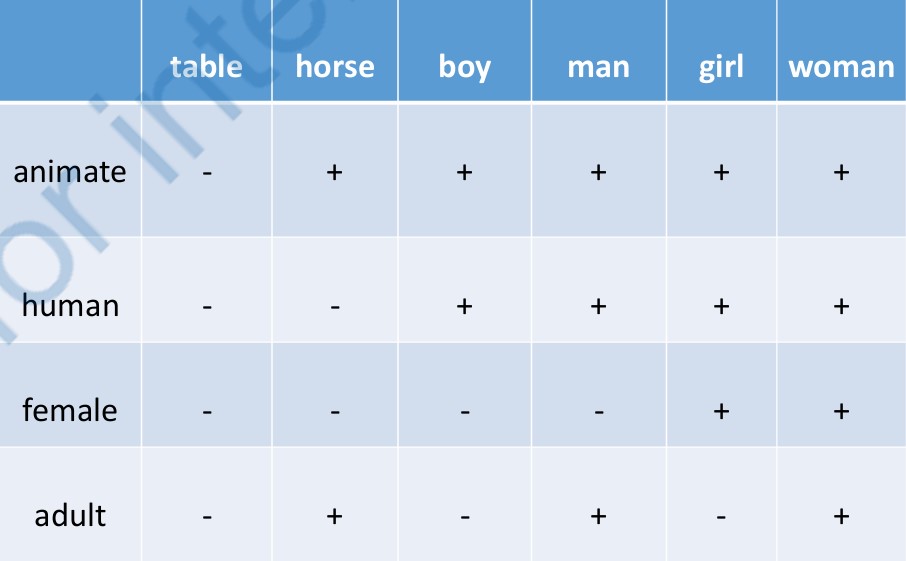
semantic analysis, basic components
Semantic roles/Thematic roles
Instead of thinking of words as “containers” of meaning, we can look at the “roles” they fulfill within the situation described by a sentence. If the situation is a simple event, as in
The boy kicked the ball, then the verb describes an action (kick).
The noun phrases in the sentence describe the roles of entities, such as people and things, involved in the action. We can identify a small number of semantic roles (also called “thematic roles”) for these noun phrases.
Semantic roles are roles that words (typically NPs - tham thể trong câu - ……………) fulfill within the situation described by a sentence.
Agent
Theme (patient)
Instrument
Experiencer
Location
Source
Goal
participants
Agent:
The entity that p………. t……… a……... Agents are typically h……….. , but they can also be n…..-h…… e………. that cause actions.
The boy kicked the ball.
The wind blew the ball away.
A car ran over the ball.
The dog caught the ball.
The boy cut himself.
perform the action, human, non-human entities
Theme
Theme (also known as "patient"): the entity that is i……… in or af………by the action. The theme can also be an entity that is simply being d…………..
The boy kicked the ball.
The wind blew the ball away.
The dog chased the boy.
The boy cut himself.
The ball is red.
involved, affected, described
Experiencer
An entity, usually a person, that has a f………., p…………. or s……….
• The boy saw a cow.
• The boy feels sad.
• Did you hear that noise?
feeling, perception, state
Instrument
The entity …….. ….. the agent to perform an action.
The boy cut the rope with an old razor.
He drew the picture with a crayon.
used by
Location, source, and goal
These roles designate where an entity is in the description of an event.
Location: denotes …….. an entity is
Source: denotes where the entity m……….. f………
Goal: denotes where the entity m_______ t_______
Mary saw a fly on the wall (location).
She borrowed a magazine from George (source).
She handed the magazine back to George (goal).
She squashed the bug with the magazine.
where, moves from, moves to
Identify the semantic roles of the underlined parts,
1. John sold the book to Mary.
agent, theme, goal
Identify the semantic roles of the underlined parts,
2. Mary bought the book from John
agent, theme, source
Identify the semantic roles of the underlined parts,
3. He gave me his new novel.
agent, goal, theme
Identify the semantic roles of the underlined parts,
4. The boy opened the door with the key.
agent, theme, instrument
Identify the semantic roles of the underlined parts,
5. He used an axe to fell the tree.
agent, instrument, theme
Identify the semantic roles of the underlined parts,
6. The news pleases me
theme, experiencer
Identify the semantic roles of the underlined parts,
7. I got some money out of the bank.
agent, theme, source
Identify the semantic roles of the underlined parts,
8. My grandmother was sent a card.
goal, theme
Identify the semantic roles of the underlined parts,
9. People filled the room.
agent, location
Identify the semantic roles of the underlined parts,
10. Hanoi is a crowded city. Note: an entity that is simply being described.
location, theme
……….…… ……………
Synonymy
Antonymy
gradable
complementary/binary
conversive (relational)
reversive (directional)
Hyponymy
Prototypes
Homonymy
full/perfect homonyms
homophones
homographs
Polysemy
Meronymy
Metonymy
Word play
Lexical relations
Synonymy
Synonyms are two or more words or phrases that have the s……. or n……… the same meaning.
Almost/nearly; big/large, broad/wide; buy/purchase, cab/taxi, car/automobile; couch/sofa, freedom/liberty
Synonyms can often, though not always, be substituted for each other in sentences. There are many occasions when one word is appropriate in a sentence, but its synonym would be odd. Eg:
Sandy had only one answer correct on the test.
Sandy had only one correct reply on the test.????
Synonyms can differ from each other in terms of their
denotation (s………….. synonyms),
These share the same basic meaning, though sometimes one is more formal.
Begin / Start
End / Finish
Buy / Purchase
Help / Assist
connotation (s………….. synonyms),
Words have similar meanings, but differ in tone, formality, or emotional coloring.
Child / Kid (kid = informal)
Residence / Home (residence = formal, home = warm/personal)
Job / Occupation (occupation sounds more formal or technical)
Slim / Skinny (slim = positive, skinny = negative)
collocations (p…………….. synonyms,)
Some synonyms can’t be swapped because they “collocate” (naturally go) with certain words.
Answer / Reply → you “answer a question” but “reply to a letter.”
Strong tea / Powerful tea (only strong collocates with tea)
Fast food / Quick food (only fast collocates with food)
Do homework / Make homework (only do collocates with homework)
where they are often used (t…………. synonyms).
Fall (US) / Autumn (UK)
Pavement (UK) / Sidewalk (US)
Flat (UK) / Apartment (US)
Holiday (UK) / Vacation (US)
Truck (US) / Lorry (UK)
Bad/terrible; beautiful/handsome; debate/argue
Friend/mate; police/cop; father/daddy
Make/let; say/tell; pair/couple,
Fall/autumn; car/automobile; pavement/sidewalk
e……………….. (nói giảm, nói tránh): Die/pass away; dead/late; corpse/remains
same, nearly, semantic, stylistic, phraseological, territorial, Euphemisms
Antonymy
Two words or phrases that have opposite meanings.
Alive/dead; big/small; happy/sad; fast/slow; hot/cold; long/short; male/female; marned/single, true/false
1. ………………… antonyms are opposites along a scale.
They can be used in comparative constructions. Big/small; happy/sad; fast/slow; cold/hot
2. …………….. (binary) antonyms: the negative of one implies the other. In other words, the denial of one term is the assertion of the other term.
Dead/alive; single/married; true/false.
My grandparents aren't alive. => My grandparents are dead
I'm single. => I'm not married
3. ……………. (relational) antonyms: denotes a kind of role reversal in a relationship. They are pairs in which each member depends upon the other. We can say that 'you can't have one without the other'
buy/sell;
lend/borrow;
give/receive
husband/wife;
teacher/student,
employer/employee
4. …………….. (directional) antonyms are pairs in which each member expresses the reverse of the other. In this case, you can have one without the other. Eg:
Verbs:
rise and fall. Note the difference here between buy and sell. If the temperature rises, this does not mean that something else falls.
Adverbs: An example is backwards and forwards. Again, if I am going backwards, this doesn't mean that you or anyone else is going forward!
Gradable, Complementary, Conversive, Reversive
………………
The relationship between two or more words where the meaning of one form ………… the meaning of another. Eg:
Animal/dog; dog/poodle; vegetable/cabbage; tree/banana.
Vehicle: car, bus, bike, motorbike
The meaning of "dog" includes the meaning of "animal".
A dog is a kind of animal.
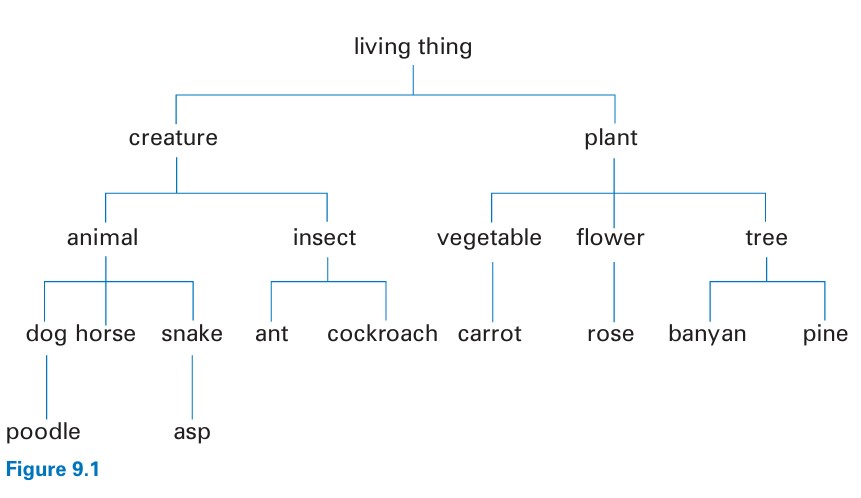
Hypernym vs. hyponym
Plant (hypernym): vegetable, flower, tree
Vegetable (hypernym): carrot, cabbage, cauliflower, lettuce
Flower ( hypernym): rose, lotus, daisy, daffodil
Tree ( hypernym): banyan, pine, banana, oak, elm
The …………… is the superordinate term (= higher-level): plant, vegetable, flower, tree
Vegetable, flower, tree: are ….-…………… (words that share the same superordinate term) of plant.
…………….. (the most typical member of a category, It’s the mental image that comes to mind first when we think of a category.)
'The characteristic instance' of a category is known as the prototype
E.g. canary, cormorant, dove, duck, flamingo, parrot, pelican, and robin are co-hyponyms of the superordinate bird (hypernym).
According to some researchers, the most characteristic instance of the category 'bird' is the robin.
Hyponymy, includes, hypernym, co-hyponyms, Prototype
……………..
Homonyms are two words that sound and/or are written the same but have different meanings.
……/……… …………….: two words that have the same spelling and the same pronunciation, but different meanings. Eg:
Bat (flying creature) — bat (used in sports)
Pupil (at school) — pupil (in the eye)
Bank (of a river) — Bank (financial institution)
……………… : two words that have the same pronunciation but different spelling.
allowed - aloud
sea - see;
pair - pear;
whether - weather
……………. : two words that have the same spelling but different pronunciation.
bow (v) - bow (n); wind (n) - wind (v)
row (v) - row (n); wound (v) - wound (P-Pii)
record (v) - record (n)
Homonymy, Full/perfect homonyms, Homophones, Homographs
………………..
A word has ………… …………. that are related to one another.
Head: part of the body, froth on top of a glass of beer, person at the top of a company or department
Mouth: one's mouth, an animal's mouth, the part of a river which empties into the sea.
Bug: insect, enthusiast, electronic device for eavesdropping.
Fire: To burn or ignite, to shoot a gun, to discharge from one's employment.
Court: an enclosed area where games such as tennis are played, the place where legal trials take place, and where crimes are judged.
Homonymy represents different entries in a dictionary, while the different meanings of a polysemous/polysemantic word are listed under a single entry.
more explanation:
Homonymy → unrelated meanings → different dictionary entries.
Polysemy → related meanings → one dictionary entry, with sub-senses.
Polysemy, multiple meanings
Meronymy
What is Meronymy?
Meronymy = the part–whole relationship in meaning.
A …………… is a word that names a part of something.
The opposite is ………….. = the whole to which the part belongs.
👉 Formula:
Meronym (part) → Holonym (whole)
Examples
a) Body
Hand (meronym) → Body (holonym)
Finger (meronym) → Hand (holonym)
b) Objects
Wheel (meronym) → Car (holonym)
Keyboard (meronym) → Computer (holonym)
c) Time
Week (meronym) → Month (holonym)
Day (meronym) → Week (holonym)
Minute (meronym) → Hour (holonym)
How is this different from Hyponymy?
Hyponymy = “kind of” relationship (category–subcategory)
Example: Dog is a hyponym of Animal (a dog is a kind of animal).
Meronymy = “part of” relationship (whole–part)
Example: Wheel is a meronym of Car (a wheel is part of a car).
Word Play
Writers, poets, and advertisers often use meronymy for wordplay because mentioning a part can evoke the whole (……………. - hoán dụ).
For example:
Saying “All hands on deck!” → “hands” (meronym) actually means “people/sailors” (holonym).
Saying “Nice wheels!” → “wheels” (meronym) refers to “car” (holonym).
Mary had a little lamb (we think of a small animal). Mary had a little lamb, some rice and vegetables (we think of a small amount of meat.)
=> The polysemy of lamb allows the two interpretations.
Why are trees often mistaken for dogs? (recognizing the homonymy in the answer: Because of their bark.
Why is 6 afraid of 7?, (Because 789) => identifying the homophones.
meronym, holonym, metonymy
 Note
Note  Flashcards (131)