AQA Psychology Paper 2
 Studied by 9 people
 Call Kai
 Learn
Learn Practice Test
 Spaced Repetition
 Match
Match Flashcards
 Knowt Play
1/270

There's no tags or description
Looks like no tags are added yet.
Name | Mastery | Learn | Test | Matching | Spaced | Call with Kai |
|---|
No analytics yet
Send a link to your students to track their progress
271 Terms
define psychology
the scientific study of the mind and behavior
when did Wundt open the first laboratory dedicated to psychology?
1879
what is introspection?
analyzing own thoughts and feelings
break down thoughts and feelings to understand them
describing experiences when presented with stimuli
How is introspection carried out?
ppts (trained to effectively reflect) asked to listen to a metronome
record conscious thought
using standardized instructions
ppts
What were the pros and cons of Wundts introspection?
PROS
control, independent and dependent variables
not philosophical
paved the way for controlled techniques
still used today in certain therapies
CONS
doesn’t explain how the mind works - it is subjective
accounts cant be confirmed impacting reliability
results not easily replicable
unconscious behavior cant be tested
what is reductionism?
The belief that things can be simplified into cause and effect and broken into small parts
who are the key theorists for the learning approaches?
Pavlov
Skinner
Bandura
what are the key assumptions of the behaviorist theory?
behavior learnt > inherited
valid to study animals as same principles apply
only observable behavior should be studied
explain classical conditioning
UCS → UCR
UCS + NS → UCR
CS → CR
learning occurs through the paring of an NS and an unconditioned which produces an automatic response
after several parings there is an association and an NS can produce the response alone
how did pavlov develop classical conditioning
when dogs are given food they salivate
Pavlov then each time the god was given food rang a bell
this means that the bell was associated with the food
after this repeatedly was done the food was taken out of the procedure
when the bell was rang the dog would now salivate
what are the principles of classical conditioning?
generalization - a similar stimuli will also trigger a response
discrimination - when a similar stimuli does not produce the response
extinction - when the response no longer occurs with the CS as no food is given
who developed operant conditioning and what ideas is it based on?
skinner 1938
behaviour is based on learning by consequences
what is positive reinforcement?
behavior is more likely to continue due to positive consequence
what is negative reinforcement?
behavior is more likely to continue due to avoid negative consequence
what is punishment?
behavior is less likely to occur due to negative consequence
explain the Skinner box
box that Skinner put a rat in
time was recorded for how long it took the rat to find the level that dispensed food
initially rat would accidentally press lever. the longer time spent in the box the more the rat understood how to get food (positive reinforcement)
when the rat realized the level delivered an electric shock they stopped pressing the lever (punishment)
when the rat realized that pulling the level would prevent the shock it kept doing it (negative reinforcement)
how did Skinner vary the frequency of reinforcement?
continuous - reward every time
variable ratio schedule - reward at intermittent intervals
what are the strengths of the behaviorist approach?
scientific methods - controlled, replicable, observed behaviour
practical applications - applied to rang of real-world behaviours = phobia treatment (systematic desensitisation)
what are the weaknesses of the behaviorist approach?
use of animals - lack of validity, different brain structure, cannot be generalized
lack of biology - emphasis on environment but evidence from twin studies shows genetic basis, incomplete approach
deterministic - implies be have no conscious control over behavior (no free will)
Who developed SLT and when?
Bandura 1960s
what were Bandura’s beliefs about behaviour?
that people learn behaviour through observation of others and either reinforcement or punishment
what were the groups on the bobo doll study
72 children
2 experimental group and 1 control (24 each)
all had equal number of boys and girls
group 1 = exposed to aggressive
group 2 = exposed to non-aggressive
what was the procedure of the bobo doll study
children were taken into a room alone and shown a person role model eather being aggressive or non-aggressive with the doll
a second room was then used where the child could not touch any toys to raise aggression levels
then child observed playing with toy
What were the findings of the bobo doll study
children exposed to aggressive ode showed aggressive behavior and vise versa
boys imitated same sex model more than girls
boys more likely aggressive
boys more physically aggressive and girls ore verbally aggressive
not only rewards influence behavior
what are the stages of SLT?
IDENTIFICATION
observer associates self with role model, want to be like them
MODELLING
leads to imitating of models behavior - more likely if positively reinforced
what are bandura’s mediational processes?
attention = person must pay attention to model
retention = behavior has to be remembered
reproduction = observer must have ability to replicate behavior
motivation = observer must want to replicate behavior
what are the strengths of SLT?
supporting evidence = from controlled research, increase validity
can account for cultural difference = low levels of aggression in the !kung people (south Africa) where parents don’t use physical punishment - credibility
free will = shows mediational processes that are neglected by behaviourists
what are the weaknesses of SLT?
unrealistic = lacks ecological validity, controlled lab setting, limits conclusions
biology ignored = can’t explain gender differences, biology shows links between aggression and testosterone
What are the basic assumptions of the biological approach?
everything psychological is biological first
behavior originates from genes, nervous system and neurochemistry
mind is within brain so behavior has a physical basis
what is the influence of genetics on behavior?
genes influence behaviour
behaviors has evolved through natural selection (survival of the fittest) where most desirable traits are passed on
aggression = fight or flight for safety
memory = help retain survival information
etc
what is the influence of our genotype on behavior?
genetic makeup occurring at conception
genetic code that predisposes how we develop as individuals
what is the influence of phenotype on behavior?
characteristics in a person which are either…
expression of genotype
result of an interaction between our environment and genotype
what are the 4 categories that fall into genes determining our behavior?
genetics
genotype
phenotype
nervous system
how are twins used to study the influence of genetics on behavior?
non identical (dizygotic) = share 50% of genes
identical (mono zygotic) = share 100% of genes
concordance rates of OCD
MZ = 68%
DZ = 31%
What is a concordance rate ?
express the probability of a trait that is present in one twin being present in the other
how does the nervous system influence behavior?
neurons make up the brain and specific structures within it
neurons in the brain are what determine behavior therefor any physical damage to the brain will result in a change in behavior.
H.M 1953
what are neurotransmitters?
chemicals found in the brain that transmit impulses from one neuron to another. Psychologists believe that different levels of neurotransmitters influence behavior.
Eg low levels of serotonin are thought to be linked to OCD.
explain neurotransmission…
impulses travel along axon
impulses reach the end of it at the dendrites (the arms at the end of the cell)
neurotransmitters are triggered to be released and travel across the synaptic cleft (gap between neurons).
neurotransmitters are recycled between impulses.
then reach the receptors at the other neuron and trigger the next electrical impulse.
what can cause a deficit of a neurotransmitter (eg serotonin) and what is a solution?
neurotransmitters can be absorbed by enzymes causing a deficit and resulting in a change in behavior.
can also be lacking at birth or used up due to trauma.
can take medication to trigger production and prevent the neurotransmitter deficit.
What are the strengths of the biological approach?
supporting evidence = twin studies, supports assumption that genetics are associated with behaviour due to positive correlation in concordance rate and genetic similarities
practical applications = real-life applications of the approach, understanding of neurotransmission means there is effective drug therapies, provides support for the approach
what are the weaknesses of the biological approach?
contradictory evidence = cordance rates in twin studies never 100%, not completely genetic, fails to acknowledge role of environment
other problems = ethical issues trying to find basis for some behaviors, criminal gene may take away a persons accountability for crimes they commit, not always possible to apply approach
determinism = sees human behavior and genetic and out of our control, no freewill
how do mental processes determine behaviour according to the cognitive approach?
Behaviour is determined by the way that we process information from our environment - how people perceive, store, manipulate and interpret information.
what are the basic assumptions of the cognitive approach?
internal mental processes can be studied by making inferences about mind based on behavior
thoughts processes can and should be studied scientifically, and well controlled lab experiments can aid us in this
controlled lab settings can be used to investigate what an individual is thinking
what are inferences?
assumptions based off observable behavior about mental processes that can’t be directly studiedrch evidence
relies on going beyond immediate research evidence
what did Simon and Chabris do?
1999 invisible gorilla
example of studying internal mental processes
applied the scientific method to make inferences about the internal thought processes that caused attention-based blindness, all by observing behaviour
calculated the percentage of people who had attention based blindness and made inferences
what are schema?
mental frameworks of expectations and beliefs that develop through experience and influence our cognitive processing. Tells us how to respond in certain situations. a ‘package of beleifs’ based on our prior experience
why are schemas useful?
people able to predict what will happen in the world based on experiences
means we will respond appropriately
keeps us safe
enable people to process information rapidly (mental short-cuts)
why aren’t schemas useful?
can lead to negative interpretations of self or others
prejudices
perceptual errors (eg misread/mishear song lyrics)
implications for EWT and accurate recall
what is the information processing model?
A THEORETICAL MODEL - used to study internal mental processes
INPUT(environmental stimuli) → PROCESSING(info is coded) → OUTPUT(behavior shown)
suggests information flows through the cognitive system in stages
this can be used to provide testable theories about mental processing which can be studied.
Explain the multistore model of memory
EXAMPLE OF A THEORETICAL MODEL
stimuli triggers sensory memory.
When attention goes to this then the information is stored in STM
this is rehearsed in the STM
rehearsal of this information eventually takes it to LTM
this can then be retrieved to the STM
what are the information processing model and the multistory model of memory both examples of?
theoretical models
what are the similarities of the mind and computers in the cognitive approach?
core assumption of the cognitive approach - the mind can be compared to a computer
process info
coding
input, process, output
memory (storage)
what is cognitive neuroscience?
study of how brain structures influence mental processes
cognitive and biological processes can be combined to explain behavior.
advances in scanning methods have allowed this area of psychology to progress fast over the past 20 years.
what scans have helped the development of cognitive neuroscience?
PET = radioactive substance injected into blood, sensors detect where flood flow is in the brain
FMRI = measures changes in brain activity by looking at blood flow. active areas use more oxygen so there is an increase in blood flow
What are the applications of cognitive neuroscience?
scanning/imaging techniques eg. to locate different areas of memory in the brain, mean there is now treatment for memory problems
computer simulations can be used to test theories about mental processes like memory and attention.
What are the strengths of the cognitive approach?
supporting evidence uses scientific and objective methods = lab experiments, high control, psychologists can be confident about inferences, reliable objective data, neuroscience means biology and psychology can come together, study of mind is a credible scientific discipline.
practical applications = helped psychologists understand how we form impressions of people, used to inform CBT, input towards AI, has real-world applications
less deterministic that other approaches = some conscious control over behaviour and how we think, can think before responding to a stimulus, accountability for peoples actions.
What are the weaknesses of the cognitive approach?
research lacks validity = use of lab research is artificial, not representative of real life. means lacks external validity and cant be applied to everyday experiences, psychologists can only infer so can face results being abstract and potentially subjective
reductionist (oversimplifies complex processes) = comparison with computer criticized, ignores the influence of emotion and motivation. complex processes are therefor simplified. eg. research shows impact of emotion on memory ie anxiety on ETW, not a complete approach.bh
what is the basis of the psychodynamic approach?
influence of childhood experiences on behaviour (with emphasis on sexuality on some parts of the theory)
when did freud live?
1856-1939
what is psychoanalysis therapy(developed by Freud)?
talking through early experiences and childhood occurrences and fears - helps bring repressed memories forward
addresses conflicts within the mind due to traumatic experience
what were freuds three basic assumptions?
unconscious mind drives our behavior
instincts motivate our behavior
early childhood influences our later behavior
what was freud’s beliefs about the role of the unconscious?
refers to the thoughts we have without any conscious awareness
drives behaviour
this is where traumatic memories are stored
what are the three levels of consciousness? (psychodynamic)
the conscious (thoughts and perception
the preconscious (memories and stored knowledge)
the unconscious (irrational wishes, fears, shameful experience)
what are freud’s three parts to the personality?
id = impulsive (demands satisfaction), in the unconscious (birth-18 months)
ego = conscious part of the mind, mediates between id and superego (realistic ways to satisfy both parts) (18 months and 3)
superego = found in the unconscious, morality principle and acts on rules and societal values in the unconscious, aims to control the ids impulses (age 3-6)
what are defence mechanisms?
too much conflict between the id and superego can cause anxiety
defense mechanisms are strategies use unconsciously to reduce anxiety
what are the three types of defense mechanisms?
repression = putting unpleasant thoughts into the unconscious
denial = refusal to accept the reality of the situation
displacement = expressing the strong emotions (eg. anger) on other neutral objects/persons
what is freud’s thinking behind the psychosexual stages?
stages of development that we go through from birth until age 18
too much pleasure at a stage can lead to fixation or lasting behaviors
trauma in a stage can also have this effect (fixation)
what are freud’s 5 psychosexual stages? and when is each developed
oral = 0-18months (pleasure through the mouth), influences people in habits such as nail biting and chewing
anal = 18months - 3years (pleasure through controlling feces), influences anal retentive - tidy and organised, or anal expulsive - messy, thoughtless
phallic = 3-6 years (pleasure through genitals, sexual feeling towards the opposite sex parent - Oedipus and Electra complexes), influences narcissistic personality or potential homosexuality
latent = 6 - 11years (sexual energy displaced and is a calm time in development), no impact on adult personality
genital = 12years+ (pleasure gained through genitals and will remain like this for life), influences difficulty forming heterosexual relations
how is the psychodynamic approach supported by case studies?
Little Hans - phobia of horses was interpreted by Freud as an indication that he was in the phallic stage of development
shows that there is evidence to support Freud’s theories.
however
issues with generalising as CS is a small sample
information about the hand was given by the father so it may have been misinterpreted/not representative of Hans’s true symptoms.
what are the practical applications of the psychodynamic approach?
led to the development of psychotherapy
involves helping patients bring repressed thought into the conscious to be dealt with
shows that there are real world applications and that some of his methods were effective
what are the following weaknesses of the psychodynamic approach?
cannot be tested
ideas such as id ego and superego are abstract concepts that cannot be measured
defence mechanisms are in the unconscious so cannot be directly studied.
too deterministic
The idea shows that people’s behaviour in life will be the result of childhood trauma and that this is inevitable
means that individuals do not have a choice in their behaviour.
Who developed the humanistic approach?
rogers and maslow 1950s
criticised the psychodynamic approach for its focus on unhealthy development and deterministic view.
what are the 4 basic assumptions of the humanistic approach?
every individual is unique so generalisations cant be made between people
everyone has free will
people should be viewed holistically
scientific methods should not be used to study behaviour as all people are different
What is self-actualisation?
drive all individuals have to achieve their ultimate goal
is this is achieved they feel ultimate satisfaction
rogers and Maslow believed all people reach this goal differently
explain Maslow’s hierarchy of needs…
self-actualisation (creativity)
esteem (self esteem and respect for others)
love/belong (friends and family
safety and security (shelter, employment)
physiological needs (food, water)
starting from 5 people must achieve each level to move to the next. all previous levels must be satisfied to read self actualisation
explain rogers focus on the self…
proposed individuals have 3 selves
in order to acheive self-actualisation they must integrate all three of them
they also need congruence and conditions of worth
what are rogers 3 selves?
the self-concept - the way a person feels about themselves (low self-esteem = poor self-concept)
the ideal self - the self a person wishes for themself to be
the real self - the way the person actually is
what is congruence in rogers focus on the self?
to achieve SA a person must be congruent (means the self-concept and the ideal self need to be the same or similar
important part of getting to congruence is ‘unconditional positive regard’
when a person is loved for who they are by someone else
what are conditions of worth in rogers focus on the self?
requirements that a person feels they need to be loved/feel worthy
often these are boundaries set by parents
if a person experiences this they are less likely to have ‘unconditional positive regard’, reducing the chance of self-actualisation.
explain the link between the humanistic approach and counselling in psychology…
this approach has led to the development of counselling
The client-therapist relationship is important and encourages unconditional positive regard
allows client to be honest and reveal barriers to them being congruent
what are the 3 weaknesses of the humanistic approach?
cannot be tested scientifically
the belief that using science to study human behaviour in inappropriate means that there is a lack of objective evidence to support the theory.
subjective
The subjective experience of individuals is difficult to test. eg, measuring self-actualisation
also means there is lack of scientific evidence to support the theory.
culturally biased
theory has been criticised for only explaining behaviour in individualist cultures (where there is a focus on the self and personal development) ie. self-actualisation os only relevant in these cultures
means there are limited explanations from the theory when it comes to collectivist cultures (focus on group and well being of others)
what are 2 strengths of the humanistic approach?
less deterministic than the psychodynamic approach
allows for personal development and free will in behaviour
means individuals have the power to change their futures
practical applications
led to the development of counselling
Elliot 2002 conducted meta-analysis of 86 studies and showed that humanistic therapy was more effective than no treatment
shows that the approach has uses in the real world and leads to the improvement in a person’s life
What makes something a science ?
if it follows the scientific process
explain the scientific process diagram… (6 step)
observations
develop hypothesis
test hypothesis
analyse results
develop theory
repeat/modify and repeat
what are the 4 features of science?
theory construction and hypothesis testing
objectivity and the empirical method
replicability and falsifiability
paradigms and paradigm shifts
explain theory construction and hypothesis testing as a feature of science…
theory is an explanation for a phenomenon based on observations or empirical data (developed and modified through hypothesis testing)
hypothesis = testable statement making a specific prediction
What is objectivity and empirical method as a feature of science?
empirical evidence = gained through objective, real world experiments, observation and measurements.
objectivity = events and findings are not influenced by the individual experiencing them.
high levels of objectivity increase confidence in the results regardless of who carried out the investigation - can be used to construct theories
what is replicability and falsifiability as a feature of science?
replicability = ability to check and verify the results of a study by repeating the method of the study to assess if similar findings are achieved
falsifiability = likelihood of the same results occurring twice or more, making sure they aren’t by chance. makes findings more reliable when they occur more than once (increases confidence in theory building)
What did Karl Popper (1902-1994) argue about falsifiability?
argued it was not possible to prove a theory, only to disprove it.
swans —>
if a scientist only ever saw white swans, develop a theory that all swans are white, but would only take one black swan to disprove that theory.
concluded that no amount of evidence can prove a theory to be right as one piece of evidence can prove a theory wrong. Therefore the null hypothesis of an experiment is tested to show if theory is incorrect - studies can only ever support a theory, not prove it
what are paradigms and paradigm shifts as a feature of science?
paradigms are a theory that is accepted by the majority of scientists in a field change over time as more evidence accumulated paradigm shifts
kuhn 1962 believed that science progresses in revolutions and called these revolutions paradigm shifts.
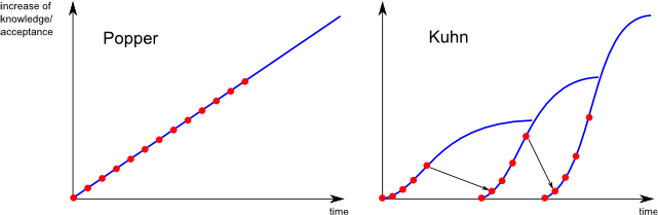
what are the three phases in science?
pre-science = variety of theories but not one generally accepted theory or paradigm
normal science = one theory (paradigm) remains dominant, despite occasional challenges
revolutionary science = disconfirming evidence accumulated until a theory/paradigm is overthrown, no longer maintained (paradigm shifts)
what are the two methods of analysis?
content analysis = statistical process that involves categorising and quantifying events and behaviour
frequency and numerical coding of themes - finding categories or codes
thematic analysis = method to identify patterns of meanings and themes in data
focus on finding recurrent themes in qualitative data.
What is coding and it’s importance in methods of analysis ?
the process of placing data into categories
potentially putting qualitative data into quantitative
breaks down data into manageable categories for analysis
What are the 5 steps of content analysis?
get to know the data (repeated reading and viewing)
identify important categories
work carefully through the data (eg re-reading transcripts to make sure details are not overlooked)
count/tally the number of occurrences of each of the identified categories
check reliability by
a) repeating content analysis (test-retest reliability)
b) use second researcher to carry out content analysis on the same data independently (inter-rater reliability)
what are the two ways of checking reliability of findings?
test retest reliability - repeat content analysis on 1 or more occasions using same data set under same conditions, at different times
inter-rater reliability - use more than one researcher to carry out content analysis independently on same data.
in both cases compare results of the two analyses, calculate the correlation coefficient (+0.8 is generally accepted as indicating high levels of reliability)
What is the procedure for thematic analysis? (4 steps)
use coding initially to analyse data
review the data/codes looking for emergent themes
support for themes comes from direct quotes from the data
validity of themes is checked by collecting a new set of data
what is an emergent theme?
a theme a recurrent idea which is descriptive or qualitative
what are the strengths of content/thematic analysis?
allow patterns in data to be analysed, and conclusions to be drawn
can be replicated to improve validity
what are the weaknesses of content/thematic analysis?
reducing data via coding can remove detail and reduce the richness of the data set
subjective judgment is needed to define categories and coding units
opens up the possibility of researcher bias = looking for patterns or things to support a belief
 Note
Note  Flashcards (47)