Hypothalamus & Pituitary
 Studied by 0 people
 Call Kai
 Learn
Learn Practice Test
 Spaced Repetition
 Match
Match Flashcards
 Knowt Play
1/18

Earn XP
Description and Tags
week 5, lesson 2, unit 6
Name | Mastery | Learn | Test | Matching | Spaced | Call with Kai |
|---|
No analytics yet
Send a link to your students to track their progress
19 Terms
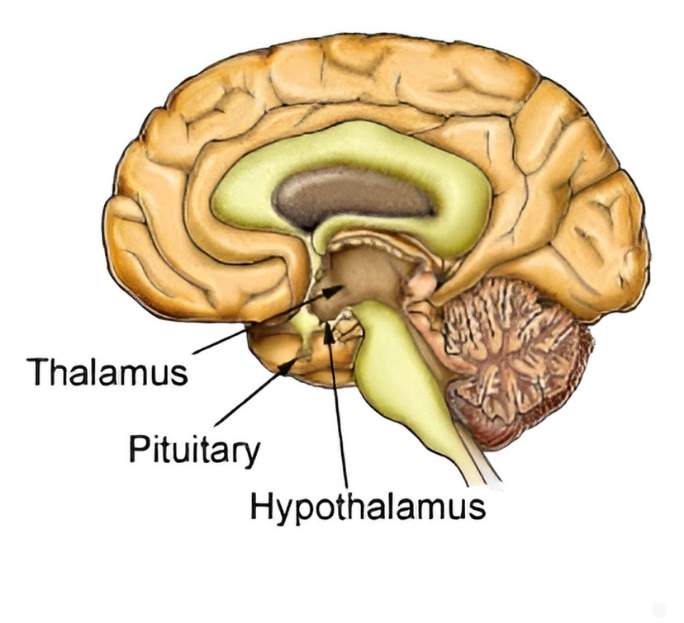
where is the hypothalamus located
at the base of the brain just above the the pituitary gland and below the thalamus.
how does the location of the hypothalamus help its function
Because of its central location, it can receive information from all over the brain. It is composed of many regions made up of groups of nerve cell bodies, which are call nuclei. Several of these nuclei control the release of hormones from the pituitary gland.
How does the hypothalamus contribute to maintaining homeostasis in the body?
The hypothalamus is involved with some of the body's homeostatic mechanisms, including the regulation of body temperature, water balance, and energy production. It is also involved in regulating the behavioural drives of thirst, hunger, and sexual behaviour. In order to perform all of these complex and widespread function, the hypothalamus receives large amounts of information from all around the body, including metabolic, hormonal, temperature, and neural information.
What hormones are secreted by the hypothalamus?
The hypothalamus secretes many types of hormones - sometimes called releasing or inhibiting hormones because they cause the release or inhibition of a hormones from the pituitary gland.
The hormones in the list below are released by the hypothalamus and travel to the anterior pituitary
Prolactin releasing hormone (PRH)
Thyrotropin releasing hormone (TRH)
Corticotropin Releasing Hormone (CRH)
Growth Hormone Releasing Hormone (GHRH)
Growth Hormone Inhibiting Hormone (GHIH)
Gonadotropin Releasing Hormone (GnRH)
Prolactin releasing hormone (PRH)
Prolactin releasing hormone (PRH) hormone is released after birth and continuously to help breastfeed a baby. It causes the release of prolactin from the anterior pituitary which then stimulates breast tissue to make milk.
When not breastfeeding, prolactin inhibiting hormone (PIH) is released from the hypothalamus and inhibits the release of prolactin, preventing the production of milk.
Thyrotropin releasing hormone (TRH)
Thyrotropin releasing hormone (TRH) is released by the hypothalamus to the anterior pituitary, which will then release thyrotropin stimulating hormone, which will affect the thyroid.
Corticotropin Releasing Hormone (CRH)
is released by the hypothalamus and stimulates the anterior pituitary to release adrenocorticotropic hormone (ACTH). This in turn will stimulate the release of cortisol, involved in many actions throughout the body The main reason for cortisol to be released is in response to stress.
Growth Hormone Releasing Hormone (GHRH) Growth Hormone Inhibiting Hormone (GHIH)
Growth Hormone Releasing Hormone (GHRH) will stimulate the anterior pituitary to release Growth Hormone (GH), while Growth Hormone Inhibiting Hormone (GHIH) has a slight inhibitory effect on GH release.
Gonadotropin Releasing Hormone (GnRH)
is released from the hypothalamus and stimulate the anterior pituitary to release hormones that then affect the gonads.
How are the anterior and posterior sections of the pituitary gland related to the hypothalamus?
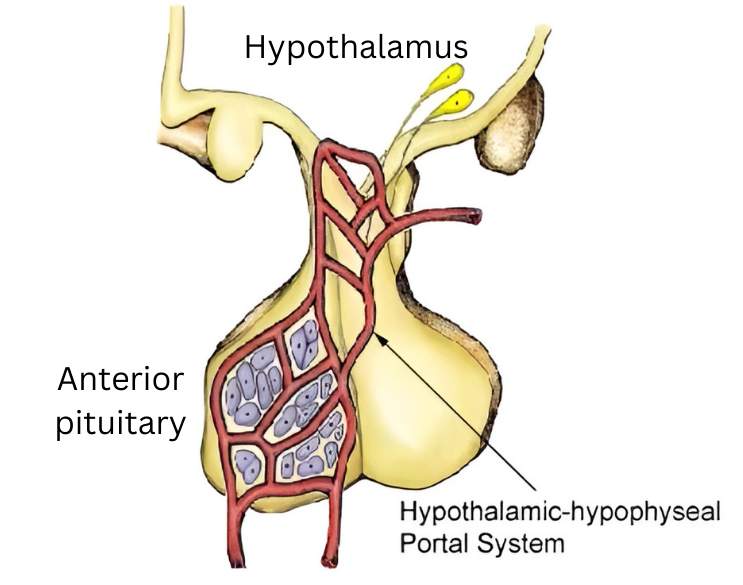
The pituitary gland is separated into two distinct regions - the anterior and the posterior pituitary. The anterior pituitary is formed during development from the tissue of the roof of the mouth. It is made up of endocrine tissue and is regulated by hormones. The hypothalamus sits above the pituitary gland and communicate with the pituitary through two different mechanisms, the hypothalamic-hypophyseal portal system and the hypothalamic-hypophyseal tract.
Hypothalamic-hypophyseal portal system.
The hypothalamus communicates with the anterior pituitary by secreting the releasing or inhibiting hormones into the portal system. The portal system is made up of small blood vessels that link the hypothalamus directly to the anterior pituitary. The hormones from the hypothalamus then travel through the portal system to the anterior pituitary to either stimulate or inhibit the release of pituitary hormones.
The posterior pituitary
develops from neural tissue at the base of the brain. It contains the axons and nerve terminal of neurons whose cell bodies lie in the hypothalamus. The tract of the neurons is sometimes referred to as the hypothalamic-hypophyseal tract. These neurons produce neurohormones in the hypothalamus that are secreted into the blood from the posterior pituitary in response to action potentials.
Why is the pituitary gland often referred to as the master gland of the body?
The anterior pituitary is a key endocrine gland that controls several critical bodily functions by releasing hormones into the bloodstream. It produces hormones such as growth hormone (GH), thyroid-stimulating hormone (TSH), adrenocorticotropic hormone (ACTH), and gonadotropins (LH and FSH), which regulate growth, metabolism, stress response, and reproductive functions, respectively. The release of these hormones is regulated by the hypothalamus through the specific releasing and inhibiting hormones. Overall, the anterior pituitary plays a central role in maintaining homeostasis by coordinating various physiological processes.
The posterior pituitary releases two crucial hormones:
oxytocin and antidiuretic hormone (ADH) also known as vasopressin. Unlike the anterior pituitary, the posterior pituitary does not produce its own hormones; instead, it stores and releases hormones produced by the hypothalamus. Each hormone is made in its own set of neurons, and is synthesized in the cell body of those neurons.
Axonal Transport:
Once synthesized, oxytocin or ADH is packaged into vesicles (small membrane-bound sacs) and transported along the axons of the neurons to the posterior pituitary gland. These axons extend from the hypothalamus down into the posterior pituitary, where the hormone is stored. Oxytocin or ADH is stored in the nerve endings (axon terminals) within the posterior pituitary until it is needed. The posterior pituitary is not a gland that synthesizes hormones itself but rather a storage and release site for hormones made in the hypothalamus, including oxytocin.
When the body requires oxytocin (e.g., during childbirth, breastfeeding, or in response to certain social and emotional stimuli), a signal is sent from the hypothalamus. This signal triggers an action potential that causes the release of oxytocin from the nerve endings in the posterior pituitary into the bloodstream.
The functions of the posterior pituitary are essential
for fluid regulation, reproductive processes, and various aspects of social bonding and behaviour.
Oxytocin plays a vital role in
childbirth by stimulating uterine contractions and promotes milk ejection during breastfeeding. It is also the 'bonding hormone' and is also released when hugging someone.
ADH regulates
the body's water balance by increasing water reabsorption in the kidneys, helping to maintain blood pressure and fluid balance. If someone is producing a lot of ADH, they will retain more water. If a person is not producing a lot of ADH, they will produce more urine.
 Note
Note  Flashcards (131)