IV. Monocytes and Macrophages
 Studied by 0 people
 Call Kai
 Learn
Learn Practice Test
 Spaced Repetition
 Match
Match Flashcards
 Knowt Play
1/25

There's no tags or description
Looks like no tags are added yet.
Name | Mastery | Learn | Test | Matching | Spaced | Call with Kai |
|---|
No analytics yet
Send a link to your students to track their progress
26 Terms
Myeloid progenitor → CFU-GM
GM-CSF and interleukins drive monocyte formation
Monocytes develop in BM
Circulate briefly in peripheral blood
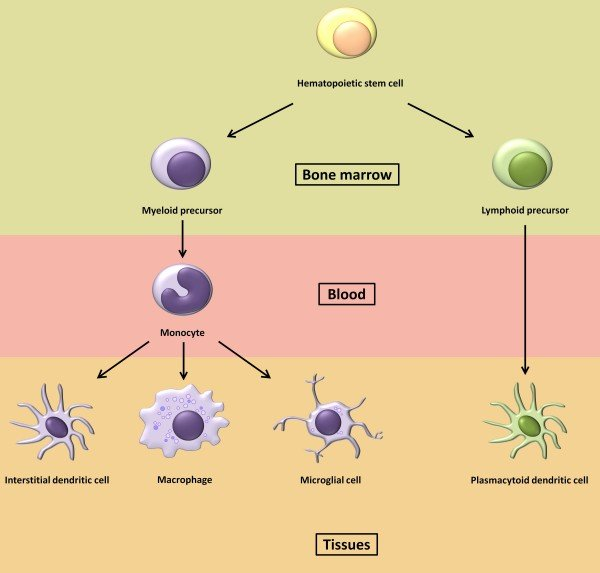
Migrate into tissues → macrophages
Macrophages function in infection defense
Importance of myeloid progenitor cell, CFU- GM, monocytes, macrophages
Macrophages are named on location in the body:
Monocytes: __
Kupffer cells: __
Microglial cells: __
Osteoclasts: __
Langerhans cells: __
Alveolar cells: __
Monocytes—peripheral blood
Kupffer cells—liver
Microglial cells—central nervous system
Osteoclasts—bone
Langerhans cells—skin
Alveolar cells—lung
Cell line of Monocytes
Monoblast: No cytoplasmic granules
Promonocyte
Monocyte
Macrophage
Monoblast
Earliest recognizable monocyte precursor
NO CYTOPLASMIC GRANULES
12-18 um: N:C = 4:1
round/oval eccentric nucleus w/ fine chromatin; 1-2 nucleoli
Dark blue cytoplasm
Promonocyte
12-20 um; N:C = 3:1
Irregularly shaped, indented nucleus w/ fine chromatin; 0-1 nucleoli
blue to gray cytoplasm; fine azurophilic granules
Monocyte
12-20 um
Horseshoe or kidney-bean-shaped nucleus “Brainlike” onvolutions
FIne, lacy chromatin
Blue-gray cyto; may have pseudopods and vacuoles
Many fine azurophilic granules → ground glass appearance
Transitional cell bc it migrates into tissue and becomes fixed or free macrophage
Macrophage
TIssue Monocyte
15-80 um
Indented, elongated, or egg shaped nucleus, w/ fine chromatin
Blue-gray cyto w/ many vacuoles and coarse azurophilic granules; may contain ingested material
Monocyte Characteristics
RR = 2-10% peripheral blood
granules are lysosomes that contain hydrolytic enzymes, including peroxidases and ACP
Highly motile cells tht marginates against vessel walls and into tissues
Monocyte/Macrophage role
initiating and regulating the immune response
They process ingested material and also process _____ , which is relayed to the _____ lymphs
They process ingested material and also process antigenic information, which is relayed to the T helper (CD4) lymphocyte. The T helper lymphocyte coordinates the immune response to foreign antigens.
T lymphs coordinate what?
The T helper lymphocyte coordinates the immune response to foreign antigens.
Moncytes/Macrophages arrive at site of inflammation after neuts. What is the difference between neuts and monocytes in this process?
Unlike neutrophils, the phagocytic process does not kill the monocyte.
Monocytes/Macrophages are very efficient phagocytic cells w/ receptors for…?
IgG or complement-coated organisms
Why are Monocytes/Macrophages known as scavenger cells?
ability to ingest foreign material
Blood monocytes func.
ingest Ag-Ab complexes and activated clotting factors, limiting the coagulation response
Splenic macros func.
remove old/damaged RBCs and conserve iron for recycling.
Liver macros func.?
remove fibrin degradation products
Bone marrow func.
remove abnormal RBCs, ingest bare megakaryocyte nuclei or extruded RBC nuclei, and store and supply iron for Hgb synthesis
Monocytes secrete what?
cytokines/interleukins and tumor necrosis factor
Nonmalignant Monocytic Disorders include:
Monocytosis
Lipid storage disorders:
Gaucher disease (gaucher cells)
Niemann-Pick disease (Niemann-Pick cells)
Sea-blue histiocytosis
Monocytopenia
APLASTIC ANEMIA
Monocytosis
Inc. in the abs. # of **monocytes** associated w/
Recovery stage from acute bacterial infections and recovery following
marrow suppression by drugs
Tuberculosis, syphilis, subacute bacterial endocarditis
Autoimmune disorders (systemic lupus erythematosus - SLE, rheumatoid arthritis - RA)
Tay-Sachs and Fabry diseases
Lipid storage disorders: Gaucher disease
most common lipid storage disorder and has an AUTOSOMAL RECESSIVE inheritance pattern
Gaucher cellls more commonly seen in BM
Glucocerebrosidase deficiency leading to accumulation of glucocerebrosides in macrophages of BM, spleen, and liver
Lipid storage disorders: Neimann-Pick Disease
Autosomal recessive inhertiance patter
Niemann-Pick cells in BM
Sphingomyelinase def. causes sphingomyelin to accumulate in macrophages in multiple organs and BM
Lipid storage disorders: Sea-blue histiocytosis
unk defic. → sea-blue macrophages in spleen and BM
Other Lipid storage disorders: Tay-sachs vs Fabry diseases
Feature | Tay-Sachs Disease | Fabry Disease |
|---|---|---|
Inheritance | Autosomal recessive | X-linked |
Primary impact | Severe, early-onset neurodegeneration | Multisystem disease (vascular, cardiac, renal, skin) |
Classic sign | Cherry-red spot | Painful skin lesions; kidney and heart involvement |
Monocytopenia
dec in # of monos, associated w/ stem cell disorder: Aplastic Anemia
 Note
Note  Flashcards (34)